Books Archives
I'm in Oprah Magazine
Click here to read my personal essay in this month's O, the Oprah Magazine. It's part of an assemblage of essays on love, which means that if you pick up a hard copy at the newsstand, you get the extra pleasure of pieces by the likes of Mary Gaitskill and Amy Bloom.
The irony that my essay would appear after the boyfriend featured in it and I have broken up is not lost upon me. But I learned so much from being with Joe, and the lessons I came to embrace in the essay are more true for me than ever.
September 16, 2008 · 11:24 PM · Books · Comments (0)

Come Celebrate Canteen Issue 3
My esteemed friend Sean Finney is hosting a party to celebrate issue three of his literary magazine Canteen next Tuesday. I'll be there, and I highly recommend:
Canteen Issue 3
San Francisco Launch Party
WHEN:
Tuesday, September 9
7-10 p.m.
WHERE:
Root Division gallery
3175 17th Street (at South Van Ness Ave.)
DONATION:
$10 gets you a copy of Issue 3, cocktails by No. 209 Gin, snacks by Whole Foods, and music by DJ Duke of Windsor.
Come celebrate the release of Issue 3. See how Canteen is redefining the literary magazine with creative insight from the likes of Benjamin Kunkel, Dana Goodyear, and Porochista Khakpour.
Read about our first launch party in the San Francisco Chronicle:
http://www.sfgate.com/cgi-bin/article.cgi?file=/c/a/2007/05/18/DDG5MPSRLM1.DTL
September 05, 2008 · 01:52 PM · Books · Comments (0)
Thanks to the folks who came to the Makeout Room last night to hear me at the dublit reading. (That means you, Anna from Grace Cathedral.) It was great to share new work with new listeners.
July 24, 2008 · 02:28 PM · Books · Comments (0)
Hear Me Read Wednesday
I'm reading this Wednesday at 7:30 in a fundraiser for the terrific website dublit, where writers share audio recordings of their work. The cover charge goes to help dublit buy the recording equipment that will be needed for dublit to help capture this year's Litquake Festival in October. My contribution to the Wednesday dublit party will be to share a very short, a relatively new, short story. Here's all the info you need, from the organizers:
"Wednesday, July 23rd
7:05pm - 9:35pm
Makeout Room (3225 22nd St, San Francisco) - where "PDA is encouraged" (but 21+ ID is required)
$5 at the door; or
$5 for guaranteed admission, buy pre-event tickets here; or
$0 for free admission, post an original story my midnight, Monday Jul 21...
Readers will include the indomitable Alan Black, intractable Mickey Disend, ineffable Rachel Howard, imprimateur Sean Finney, and impactful Silvi Alcivar, plus a pleasant surprise or two."
Hope to see you there.
July 21, 2008 · 10:58 PM · Books · Comments (0)
Hear me read a new story--just click
This is very cool: Thanks to the enterprising John Yi and his new website dublit, you can hear me reading the story I shared two weeks ago at the Progressive Reading Series just by clicking this icon:
So give it a listen if you'd like to hear what I'm up to, fiction-writing-wise. And check out the rest of the dublit site to discover other great shorts or even record and upload one of your own.
Many thanks to John Yi and dublit.
May 31, 2008 · 04:10 PM · Books · Comments (0)
Hear Me Read Saturday
I'll be reading one of my newer short stories this Saturday at the Progressive Reading Series, 7 p.m. at the Makeout Room in San Francisco's Mission District. I had been scheduled to read next month, but when Mary Roach had to drop out, organizer (and amazing novelist) Stephen Elliott bumped me up in the lineup. And what a great lineup it is:
Pam Houston, Adam Mansbach, David West, Mark Pritchard
Plus: Sticky Notes from This American Life's Starlee Kine
Josh Bearman's Multi-Media Extravaganza
Comedian Nato Green
and The Progressive Reading Series All-Star Minstrels
Your $10-$20 sliding scale donation at the door goes to help save rent control--NO on Prop 98 and YES on Prop 99 on the June 3 ballot.
7 pm at The Makeout Room
3225 22nd Street 415 647 2888
Click here for more info.
May 14, 2008 · 11:17 AM · Books · Comments (0)
My Other Life
If you're curious about the non-dance-writing side of my life and live on the Bay Area's peninsula, I'm reading with my esteemed friend and fellow memoirist and fiction writer Lindsey Crittenden next Thursday, March 20, at the Notre Dame de Namur University. I'll probably read a bit from my memoir, but also from newer short stories--scary and exciting. Click here for the scoop.
March 12, 2008 · 11:08 PM · Books · Comments (0)
Litquake!
San Franciso's Litquake Festival kicks off Saturday--and I'm on the opening day "Off the Richter Scale" lineup. I'll be reading a BRAND NEW short story, and I'll be in great company with Kim Addonizio, Kate Braverman, Michelle Richmond and others from 2-3 pm at the San Francisco Main Library's Koret Auditorium. The readings keep rolling all day Saturday and Sunday at the library, and the festival rolls on all week long, with more than 300 authors. I'm planning to make Wednesday's special Litquake-edition Porchlight, and of course the famous Lit Crawl finale up and down Valencia and Mission streets. Everything you need to know is here. Hope to see you this Saturday.
October 04, 2007 · 03:19 PM · Books · Comments (0)
Getting Gritty at Litquake
Litquake, San Francisco's wildly fun week-long literary festival, has just announced its October 2007 lineup. It's the festival's eighth year, and my third reading in it--I'll be part of the opening day "Off the Richter Scale" marathon October 6th at the San Francisco Main Public Library. I'm on a slate called "Gritty City," presumably because my memoir is about my father's unsolved murder, though it doesn't take place in any city (rather, in small town Central California), and I wouldn't characterize the writing as particularly "gritty." But murder is a gritty topic and so gritty I am. And I can hardly complain, either, because I find myself in amazing company from 2-3 p.m. that Saturday. Also reading that hour are Michelle Richmond and Kim Addonizio, both kick-ass tough-but-tender writers, and Kate Braverman, whose story collection "Squandering the Blue" is one of my all-time favorites (If you've never read her story "Tall Tales from the Mekong Delta," get yourself a copy NOW).
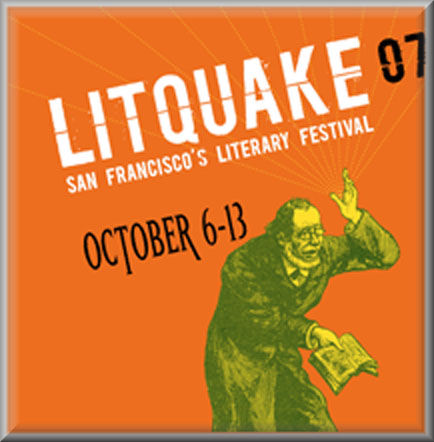
Litquake comes to a carousing close on October 13th with the rambunctious Lit Crawl--four hours of free readings at more than 30 bars, cafes, and bookstores up and down Valencia Street. I never miss it. For everything you need to know about the festival, click here.
Perhaps I'll try to settle on something suitably "gritty" to read from my memoir on Oct. 6th, perhaps I'll try out one of my latest short stories (does marital heartbreak count as "grit"?). In any case, hope to see you at the main library on Oct. 6th.
September 03, 2007 · 08:48 PM · Books · Comments (0)
My very good friend and much admired fellow member of my writers group, Lindsey Crittenden, has a personal essay today in the New York Times. It's about sorting through her parents' belongings after both had died, and it's poignant and beautiful. Here's a snippet:
"One day I turned to Photos & Stuff, six boxes labeled in my father’s chicken scratch. I reached for the box cutter, but the cardboard was so soft that the flaps almost fell apart in my hands as I started sneezing from the dust. These were old boxes, the contents in no particular order.
The year of my birth seemed as good an organizational device as any, so I made two piles, Before 1961 and After 1961, and draped a Hefty bag over a chair for trash. Most decisions came easily. I didn’t need two pictures of blurry pink bougainvillea against a whitewashed wall, or 10 shots of my nephew with his chubby fist in his first birthday cake. But the accumulated glimpses — Mom’s smile, Dad’s eyes crinkled in laughter — added up and, after 10 minutes, I was worn out.
I was halfway through a roll from a trip my parents had taken to Grand Teton National Park in 1995, flinging scenic vista after scenic vista into the Hefty bag, when my hand stopped. A shot of a wooden chapel on the edge of a field glorious with lupine. I recognized the scene from a moment of family lore: in 1970 my brother, then 3, had walked into that empty chapel to recite the Lord’s Prayer without prompt. He’d died in 1994, the year before Mom returned to the spot and took the photo.
I wasn’t just the person deciding which pile it went into; I was the only person alive who understood why it had been taken in the first place. If I threw it away, I was throwing away layers of emotion and association and identity. And if I kept it, well what then? "
Read the rest here.
"The Water Will Hold You," Lindsey's recently published memoir, is exquisite too, by the way. "Exquisite" is the word I used in the quote I provided for the jacket, but I'm hardly alone in the sentiment: Publishers Weekly called the book "exquisitely written" in a starred review. Check out Lindsey's book here.
June 21, 2007 · 12:28 PM · Books · Comments (0)
I think this is the first author website that actually led me to buy the book.
April 18, 2007 · 05:56 PM · Books · Comments (2)
My short story "Bolero" is now out in the spring issue of ZYZZYVA, available in a bookstore near you, and online. I'm quite excited about it, but I've hesitated to post it here for two reasons: First, it's very different from the dance writing I do for the Chronicle, which attracts the bulk of my traffic here; second, it's about sex. It's not meant to be titillating, and I believe it to be instead rather tender and sad, but it is explicit.
If that offends you, please don't read it; if it doesn't, click here, or better yet, support the culture of literary magazines and buy a copy of ZYZZYVA from your neighborhood independent bookseller. And come to the San Francisco Main Library May 17th, which brings me to the reason I've finally posted this: I'll be reading that Thursday, alongside other spring issue contributors, at 6:30 p.m. in the Book Bay just off Grove and Larkin Streets. Admission is free.
April 10, 2007 · 03:27 PM · Books · Comments (1)
Good news--I've just placed a short story with ZYZZYVA, the literary magazine of West Coast writers and artists. I've been working hard on my fiction over the last year and I'm excited to start getting it out into the world. My story "Bolero" (no spoilers here; you'll have to read it to find out why I've titled it thus) will appear in the immediately forthcoming spring issue. It should hit the stands within the next few months. I can promise that it's short, potent, and arrestingly realistic about a titillating tough topic. I'll certainly let you know when to go out and grab a copy.
January 29, 2007 · 08:00 PM · Books · Comments (0)
Grotto Nights Returns
Mark your calendar: Grotto Nights--the reading series produced by the office co-op where I work--are back:
"Driving Obssession
Grotto Nights is back and it's furious, fast, and free. Join us for a night of reportage, science, and art in the form of a subversive Valentine to our cars.
When: MONDAY, FEBRUARY 5 at 7 p.m. (doors open at 6:30 -- seats available on a first come first served basis -- early arrival is highly recommended). After the event there will be a party for audience and performers.
Where: MEZZANINE (444 Jessie Street@ Mint, San Francisco 94103) -- No-Host Bar/21+.
Fee: Unlike gasoline, it's FREE!!
DRIVING OBSESSION is a fond, provocative look at our obsession with cars and driving, and how it's changing the world.
THE PROGRAM:
Bucky Sinister reads his show-stopping poem on NASCAR.
Lisa Margonelli reads about the unexpected perils of cheap gasoline from her new book Oil On the Brain: Adventures from Pump to Pipeline.
Dr. Graham Fleming of Lawrence Berkeley Laboratory explains how he and others are using synthetic biology to create fuels for the future.
Dan Hoyle does a scene from his hit one-man show now playing at the Marsh--Tings Dey Happen-- based on the year he spent studying oil and politics in Nigeria on a Fulbright scholarship.
Baghdad taxi driver/art student Mounaf Shaker's documentary film Omar Is My Friend shows his search for gasoline, a living, and hope in today's Iraq.
Andy Raskin tells a first person story about driving, dating, and the genetic component of parking.
The musical group The Loins (featuring writer Beth Lisick) does a surprise performance of an car-based piece of literature.
JD Beltran shows two short films about love, obsession, and cars from her "Secrets" series.
Ben Baumgartner shows his latest body of NASCAR-themed art.
Matt Jalbert shows his photographs of crashed and abandoned cars."
See you there.
January 25, 2007 · 03:45 PM · Books · Comments (0)
If you've still got last week's New Yorker winter fiction issue, I just love love love that Louise Erdrich story, "Demolition."
January 05, 2007 · 01:13 PM · Books · Comments (0)
My friend Steve Elliott has just announced the following event, which I highly recommend:
"Laughing Liberally and LitPAC Present
Two Hours Of Comedy & Literature; A Benefit for Slain Iraqi Comedian Walid Hassan
When: Monday, January 8, 2007, 7pm to 9:00pm
Where: Make-Out Room, 3225 22nd St. at Mission
Comedians and writers will perform to raise money for the family of Walid Hassan who was murdered in Baghdad. Hassan was the creator of the sketch comedy show "Caricatures" on al-Sharkiya television, which made fun not only of the US Army and Iraqi authorities but also the Sunni insurgents and Shiite militias. The benefit at the Make-Out Room at 3225 22nd St. in San Francisco on Monday, January 8 at 7pm will feature subtitled video of Hassan's show.
Price: Donations requested of $10-20.
Who:
Daniel Handler author of Lemony Snicket
Andrew Sean Greer author of Confessions of Max Tivoli
Michelle Tea author of Valencia and Rent Girl
and Tom Barbash author of On Top of the World.
Comedians: headliner Joe Klocek, Sal Calanni of sketch group Tossing Alice, Ali Mafi of the Axis of Evil Comedy Tour, podcast comedy phenomenon Mark Day, Samantha Chanse, Tessie Chua, Arthur Gaus, and Kurt Weitzmann.
The benefit will be hosted by Nato Green of Iron Comic and Stephen Elliott of LitPAC"
I don't know about the comedians, but the writers involved are fantastic, and God knows we could all use a little humor with the bad news coming out of Iraq. See you there.
January 01, 2007 · 06:20 PM · Books · Comments (0)
Your Favorite Author Wants You To Vote
I'm really optimistic about the elections next week, so when "Happy Baby" author and LitPac founder Stephen Elliott asked me to participate in his "voter wake-up call," I was thrilled. Here's the deal, and it's very cool: sign up by sending an email to stephen at litpac dot org by 10 a.m. Monday and you will receive, on election day, a personal phone call reminding you to vote from either yours truly, Dave Eggers, Jonathan Franzen, Po Bronson, or one of the other fantastic writers Stephen has enlisted.
Check it out here. And please. Vote.
November 03, 2006 · 03:38 PM · Books · Comments (0)
See me at Litquake
Litquake, San Francisco's mammoth 9-day literary festival, kicked off Friday night, continued with readings all weekend long, and kept rolling last night with a special Litquake edition of the Porchlight storytelling series in which Kathi Kamen Goldmark told of playing author escort to Hunter S. Thompson--think copious amounts of bourbon, a cranial injury while swimming with seals, and a bizarre book inscription thanking her for "fat boys."
I'm reading this Friday on the "Crime and Consequences" slate, and I hope you'll come out:
"Friday, October 13, 6:30 p.m.
Crime and Consequences is an evening of writers reading from various perspectives on crime. Told from the point of view of an ex–police chief, ex–bank robber, crime victim’s child, criminal’s child, and an historic reformed crook recounting his glory days, this event will be an intelligent look at malfeasance and its results. The Hemlock Tavern (1131 Polk Street). FREE.
Lineup includes: Robert Mailer Anderson, Bennett Cohen, Rachel Howard, Joe Loya, Margo Perin, and SFPD Chief Prentice Earl Sanders (Ret.)."
In the meantime, there's a "Politics of Food" panel tonight, a Word for Word theater production of a short story by Andrew Sean Greer, Kidquake with children's authors on Wednesday, and a lot more. Check out the whole schedule at www.litquake.org.
October 10, 2006 · 01:45 PM · Books · Comments (0)
I loved Mark Haddon's "The Curious Incident of the Dog in the Night-time" as much as the next person, so I was genuinely disappointed to find that his new novel, "A Spot of Bother," is rather lightweight stuff. From my review in yesterday's San Francisco Chronicle:
"It must be the best kind of curse, writing a first novel that becomes a smash best-seller and also happens to be a fine book. Or maybe Britain's Mark Haddon never worried about what fans of "The Curious Incident of the Dog in the Night-Time" might expect from his follow-up.
The 2003 first novel that sent legions of book club members to their local bookstores asking, "Do you have that one about the dog and the night?" boasted a great hook: An autistic boy investigates the death of a neighbor's dog and accidentally uncovers the secrets of his parents' split. But it wasn't any mere gimmick that had readers pushing "Curious Incident" into friends' hands, and it wasn't simply the mesmerizing believability with which Haddon entered the autistic mind. There were high stakes in "Curious Incident," and heartbreak.
Haddon's new novel, "A Spot of Bother," doesn't have that kind of power, and it's not likely to win ardent admirers. It's a pleasant comic caper, the literary equivalent of a night spent watching a romantic comedy. There's nothing wrong with it, but nothing hugely memorable, either.
It takes place in a quaint English village and revolves, as so many romantic comedies do, around a wedding. Katie Hall, a well-educated single mom, is about to marry Ray, a goodhearted working-class lug. The problem is, she can hardly force herself to tell him, "I love you," and frets that she's using him for free child care and housing. Meanwhile, brother Jamie loses love-of-his life Tony when he selfishly declines to invite Tony to the nuptials. Mother Jean, by the way, is having an affair with her husband's former co-worker. And the final trouble that makes this all collapse? George Hall, the family's sweetly unhinged patriarch, has just discovered a patch of eczema he feels certain is cancer."
Click here for the full review.
September 04, 2006 · 08:46 AM · Books · Comments (0)
Today is the birthday of Jean Rhys, possibly my favorite writer of all time. I've read "Voyage in the Dark" at least six times and every time I can't imagine a more perfect novel. Public radio's "Writers Almanac" erroneously attributes the plot of "Voyage in the Dark" to "Good Morning, Midnight," but otherwise gets the basics right:
"It's the birthday of writer Jean Rhys, born Ella Gwendoline Rees Williams in Roseau, Dominica, West Indies (1890). She was a depressed alcoholic who called herself "a doormat in a world of boots," . . .
Rhys wrote throughout the 1920s and '30s, and then dropped out of public view for about twenty years when she went off to live in a cottage in the English countryside. She started to write again at the end of the '50s, and wrote short stories that were published in British magazines. In 1960 , she came out with her most famous novel, Wide Sargasso Sea, about the relationship between a powerful European man and a poor West Indian woman."
I'm reading Joan Didion's "Play It as It Lays" right now and finding it so strikingly stylistically similar . . .
August 24, 2006 · 10:52 AM · Books · Comments (0)
Two readings to recommend this week. First, humbly, I'll be reading from my memoir "The Lost Night" 6 p.m. Thursday at Cody's Books, 2 Stockton St., SF, just off Union Square. That's right, Cody's--which marked its fiftieth anniversary with the tearful closure of its landmark Berkeley store--lives on downtown, and you should come check out the new space. Also, this is the last San Francisco appearance I'll be doing for "The Lost Night" (ever?), and I promise I'm a gracious book signer.
Also, I've just gotten word of a reading to benefit the wonderful no-kill shelter where, for the past two years, I've volunteered as a dog walker, Pets Unlimited. Ken Foster has written a memoir about the solace he found in his rescued dogs after 9/11 and the deaths of his friends Lucy Grealy and Amanda Davis. As Booklist wrote: "Foster believes that dogs are like tattoos: they leave an indelible mark. His warm, candid, and unusual account of his experience in animal rescue is not sentimental about the hard work of saving dogs but rather confident, reflecting his belief that taking action on behalf of abandoned dogs is the right thing to do."
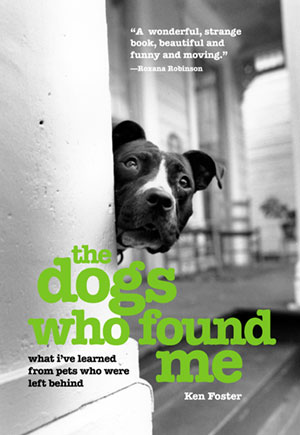
Foster will be camping out at the Kiehl's store on the corner of Washington and Fillmore (across the street from Pets Unlimited), from 4-7 p.m. Friday. He'll then head over to the Pets Unlimited boardroom for a reading and discussion from 7-8.
If the idea of handing out books in a skin-care boutique strikes you as a little odd, take note that a $20 book purchase gets you a free Kiehl's goody-bag--and all proceeds go straight to Pets Unlimited. Believe me, it's a worthy cause. Pets Unlimited doesn't take direct surrenders but instead visits other shelters to take in dogs that would likely otherwise be euthanized. Some of them have serious behavioral problems that improve quickly with one-on-one love and retraining. I've befriended blind dogs, snappish dogs, dogs with funky hair that just need a grooming makeover, dogs that were beaten by their past owners but learn to trust again. Pets Unlimited never gives up on any of them, and in due time they find their rightful homes. If you live in the city and love dogs, I recommend checking out this amazing shelter, and this reading.
July 12, 2006 · 10:32 AM · Books · Comments (0)
Transparent Truths
I reviewed Marie Arana's lively and delightful "Cellophane" for today's San Francisco Chronicle:
"Marie Arana's first novel, "Cellophane," could take a prize for most jam-packed prologue, even judged against breakneck openers by Isabel Allende and Gabriel Garcia Marquez, her clear forbears. Arana, editor of the Washington Post's Book World, may divide her time between D.C. and Lima, Peru, but she draws upon both the color and the literary traditions of Latin America with perfect fluency. Like Marquez's "One Hundred Years of Solitude," "Cellophane" begins with a vision of our protagonist's death: "in a bustling metropolis, surrounded by doting women, far from his paper, the trees, and the rush of a great, dark river." As surely as paper disintegrates to pulp, this exuberant and virtuosic novel will circle around to that alienated ending. But first, in the space of 12 pages, she gives us nearly a whole life.
Don Victor Sobrevilla has two equal loves: engineering and paper. In quick succession, he also acquires a wife, three children, and -- after a series of troubled births attended by both priests and witchmen -- an ecumenical outlook toward the natives' magical beliefs and the Peruvian gentry's Catholic faith. Fascinated since boyhood by a poster of Gustave Eiffel's "Iron House" deep in the Amazon rain forest, he moves his family far up the river to the untamed Ucayali region, where he builds a bustling paper factory. The awed Indians-turned-workers call him "the shapechanger."
The story proper picks up in 1952, just as Don Victor discovers a formula for newfangled cellophane. The residents of tiny Floralinda are bewitched, either literally or figuratively, by the film's shiny transparency. Suddenly everyone is blurting their most candid thoughts, with consequences that are first funny, then erotic and finally disastrous. "
Click here for the full review.
July 02, 2006 · 01:25 PM · Books · Comments (0)
Arrived early at the Main SF Public Library Tuesday for Michelle Tea's completely absorbing and highly recommended RADAR reading series (next one, with Chelsey Johnson, David Larsen, Joan Jett Blakk and Tina D’Elia, March 22 6 p.m.). Started browsing the Friends of the Library bookstore to kill time and picked up imperceptibly use copies of:
Big Cats, by Holiday Reinhorn
Esther Stories, by Peter Orner
Shine On, Bright and Dangerous Object, by Laurie Colwin
Primitive People, by Francine Prose
Grand total: $18. Four nearly-new books for the price of one, and the profit benefits the library. Why haven't I done this more often?
February 06, 2006 · 09:55 PM · Books · Comments (1)
Reading List
Recently my old paper of employ, the SF Examiner, asked 11 writers to dish on their latest reading passions. Regular readers of this site won't be surprised (and might be a little wearied--I'm moving on, I swear!) to learn I recommended the short stories of Laurie Colwin:
“I’ve become a mad proselytizer for Laurie Colwin after hearing her story ‘The Lone Pilgrim’ (Harper Perennial) on the public radio show ‘Selected Shorts.’ Colwin died at age 48 of a sudden heart attack in 1992, but all of her 10 books remain in print thanks to ardent word of mouth. I love her because she writes about the deeply private passions of outwardly sensible, buttoned-down people. To her, it seems, part of the charm of life is how we try and fail to neatly shape it. I’ll probably read her novels and even her cooking memoirs eventually, but of the short-story collections I’ve devoured, ‘The Lone Pilgrim’ is best.”
Scroll down in the story to learn why Daniel Handler is fired up by Jim Shepherd, Beth Lisick is raving about the new novel by Michelle Tea, and Peter Orner is rediscovering Joseph Mitchell.
February 05, 2006 · 05:03 PM · Books · Comments (0)
I reviewed Melissa Holbrook Pierson's eloquent and exasperating "The Place You Love Is Gone" for the Chronicle book review:
"Pity the poor publicist assigned to "The Place You Love Is Gone." Not that the book is a bum product: Every paragraph Melissa Holbrook Pierson pens is filled with filigreed detail, stylized turns of phrase, piercing stabs of emotion. But how do you pitch this book, exactly? Is it a rallying cry for Wal-Mart haters or a cautionary tale for urban planners? Is it sociology, history, philosophy or memoir?
Like any rich work that cannot be reduced to a hook (and especially like the work of similarly ruminative writer Rebecca Solnit), "The Place You Love Is Gone" is none of these and more. Don't be fooled: Pierson's book is not an indictment of today's rapid pace of development. It's too emotionally complicated for that. Pierson mourns lost derelict warehouses as much as dairy farms, and strip malls are but a blip in her universe of grief. Her amorphous subject is not suburban sprawl or downtown regeneration but time itself, or, as she puts it, "the fundamental existential tragedy of more driveways, of what is lost and how it hurts to know that it will never come back." "
Click here for the full review.
January 23, 2006 · 10:26 AM · Books · Comments (0)
Finally among the flurry of commentaries on the James Frey scandal (and I've read most of them), someone writes a common-sensical story about the ethics of memoir writing. It's not a genre you should enter unless you're ready to search your conscience. From the Christian Science Monitor:
"Indeed, like novelists, many memoirists write pages of dialogue, even if the actual conversations took place decades earlier. They often create composite characters, collapse time, and fill scenes from long ago with lush detail.
"You're taking the highlights of your life. It's a work of art, it's selective, it's subject to memory," says memoirist Lili Wright, author of "Learning to Float" (2000). "A memoir is art, it's literature. It's not journalism, it's not a documentary."
For many memoirists, balancing reality with the art of writing is difficult.
"Every second of the process, you're confronting questions about ethics and the boundaries of what's true and not true," says Nancy McCabe, author of 2003's "After the Flashlight Man."
Some authors consult their journals and diaries. Others, like Ms. Karr, check with people featured in their memoirs and ask them to sign releases stating the books are accurate. This is a good idea, Karr says, not least because "most of the people in my family are armed."
In the larger picture, Karr says such consultations help keep her honest. "For me, the greatest pressure is to tell the truth to the best of my ability, knowing that it will be corrupt, and I'll forget things, and I'm self-serving."
In addition to fact-checking, some memoirists warn readers about the pitfalls of memory . . .
It's important to be clear and upfront with readers, says Patricia O'Toole, author of the 2005 biography "When Trumpets Call: Theodore Roosevelt After the White House." "You have to let the reader know what your game is. If you're telling the reader it's the way it really happened, it ought to be the way it really happened." "
I actually took a similar tack to Joe Loya, who's quoted at the beginning of this story: I left out a few details of my father's case that were complicated, unbelievable, and in my judgment not relevant to the heart of the story. I'm happy to say I fabricated nothing--and would never have considered doing so. I did recreate pages of dialogue from when I was 10 years old, and those pages, while true to my memory, are reconstructed and obviously not verbatim. Memoir writing is not journalism, but just as any journalist should be ready to wrangle with her conscience and come out clean, so should any memoir writer.
It's a hornet's nest of issues for working writers to debate--and if you're working on a memoir, or thinking about doing so, of just want to enter the tussle, take note: San Francisco's non-profit writing center 826 Valencia is holding an adult seminar 6 p.m. this Sunday on memoir writing. I'll be on the panel, as will Joe Loya, Julia Scheeres, and Michelle Tea, and Dave Eggers will be moderating. Click here for the details.
January 19, 2006 · 02:08 PM · Books · Comments (0)
The Chronicle's Heidi Benson follows up on the San Francisco reaction to JT LeRoy's unmasking. Stephen Beachy--who first alleged that LeRoy was Laura Albert's creation in a New York magazine piece--says "The hoax needed to be revealed in order for us to ask the really important questions -- about what we want to believe and why, what we project onto 'outsiders,' and the magical aura we grant celebrities."
Dave Eggers says the LeRoy stories are well-written no matter who penned them, Armistead Maupin is incensed by the idea of someone using a fiction of AIDS and childhood abuse for sympathy, and Daniel Handler aka Lemony Snicket is "bemused," as is his delightful wont: "The only question is, did the person who wrote these things have as colorful a history as some people seem to believe?" Handler asked. "That's a question you could ask about Jack London."
January 10, 2006 · 10:18 AM · Books · Comments (1)
Grotto co-founder Po Bronson's website has up-to-the-minute pages on the wonderful new office I'm fortunate to share with these folks. Click here to read about what the Grotto does and see pics of the new digs.
January 09, 2006 · 07:53 PM · Books · Comments (0)
True Fiction?
Sunday was a big day for literary scandals: First the New York Times unmasked the public face of former-child-prostitute-turned-novelist J.T. LeRoy and asked whether the writer wasn't a whole-cloth fabrication of his supposed adopted parents. If you're unfamiliar with LeRoy's work, he's a favorite of celebrities like Tatum O'Neal and Courtney Love, and he's gotten a leg up from many wonderful writers, like Tobias Wolff. He writes a column in 7X7 magazine, and his work is often read at SF literary events by stand-ins for the "shy" author. I haven't had any brushes with him, and don't have anything to add, but even if you're not on the SF lit scene this is a crazy story, following on the long investigation that ran in New York magazine a few months ago.
Then, just when Oprah thought it was safe to tap contemporary writers again for her book club, The Smoking Gun goes sniffing around "A Million Little Pieces" author James Frey. The findings are lengthy, but the bottom line allegations are that he seriously embellished the circumstances of his numerous arrests, and invented a relationship with a girl sadly killed in a train crash.
The core issue of both scandals, of course, is that although Leroy was working in fiction and Frey in memoir, both depended on the authenticity of their tales to shore up the poignancy of their works.
As for the Frey case, we all know that memoir as a genre depends upon a degree of memory reconstruction and that storytelling demands a certain streamlining of events. Even William Zinsser's collection of interviews with memoir writers is called "Inventing the Truth." In my book, I stuck to what I knew to be the facts, never willingly inventing incidents, but often conjuring scenes from memory--which obliged me to always be mindful that my memories were strongly influenced by what I wanted to believe. The ethical delicacy of this became a theme of the book.
My brother in-law Dave insists I committed a grave crime of ommission by reducing his wedding toast--a rousing sing-along involving re-tooled lyrics to the tune of Camp Town Races--to the words "the best man spoke." But apparently, Neal Pollack has more serious liberties to fess up to.
Pollack link via Bookslut.
January 09, 2006 · 02:26 PM · Books · Comments (0)
"Even the worst true thing fills the consciousness with the light of its correctness."
--Laurie Colwin, "A Mythological Subject"
December 23, 2005 · 09:48 AM · Books · Comments (0)
Speaking of year-end lists, Bookslut's Jessa Crispin has a wonderfully prickly column in the Book Standard on what your personal best books of 2005 says about you:
"If the only women on your list are Mary Gaitskill and Joan Didion . . .
. . . or perhaps a token mention of Zadie Smith, whose On Beauty is not as good as everyone says it is, you need to be reprogrammed. This year, a survey was released saying men do not read books by women, especially not fiction. That, I suppose, explains why books like A.L. Kennedy's Paradise, Svetlana Alexievich's Voices from Chernobyl and Maureen McHugh's Mothers and Other Monsters have gotten almost no love. "
December 23, 2005 · 09:45 AM · Books · Comments (0)
How many other readers out there are discovering the astonishments of Laurie Colwin after that gorgeous reading of her story "The Lone Pilgrim" on Selected Shorts last week?
December 05, 2005 · 09:58 PM · Books · Comments (1)
Cover Story
One thing you don't realize as a first-time author is how much of your time will be consumed in agony over the cover design of your book. It's total guess-work--on your part and on the publisher's--and for the last month I've been fretting over what the cover of the paperback of "The Lost Night," due out next summer, will look like.
Even best-selling authors aren't immune from the trials and tribulations of cover design. Po Bronson, a fixture here on the SF literary scene and the author of "What Should I Do With My Life?," is about to come out with a new book about family. He took the extraordinary step of polling more than 1,000 of his readers about possible cover designs, and then narrating the whole process here. I'm in awe of his tenacity, and feeling wearied just thinking about all the work he must have put into this. In the end I think he got the right design.
Now back to fretting about the paperback.
November 08, 2005 · 11:44 AM · Books · Comments (0)
Underlined
"Write as if you were dying. At the same time, assume you write for an audience consisting solely of terminal patients. That is, after all, the case."
--Annie Dillard, The Writing Life
July 08, 2005 · 12:18 AM · Books · Comments (1)
Good Read
If you've still got the New Yorker's June 13 "Debut Fiction" issue sitting around your house, definitely pick it up and read Uwem Akpan's "An Ex-Mas Feast." It's the too-realistic-to-be-disbelieved story of a boy on the streets of Nairobi who is losing his beloved big sister to prostitution. His parents make him sniff glue to ward off hunger and have his siblings take shifts dangling the baby in front of tourists for change. It's beautifully written, and heartbreaking. One of the most moving short stories I've read in years.
June 24, 2005 · 09:23 AM · Books · Comments (1)
Hoop Dreams
The Chronicle asked me to review Melissa King's memoir of pickup basketball, "She's Got Next":
"Melissa King's got guts. She wanders the streets of Chicago and Los Angeles looking for a good game of pickup basketball, playing with street- smart kids and lecherous men, 6-foot-5 dunkers and trash talkers. She's also got issues: insecurity, indirection and a wariness of the opposite sex, albeit that seems more warranted with every creepy specimen she introduces. The courts are her life classroom. A premise ripe for hokey wisdom? Yes, if the frankness of her voice didn't keep her memoir, "She's Got Next," so authentic.
"I've always tried to look like I have some game when I'm dribbling around trying to get in, but I never say too many cocky things like 'I got skills,' or 'Get that weak s -- outta here,' or 'Not in my house, baby,' or much of anything else, really," she writes with characteristic slouch. "Words can get squirrelly sometimes, and I know I'm just an average type of player."
It's easy to see why sections from the early chapters of the book, first printed in the Chicago Reader, got plucked for the anthology "Best American Sports Writing." The writing is not precise, but it's direct, displaying a teenager's disdain for dishonesty but leveled with an adult's maturity. And it can't be separated from the likable toughness of King's persona. This is an Arkansas-born woman who hates it when men try to pick her up and carry her, who chooses baggy shorts over spandex, who doesn't mind calling herself a "stubborn jackass." She's a woman who requires intimacy on her own guarded terms.
But the appeal of King's experience comes over better in short sections than as a book-length narrative. King's life on the courts is scattershot. So is the storytelling in this book."
Click here to read the full review.
June 12, 2005 · 11:57 AM · Books · Comments (1)
Writing the War, and Beyond
London’s Financial Times recently ran an article on the National Endowment for the Arts’ new “Operation Homecoming: Writing the Wartime Experience initiative. The program taps A-list writers to help teach returning soldiers how to mold all the raw and intense things they’ve seen and done in Iraq into narrative, and it caught my attention for two reasons. First, the workshop the Financial Times reporter covers is led by Tobias Wolff, a memoirist I (and just about anyone else working in the memoir genre) greatly admire. Second and most importantly, since my younger brother Emmet deployed to Iraq, I’ve seen how hungry the soldiers there are to read and write, and I can only hope Emmet gets to participate in this NEA program someday.
The FT article describes a typical class session:
“[Corporal Matthew Richards] . . . signed up, against his father’s wishes, to join the Marine Corps on his 18th birthday, 2001. He wanted to serve his country after the September 11 attacks. He describes talking with an old friend about their shared experiences in Iraq. “We talked about morality and the war, and he’s a bit more religious than I am and feels the need to find some place he can go to make up for things out there, missionary work or something. I won’t be doing that myself, but I do agree that I also need cleansing.”
Richards is 20,000 words into a novel - the main character is initially indifferent to events around him but slowly grows in moral understanding. But something is troubling Richards and he can’t write about it. Last August, his unit fought a battle against Moqtada al-Sadr’s militia in Najaf, the spiritual heart of the Shia world. It was intense urban combat, “something like D-Day, with tracer bullets flying and mortars exploding”. In a room next to him, he heard the shouts of “Shoot him! Shoot him!” The marines had flushed out a “militia guy” with a rocket-propelled grenade, who began running up the stairs. Richards saw his sergeant follow and draw his knife. What happened next still haunts him. All he remembers are the shrill screams as the enemy soldier was stabbed.
It was a dark moment. He wants to convey its essence in writing, but feels unable to. He wants to turn these events into fiction. If imagination and metaphor is the novelist’s domain, this kind of reality is either gold dust or poison. The last American generation to cover a big war produced some of the most disturbing books about combat and guerrilla warfare, such as Michael Herr’s Dispatches, Ron Kovic’s Born on the Fourth of July and Philip Caputo’s A Rumor of War.”
Everything in the article makes “Operation Homecoming” sound like a model program. But then towards the end, the tone turns bafflingly snarky. Intense experience, the writer says, doesn’t necessarily make for finely crafted literature. He entirely misses the point.
To begin with, “Operation Homecoming” may indeed produce some fine literature, and to express deep skepticism of this is to fall into the trap of stereotyping servicemen and women as uneducated and illiterate. Second, the program will boost the cause for literature in this country whether or not a book on the order of Tobias Wolff’s “In Pharoah’s Army” emerges.
There’s the therapeutic value, of course, which I’m sure many soldiers will find priceless. But this writing therapy doesn’t just benefit the individual soldier. In seeing how writing mines individual experience for deeper truths, in seeing how much skill and hard work is required in striking at those truths, these soldiers are bound to emerge with a heightened appreciation for the art of good writing, and a better eye for it. And solider by soldier, in the years to come, this is going to make for a more literate American society.
I’ve seen that the soldiers in Iraq are eager and receptive; their encounters with life-or-death situations leave them needful of a medium capable of more profundity than a video game or a Hollywood blockbuster. Since deploying to Mosul, my brother—always a capable wordsmith but never much of a bookworm—has read Graham Greene, George Orwell, Ernest Hemmingway, and the Wolff memoir, which I sent him. Just today he sent me an email saying he was so excited about Jonathan Safran Foer’s “Extremely Loud and Incredibly Close” that he wants to send me a copy.
He’s not the only soldier in his platoon excited about writing. Last month, I sent Emmet an advance galley copy of my memoir. (After all, he appears as a minor character in it, though his star moment comes at age four, when I accidentally vacuum his hand and he’s forced to wear a white sock over the broken bones, so that our neighbors dub him “Michael Jackson”.) The galley ended up circulating among the platoon members, a handful of whom wrote to me. One soldier said my memoir had inspired him to write—not about the war, but about his childhood. Another soldier wanted advice on a novel he’d been working on. They both have stories to tell. I hope they too are lucky enough to participate in the NEA’s “Operation Homecoming.”
May 25, 2005 · 11:29 AM · Books · Comments (0)
The Village Voice takes an analytical look at Lit Bloggers, surveying the fresh ethical questions they face:
"Literati are increasingly turning to the blogs for discussion, gossip, analysis, and a sense of community. Inevitably, publishers have noticed the power of these informal networks to generate word-of-mouth buzz—the holy grail of marketing—and are looking for ways to harness it. In turn, many bloggerati are on the verge of becoming that contradiction in terms, the professional enthusiast. So what happens now, when these amateurs are faced with the chance to wield influence and become insiders? . . .
We read the best of the litblogs for the way they sift through the media ether, make interesting juxtapositions, provoke intelligent conversation, and connect lesser-known writers with an eager audience. In an era when books have been pushed to the margins of the cultural conversation, maybe that's more than enough. But as Lipsyte warned in a recent e-mail to Sarvas, bloggers "need to remember the eternal draw, too: a cranky individual with smart idiosyncratic tastes and a good bullshit detector."
April 22, 2005 · 02:22 PM · Books · Comments (0)
The bound galleys for my memoir “The Lost Night” arrived this week, which is pretty damn exciting. After a satisfying night at San Francisco Ballet yesterday (look for the review in the Chronicle tomorrow), I’m pressing onward with the novel this afternoon. And just when I needed a little nudge past first draft dread, I’ve discovered this wonderful site with early versions of stories by San Francisco writer Julie Orringer, whose collection How to Breathe Underwater I so admired last year. Click this link and you’ll find pages from Orringer’s working journals and manuscript excerpts with her Stegner Fellowship professors’ comments. It’s a reassuring reminder that steady revision is sometimes the name of the game—though it helps to be blessed with Orringer’s talent.
March 10, 2005 · 11:23 AM · Books · Comments (0)
Tolstoy with a twist
I've got a book review of a rather good novel in the Chron today:
"At a glance, Czech composer Leos Janácek's Kreutzer Sonata string quartet might seem merely another vehicle for the Dutch novelist Margriet de Moor's musical storytelling, much as the world of 18th century Italian opera inspired rhapsodic characters in her first book published in America, "The Virtuoso."
But "The Kreutzer Sonata" also refers to the Tolstoy novella that, with its tale of a coquettish wife and a murderous husband, inspired Janácek's tempestuous motifs. What does a moralizing classic of Russian literature have to tell us about modern sexual jealousy? Much, in de Moor's gifted hands, though the lessons remain as mysterious as music itself."
January 30, 2005 · 06:59 PM · Books · Comments (0)
The Literary Impresario
It’s been a crazy busy week, packed with dance work. Fitting in daily blocks of time for fiction work (I finished the first draft of a new story) was a challenge, and my mind felt distracted with dance thoughts. So it made me feel re-balanced and reconnected to attend Sean Finney’s new literary series at Canteen Restaurant Tuesday night. Andrew Sean Greer (“The Confessions of Max Tivoli”) and Samina Ali (“Madras Rainy Days”) read, and our three courses of fine food and talk was every bit as fun as this Chronicle article would make you think.
January 29, 2005 · 08:44 PM · Books · Comments (0)
The New York Times asks nine writers under forty which writers influenced them most. Jhumpa Lahiri chooses William Trevor, JT Leroy cites Breece D’J Pancake, and Maile Meloy opts for Geoffrey Wolff.
January 17, 2005 · 12:55 PM · Books · Comments (0)
Just about every booklover in the blogosphere knows of the Bookslut, but literate dance-goers may not. The Chicago Tribune offers a solid profile:
“Bookslut, recognized by Time magazine and The New York Times as a premiere Web destination for book lovers, celebrates a double anniversary this winter -- its third birthday and the first anniversary of its move to Chicago from Austin, Texas.
In a sea of competing Internet voices, Bookslut.com has distinguished itself through snarky, literate book reviews, thoughtful author interviews and a trend-tracking blog that attracts between 5,500 and 6,000 visitors daily . . .
. . . When writing about critic and novelist Dale Peck, Crispin called his work, "Not even bad enough to be trashy. I tried to read "The Law of Enclosures" until I noticed I was using the cover to try to saw through my wrist."
In response, during an interview with Gawker.com, Peck called Crispin "ditch-dirty stupid" -- a sign that Peck, notorious for writing savage book reviews, was either fading or that Crispin had arrived, pre-emptively beating a grandmaster of insults at his own game.
Still, Bookslut contains more raves then pans. It also exists to discover, extol and lavish superlatives on Crispin's favorite, often unsung books and graphic novels.”
Link via Arts Journal.
January 14, 2005 · 11:39 AM · Books · Comments (0)
Pub Lit
San Francisco’s Edinburgh Castle Pub--for years now host to traditional fish and chips, stiff drinks, and some of the city’s sexiest writers-—has produced its first ever anthology. Saith the Chronicle:
"Generations of literary greats have spent many a late night drawing inspiration from the watering holes they frequented. James Joyce was a regular at Davy Byrnes Pub in Dublin, Ernest Hemingway loved Harry's Bar in Venice, Charles Bukowski would drag himself into any dive in Los Angeles that wouldn't throw him out.
So it only makes sense, as Alan Black says, to put the pub into publishing.
Black, the bar manager at the Edinburgh Castle Pub, has published -- with writer Luke James and former bartender Sean O'Melveny -- a book that was, in their words, "forged" at the pub in San Francisco's Tenderloin neighborhood. As they describe it on the first of its 174 pages, "Public House" is "an anthology of spoken word, short fiction, poetry, image, and rant." "
Among the notables included are Ivine Welsh, Po Bronson, Mary Roach, and my friend and former fellow writers group member Anne N. Marino, author of the novel “The Collapsible World.” Check it out.
December 22, 2004 · 04:05 PM · Books · Comments (0)
Dance in the Age of AIDS
I’m in the Chronicle today with a book review of David Gere’s How to Make Dances in an Epidemic: Tracking Choreography in the Age of AIDS”:
“In 1990, "one AIDS death" (the reality, not the performance) was occurring every 10 minutes, and HIV was taking a lasting toll on the dance world. As a gay man and as a former dance critic for this and many other Bay Area publications, Gere found himself in the midst of devastation and its artistic aftermath. The "choreographic response" as defined by Gere, now an associate professor at UCLA, took many guises: ACT UP demonstrations, AIDS quilt unfurlings, and yes, proscenium stage dances. Gere trains his sharp eye on all of these, and though his methodology is academic, his voice is personal, impassioned and sometimes pointedly provocative.
Gere takes a Brechtian stance on the line between art and politics, and his viewpoint is unabashedly activist. Dance critics, as his introduction explains, have been reluctant to analyze homosexual themes in dance. If Gere's own interpretations sometimes push this issue to a graphic and reductionist extreme, his descriptions are usually keen and engrossing.”
December 16, 2004 · 12:07 PM · Books · Comments (0)
Photo Op
As a first-time author sweating the details of publicity and jacket photos, I’ve been well aware of Marion Ettlinger. Her photo credit under an author photo signals that the writer in question is being positioned as a literary contender. But this New York Times piece by Lee Siegel analyzes her status with eviscerating thoroughness:
“Just as the Brazilian photographer [Sebasti-o Salgado] unintentionally romanticizes grim, back-breaking labor in his attempts to ennoble the workers he portrays, Ettlinger's photographs separate fame from achievement in her attempts to, well, separate fame from achievement. This isn't so easy to pull off: her obscure authors look like children forced to wear adult-sized clothes in preparation for a party they haven't been invited to. The few actual famous people Ettlinger has shot survive her grandiloquence by the sheer force of having come through life and triumphed in their work. Elizabeth Hardwick, for example, is one of the very few writers in the book to look down and away from the camera, as if she sensed something secretly deflating about Ettlinger's superpolished inflations.”
The question remains: To be Ettlingered or not to be Ettlingered? I’m not the first author-to-be to face the uncomfortable issue, as this very funny Salon story by George Packer reassured me:
“Publishers have always expected readers to judge a book by its cover. Now they expect a writer to be judged by his face. Given the unlikelihood that good books will be written by beautiful people, publishers can either lower their literary standards or improve their authors' faces. More and more seem to take the second approach.
I've gotten used to picking up a book by someone I know personally and checking the back flap to see what authorship has done to their appearance. Dark background, unusual garment, oblique angle, tilt of head, hair falling forward, chin resting on hand, cool gaze: my nervous-smiling, twisty-nosed, sad-eyed acquaintance has undergone the most startling transformation. I never understood how it was done.”
November 17, 2004 · 12:12 PM · Books · Comments (0)
Realism
As an antidote to the Columbia Journalism Review victim-fest on first-time authors which I wrote about recently, the current Poets & Writers magazine has an article by M.J. Rose on what new writers can actually do to help promote their books. It’s not available online, but here’s a quick quote:
“As authors, we can write and edit our own career scripts. We can choose to be optimists or pessimists, curmudgeons or spoiled brats. We can harbor huge expectations or no expectations. Perhaps the best choice is to be a realist.”
Sounds sensible to me, and far more helpful than shaking your fists at the publishing world.
November 07, 2004 · 10:24 PM · Books · Comments (0)
Underlined
“He had assumed, as a husband and then an adulterous one, that his need for a woman was as carnal as it was spiritual. But now celibacy was easy; when he imagined a woman, she was drinking with him, eating dinner. So his most intense and perhaps his only need for a woman was then; and all the reasons for the end of his marriage became distant, blurred, and he wondered if the only reason he was now alone was a misogyny he had never recognized: that he did not even want a woman except at day’s end, and had borne all the other hours of woman-presence only to have her comfort as the clock’s hands moved through their worst angles of the day.”
--Andre Dubus, “The Winter Father”
October 28, 2004 · 04:19 PM · Books · Comments (0)
The Christian Science Monitor rounds up new philosophy books for the layman. Academics may look down their noses, but I’m glad these books are out there. I would tackle a degree in philosophy if I were ever to return to school. But sometime after getting in to an MFA program and balking at the $28,000 a year in tuition, I committed myself to lifelong auto-didacticism. I make do with books supplemented by lectures from The Teaching Company (don’t laugh till you try them; they’re quite good).
And I listen to Philosophy Talk Tuesdays at noon on the Bay Area’s KALW 91.7. The show, hosted by Stanford University professors Kenneth Taylor and John Perry, is in its pilot year. The duo is no Click and Clack, as this otherwise upbeat Chronicle story strangely takes pains to emphasize, but they keep the discussions—on everything from affirmative action to “the meaning of life”—lively and on topic, and they recruit eminent guests. A master’s program in an hour a week? Of course not. But a fun way to pick up tidbits to ponder while you’re eating lunch.
CS Monitor link via Maud Newton.
August 23, 2004 · 01:59 PM · Books · Comments (0)
Also in the NY Times yesterday, Laura Miller notes that more than 175,000 new titles saw print in 2003, and asks anonymous editors the tough question:
“[H]ow many books are too many? For authors, are better chances at being published eventually canceled out by the likelihood that their books will get lost in the crowd?”
July 19, 2004 · 03:19 PM · Books · Comments (0)
"In its deceit, its outright lies, its spinelessness, its weak-mindedness, its pointless violence, in the disgusting personalities it holds up to our youth to emulate, in its endless and groveling deference to our fantasies, television undermines strength of character, saps vigor, and irreparably perverts notions of reality. But it is a tender, loving medium; and when it has done its savage job completely and reduced one to a prattling, salivating infant, like a buxom mother it stands always poised to take one back to the shelter of its brown-nippled bosom."
Frederick Exley, A Fan's Notes, 1968.
July 16, 2004 · 05:53 PM · Books · Comments (0)