Dance Archives
SF Ballet's New "Swan Lake"
Site Sponsor
Vividseats.com is your one-stop source for all Concert Tickets, Theater Tickets, and Ballet and Dance Tickets. Use Redemption Code RACHEL and get 5% off all tickets, including Dirty Dancing Tickets, Romeo And Juliet Tickets, Lord Of The Dance Tickets, and Wicked Tickets!
My preview in this Sunday's Chronicle:
"Helgi Tomasson is having trouble keeping secrets.
The normally reserved, cool artistic director of the San Francisco Ballet rises suddenly from the sofa in his office at the Ballet Association building. He hurries across the room, pauses as if he knows he shouldn't do this, then lifts a black cloth. Voila! Before him stands a scale model of the third-act set for his new production of "Swan Lake," premiering Saturday.
A boyish smile warms Tomasson's face, and he clasps his hands.
"Now you can see," he says.
And it's impossible not to share in his anticipation. The palace scene devised by Tony-nominated Broadway designer Jonathan Fensom looks nothing like the fusty Watteau-inspired ballroom of Tomasson's previous "Swan Lake" production, which raised the level of the company's dancing - and its national stature - at its first performances in 1988. In fact, the new set's bold spaciousness - and in particular, a dramatic focal point Tomasson wants to keep under wraps - looks strikingly different from the antiquated image much of the general public probably holds of the Tchaikovsky classic.
Tomasson is counting on the full-size realization of this model to live up to the dazzle. This "Swan Lake," more than two years in the making with a budget of $3 million, must stay vital for at least 15 years.
Then there is Tomasson's deeper ambition. He wants to defy that catch-22 of ballet box office: Productions of the story ballet classics such as "Swan Lake" are essential to drawing in older audiences, yet can project an image of ballet as outmoded to a new generation of viewers.
"I don't want this 'Swan Lake' to look old-fashioned for young people," he says, reiterating his most cherished goal for the fourth or fifth time. "To me, this is really a love story. A strong love story. I wanted to rekindle that part of it." "
Click here to keep reading.
Casting is now available here. I'll be seeing all six pairs of Odette/Odiles and Siegfrieds and reviewing them all for the Chronicle.
February 13, 2009 · 03:44 PM · Dance · Comments (0)

SF Ballet Hits High "in the middle"
My review in Saturday's Chronicle:
"Everyone who sees William Forsythe's "In the Middle, Somewhat Elevated" is knocked out, and no wonder. It's like going on safari, watching exotic creatures prowl through their native habitat and pounce into displays of territorial command. Ballet dancers as a pride of muscle-rippling, competitive lions. Ballet class - to my mind, the implied setting of Forsythe's signature 1987 work - as their savanna.
Nearly every company in the world dances "In the Middle" these days, it seems. But Thursday at the opening of San Francisco Ballet's Program 2, I couldn't help thinking the War Memorial Opera House was the place to see it. Few international-caliber troupes have cultivated personality and passion with the fervor of Artistic Director Helgi Tomasson. The payoff shines in "In the Middle" as well as in two encores from last season's New Works Festival.
That "In the Middle" should look like such an artifact of its era and also so fresh is testament partly to the vigor of performance it receives here, but mostly to Forsythe's evolutionary place in ballet tradition. From the industrial-chic lighting and electronic Thom Willems score to the ethos of sexually aggressive individualism (think "A Chorus Line" meets "Fatal Attraction"), "In the Middle" screams late '80s. Yet its stretched-to-the-limits understanding of classicism - vestigial glimmers of Petipa and Balanchine between all those extreme extensions and provocative crouches - is timeless.
Kristin Long and Ruben Martin were scorching hot in the final pas de deux, energy running like an electrical current between their eyes. When she stood on pointe and leaned her hips toward his, her body bending like a bow, I just about thought he would lick her face."
Click here to read the rest.
January 30, 2009 · 05:26 PM · Dance · Comments (0)
Chronicle Redesign
The latest on the Chronicle's changes, from a story in the paper:
"The next major addition to The Chronicle is a themed daily Datebook section that will focus on a topic that readers care about: Health on Monday, homes on Wednesday, restaurants on Thursday and the great outdoors on Friday. In addition to this themed content, readers will still find the Bay Area's most complete guide to local entertainment and places to go and things to do."
January 29, 2009 · 09:50 AM · Dance · Comments (0)
SF Ballet: Possokhov's "Lilacs"
Site Sponsor
Vividseats.com is your one-stop source for all Concert Tickets, Theater Tickets, and Ballet and Dance Tickets. Use Redemption Code RACHEL and get 5% off all tickets, including Dirty Dancing Tickets, Romeo And Juliet Tickets, Lord Of The Dance Tickets, and Wicked Tickets!
My review of Tuesday's SF Ballet's program one opening in the Chronicle:
"How valuable will former San Francisco Ballet principal dancer Yuri Possokhov prove as the company's resident choreographer? The jury's still out after the world premiere of his "Diving Into the Lilacs" on Tuesday night at the War Memorial Opera House.
"Lilacs," his third work for the Ballet since retiring from the stage in 2006, provides a sweeping showcase of lush dancing for three ravishing couples and a corps of eight. But it's unlikely that much beyond the strong performances will prove lasting.
As happens often with Possokhov, visual design and theatrical flair overshadow choreographic depth. Benjamin Pierce's scenery suspends a sort of lilac diorama within a wall of black. Sandra Woodall's costumes dress the men in swashbuckling vests and boots, the women in slim gossamer gowns.
Possokhov has said that the music, the Sinfonietta for String Orchestra by Shostakovich-influenced Boris Tchaikovsky (not Pyotr Ilyich Tchaikovsky, though few would confuse them), evoked memories of boyhood Moscow with lilacs in bloom. And indeed, no shortage of nostalgia and passion permeates "Lilacs," with its busy abundance of swirling lifts, swooning melts and devastated clutches. But much of the high emotion feels unearned.
There are ingenious movement motifs - too many to cohere meaningfully. The men have propeller arms, a macho legs-apart stance with shoulders swaggering, and long passages with fists clenched, a favorite Possokhov crutch. The women are constantly tossing in weird little contemporary fillips when they're not lying on the floor like corpses (a compelling image that goes nowhere). Because Possokhov's response to Tchaikovsky's pretty, middle-of-the-road modernism attains only surface musicality, nothing really registers.
Yet it's hard to feel disappointed with Tuesday's cast milking every moment."
Click here for the rest.
Chronicle dance reviews will be getting shorter: 300 words per review now for most performances, 500 words for SF Ballet. (Previously most dance reviews were 500 to 600 words, 600 to 800 for the Ballet.) I'm working my hardest to make my writing as concise and pared as possible, and I hope over time the results will show. It's particularly difficult, though, with a company filled with so many beautiful dancers as SF Ballet. Before cuts for space, my program one review continued to end thus:
"And the ensemble kept bringing back the bite, Lily Rogers a budding goddess of subtle musicality in the first theme, Nutnaree Pipit-Suksun unnervingly serene in the third, and Jennifer Stahl leading the quartet of sleek Phelgmatic ladies, each as coolly self-possessed as a Vogue cover model."
The sentences may be excised, but the admiration remains.
January 28, 2009 · 08:58 PM · Dance · Comments (0)
Sean Dorsey Dance
My interview with Sean Dorsey in the Chronicle:
"You might expect Sean Dorsey's dances to be aesthetically transgressive or politically provocative. Dorsey - born female but now preferring the pronoun "he" - is the founder and director of Fresh Meat Productions, which he says is the nation's first year-round presenter of transgender arts.
Sometimes the most progressive thing an artist can do with a marginalized experience is to present it in a familiar, easily relatable form. Weaving movement with story, the 36-year-old Dorsey tells finely crafted, poignant tales of transgender life. In "Uncovered: The Diary Project," premiering this weekend at Dance Mission Theater, Dorsey turns his attention to the life of Lou Sullivan.
A female-to-male transsexual gay man, Sullivan lived in San Francisco from 1975 until his death in 1991, founding groundbreaking peer-support groups and publishing newsletters and informational booklets. The voluminous journals, medical records and letters he bequeathed to the Gay, Lesbian, Bisexual, Transgender Historical Society form the source material for "Lou," Dorsey's new suite of dances.
Q: You didn't know anything about Lou Sullivan when you undertook this project.
A: A lot of transgendered people haven't even heard of Lou Sullivan. That revealed to me the need to bring his story forward. I researched several people in letters and memoirs, knowing I wanted to work on a single life story. Lou's actual writing is gorgeous and articulate and sensual and so clear and beautiful. As soon as I read it, I knew he was the one.
Q: Three other excellent dancers star in this show with you. How do you, as a quartet, bring Lou Sullivan's story to life?
A: I'm not trying to physically embody Lou onstage or impersonate him.
I open the piece with my own writing as a witness narrator. All the rest of the text is taken from his journals and grouped into thematic episodes like love, transition, loss. They follow the arc of his life and journey, but some are in a more storytelling voice, some are more abstract and poetic. "
Click here for the rest.
January 28, 2009 · 08:55 PM · Dance · Comments (0)
Company C Review
I reviewed Company C's latest in Tuesday's paper:
"Many a burgeoning ballet troupe could benefit from having a ballet by Alonzo King in its repertoire. On Friday at Walnut Creek's Lesher Center for the Arts, the East Bay's Company C Contemporary Ballet gained an ersatz substitute: "Which Light in the Sky Is Us," a world premiere by Gregory Dawson.
That's not to disparage Dawson's obvious talent. Every emerging choreographer begins by imitation, and with more than a decade spent dancing for King's Lines Ballet, it's only natural that Dawson would be highly influenced by the work of his former boss.
The fine commissioned score, by Ben Juodvalkis and Moses Sedler, sounds like a reduction of Lines Ballet's greatest hits: bold industrial sounds mingling with Tibetan prayer gongs, African percussion and elegiac strings. Yet Dawson's personal choreographic gifts glimmer within the ballet. His movement leans toward more obviously classical vocabulary than King's, which makes for clearer unison sections. And his stagecraft with tension-building transitions is tremendous. Just when you think you know where the structure of a section is going - four women lined up along one wing, say, with a soloist center stage - in pops a visitor whose arrival seems both surprising and inevitable.
Most important, though, is how focused and emotionally immersed Company C's members look in "Which Light." The young dancers - being steadily groomed by Artistic Director Charles Anderson - have grown tremendously in recent seasons in ballets by luminaries like Twyla Tharp and Antony Tudor. But in "Which Light" they look grown up - not mere performers, but artists. "
Click here for the full review.
January 28, 2009 · 08:52 PM · Dance · Comments (0)
Alonzo King Talks Design
A few months back, I was asked to propose a choreographer to interview for design mind, the new magazine produced by the global design and innovation firm frog design. Quickly, I settled on Alonzo King, a choreographer who thinks beyond the often cloistered dance world, looking towards the transcendent.
So there Alonzo King and I were at frog's San Francisco studios last Thursday, where I interviewed King before a packed audience of designers transfixed by his insights on artistic authenticity.
Meanwhile, the new issue of design mind containing King's thoughts on collaboration is now available at select bookstores and newsstands. As befits a publication produced by a design firm, it is gorgeous (take a look especially at these stunning photos by French photographer Denis Darzacq). The Lines Ballet dancers receive an elegant spread of photos by Marty Sohl, well worth the magazine's price. But if you can't find a hard copy, you can at least read my interview with King online. Here is an excerpt:

"In a sweaty San Francisco dance studio, Alonzo King watches a quartet of men entwine around one another, forming a spinning line that soloist Brett Conway, his limbs fluid and yet tensile as a spider’s thread, keeps trying to break through.
“This is interesting to me because it’s a fixed point — convergence, and then one emerges,” King says in his gentle voice. “It’s that same tightness and then” — he throws his long arms wide — “whoosh! So as an idea, tightness and then release.”
King is talking to a group of musicians who will soon go back to their studios to create a score for his new ballet (which premiered on October 17th in San Francisco). The legendary saxophonist Pharoah Sanders, who played with John Coltrane’s jazz ensemble in the 1960s, will improvise live over this musical base, though he won’t be coming to the studio to see the dancing until three days before opening night. It’s risky, but risk-taking and collaboration are the driving forces of King’s creative vision.
In twenty-six years of making dances for his Lines Contemporary Ballet, King has paired his dancers with tabla master Zakir Hussain, Hindustani singer Rita Sahai, a band of Central African pygmies called the Ba’Aka, and a US-based group of kung fu practicing Shaolin monks. For King, collaboration is the essence of creative expression. It also poses a management challenge that any business leader or manager can appreciate: How do you bring seemingly disparate teams together for a cohesive — and transcendent — result? King shared his thoughts on collaboration during a rehearsal break in his office on September 18, 2008.
I OFTEN SAY IF TWO MEDIOCRE PEOPLE come together, a scientist and a farmer, and they meet and discuss what they do, they’ll say, “We’re really in two different worlds.” But if it’s a visionary scientist and a visionary farmer, they’ll say, “My God, we’re doing the same thing.” I want to talk to the world’s top scientists. What does that have to do with ballet? A lot. Anyone who has dedicated themselves to something and given their best [is] at a high level of expertise. They’ve got a lot to offer, and I’m interested in conversations with them. "
Here is the link to the full interview.
January 24, 2009 · 05:42 PM · Dance · Comments (0)
SF Ballet Gala
Site Sponsor
Vividseats.com is your one-stop source for all Concert Tickets, Theater Tickets, and Ballet and Dance Tickets. Use Redemption Code RACHEL and get 5% off all tickets, including Dirty Dancing Tickets, Romeo And Juliet Tickets, Lord Of The Dance Tickets, and Wicked Tickets!
My review in today's Chronicle:
"George Balanchine's "Stars and Stripes" has closed out many a gala, but San Francisco Ballet Artistic Director Helgi Tomasson must have known that its campy, high-kicking patriotism could never appear so felicitous as the day after President Obama's inauguration.
And so it was at the Ballet's 76th season opening: the guys in their feathered parade hats twirling, the girls bedecked in red, white and blue saluting, the American flag rising as the crowd clapped along to John Philip Sousa marches.
What better way to celebrate a new era than with one of the most satisfying Ballet kickoffs in recent memory? After several seasons bogged down by the pomp and ponderousness of big anniversaries, the programming Wednesday was sprightly, the star turns mostly sparkling. This was also the first time in many a tendu that women outshone men in a troupe often accused of allowing male talent to eclipse its ballerinas.
Though the exceptions of male brilliance were striking. In the pas de deux from "Le Corsaire," recent Ballet Nacional de Cuba defector Taras Domitro made a spectacular local debut, launching his tawny, compact body into textbook-perfect jumps, imbuing the connecting moments with spontaneity and never-overplayed feline prowess. "
Click here to read on.
January 23, 2009 · 02:07 PM · Dance · Comments (0)
Company C's Charles Anderson
Site Sponsor
Vividseats.com is your one-stop source for all Concert Tickets, Theater Tickets, and Ballet and Dance Tickets. Use Redemption Code RACHEL and get 5% off all tickets, including Dirty Dancing Tickets, Romeo And Juliet Tickets, Lord Of The Dance Tickets, and Wicked Tickets!
I profiled Company C Contemporary Ballet founder Charles Anderson for today's Chronicle:
"In a studio in Walnut Creek, a large man wearing jeans and sneakers stands before a group of lithe, chiseled dancers. "I like the attack," he says, throwing his full weight into a jump, "but keep it natural." When Charles Anderson demonstrates, his movement is expansive and graceful.
A stranger meeting Anderson on the street wouldn't guess that the big, jovial 43-year-old possesses a formidable ballet pedigree: His father is a former San Francisco Ballet principal, his mother a soloist. And even someone familiar with Anderson's eight years performing with New York City Ballet, and his reputation as one of the West Coast's most respected ballet teachers, probably wouldn't have thought, six and a half years ago, that his Company C Contemporary Ballet would become such a success.
After all, Anderson had virtually no budget and two months' prep time in late 2002, when a manager at San Francisco's Cowell Theater, looking to fill a cancellation, asked him to get some dancers together and put on a show. He had no staff, no funding and only his own choreography to stage. And really, did the Bay Area need another ballet company?
As it happens, the Bay Area did. The 13-member Company C, which will perform in Walnut Creek and San Francisco during the coming month, doesn't just offer committed, attractive young dancers. It also offers dance works - some masterpieces, some simply delightful - not danced by other California companies.
"My feeling is San Francisco is saturated with dance of all kinds, and you have to bring something else to the table," Anderson says after rehearsal, his blue eyes still boyish against pale skin and red hair. "As great as San Francisco Ballet is, there are a ton of great works that aren't in its purview for whatever reason."
The acquisitions were gradual. But, tapping his East Coast connections and his broad taste, Anderson began assembling a repertory of rare stature and eclecticism for a chamber troupe. A 2008 program juxtaposed Antony Tudor's wrenching, too seldom performed 1937 landmark "Dark Elegies" with David Parson's zany 1986 caper "The Envelope." Other programs have showcased everyone from modern dance living legend Paul Taylor to razzle-dazzle ballet showman Michael Smuin.
Then, in April, came the coup. After previously acquiring two well-known Twyla Tharp works, Company C gave the world premiere of a Tharp ballet that the famously prolific choreographer created years ago but then forgot about. "
Click here for the rest of the story.
January 18, 2009 · 08:04 PM · Dance · Comments (0)
SF Ballet 2009
The new San Francisco Ballet season, kicking off with a gala January 21st, is nearly upon us. I profiled retiring ballerina Tina LeBlanc for this Sunday's Chronicle:
"Tina LeBlanc is getting teary, but not because of her impending farewell to the ballet stage.
"I was totally crushed," LeBlanc says in a quiet room at the San Francisco Ballet Building, remembering the day she auditioned for the summer training program at American Ballet Theatre in New York. She had made it into the school the summer before; even though she was just 15, she knew her dancing was strong.
"One of the judges saw my confusion when my number wasn't called. She called me over and said, 'You're just too short. You haven't grown.' "
LeBlanc, 5 feet 1 - "I have been measured lately at 5 foot 1 1/2!" - raises a hand to a watery eye and laughs. "It was all I could do to walk out of that audition without bursting into tears. It was a blow. Not that I regret anything that has happened in my career."
It is hard to imagine what in LeBlanc's 27 years of professional dancing - 17 with San Francisco Ballet - she could have to regret. At 42, faint traces of gray framing her no-nonsense face, she has entered the growing pantheon of mold-breaking Ballet ballerinas who prove that skill, artistry and passion trump body-type strictures. With her pliant feet and diminutive-but-strong-as-nails legs, she is a supreme technician, lending sparkling clarity to ballets by George Balanchine and Artistic Director Helgi Tomasson. But her gala goodbye performance May 9 will surely also show what has made her a total dancer, valuing nuance, precision and musicality over gymnastics and flash, whether weeping as "Swan Lake's" Odette or hoofing it up as the cowgirl in Agnes DeMille's "Rodeo."
"Nothing seems impossible for her," says fellow Ballet principal Kristin Long, who first admired LeBlanc's fearless freedom when both trained as children at the Central Pennsylvania Youth Ballet. "She has this incredible daring quality when she's onstage." "
Click here to keep reading.
I also describe the season's offerings. And I interview the designer of the new "Swan Lake," Jonathan Fensom:
" After San Francisco Ballet's forward-looking 75th anniversary in 2008, with its 10 commissioned world premieres, Artistic Director Helgi Tomasson is returning to a classic. He raised the caliber of San Francisco Ballet's dancing, and its national esteem, when he choreographed his first "Swan Lake" for the company 21 years ago. Now, for his new production premiering Feb. 21, Tomasson has teamed with Tony-nominated Broadway designer Jonathan Fensom ("Pygmalion," "Journey's End"), making his first foray into ballet.
We talked with Fensom about the new "Swan Lake" as he was in New York, putting finishing touches on the Manhattan Theatre Club's "The American Plan."
Q: This is a fairly traditional, not a postmodern or revisionist, "Swan Lake," and yet you're doing some forward-looking things with it. What was the driving intention behind this production?
A: Right away when I was asked to do this, I wanted to make the narrative clearer. In ballet and in opera, a lot is expected of the audience, as if they have to do their homework before seeing the show. With San Francisco Ballet's new slogan about "a new way of seeing ballet," I thought, let's try to design with a very strong narrative in mind and make the story clear for people who have never seen this ballet.
For one thing, we've made it Odette's story, more than Prince Siegfried's story. And there's a prologue that lays out the backstory. The audience will be aware that something strange has happened.
Q: In a lot of "Swan Lake" productions, the look is heavy and Germanic, Disneyfied medieval. What kind of style did you work for?
A: It's early 19th century, Regency period, with high collars, large sleeves that taper. We haven't gone Gothic. I wanted to keep a lightness of touch. In each scene, an object becomes a motif. In the first scene, for instance, we're outside the palace, and the motif is the palace wall. Siegfried is trapped. He's living the bachelor lifestyle, but he's oppressed by it.
At the lakeside, the emotion evoked is wild, and in the ballroom everything is contained and orderly. I'm taking advantage of that wonderfully wide Opera House stage to use a lot of objects. I've designed sculptural forms to move about the stage. I figure dancers are sculptural forms, I wanted the scenery to work that way, too. We've pulled away from the usual painted drops. The effect is more magical - or that's the plan."
Click here to keep reading that.
January 09, 2009 · 07:40 PM · Dance · Comments (0)
What to Watch in 2009
Site Sponsor
Vividseats.com is your one-stop source for all Concert Tickets, Theater Tickets, and Ballet and Dance Tickets. Use Redemption Code RACHEL and get 5% off all tickets, including Dirty Dancing Tickets, Romeo And Juliet Tickets, Lord Of The Dance Tickets, and Wicked Tickets!
The Chronicle asked me to list ten dance performances to look out for, appearing in this Sunday's Pink section. Here are a handful:
"San Francisco Ballet (Jan. 7-May 8, War Memorial Opera House) After last year's forward-looking 75th anniversary, Artistic Director Helgi Tomasson tends to tradition with a new "Swan Lake." Also tantalizing: the return of William Forsythe's slam-bam "In the Middle, Somewhat Elevated"; a revival of Antony Tudor's heartbreaking masterpiece of psychological insight, "Jardin aux Lilas"; and Balanchine's magisterial three-part "Jewels" - particularly alluring with the ravishing Sarah Van Patten dancing "Diamonds."
Compagnie Marie Chouinard (April 10-11, Yerba Buena Center for the Arts' Novellus Theater) The sexually provocative, fearlessly primal company from Montreal made an indelible San Francisco debut in 2005. Now San Francisco Performances brings us Chouinard's take on two erotically charged classics: "Rite of Spring" and "Afternoon of a Faun."
Paul Taylor Dance Company (April 29-May 3, Yerba Buena Center for the Arts' Novellus Theater) One year without modern master Paul Taylor is too long. Returning to San Francisco Performances after a hiatus, Taylor's sunny company will dance his usual mix of the daffy and divinely bittersweet, bringing two new works along with the classic "Esplanade" and 1969's disturbing, erotic "Private Domain."
Anna Halprin (May 1-3, Stern Grove) Eighty-eight and dancing with unbridled beauty, the Bay Area's postmodern pioneer creates a new, free site-specific work for Stern Grove, the leafy bower of an outdoor performance space designed by her husband, seminal landscape architect Lawrence Halprin."
Click here for my full list.
One extra heads-up: the Yerba Buena Center for the Arts is really on the ball for 2009, bringing intriguing visitors from Japan and New York. Be sure to check out their full line-up here.
On a personal note, I'm off to North Carolina for another graduate school residency for the next twelve days. But coming soon, a big preview package on the coming SF Ballet season in the Chronicle on January 11.
January 02, 2009 · 04:54 PM · Dance · Comments (0)
Year in Dance 2008
My list in Sunday's Chronicle:
"HIGH: San Francisco Ballet's Maria Kochetkova in "Giselle" (Feb. 19): Tiny, delicate and irrepressibly sweet, the Russian-trained Kochetkova broke our hearts. Cutting through all the hype of San Francisco Ballet's forward-looking 75th season, the company's doll-like new principal gave a performance to remember for a lifetime.
LOW: Mark Morris Dance Group in "Romeo and Juliet: On Motifs of Shakespeare" (Sept. 26): Modern masters have their off years, too. Morris resurrected Prokofiev's original score but didn't show any feeling for the music. A handful of clever dramaturgical touches couldn't bring passion to this star-crossed production.
MOST IMPROVED: Smaller Bay Area ballet companies: They had a banner year. The reborn Oakland Ballet Company charmed in family-friendly fare, Diablo Ballet danced Balanchine with fresh panache, and Company C Contemporary Ballet romped through the world premiere of a lost Twyla Tharp creation. With the Smuin Ballet also carrying on strongly, there was ballet for everyone.
MVP: Jessica Robinson. CounterPulse's tireless executive director runs a tiny performance venue with a big impact, fostering new work by developing choreographers seemingly in all styles and genres - and just as important, promoting substantive dialogue among artists and their audiences."
And a few selections from my top 10:
"Retrospective Exhibitionist: (Miguel Gutierrez, May 9) A fleshy naked man. Holding a backbend. Singing a Kate Bush song in falsetto as a lit candle rises near his bare derriere. Gutierrez, a Joe Goode alumnus now in New York, was outrageous - but his meditation on narcissism was oddly touching, too.
Craneway Event: (Merce Cunningham Dance Company, Nov. 9) Cal Performances presented the 89-year-old modern dance maverick's timeless experiments in time and space at a former Ford assembly plant at Point Richmond. To see these superhuman dancers doing superhuman things - up close, inside a glistening palace of a warehouse perched on the edge of the sea - was heaven.
Axis Dance Company 20th anniversary season: (Nov. 15) Oakland's trailblazing troupe for dancers with and without disabilities astonished us again with the intense chemistry between feisty Sonsheree Giles and Rodney Bell, lashed tightly to his wheelchair but spectacularly agile, in a duet by Alex Ketley."
Click here for the full list.
December 26, 2008 · 07:43 PM · Dance · Comments (0)
SF Ballet Nutcracker
Belatedly, my "Nutcracker" review in last week's Chronicle:
"In a winter of belt-tightening economic gloom - and as a silver lining, one hopes, a Christmastime not reduced to mere shopping - let's get the consumer advice out of the way. Is San Francisco Ballet's "Nutcracker" worth the outlay? The giggling children and shining parents at the War Memorial Opera House on Thursday suggested a "yes" that can't be measured in ticket prices.
Five seasons after the unveiling of Artistic Director Helgi Tomasson's luxurious production, the verdict is clear: This is one of the best "Nutcrackers" in the country and, by my estimation, the most visually elegant. The setting - 1915 San Francisco, with Clara dreaming about sights from the Panama-Pacific Exposition - is ingenious. The choice of a teenage Clara on the cusp of maturity makes for seamlessly satisfying storytelling.
The scenery - fog-shrouded Victorians, and for the second act a crystal palace that evokes the Conservatory of Flowers - is gorgeous. The battle between the toy soldiers and the mice is one of the cleverest in the business. My only serious complaint is that Tomasson's "Waltz of the Flowers," which ought to be an exuberant highpoint, feels cold and sterile. "
Oodles of photos online, if you click here for the rest of the review.
December 15, 2008 · 01:45 PM · Dance · Comments (0)
SF Ballet Nutcracker on PBS
My little ditty of a story in the Sunday Chronicle:
"San Francisco Ballet was the first company to dance the full "Nutcracker" in North America, in 1944. But it was George Balanchine and the New York City Ballet that turned the then-relatively unknown Tchaikovsky score into a holiday tradition - and the ballet world's bread and butter - in the 1950s. Now San Francisco Ballet is about to reclaim the "Nutcracker" mantle in a big way with the nationwide PBS "Great Performances" broadcast of Artistic Director Helgi Tomasson's "Nutcracker" - set in 1915 San Francisco - on Dec. 17.
With its softly fog-shrouded sets and sumptuous Edwardian-era costumes, the Ballet's "Nutcracker"- also soon available on a DVD from Opus Arte/Naxos - looks tailor-made for its close-up. But Tomasson wasn't thinking about television when he conceived his widely acclaimed $3.5 million production, which premiered in 2004.
"After the fact, so many people said, what a beautiful production, and it takes place in San Francisco," said Tomasson, who devised a scenario in which the teenage Clara dreams about the fantastical sights she's just seen at the city's World's Fair. "That got the ball rolling."
Tomasson's "Nutcracker" was filmed over three performances last December, with eight cameras capturing every angle of glamorous Yuan Yuan Tan as the Snow Queen and technically virtuosic Vanessa Zahorian as the Sugar Plum Fairy. Emmy-winning director Matthew Diamond, who also directed the Ballet's 2003 recording of "Othello," said filming the gorgeous Act 2 divertissements of waltzing flowers, French cancan girls and a wild Chinese dragon was the easy part - it was editing the story-packed Act 1 that posed a challenge."
Click here for the full story.
December 07, 2008 · 10:31 PM · Dance · Comments (0)
Diablo Ballet Back in Fine Form
Site Sponsor
Vividseats.com is your one-stop source for all Concert Tickets, Theater Tickets, and Ballet and Dance Tickets. Use Redemption Code RACHEL and get 5% off all tickets, including Dirty Dancing Tickets, Romeo And Juliet Tickets, Lord Of The Dance Tickets, and Wicked Tickets!
My review in Monday's Chronicle:
"This may be sacrilegious to admit, but there have been moments during Diablo Ballet's past two budget-woe-beleaguered years when I've asked myself, "How urgent is it to save this little company, really?" On Friday at Walnut Creek's Lesher Center for the Arts, I felt the shame of that ungenerous thought, and happily. The hardy Diablo performers danced with total panache in excerpts from "Who Cares?," one of George Balanchine's most deceptively breezy minor masterpieces, yet one of his most stylistically demanding.
This was Diablo's finest hour in many moons, and it was sheer pleasure.
It seems the talented troupe members finally have the right people cracking the whip again. Artistic Director Lauren Jonas is reportedly spending less time in the office as interim executive director and more hours in the studio, and the results show. Just as crucial, one guesses, was the oversight of former San Francisco Ballet principal and now Oregon Ballet Theatre Artistic Director Christopher Stowell, who coached this staging. The Diablo dancers clearly lapped up his attention to meticulous artistry.
"Who Cares?" may sound like a fail-proof package - Gershwin tunes, chorus line girls in short skirts, starry-eyed romanticism - but without the right details, it falls flat, as anyone who saw San Francisco Ballet's most recent rendition can attest. Diablo made it an irresistible souffle."
Click here for the rest of the review.
November 23, 2008 · 10:50 PM · Dance · Comments (0)
SF Hip Hop DanceFest
My review in Monday's Chronicle:
"The San Francisco Hip Hop DanceFest's audience isn't shy about its predilections: The mob screams for a fat beat, claps along when a crew breaks out old-school James Brown or vintage '80s Janet Jackson and shouts "work it out!" when a dancer starts slamming. But like any crowd that knows how to have a good time, the festival's fans rarely err in taste - and neither does founder, director and producer Micaya.
I wasn't able to catch the 10th anniversary festival's Program A on Friday at the Palace of Fine Arts Theatre, but that was surely my loss, because Saturday's Program B was sick, buck, dope, stupid - insert whatever other hip-hop accolade you wish - the best of the eight editions of the festival I've been fortunate enough to witness through the years.
Just when we thought Micaya's international scouting had shown us everything possible in hip-hop, along comes Indiana's Breaksk8 Dance Crew. These five guys dance on roller skates, and this ain't no roller derby. They do tight, hard-hitting moves that most crews would kill to pull off with their feet on the ground. Then they do more, throwing themselves into b-boy spins, scissoring their legs in handstands.
Also on the novel side was Philadelphia's MopTop Music and Movement, led by Buddha Stretch, a repeat visitor to the festival. For "HipHop/Beebob" he took a Charleston-grooving song by Common and staged a 1920s speakeasy bash. You haven't seen street tough redefined until you've seen B-girl Bounce whirl through a corkscrew in a flapper dress and heels.
But some crews didn't need a gimmick, just a good booty-shaking."
Click herefor the rest of the review.
November 23, 2008 · 10:47 PM · Dance · Comments (0)
Blixa Bargeld, Nanos, and Kunst-Stoff
My review in Friday's Chronicle:
"To the public, Blixa Bargeld might most easily be identified as the former guitarist for Nick Cave and the Bad Seeds. But to serious fans of experimental music, Bargeld is a cult hero: founder of the group Einstürzende Neubauten, power-tool-wielding savant of industrial music and major influence on everyone from Nine Inch Nails to Depeche Mode. So local music collective Nanos Operetta and dance company Kunst-Stoff must have counted it a coup when Bargeld chose to work with them on a San Francisco edition of his "Execution of Precious Memories," continuing through Sunday at Project Artaud Theater.
The "Execution of Precious Memories" project - with its morbid Bargeldian double entendre - began in Bargeld's hometown, Berlin, in 1994 and has been executed, so to speak, in six more cities since. Calls for memories are put out to residents of the particular city; a 50-item questionnaire is distributed by e-mail and flyers. The collaborators then gather the anonymous answers and work under Bargeld's direction to shape them into an original piece.
For this run, Bargeld also presides over the recollecting, reading many of the memories in his deep, crisp, horror-movie-worthy voice, tall frame cloaked in a black three-piece suit. He sings, and for the final climax he lets out a piercing, clear animal scream that is one of the most astonishing things I have ever heard a human voice produce. But the real star here is Nanos Operetta's music.
With Bargeld at the mike, Nanos leader and vocalist Ali Tabatabai has stepped aside, but the lush music stands strong without his charismatic presence. To Nanos fans, it will sound like much of what the collective has produced over its busy seven years: a Jacques Brel-meets-Persia fever dream of accordion, strings and relentless vibraphone; wild percussion and an eerie singing saw whining above it all. "Execution of Precious Memories" sounds less dark and twisted to me than much of Nanos, though, and more softly swooning. It's sweeping and absorbing.
I wish I could say the same for the project's other elements."
Click here for the rest of the review.
November 20, 2008 · 09:42 PM · Dance · Comments (0)
Chris Stowell at Diablo Ballet
My Q and A in Friday's Chronicle:
"San Francisco Ballet fans miss Christopher Stowell, who for 16 years was one of the finest male dancers in the company's history. But though Stowell retired from the stage in 2001, he's hardly disappeared. In 2003, Stowell made good on his ballet lineage - he's the son of Kent Stowell and Francia Russell, founders of Seattle's Pacific Northwest Ballet - and became artistic director of Oregon Ballet Theatre in Portland. He hasn't shied from calling on his San Francisco connections, whether hiring San Francisco Ballet dancers, recruiting from the San Francisco Ballet School or tapping Ballet choreographers like Yuri Possokhov. His emphasis on contemporary classicism at OBT has brought the troupe accolades in festivals like the Kennedy Center's "Ballet Across America" and New York's "Fall for Dance."
Last week, Stowell returned to the Bay Area to help out another troupe, Walnut Creek's Diablo Ballet, which will dance excerpts from Stowell's "All Eyes on You" as part of the company's "An Evening on Broadway" program this weekend.
Q: Oregon Ballet Theatre has been generating a lot of buzz during your five years there.
A: We're getting a lot of attention. It's very satisfying.
Q: Ticket sales at OBT's home performances are up 50 percent. What's your strategy?
A: I try to surprise our audiences all the time about what ballet can be. The people who are afraid of a tutu find out that ballet can be contemporary; it's not uptight. And the people who are scared of no tutu get dancing that is still classical and discover that the language of ballet can be so many interesting things. But it's still ballet. If it reminds me of a music video, I'm not interested."
Click here for more.
November 20, 2008 · 09:40 PM · Dance · Comments (0)
LevyDance and Hennessy's "Delinquent"
Catching up on Chronicle reviews I haven't had time to post this week. Both these shows are over, alas. But first up, LEVYdance:
"For all the physiological complexity of young Benjamin Levy's whiplash choreography, some aspects of LEVYdance's sexed-up appeal are simple: He works with good-looking dancers, and he knows how to make them look good.
Continuing through Saturday, that attractiveness extends to the setting. For its seventh home season, LEVYdance has opened its own little nook of SoMa, an alley off Folsom and Eighth streets that plays village square not only to LEVYdance's headquarters at Studio Gracia but also to the atelier of couture designer Colleen Quen and an automotive repair shop.
Wednesday night a nearly full moon shone above the brick buildings with their lovely murals and tendrils of trumpet vine, while three stages connected by catwalks occupied the center. The audience sat on two sides and in the pit created by the performance platforms, where a hipster crowd curled up on cushions, cozily nursing cups of mulled wine and hot chocolate.
A San Francisco scene, to be sure, and it was no surprise that the dance that looked most natural in these environs was last year's "NuNu," a dance-party romp set in part to a club anthem by Fabolous."
Click here for the full review.
And then, Keith Hennessy's "Delinquent" which, if you read the full review, you'll see I found mildly disappointing:
"Near the beginning of Keith Hennessy's new one-hour show, "Delinquent," Lick Wilmerding High School senior Constance Castillo sits high in a sling hoisted by her fellow cast members. "Two of us have been locked up on both sides of the bay," she says, steely-eyed. "Three know someone killed in the last month. Five have parents who have been incarcerated. Some have parents in prison right now. All have stolen."
And all - so the hook of this Yerba Buena Center for the Arts Bay Area Now presentation goes - have been labeled "juvenile delinquents" at some time in their lives, though the most eloquent protest against the ways youth incarceration demeans human potential is a quick glimpse through the program bios. Some of the cast members have already graduated from colleges like UC Santa Cruz, others volunteer for the ACLU or study at major ballet schools - hardly the stereotype of underachieving kid thugs. All are honest, compelling performers, and choreographer Hennessy - a veteran performance artist and activist best known for his anti-fear-mongering AIDS rituals - mostly does right by their diverse talents.
"Delinquent" is strongest whenever Hennessy lets these teens and no-longer-quite-teens do their thing. "
Click here for the rest.
November 20, 2008 · 09:34 PM · Dance · Comments (0)
Farewell, Clive Barnes
I'm very sorry to hear of the great critic Clive Barnes' passing. I grew up on him and his wit and effortless deep knowledge, as almost everyone writing about dance today did.
November 19, 2008 · 03:16 PM · Dance · Comments (0)
AXIS Dance's 20th Anniversary
Site Sponsor
Vividseats.com is your one-stop source for all Concert Tickets, Theater Tickets, and Ballet and Dance Tickets. Use Redemption Code RACHEL and get 5% off all tickets, including Dirty Dancing Tickets, Romeo And Juliet Tickets, Lord Of The Dance Tickets, and Wicked Tickets!
My story in Sunday's Chronicle:
"One of the most riveting Bay Area dances of 2008 starred a tiny, fierce redhead and a brawny, burningly intense man in a wheelchair. In Alex Ketley's duet "To Color Me Different," Axis Dance Company members Sonsheree Giles and Rodney Bell toss themselves into a torrent of volatile intimacy. Giles flips herself over Bell's shoulders and across the stage; Bell throws the wheelchair, tightly lashed to his immobile legs, to the floor and rolls upright again, in full command of his essentially three-limbed physicality.
No doubt part of the fascination of the piece comes from seeing an unconventional body fearlessly attempting unexpected things. But watching "To Color Me Different" at various local dance festivals this summer, there was no separating the power of Bell's physical determination from his passionate connection with Giles.
This is not a duet about being disabled; it's about the perils of attraction and trust. And it's being danced again next weekend in Oakland as part of a larger Ketley piece, "Vessel," which will receive its world premiere during Axis Dance Company's 20th anniversary home season.
Hard to believe, but true: Oakland's Axis has been pushing dance combining performers with and without disabilities into the realm of great risk-taking art for two decades. "
Click here for more. And here's a timeline of the company's milestones.
November 10, 2008 · 10:52 PM · Dance · Comments (0)
Cunningham at Cal
My review in the Chronicle:
"Friday night, lost in Merce Cunningham's sensuous "Biped" at UC Berkeley's Zellerbach Hall, I thought I'd start this review by rhapsodizing about "Biped" as the perfect portal for someone who's never seen a Cunningham dance. I thought I'd tell readers that if you're considering coming to the Merce Cunningham Dance Company's second weekend at Cal Performances - and you should - you should make certain to come on Friday, when "Biped" will be repeated. I'd go on about "Biped's" shimmering Gavin Bryars score, about how the 1999 dance feels more lush and human and generous than most of Cunningham's work, about how the ghostly motion-capture video projections, the disembodied lines moving like angelic forces of geometric beauty, warm up a spirituality that tends to feel coldly intellectualized.
After all, I figured, especially as Cunningham nears 90 years of age - and as Cal Performances does right by his troupe's venerated 55 years with two packed weeks of colloquia, a film series and more - Cunningham converts forget that his work frequently strikes the uninitiated as inscrutable, impenetrable, even pointless. Liberating dance from music and decor, embracing chance techniques, embodying the Zen attitudes of his partner and collaborator, John Cage: You can read about all the avant-garde advances in the dance history books and still feel affronted at the performance. After all, a lot of Cunningham is meant, however slyly, to affront you.
My own Cunningham conversion came very late, just two years ago. I was watching a typical Cunningham dance with its typical unsettling mix of precision and randomness, and suddenly it struck me. The key was to release myself from the paralyzing burden of trying to find my own meaning in every moment - to refrain from reprimanding myself for tuning out. I surrendered to watching Cunningham as a kind of meditation. And suddenly, the beauty of sheer form was everywhere."
Click here for the rest of the review.
November 10, 2008 · 10:49 PM · Dance · Comments (0)
Change--and ballet--come to the White House
I first posted this in January 2007, but I'm posting it again in honor of Barack Obama's first hire:
"You know how people say, 'crawl, walk, run'? Well, for me it was always 'crawl, walk, ballet'."
--Democratic Caucus Chair and former ballet dancer Rahm Emanuel today on Fresh Air. Click here for the interview.
And I thought I couldn't be any happier about Obama's triumph. Now thanks to him we have a ballet fan in the White House.
November 07, 2008 · 11:03 PM · Dance · Comments (0)
Oakland Ballet
Site Sponsor
Vividseats.com is your one-stop source for all Concert Tickets, Theater Tickets, and Ballet and Dance Tickets. Use Redemption Code RACHEL and get 5% off all tickets, including Dirty Dancing Tickets, Romeo And Juliet Tickets, Lord Of The Dance Tickets, and Wicked Tickets!
My review in today's Chronicle:
"For two years now, the Oakland Ballet Company has been an irresistible underdog, replete with an against-all-odds story. Could Ronn Guidi really reclaim the troupe he founded in 1968 - the troupe that foundered and finally folded seven years after his 1999 retirement - and bring it back to life with its old plucky spirit? Oaklanders who knew Guidi and remembered the Oakland Ballet heydays of the '80s and '90s hoped yes - and gave Guidi a lot of credit for heart.
But Saturday at the Paramount Theatre, extra points for perseverance were no longer necessary. In its third repertory outing, the reborn Oakland Ballet danced like a company without need for allowances. This was a well-chosen program that kept matinee families happy while offering more serious ballet lovers much to admire.
The best decision Guidi made was bringing back former Oakland Ballet star Michael Lowe's "Bamboo," an imagistic mingling of Chinese childhood memories. Not a small portion of pleasure was thanks to Melody of China playing traditional instruments in the pit, but the charm of the choreography is all Lowe's. Six women in elegant green leotards wafted like tender leaves, legs sprouting upward as the men in brown held their bodies upside down. Jenna McClintock and Ethan White danced a Tai Chi-inspired pas de deux punctuated by silent suspense. In the most memorable section, a gaggle of men as young ducks quacked with hands and mouths, lying on the lip of the stage with legs skyward like bobbing tails.
The ensemble moved harmoniously, led by gracious Gianna Davy. Harmoniousness, softness, an unassuming generosity: Those qualities are beginning to re-emerge as a company style and ethos, and they brought a good-natured vibe to Ron Thiele's "How'd They Catch Me?," which could have looked like a bad '80s flashback. "
Click here for the full review.
October 27, 2008 · 10:54 PM · Dance · Comments (0)
Lines Ballet with Pharoah Sanders
My review in today's Chronicle:
In the middle of Lines Ballet's "The Radius of Convergence," five men form a line that spins and collapses. Brett Conway, the troupe's most eloquent male dancer, peels off in rapturous spools of motion, finally laying his body upon the other men's arms as they spasm.
Perhaps that spinning line represents the ballet's titular radius. Whatever the case, it provides the only moment when the dancers seem to live within the music. And I don't think it's coincidence that it's danced to an Edgar Meyer violin concerto, the music Artistic Director Alonzo King used when he created it, rather than to the commissioned score he superimposed on this ballet later.
"Radius," continuing at the Yerba Buena Center for the Arts' Novellus Theater through Sunday, is billed as a world premiere collaboration with famed saxophonist Pharoah Sanders, but precious little convergence of music and movement graces it. Unlike in many of Sanders' six previous collaborations with Lines - several of them among King's most beautiful works - the former member of John Coltrane's ensemble did not actually create the score. Instead, King called in a trio of standby electronic composers - Miguel Frasconi, Leo Hurley and Leslie Stuck - to provide a sort of sonic carpet. Sanders sits onstage improvising - mostly, on Saturday, with feathery low notes.
The result looks like a bland rehash of earlier Lines creations, dressed in the usual Lines way: sleek dresses and leotards by artistic associate Robert Rosenwasser in a dull moss green and space-age lighting by Axel Morgenthaler. The recorded sound offers a by-now-cliche aural assemblage: shattering glass, the hum of street traffic, solemn reverberations of what sounds like a Tibetan prayer gong.
Sanders seems so incidental that you sometimes forget he's there. The nine Lines dancers do the usual Lines things: twist and twine, cling to one another and pull apart in ways that suggest psychological allegories. In the one section when we hear only Sanders' improvising, the disconnect between musician and dancers is painful, four women each stepping forward to take solos, their steps tentative, as though the saxophone notes might reprimand them."
Click here for the rest of the review.
October 20, 2008 · 02:54 PM · Dance · Comments (0)
Kirov "Don Q"
My review in tomorrow's Chronicle:
"I thought I'd died and woken up in a different era of ballet history Friday night. After opening its Cal Performances run earlier last week with a pristine but lifeless anthology of Petipa's Greatest Hits, the Kirov Ballet overwhelmed a standing-ovation crowd at UC Berkeley's Zellerbach Hall with a "Don Quixote" that was sensationally spirited, sunny, even swarthy - in a word, blood-pumping.
The spectacle was all the more disarming at a time when performances of the 19th century story ballets - especially in America - tend to be box-office driven and dutiful. "Don Quixote" is the Russians' heritage - Petipa created it for the rival Bolshoi Ballet in 1869, and the Kirov credits its production (questionably) to the 1902 Alexander Gorsky staging - but the Kirov doesn't dance it like a museum piece. Instead, the famous Kirov tough-as-nails technique feels unloosed in a faux-Spanish celebration of gypsy madness and young love."
Click here for the full review.
October 19, 2008 · 07:05 PM · Dance · Comments (0)
5 Q's with Smuin Ballet's Amy Seiwert
My interview in the Chronicle today:
"When ballet showman Michael Smuin died last year, he left behind a lively legacy, a company of devoted dancers and a choreographic protege, Amy Seiwert. "Boss," as Smuin Ballet dancer Seiwert called him, always championed her sharply innovative, formally dazzling ballets, which she began choreographing about a decade ago. In June, Seiwert retired from the stage to become Smuin Ballet's resident choreographer. Her latest work, "Been Through Diamonds," premieres this week alongside Smuin's "Dances With Songs" and Robert Sund's "Carmen."
Q: The new ballet sounds quirky.
A: (Company director) Celia (Fushille) asked me to do something celebrating the company's 15th anniversary. I can be moody and dark, but she wanted a celebration, to classical music. I spent about 100 hours listening to Mozart before I chose the String Quintet in C Minor. It has a beautiful humor about it.
The title is a lyric from the J. Geils Band song "Love Stinks." There's another line from the song, "You love her, but she loves him," and that kind of relationship started going through my mind. For the first section of the dance, I created a flow chart. Shannon loves Brooke, but Brooke loves Shane, Shane loves Erin, Erin loves Matt, Matt loves Robin. The dancers would ask, "So does Robin love Shannon?" And I was like, "No. Shannon doesn't get any love." "
Click here for the full interview.
October 19, 2008 · 05:08 PM · Dance · Comments (0)
The Kirov at Cal
Site Sponsor
Vividseats.com is your one-stop source for all Concert Tickets, Theater Tickets, and Ballet and Dance Tickets. Use Redemption Code RACHEL and get 5% off all tickets, including Dirty Dancing Tickets, Romeo And Juliet Tickets, Lord Of The Dance Tickets, and Wicked Tickets!
My review in Thursday's Chronicle:
"Two years ago, the former Los Angeles Times dance critic Lewis Segal wrote an article called "Five Things I Hate About Ballet," slamming the majority of today's ballet performances as "flatulent" and "trivial."
He was widely trounced as an enemy of the art form, but anyone who knew Segal - and his encyclopedic command of ballet history - understood that his vitriol was in direct proportion to his deep love of classical dance. Tuesday night, watching the Kirov Ballet at UC Berkeley's Zellerbach Hall, I thought I knew just how he felt.
The Kirov is Russia's bastion of 19th century classicism, the place where Petipa reinvented classical technique, the institution that birthed such rebels as Nijinsky and Balanchine. To see the 24 corps women in the "Shades" act of "La Bayadere" Tuesday was still to see an unparalleled demonstration of the ballet ideal of physical perfection, every leg held at the optimal angle of beauty in relation to the back, every chin turned for the precise degree of twist in the neck. The Kirov dancers' feet were exquisitely arched to a one, their legs crisp and efficient as jackknives. Witnessing such a refinement of technique, you can't help wishing it weren't so purely mechanical, that it meant something."
Click here for the full review.
October 15, 2008 · 06:46 PM · Dance · Comments (0)
Litquake and ODC Theater Team for Off Book
My review in today's Chronicle:
"The Bay Area boasts one of the country's most exciting dance scenes, and one of the country's liveliest literary scenes. But rarely if ever do the two come together with such freewheeling spirit as at Off Book: Stories That Move, presented Thursday at Project Artaud Theater.
For "Page to Stage," the festival's centerpiece, ODC Theater teamed with the raucous literary festival Litquake to match three local writers with choreographer counterparts, each pair free to collaborate according to personal whim. The results were not always ambitious, but their unpretentious looseness made them all the more appealing.
The shame about "Page to Stage" was that it ran only one night, with JoAnn Selisker's one-woman show "Off Leash" opening the Off Book festival Wednesday, and Los Angeles choreographer Rosanna Gamson's "Ravish," about the Brontë sisters, closing out the weekend (and repeating tonight and Sunday). ODC Theater Director Rob Bailis should trust more in his commissioned talent.
One of the pairings in "Page to Stage" on Thursday was, for this lover of both literature and dance, practically the fulfillment of a personal aesthetic-pleasure-overload fantasy. The sassy Mission District memoirist Michelle Tea read her story "I Used to Be a Lesbian" while the deliciously witty Contact Improvisation Zen master Scott Wells sent eight strapping men tumbling over each other, stripping down to skivvies and making bizarre animal noises. "
Click here for the full review.
October 10, 2008 · 10:39 PM · Dance · Comments (0)
Chitresh Das
My review in the Chronicle today:
"The North Indian dance form Kathak may not seem as prime as, say, flamenco for a popular explosion - but try telling that to Pandit Chitresh Das. For nearly 40 years, he's tirelessly promoted Kathak in the U.S., training his "rainbow coalition" of multi-ethnic, American-born disciples here in San Francisco. And for the last three years, he's toured the world trading riffs with the young tap virtuoso Jason Samuels Smith, in their spectacularly entertaining "India Jazz Suites."
Despite that cross-cultural conversation, Das is not a hybridist - he has no interest in mixing Kathak into Western dance styles as the phenomenally popular British choreographer Akram Khan does. Das works within his tradition. And Saturday at the Yerba Buena Center for the Arts' Forum, he returned to one of Kathak's oldest traditions, the evening-length solo. It dates from the 15th century, when kathakas (storytellers) toured the Mughal courts - yet the largely improvised solo is rarely performed in India today.
Das' two-hour performance was, first of all, testament to his physical vigor. At 63, he is agile and athletic, a powerhouse example of the muscular style of Kathak he espouses, with its emphasis on swift turns and lightning-quick feet."
Click here for the full review.
September 29, 2008 · 03:25 PM · Dance · Comments (1)
EmSpace Dance
My review in the Chronicle:
"Show up for EmSpace Dance's "Keyhole Dances," and choreographer Erin Mei-Ling Stuart will meet you at the door, in a red negligee and cheetah-print slippers, her freshly washed hair swept up in a bath towel. Ushering you upstairs to her Victorian flat, she'll offer you a cookie and invite you to play voyeur - and Saturday, there was plenty to peek at.
In the bathroom, Jennifer Wright sat on the toilet bawling into a cell phone, while in the TV room, Jesselito Bie and Jessica Fudim wrestled for the remote in slow-motion acrobatics. In one bedroom, a couple shuffled Tarot cards; in the living room, Christy Funsch danced a sad tango, staring longingly out the window at the intersection of Steiner Street.
It's a constant challenge for talented young choreographers to find affordable spaces in which to show their work; Stuart has solved this by using her home, the exact address provided when you visit the EmSpace Web site and buy a ticket. Her flat is large and slightly creepy, with dark paneling and burgundy carpet; her cast is an assemblage of compelling personalities, many drawn from Huckabay McAllister Dance, with which Stuart performs; and her choreography is quirky, intimate and unexpected. "Keyhole Dances" is a modest show, but a charming one."
Click here for the rest.
September 22, 2008 · 11:44 PM · Dance · Comments (0)
Robert Moses at YBCA
I asked Robert Moses five questions for this Sunday's Chronicle:
"San Francisco dance company Robert Moses' Kin has rocketed in national reputation recently, gaining notice for Moses' fast and furious, streetwise yet eloquent style and his bold way of exposing the hypocrisies of race and gender in America. A faculty member at Stanford University, Moses grew up in Philadelphia and Long Beach, and danced in the companies of Twyla Tharp and ODC/Dance before founding his troupe in 1995. His latest work premieres this week as part of the Yerba Buena Center for the Arts' Bay Area Now series.
Q: How did you absorb all the influences that go into your movement style?
A: It's a combination of all the stuff I've studied, including some Afro-Haitian. Then just watching people, you see what they do, going to clubs. I used to watch people on breaks in high school, too. You'd get a room that the teachers stayed out of. Somebody brings a radio, and the next thing you know, people are up dancing.
Q: For your new dance, "Toward September," you use music you created, something you've been doing a lot. Is this a new phase?
A: There's a weird cult of collaboration happening right now. I think it's also important to find your individual voice. I love to collaborate, but at the same time you have to go back and mine yourself."
Click here for the full interview.
September 12, 2008 · 04:15 PM · Dance · Comments (0)
DanceWaves 2 and 3
I wish the opening of the WestWave Festival's "DanceWave" series had been as strong as the "DanceWave 3" program I caught last night. In addition to a stunning performance by AXIS Dance's Rodney Bell and Sonsheree Giles in Alex Ketley's riveting "To Color Me Different," I especially enjoyed Chris Black's deadpan "Headlines," with its overlapping medley of inspirational pop songs accompanied by deliciously ridiculous movement phrases. The skirt-shaking vitality of Afro Puerto Rican troupe Hablando con Tambores was a major discovery, and it was an eye-opener to see leading Joe Goode dancer Jessica Swanson moving those hips Middle Eastern style with Zooz Dance Company. Even when the choreography disappointed, as in the talented Brittany Brown Ceres's "Shade," the dancing last night was always professional and frequently luxurious, as with Ballet Afsaneh soloist Tara Catherine Pandeya.
Wednesday's "DanceWave 2" did not reach such a consistent standard, but I enjoyed Alayna Stroud's artful pole dance (no, not the naughty kind) and the elegant Odissi dance of Guru Shradha. Fellow Travelers Performance Group rolled out their trademark dark absurdity in "Cocktail Hour," with its central dancer strapped into what looked like a medieval torture device, a wooden wheel attached by ballast to her back, orbiting the stage as she turned in place and fellow dancers with martinis ducked beneath its axis.
Humor is in the funny bone of the beholder; I heard notable dance rabble rouser Keith Hennessy squealing in delight at Amy Lewis's "How many presents/balls/chips/scarves/books/hearts/circles can you wrap/catch/win/throw/read/cut out/make in four minutes thirty-two seconds?," while what struck me as pure obnoxiousness made me long to flee the theater. The beautifully danced hula of Halau o Keikiali'i soothed my nerves.
I still feel torn between appreciating the WestWave Dance Festival's special role in the Bay Area dance scene, and wanting a more curated approach. As it stands, I find it too uneven to recommend to the general public--but it's an important place for choreographers, especially younger ones, to try out ideas, and it's useful for making discoveries.
One thing I feel certain of is the effectiveness of the new five-minute format. Knowing that every piece was between four minutes and thirty-two seconds and five minutes made for a fascinating comparative study. When a piece felt interminable, you registered this all the more clearly. I found myself spending most of my viewing time thinking about why one piece was engrossing, another never-ending, and contemplating the ways my personal prejudices and tastes played into the equation.
Dancers' Group did a heroic job keeping the WestWave going. The Bay Area does need it. I hope it returns in some form in 2009.
August 22, 2008 · 07:13 PM · Dance · Comments (0)
WestWave Dance Festival
My review of "DanceWave 1" in the Chronicle:
"Time is an elastic function of human perception. Rarely have I felt that so keenly as at Tuesday's "DanceWave 1" program, part of the reinvented WestWave Dance Festival. Amy Seiwert's pas de deux "Air" seemed over in one exquisite instant, while Erika Tsimbrovsky's "The Silence of Stones" threatened to stretch a punishing eternity. In fact, each lasted five minutes.
The time limit is part of the new packaging for WestWave, a festival that has long struggled to balance inclusiveness with quality control. In recent years, it's also fought for survival in the face of funding cuts, venue closures and the inevitable exhaustion of valiant longtime director Joan Lazarus.
Those woes were solved when Dancers' Group took over WestWave, partnering with the Yerba Buena Center for the Arts and DanceArt. For this, its 17th year, WestWave has gained a grand new venue at the YBCA's Novellus Theater and, under Dancers' Group Executive Director Wayne Hazzard, a fresh format. Each of the three "DanceWave" programs offers a dozen acts, each allowed five minutes maximum to show their stuff, from ballet to belly dance, tango to taiko. Hazzard pitches it as a Bay Area dance iPod on shuffle. Each "DanceWave" program repeats at some point either tonight or Friday, but for such a simple concept, the programming is absurdly confusing. Check the schedule, and check it twice.
Or just show up and see which grab bag of five-minute performances you end up with, but come forewarned: WestWave continues to be wildly hit-or-miss. On Tuesday, the time limit only mildly mitigated a long string of misses. And then there was Seiwert's gorgeous "Air," reminding us why the WestWave is so needed.
The festival gave Seiwert, now resident choreographer at Smuin Ballet, a crucial leg up into the dance-making world by encouraging her earliest works, and even producing a full evening of her choreography last year. With "Air," she is now clearly a fully mature artist. "
Click here for the full review.
August 20, 2008 · 10:12 PM · Dance · Comments (0)
Zhukov Dance Theatre
My review in today's Chronicle:
"If you'd like reassurance that worthy talent is on occasion rewarded with generous patronage, consider Yuri Zhukov. For the last five years, the former Kirov and San Francisco Ballet dancer's choreographic efforts have premiered mostly at the student recitals of our local City Ballet School. Among the proud parents were passionate Zhukov fans, two of whom - Zhukov Dance Theatre co-founders Millicent Powers and Sandy Lee - have marketing savvy to match their money.
The debut performance of Zhukov's troupe Friday was titled "Product 01" - it came accompanied by a catalog-style program filled with arty rehearsal photography. Perhaps unfairly, such professional packaging for such a nascent venture arouses my skepticism; no matter. In a single evening, Zhukov Dance Theatre established itself as one of the most promising presences on the Bay Area dance scene. With movement this luscious, if Zhukov's selling, I'm buying.
And Zhukov's product is a definable one. It's European ballet, skillfully blending influences from latter-day William Forsythe and Hans Van Manen, among others, but serving them up more gently, without the affront of intellectual provocation or emotional disturbance. In the opening of "M&W," dancers slunk beneath a lowered lighting grid - but that industrial look is now more chic than startling. In "Passing," the six men and women wore unisex flowing skirts, another well-worn theatrical device. And yet in the best moments at the Yerba Buena Center for the Art's Novellus Theater - and especially in "Passing" - Zhukov emerged as not merely a recycler but as a developing artist in his own right, who has softer but perfectly compelling things to say."
Click here for the full review.
August 11, 2008 · 10:43 AM · Dance · Comments (0)
SYTYCD Finale
One last time, "So You Think You Can Dance" fans. My unlikely summer gig draws to a close with notes on the top four's finale performances for Voice of Dance here.
August 07, 2008 · 04:33 PM · Dance · Comments (0)
Discerning SYTYCD Viewers
Site Sponsor
Vividseats.com is your one-stop source for all Concert Tickets, Theater Tickets, and Ballet and Dance Tickets. Use Redemption Code RACHEL and get 5% off all tickets, including Dirty Dancing Tickets, Romeo And Juliet Tickets, Lord Of The Dance Tickets, and Wicked Tickets!
While I've ridden along relatively mindlessly recapping episodes of "So You Think You Can Dance," a few articulate fans of serious dance--and of the show--have restarted a far more elevated conversation. Their questions echo ones I've been wrestling with since the show's early success. Informed dance fan Joanna has moved the discussion from Voice of Dance, with its clunkier comments capabilities, to her own delightful blog. Joanna writes (and I hope she'll forgive the lengthy quotation):
" . . . Professor of Dance and writer Mindy Aloff, whose name I recognized from having read her reviews in The Nation and other publications, asked what readers of Rachel's article, viewers of the show, thought of the choreography. I think it's worth reposting her question, because she brings up a number of issues that folks have been discussing, in a variety of venues in the dance world, and in the fan boards.
"Would be interested to find even one reader's assessment of the choreography--especially since the show, itself, which I like, takes a lot of care to emphasize the subject. Does anyone (apart from Rachel) care? Would it make a difference to anyone if these were gymnasts rather than dancers? What, in your view, makes the dancing, well, dancing? And what do you all think about the fact that, say, in the rehearsal segment for the Viennese waltz, we actually heard a Viennese waltz (by Johann Strauss, Jr) but in performance the Viennese waltz choreography had to be performed to pop music. Why do you think the producers made that change? Aren't you all dancers and dance fans? Don't you have views on stuff like this?"
My reply, and her response as well as the responses of others are a little hard to follow because the site has a lame comment feature, but I want to know what people think of her question and all the questions that come with it.
Are we just suckers for a pretty face, a scripted showmance, a pop ballad? are we manipulated by the judges' vague and tendentious commentary that does little to educate us about what to look for in the performance or the choreography? Does it all boil down to "I may not know much about dance, but I know what I like"? "
Jump into the worthy dialogue here. My thanks to the esteemed dance writer Mindy Aloff for getting it started.
And on the fun side, with thanks again to blogger Joanna.
August 04, 2008 · 08:52 PM · Dance · Comments (0)
RAWdance
My review in the Chronicle:
"In a RAWdance performance, thighs work like switchblades, partners push and pull, and a leg lifted into a high, crotch-exposing extension practically becomes a fetish. The strength of this young, hip company on the rise is its distinct, muscular movement vocabulary. Its weakness is that co-founders and co-choreographers Wendy Rein and Ryan T. Smith don't yet know what they have to say with it.
The best dances at the 4-year-old group's first full home season, which repeats at CounterPULSE tonight, are the most abstract. In 2007's "The Ties That Bound, Studies," pairs of dancers dressed in unisex corsets manipulate each other like mechanical dolls to tinkling music-box sounds. In 2006's "Drained," a quartet zooms through each other's trajectories and atop platforms like buzzing atoms before shouting out, "I've had enough!" Think of the style as jackknife ballet, the limbs slashing and slicing. The center of gravity is held high, and the legs turn in and turn out like swiveling robot parts, the shoulders often hunching above. It's not an original aesthetic, but it's a clean and compelling one, and Rein and Smith may yet do original things with it.
The problem arrives when RAWdance tries to get more representational - that is, to make dances whose meanings manifest in more than just the structure of the movement, dances that come closer to suggesting scenes from real life. "Fallout," the work-in-progress premiere on this slate, needs deeper rethinking, not just expansion."
Click here for the rest.
August 02, 2008 · 12:53 PM · Dance · Comments (0)
SYTYCD Top Six
It's getting down to the wire, "So You Think You Can Dance" fans. My Voice of Dance commentary on the top six is here.
July 31, 2008 · 04:44 PM · Dance · Comments (0)
"New Traditionalists" at ODC Theater Fest
My review for the Chronicle:
"The ODC Theater Festivals' "New Traditionalists" slate has a political point to make: Isn't so-called "ethnic dance" contemporary dance too? Why should styles like Kathak or West African get marginalized as "culturally specific" while modern and postmodern dance - which arise from their own, mostly Caucasian, post-Martha Graham traditions (and which can certainly look "culturally specific" to plenty of baffled first-time viewers) - get labeled mainstream art?
It's a point that's ripe in the Bay Area, where our region's claim to the highest per-capita dance activity in the United States rests heavily on our dazzling diversity of dance styles. And it's a perspective that's welcome if it gets master artists like Hearan Chung and Vishnu Tattva Das in front of new audiences. Two-thirds of this program, which repeats tonight at Project Artaud Theater, ODC Theater's temporary home, is a mesmerizing display of total theatrical command.
The most enchanting discovery here is Das, a practitioner of Odissi, one of India's eight classical dance forms. Two others of those eight forms, the powerfully percussive Kathak and the somewhat gentler Bharatanatyam, are well represented in the Bay Area; Das creates an equal fascination with Odissi with a single performance.
Draped in cream and red silk and silver baubles, his chest bare, Das brings to life the Hindu deity Krishna with the rise of an eyebrow, his heavy-lidded eyes radiating sensuality. His arms flow like gentle rivers; his legs move in slow-motion control; his bell-bedecked feet occasionally stamp bursts of precise rhythms. The stance in Odissi is with knees turned out (rather than knees facing forward, as in Kathak); Das makes a drama of every deep leg bend, the long pleats of his costume fanning wide with a curious graciousness."
Click here for the full review.
July 25, 2008 · 05:28 PM · Dance · Comments (0)
SYTYCD Top Eight
For you "So You Think You Can Dance" fans: My rundown on the "elite eight."
July 24, 2008 · 02:25 PM · Dance · Comments (0)
Local Heroes at ODC Festivals
My review in the Chronicle:
The latest in ODC Theater director Rob Bailis' ambitious series of festivals is titled "Local Heroes," but it wasn't clear at Thursday's opening whether that label is yet deserved. I suppose there is more than a little unsung heroism in the dogged work of artistic experimentation, but the three emerging dancemakers at Project Artaud Theater (ODC's home while its own building is closed for major reconstruction) still have considerable growing to do before saving the dance world in a single bound.
The problems with much of this slate, which repeats tonight, have mostly to do with music. Alex Ketley and Manuelito Biag are distinctive and exciting new voices steadily building their own physical languages, Ketley's more rooted in ballet, Biag's in José Limón-influenced modern dance. But in each of their world premieres, the movement dawdles on and on without any real attempt at musicality, or even anti-musicality.
Click here.
And my latest "So You Think You Can Dance" recap at Voice of Dance is here.
July 20, 2008 · 09:40 AM · Dance · Comments (0)
Memo to the Bay Area Dance Community
I'll soon begin assembling the SF Chronicle's fall arts preview for dance. If you have a performance coming up between September and December, and you'd like me to consider it, please send the information to rachel at rachel howard dot com. Many thanks.
July 15, 2008 · 10:22 AM · Dance · Comments (0)
SYTYDC Top 12
My recap of this week's "So You Think You Can Dance," for those who are having trouble finding it, is right here.
I played hooky from ten days of crazy-intensive writing study in North Carolina and crashed the rec room of a smelly dorm to watch, the consolations of television never felt so keenly. I'm headed back to California tomorrow, and looking forward to more TV breaks with the Top 10 competitors.
July 12, 2008 · 10:15 AM · Dance · Comments (0)
Summer Gig: So You Think You Can Dance
Site Sponsor
Vividseats.com is your one-stop source for all Concert Tickets, Theater Tickets, and Ballet and Dance Tickets. Use Redemption Code RACHEL and get 5% off all tickets, including Dirty Dancing Tickets, Romeo And Juliet Tickets, Lord Of The Dance Tickets, and Wicked Tickets!
Not much dance writing happening for the Chronicle between now and mid-August. Though I miss reviewing, I'm making the most of the extra downtime to focus on fiction writing (and heading back to North Carolina to start the third semester of my MFA program at Warren Wilson College July 2-13).
Meanwhile, in the category of unexpected--and fun--summer gigs, the website Voice of Dance has tapped me to play armchair judge for the wildly popular TV show "So You Think You Can Dance." Every week I'll be recapping the Wednesday showdown--click here for my take on last week's top 16 competition. Surprised to see a dance critic more accustomed to analyzing the latest Mark Morris and rhapsodizing about Diana Vishneva writing about a TV show? Click here to read my season four-launching essay on why I'm not too sniffy to appreciate SYTYCD's hard-working and talented hopefuls, and here to read my thoughts on SYTYCD's "high culture"/"pop culture" crossover possibilities, published in the SF Chronicle last year.
Now if I only had Tivo . . .
June 28, 2008 · 03:43 PM · Dance · Comments (0)
Ethnic Dance Fest--Other Half of the Review
I reviewed the SF Ethnic Dance Festival's weekend one for the Chronicle, but the review was a little shorter than I'd intended. Here are the extras:
UPSIDE: A panorama of cultures and styles in a fast-moving showcase.
DOWNSIDE: Total disorientation.
30th ANNIVERSARY BONUS: Almost all the music is live this year, with master musicians flown in from around the world.
AUDIENCE FAVORITE: OngDance Company
MY FAVORITE: Miriam Peretz in a shodiona (“dance of happiness”) from Uzbekistan/Tajikistan, flirting with two virtuoso musicians on the doira, a rattling handheld drum.
MOST ADORABLE: The sassy little girls of CPAA Arts Center tossing red handkerchiefs in their gymnastic New Year’s dance.
And check out some great photos of the festival.
UPDATE: After experimenting with the Upside/Downside bulletpoints and factoids, the Chronicle is going to be trying out many new ways of approaching reviews over the coming year. We're working to open up the conversation about the arts in the Bay Area. Watch for reviews that break the mold in format and approach during this summer and fall.
June 09, 2008 · 12:53 PM · Dance · Comments (0)
Ethnic Dance Festival Turns 30
Site Sponsor
Vividseats.com is your one-stop source for all Concert Tickets, Theater Tickets, and Ballet and Dance Tickets. Use Redemption Code RACHEL and get 5% off all tickets, including Dirty Dancing Tickets, Romeo And Juliet Tickets, Lord Of The Dance Tickets, and Wicked Tickets!
My story in Sunday's Chronicle:
" "Chicos, listos?" Zenon Barrón's voice calls out through a sweaty studio in the San Francisco Dance Center. "Última vez, última vez!"
Rattling drums. Plaintive flute. Echelons of men march solemnly, their leader leaping fiercely about them. A circle of women hold up their hands as if to blow conch shells and flap their arms like bats. Finally, the king chooses a queen.
For a few moments, dancing together, they are Mayan royalty, proud and unassailable. And then, the music over, they are ordinary people again, joking, laughing, gathering their things to leave rehearsal.
But Barrón is still serious.
"A lot of people say doing a Mayan dance must be a fad, like after the Mel Gibson movie ('Apocalypto'), " says the trim, broad-shouldered director of Ensambles Ballet Folklórico de San Francisco. "But it's not like that. This is my culture, so I need to do the best I can to represent it well onstage."
The San Francisco Ethnic Dance Festival gives a spectacular reflection of the diversity in the Bay Area, from a Bharatanatyam group out of San Jose to a classical Cambodian dancer from Sonoma County. Hula, hip-hop, Hungarian, Haitian: If it exists in the world, it seems, you can see it at the festival. And now, with Barrón's "Las Cortes Mayas," you can see a dance that hasn't existed for centuries.
Barrón grew up in the southern Mexican mountain village of Guanajuato, learning indigenous dances from his parents. But he created the dances in "Las Cortes Mayas" himself, based on poses depicted on the ancient Mayan Bonampak murals, which Barrón studied for two years and is now bringing to life with movement also informed by ballet and contemporary dance.
Is it strictly traditional? Hardly. But the San Francisco Ethnic Dance Festival has been exploding perceptions of ethnic dance for three decades, and this year it's set to bust more boundaries than ever.
To mark its 30th anniversary, the festival is expanding to four weekends (beginning Saturday), with 36 dance companies. Fifteen will be showing world premieres, from a Korean shaman ritual to an Afro-Peruvian zapateo, and four of these are festival commissions. One of the marvels of the festival is that its talent is entirely local, but this year the lineup will pay homage to teachers and influences from beyond the bay. Fifty musicians and dancers are flying in, including a Filipino chieftain who has never before stepped foot outside his country, and some Mexican marimba masters."
Click here for the full story.
June 03, 2008 · 02:26 PM · Dance · Comments (0)
Shaolin monks at Lines Ballet
Site Sponsor
Vividseats.com is your one-stop source for all Concert Tickets, Theater Tickets, and Ballet and Dance Tickets. Use Redemption Code RACHEL and get 5% off all tickets, including Dirty Dancing Tickets, Romeo And Juliet Tickets, Lord Of The Dance Tickets, and Wicked Tickets!
UPDATE: Not until late yesterday evening did it come to my attention that there's a copy editing error in the review rendering a sentence in the second paragraph nonsensical. The sentence should read:" . . . propeller-legged jumps, lightning-fast punches, BACKFLIPS landed on the crown of the head."
Ah, daily journalism.
The Shaolin monks are back at Lines Ballet. My review in today's Chronicle:
"Usually the phrase "back by popular demand" is just so much marketing spin, but apparently the word really has gotten out about Lines Ballet's collaboration with Shaolin monks. This week's entire encore run of "Long River High Sky" at the Yerba Buena Center for the Arts Theater is sold out, and Wednesday's opening-night audience was on its feet the moment the curtain fell.
Most of the cheers during the two-hour show went to the monks' more acrobatic kung fu feats: propeller-legged jumps, lightning-fast punches, landed on the crown of the head. But after one quartet exclusively by Lines' own exquisite dancers, an irrepressible lone enthusiast shouted "Bravo!," and more power to him. Because though the monks may be mesmerizing, they're far from carrying the show. The real marvel here is how choreographer Alonzo King brings these two art forms together with a shared sense of spiritual purpose that can't be faked or fabricated."
Click here for the full review, and here for my review from last year (which, frankly, is better written). And go here for some very cool pictures.
Finally, click here to see video from last year's show, which included a different cast of monks.
May 30, 2008 · 09:57 AM · Dance · Comments (0)
Kathak Master in SF
Kathak master Birju Maharaj makes a rare U.S. appearance in SF on Sunday. My ditty in the Chronicle:
"With 15 pounds of bells on his ankles and sweat in his silver hair, Birju Maharaj stamps out ever more complex rhythms. Sometimes they sound uncannily like birds singing or rain falling. But always, just when you think you've lost the pattern, Maharaj brings it together on the first beat of the new cycle. When that happens, it's like suddenly seeing an image in a constellation of stars, or glimpsing divine design in the veins of a leaf: a spiritual experience.
"All the rhythms come from nature," Maharaj, the undisputed living master of Indian Kathak dance, explained by phone from his school in Delhi. "Nature surrounds us. The moon is dancing, the air is dancing. Dance is the movement of the universe. Rhythm is our heartbeat, until our last breath."
Few practitioners of Kathak - one of eight classical Indian dance forms - can make people see or hear that the way Maharaj can. It's no surprise that Kathak fans, and other lovers of Indian culture, will flock to the Palace of Fine Arts Theatre on Sunday for one of the 70-year-old guru's rare U.S. appearances.
Kathak is enjoying a resurgence these days with schools proliferating here and abroad. Maharaj, born into a family of legendary Kathak dancers, is largely responsible for that trend. "It's reached a point where certain dancers might try to deny this," said Anuradha Nag of San Jose, the producer of Sunday's concert and a disciple of Maharaj for 25 years. "But everybody is following in his footsteps."
With accompaniment by the virtuoso tabla player Zakir Hussain, Maharaj's solo performance will highlight Kathak's insanely musically complex game of one-upmanship between dancer and drummer, the swift turns and powerful stampings. But it will also showcase the subtler artistry that Maharaj is often credited with restoring."
Click herefor the full preview.
May 29, 2008 · 06:34 PM · Dance · Comments (0)
Paige Starling Sorvillo/blindsight at SFIAF
Catching up again. My review of Paige Starling Sorvillo's "thirty seven isolated events" in the Chronicle:
"Strange and wonderful how butoh, the post-World War II Japanese "dance of darkness," is spawning such a strong new generation of artists here in San Francisco. The latest to emerge is Paige Starling Sorvillo, and if you didn't know of her butoh background, you might not guess it immediately from "Thirty Seven Isolated Events," which her company Blindsight premiered at CounterPULSE over the weekend as part of the San Francisco International Arts Festival.
Sorvillo keeps butoh's methods - the existential intensity, the non-dancey, image-driven intentionality - and forgoes its stereotypical clawing hands and, as she aptly put it in a post-performance talk Friday, "gnarled faces." The results are not yet as startlingly original or metaphorically provocative as some of her contemporaries, like Shinichi Iova-Koga and his company inkBoat, or Ledoh and his Salt Farm collective. But they show a great deal of promise.
The strongest elements of "Thirty Seven Isolated Events," which continues this week, are the fully present performances. Tall, gamine Claire Willey gets the most stage time, along with punky, defiant Loren Robertson. In the work's most memorable section, Willey turns away from the audience and roils the incredible musculature of her naked back, reaching around to paw herself, while a live video feed of this is projected onto Robertson, clothing her in an artificial second skin. In the central section, a flailing Sorvillo calls out 37 "events" as Robertson and Willey enact them: "No. 8: You fall forward, taking me with you"; "18: Hide under the table"; "No. 22: This is where we hear our own artificial breathing"; "28: I cannot see my own hands."
The number of events refers to 37 degrees Celsius, the resting temperature of the human body. Tidy enough, but the metaphor doesn't feel as though it has anywhere to go. "
Click here for the full review.
May 29, 2008 · 06:27 PM · Dance · Comments (0)
"Speaking Chinese" at SFIAF
I really take no joy in having to write a review this negative. From yesterday's Chronicle:
"Was Andrew Wood, executive director of the San Francisco International Arts Festival, making disclaimers Thursday night? Introducing the dance-theater production "Speaking Chinese," Wood explained that the collaborators, some based in San Francisco, some in China, had been able to work in each other's presence only a handful of times. Nonetheless, he said, the performers were excited to share what they had and eager for audience feedback.
It sounded like the precurtain spiel for a work-in-progress, not a world premiere, and perhaps that's the kindest way of viewing this hourlong show, which repeats at the Yerba Buena Center for the Arts Forum tonight before touring in China. It isn't that "Speaking Chinese" is terribly offensive, it's just that there isn't much to it, despite a roster of collaborators that makes the show a poster child for the festival's goal of fostering international connections.
There's the Chinese Culture Center, local choreographer Kim Epifano and her Epiphany Productions, Shanghai producers Reckless Moments, and Beijing producer Honglan Studio. "Speaking Chinese" has its own composer (Zhu Jian'er), dramaturge (Barry Plews) and even its own interpreter (Hu He). Despite all that, this adaptation of Eileen Chang's 1943 novella "Love in a Fallen City" comes off as a series of tentative sketches that only hint at the richer story.
If you don't know Chang's book (and though it's inspired a movie and several plays, one should assume that the majority of the audience does not), you will be utterly lost by this string of bafflingly bland and choreographically thin duets. True, Epifano and team set themselves a challenge in using just two dancers, the lithe National Ballet of China star Hou Honglan and frequent Epiphany Productions performer C. Derrick Jones. But the tools of theater are many - voice-overs, props, backdrops, dramatic lighting - and though "Speaking Chinese" uses all of these in a modest way, none tell the average viewer that Honglan's Bai Liusu is a divorcee trapped by repressive conditions, or that Jones' Fan Liuyan is a playboy, or that part of their affair is happening in Hong Kong at the time of the Japanese attack and occupation. You'll be lucky even to catch the characters' names."
Click here for the full review.
May 25, 2008 · 04:40 PM · Dance · Comments (0)
Washington Post on SF Ballet's New Works Festival
Sarah Kaufman's gloomy assessment is a must-read:
" "Finally, a real success!" exclaimed one patron on his way up the aisle at the War Memorial Opera House, where he had just seen the last of 10 world premieres performed in three days by the San Francisco Ballet. Wonderful for him that he was pleased, but I was merely weary. Too many bad ballets, too few steps forward.
The company didn't envision its ambitious New Works Festival, the centerpiece of the San Francisco Ballet's 75th-anniversary season, as a microcosm of what's wrong with the ballet world. But the fact that this large outlay of money, time and talent -- unprecedented in its scope -- produced more mediocrity than revelation points to a big problem for ballet. Self-renewal is not its strong suit. Ballet does well with the old and the familiar -- whether traditional story ballets such as "Sleeping Beauty" and "Swan Lake," or their plotless offspring, the tighter, sexier undressed works of George Balanchine. This is largely what the ballet runs on these days. But in recent years, producing new masterpieces (not just new pieces) has become a challenge."
I don't agree with Kaufman's underlying cynicism (particularly her arch unveiling of the festival as a marketing play--why shouldn't it also be that?), but her piece reawakened me to a standard of what mainstream-press dance writing today could be. Hers is a level of reportage and analysis--and a level of wider cultural relevance--that could only be achieved with the benefit of weeks to mull over the festival's bigger implications. And it's done incisively, with a level head and without hyperbole. It's clearly not the kind of thinking that could be arrived at overnight.
I'm beginning to think I've valued knee-jerk passion--passion that tilts towards hyperbole--too much in dance writing lately, both my own and others. Alas, freelancing for the Chronicle, I'm often logistically unable to do the kind of deeper, longer form consideration Kaufman offers, alongside perhaps only Alastair Macaulay at the Times, and Joan Acocella at the New Yorker. But I thank Kaufman for providing an example to aspire towards.
May 14, 2008 · 10:58 AM · Dance · Comments (0)
Live Jazz at Diablo Ballet
Catching up--my review in the Chronicle Monday:
"Friday night at Walnut Creek's Lesher Center for the Arts, I ended up sitting next to a mother and her 10-year-old girl. The little girl liked ballet, and the mother regularly bought tickets for Diablo Ballet at her daughter's urging. San Francisco Ballet was too far to make it home by bedtime, and they were both quite happy with the professionalism of Diablo Ballet's dancers.
It was a useful reminder of what would be lost if Diablo Ballet dies. The family-friendly chamber troupe has survived a tough year after losing the financial backing of a major, longtime sponsor. Over the weekend, it closed a pared-down spring season with a program that looked like an ideal vehicle for bouncing back. "Jazz Fever" offered three new works by three in-house choreographers, with accompaniment by the Brett King Cosby Trio - the first time Diablo Ballet has had the luxury of live music in nearly a decade.
I'd hoped for three distinctive ballets, each with something to say, and maybe even a gem from Viktor Kabaniaev, the trio's most gifted dancemaker. In the end, all three choreographers seemed stymied by the unfamiliar musical forms of the atmospherically avant-garde '80s style jazz, mostly compositions by the Brett King Cosby Trio's own members. Each ballet noodled on to fill out the music, but without a more animating improvisatory spirit.
"Jazz Room," by Kabaniaev's brother Nikolai, was the most conventional in style, but also the most disciplined in structure. Frenetic stop-and-go solos for each of the four cast members framed a sultry duet between Jenna McClintock and Derek Sakakura, she falling backward into his strong arms and pretzeling her legs around his body into ecstatic lifts. If "Jazz Room" offered less than the role of a lifetime, you would never have known that watching McClintock (also a dancer with Oakland Ballet), who sculpted her part into a continuous dream of ravishing elegance."
Click here for the rest of the review.
May 14, 2008 · 09:16 AM · Dance · Comments (0)
Smuin and Gershwin
Catching up--my review of Smuin Ballet in yesterday's Chronicle:
"Michael Smuin was a ballet showman whose slick dances his fans loved, and plenty of critics - this one included - loved to hate. But watching his Smuin Ballet carry on after the gleefully populist choreographer's sudden death one year ago, it's hard to remember what all the fuss was about. Perhaps that's largely because Smuin's 2001 "Dancin' With Gershwin," which opened at the Yerba Buena Center for the Arts on Friday, is one of his tamer packages. It's inoffensive, undemanding entertainment that will keep Smuin devotees happy - and likely win some new fans.
This suite of ditties set to George and Ira Gershwin is not as theatrically outre or teasingly testing of the boundaries of good taste as some Smuin creations. True, there's a blond-wigged Marilyn Monroe (Robin Cornwell) shaking her moneymaker to Monroe's rendition of "Do It Again" as men with Vegas feather fans tremble with lust - a classic Smuin moment. And true, "Dancin' With Gershwin" is suffused with Smuin's love of razzle-dazzle showbiz and crazy cartoon effects. In "Swanee," to a recording by Al Jolson, the dancers wear white gloves and spats; their shirt cuffs suddenly glow in the dark, flying like birds as Jolson whistles. In "Ain't Necessarily So" (Cher's version), lithe Kevin Yee-Chan slinks through acrobatics while dancers in larger-than-life shadow projections act out the Biblical episodes behind him. There's full-company tap dancing and old-fashioned cane twirling. In one of the less-inspired gimmicks, to "By Strauss," two women in French maid outfits get twirled around on rolling office chairs.
But the bulk of "Dancin' With Gershwin" consists of pleasant, mostly indistinct, romantic pas de deux. In "I've Got a Crush on You," the man in a suit takes off her hat and turns out to be a woman - a vintage Smuin twist. "Someone to Watch Over Me" is set in the tropics, with Ethan White in a Tommy Bahama-style shirt partnering light-as-air Jessica Touchet. In "They Can't Take that Away from Me," Matthew Linzer moves through a ballroom dream with Cornwell, and in "The Man I Love," sultry Erin Yarbrough-Stewart lavishes herself upon a bare-chested Aaron Thayer.
I can't say I found either the steps or the emotional arc of any of these duets to be terribly notable, but I'm also not sure that matters. "
Click here for the rest.
May 06, 2008 · 12:37 PM · Dance · Comments (0)
New "Swan" at SF Ballet in 2009
My write-up of the San Francisco Ballet 2009 season in today's Chronicle:
"San Francisco Ballet will unveil an all-new production of "Swan Lake" by Artistic Director Helgi Tomasson in 2009 as the centerpiece of its 76th season, along with a world premiere by resident choreographer Yuri Possokhov, the return of George Balanchine's full-evening "Jewels" and a program dedicated to works by reigning modern dance master Mark Morris.
The new "Swan Lake" marks an investment in the classics after the forward-looking New Works Festival that crowned this year's 75th anniversary. Six of the 10 ballets unveiled during that festival will return next year, including Christopher Wheeldon's intimate "Within the Golden Hour" and Jorma Elo's blood-pumping "Double Evil."
But Tomasson said the time was right, 20 years after his first staging of "Swan Lake" for the Ballet, to revisit the Tchaikovsky/Petipa classic with subtle new ideas and a larger budget. The sets and costumes will be designed by Jonathan Fensom, acclaimed for his work on Broadway but doing his first work for ballet. The production will put no major revisionist twists on the iconic story, but will use video projections and other multimedia effects to create more theatrical spectacle than the old staging.
On the contemporary side, the all-Morris program marks 15 years of his association with San Francisco Ballet with three works created for its dancers: the intricate and Baroque "A Garden"; the daffy "Sandpaper Ballet"; and "Joyride," to commissioned music by John Adams, which premiered at the New Works Festival. The other New Works Festival ballets returning are Possokhov's "Fusion," Stanton Welch's "Naked" and Val Caniparoli's "Ibsen's House." "
Click here for the rest, including Tudor, Robbins, and Forsythe on tap.
And click here for a podcast interview with Helgi Tomasson. I say about five words total over the course of it. Most of the interviewing you'll hear is deputy arts and entertainment editor Leba Hertz.
May 06, 2008 · 12:31 PM · Dance · Comments (0)
Bay Area Dance Awards
My report in today's Chronicle:
"Sometimes radical inclusion creates curious exclusions. One of the great strengths of the Bay Area's booming dance scene is its wild diversity, a spectacle the Bay Area Dance Awards captures in its striking spectrum of nominees. From the elegant LIKHA-Pilipino Folk Ensemble to the Contract Improvisation-inspired stunts of Scott Wells and Dancers, seemingly no style and no genre was out of contention Monday night at the robustly populated Yerba Buena Center for the Arts Forum, where the Isadora Duncan Dance Awards bestowed its 22nd annual honors in a joint production with Bay Area National Dance Week.
And yet some absences were conspicuous: The only mentions of San Francisco Ballet were in the restaging category. And you have to wonder about priorities when the performers of a heavily costumed Chinese lion dance, no matter how vigorously dispatched, win out against an MVP-worthy array of movement artists from some of the city's finest ensembles: Lines Ballet, ODC Dance and Janice Garrett & Dancers.
Yet the Isadora Duncan Dance Awards' championings are often the kind well worth cheering. Jess Curtis and his bi-continental company Gravity haven't lacked for praise in recent seasons, but his provocative, heady postmodern experiments should be even better known. On Monday, Gravity's raucous "Under the Radar" took the choreography, company performance, and music/sound/text awards. That sweep might seem to come with a biting irony: Curtis spends half his year in Berlin because of the more generous arts funding there. But Curtis had only gratitude for his native dance climate. "The different styles of dance, the combination of the personal and political here is something special in the world," he said. "There's a kind of heart in this community that is sometimes missing [in Europe] and I appreciate calling this place home." "
Click here for the full story.
And the winners:
Choreography: "Under the Radar," Jess Curtis/Gravity
Company Performance: "Under the Radar," Jess Curtis/Gravity
Individual Performance: Ibrahima O. Diouf in "JUSAT," with Diamano Coura West African Dance Company
Ensemble Performance: Danny Luong and Peter Luong, in "Lion Leaping through the Plum Blossom Mountain to Reach the High Green," with Leung's White Crane Lion and Dragon Dance Association
Visual Design: Jo Kreiter, David Fredrickson and Stephen McCaffery/Figureplant, and Sean Riley for Flyaway Productions' "Live Billboard Project"
Music/Sound/Text: Two awards: Abbos Kosimov for "Shodiana," and Jess Curtis/Gravity and the collaborators on "Under the Radar," with musical direction by Matthias Herrmann
Restaging: Miguel Santos, for "Misa Flamenca," for Theatre Flamenco
Special Awards: Gabriela Shiroma, for her full-length theater piece "Diaspora Negra," which brought together companies representing the dance forms of Peru, Mexico, Argentina, Bolivia, and Chile.
Pandit Chitresh Das, for leading the international festival "Kathak at the Crossroads"
Sustained Achievement:
Pam Hagen, co-founder and former executive director of Lines Ballet
Miguel Santos, former artistic director of Theatre Flamenco
Pick School of Ballroom Dancing, founded in 1961
Bay Area National Dance Week Dancers' Choice Award
Jessica Robinson, executive director of CounterPULSE
April 30, 2008 · 12:04 PM · Dance · Comments (0)
Politics and Dance at ODC Theater Fest
My review in today's Chronicle:
"One of our city's most important dance spaces, ODC Theater, is closed for a major rebuild this year, but director Rob Bailis isn't sitting idle. He's teamed with the historically beleaguered, heroically persevering management of Project Artaud Theater just a few blocks away in the Mission for an ambitious series of festivals.
"For the Record," which opened last weekend, will be followed by "Local Heroes/Big Picture" in June and July, and "Off Book: Stories That Move," a partnership with the wildly popular local literary festival Litquake, in October. In the meantime, "For the Record: Dancers Debate the Body Politic" unfolds in phases, too: Legendary local rabble-rouser Sara Shelton Mann will unveil the full triptych of her "Inspirare" next weekend, and homegrown choreographer Miguel Gutierrez returns from a burgeoning international career with two works about the intersection of politics and the body the weekend after.
It's treacherous territory, politically inspired dance, but Bailis has never shied from taking chances and "For the Record's" opening weekend displayed the risks and the rewards. The two works made an unintentional case study in the pitfalls and poetic potential of overtly making art about social issues.
Aerial choreographer Jo Kreiter's "Lies You Can Dance To" took an obvious message - American history is full of deception - and beat it into the ground with simplifying visuals. Butoh artist Ledoh and his creative collective Salt Farm used a heated topic - immigration - as a jumping-off point for wildly suggestive, metaphorically expansive images that spoke not just to our times, but to the challenges of the human condition."
I could have written so much more about Ledoh, and one small line on his "Color Me America" got cut, probably for space. Here's that section of the review with the tiny cut restored:
"Ledoh and Salt Farm's "Color Me America" was stunning antidote. Though you can point to the work's trappings to explain its success, with its hip and ear-teasing electronic score by Matthew Ogaz, and its gorgeous video by Perry Hallinan, the heart of "Color Me America" is in the movement. Ledoh, born in Burma, is trained in butoh, that apocalyptic post-World War II Japanese form where focused physical intention is all, where the performer's roiling facial expressions expose the emotional inauthenticity of our typical existence. Here, he channels butoh's essence without ever falling into its cliches.
The symbols are simple but used in beguiling combination: a row of four chairs that suggests endless bureaucratic waiting, placed onstage, and in the vast Interstate 5-like landscapes onscreen, and a red-tape-like ream of gauze with which Ledoh finally strangles his fellow performer, the excellent Iu-Hui Chua. For that final scene, the broad-chested, bald Ledoh wears a red corset and skirt and tasseled Spanish hat, an absurd foreigner; he fetches a bone in a way that suggests our dog-eat-dog mindset about “aliens” (the video even shows a real dog gnawing on another dog’s skull)."
Click here for the full review.
April 28, 2008 · 10:32 AM · Dance · Comments (0)
New Works Festival C
My review in the Chronicle:
"Jorma Elo, where have you been all our lives?
The Finnish choreographer's "Double Evil" proved the unqualified hit of San Francisco Ballet's New Works Festival on Thursday, crowning Program C's final slate of world premieres with a ballet so effortlessly innovative, fresh and blood-pumping that it seemed, excepting Mark Morris' "Joyride," to occupy a different plane than all before. "Double Evil" is a thrill on its own, but a festival of 10 new ballets invites comparisons, and to my eye the most fruitful was with Stanton Welch's "Naked" from the evening before. Though different on the surface, on a deeper level they play the same game: using classical steps as a base for startlingly modern departures. So why, in the Welch, does the exercise seem stilted, studied, merely academic, while in the Elo the results are visceral and vital?
True, Elo has the benefit of in-your-face music: two movements from Philip Glass' pounding, primal "Concerto Fantasy for Two Timpanists and Orchestra," alternating with Vladimir Martinov's achingly beautiful "Come In!" (Roy Malan excellent on solo violin). And true, the Bay Area has not experienced a large body of Elo work upon which to hypothesize: Aside from "Double Evil," his first San Francisco Ballet commission, we've seen only his "C. to C. (Close to Chuck)," which American Ballet Theatre brought here last year.
But the confident style of "Double Evil" made clear why Elo, now resident choreographer at Boston Ballet, has zoomed to ballet's fore in the past five years. It's a question of attitude. To Elo, just as to Balanchine and William Forsythe, it seems that classical ballet is not some fusty, precious tradition to be violated by bringing it up to the present day. It's not - as in the Welch - an anachronism: no preening jewelry-box ballerinas here, despite Holly Hynes' wonderfully provocative Petipa-style tutus.
Instead, when Sarah Van Patten takes a slightly skewed tendu in "Double Evil," she looks just as 21st century as when she's standing turned-in, winding down like some "Coppelia" doll-cum-street-princess. "
Click here for the full review.
April 28, 2008 · 10:27 AM · Dance · Comments (0)
New Works Festival B
My review in the Chronicle:
"One of the great opportunities of San Francisco Ballet's New Works Festival is the chance to consider - or reconsider - your personal ballet aesthetic. What qualities do you value in new ballets? What speaks to you and why? And if you appreciate a ballet that offers dazzlingly sophisticated musicality, that takes classical attention to form and channels it into a modern ethos - if you cherish a ballet sure to show you something new every time you see it - then you could hardly do better than Mark Morris' "Joyride."
With its commissioned score by John Adams, "Joyride" was the PR coup of the Ballet's 75th anniversary season, and Wednesday, with Adams himself conducting, it lived up to the buzz. But it also capped a second-night slate that fulfilled the festival's larger potential: revealing the many faces of ballet today. No one who sees Program B's premieres by Stanton Welch, Julia Adam and James Kudelka could fail to marvel that ballet speaks in so many tongues.
If Morris' is the work that looks built for the ages, score one for complexity. With its shifting beat and crazy layers of rhythm, Adams' music must be a devil to count, and Isaac Mizrahi's sleek costumes make a joke of this, adorning metallic bodysuits with LED screens that continually flash random numbers. But cleverness is far from Morris' only game. There's a cool sex appeal in how these eight dancers efficiently shoot through and regroup. And there's a panoply of feeling in Morris' motifs, from a kung fu kick to a sweeping backward reach that turns into neck-clutching chaine turns.
The vocabulary looks more seamlessly integrated with a plainspoken classical virtuosity than any previous Morris ballet commission I know. Unlike works like his "Sylvia," where the ballet steps feel merely pared down in flourish to fit his aesthetic, in "Joyride" I felt Morris pushing from within ballet's language and conventions. Elizabeth Miner has a solo of fouette turns that seems to spin right out of everything she's done up to that moment; Rory Hohenstein blasts through a variation of spectacularly ticktocking legs.
But the drama of "Joyride" is its slower middle movement. Here, Morris has his couples (led by Sarah Van Patten and Gennadi Nedvigin) dance their pas de deux both facing front, side by side, the man standing slightly behind, the woman quite steady on her own, thank-you-very-much. The immediate effect is a smoldering mystery, as Morris manipulates the spacing. The larger possible influence is as an antidote to the current rave for twist-and-toss partnering that has grown not so much politically offensive as artistically bland."
Click here for the full review.
April 25, 2008 · 02:42 PM · Dance · Comments (0)
New Works Festival A
My review in today's Chronicle:
"It's tempting to treat San Francisco Ballet's gargantuan New Works Festival as a sporting event: 10 choreographers unveiling 10 world premieres over three days. Who will win? Who will lose?
But Tuesday the real winner was clear, and it was the Ballet audience. Throughout the War Memorial Opera House, veteran critics and newbie fans alike fervently debated which ballets they'd loved, and why. Artistic Director Helgi Tomasson's daring onslaught of fresh work invites a heightened, even heated dialogue - and this, more than the sheer number of premieres, is what the ballet world needs now.
Between the two busily inventive ballets by Yuri Possokhov and Christopher Wheeldon, it seemed, viewers tilted toward one or the other. With Paul Taylor's "Changes," set to blaring music by the Mamas and the Papas, I'm guessing people either loved it or hated it.
I tilted toward Possokhov, whose "Fusion" was the improbable triumph of the evening. How's this for a formula that shouldn't work: A quartet of dervishes in flowing white, juxtaposed with four couples in sleek pantsuits (costumes by Sandra Woodall); Graham Fitkin's jazzy music with its crazy time signatures, sandwiched between Rahul Dev Burman's Bollywood-esque Indian compositions (kudos to the hard-driving musical ensemble under conductor Martin West); hip-swirling and lightning-swift movement that seems to borrow from anyone and everywhere.
But Possokhov pulls it together with theatrical flair, aided by Benjamin Pierce's scenic design of floating fabric panels. Those dervishes keep intermingling with the contemporarily clothed dancers like spirits or angels. The heart of the piece is a pas de deux for Yuan Yuan Tan and Damian Smith, the four dervishes standing as a wall that she runs through, then over, then rolls beneath before her increasingly clinging coupling. Were those dervishes her block to transcendence, or her gate to it, or both? When the pantsuit-dressed men take on the dervishes' kneeling chest pumps by ballet's end, have they found a piece of nirvana on earth? The metaphorical possibilities were rich.
Wheeldon's "Within the Golden Hour," on the other hand, looked like much invention to little cumulative effect. "
Click here for the full review.
April 24, 2008 · 10:06 AM · Dance · Comments (0)
SF Ballet's New Works Festival
The SF Ballet's New Works Festival is upon us. I wrote about the preparations for yesterday's New York Times:
"AS a star of the New York City Ballet, Helgi Tomasson danced in that company’s landmark 1972 Stravinsky Festival, which unveiled more than 20 ballets and a bonanza of masterpieces. He looked to his memories of that festival’s energy as he searched for a way to crown the 75th anniversary of the troupe he now leads: the San Francisco Ballet, America’s oldest professional company.
The resulting New Works Festival, opening here on Tuesday, will present 10 world premieres by 10 wildly different choreographers, from the modern-dance master Mark Morris to classical ballet’s great hope, Christopher Wheeldon. It will do that over just three nights — a flash flood of what’s happening in ballet now.
“People say now that there’s a creative void,” Mr. Tomasson said of the general perception of ballet since the deaths of giants like George Balanchine, Jerome Robbins and Frederick Ashton. “But these creative forces take time to recognize.”
Surely any artistic director would contend that creativity in ballet is alive and well, but Mr. Tomasson is making his case with more gumption than most. His festival would be a staggering undertaking for any company, even San Francisco, the country’s third-largest troupe and generally acknowledged to be among the top tier worldwide. And the pressure can be felt throughout the San Francisco Ballet Building, just opposite the gilt-trimmed War Memorial Opera House where the company performs."
Click here for the rest of that story.
And the SF Chronicle had me give a quick run-down on who's who among the choreographers, and who's doing what. Click here for those profiles.
April 21, 2008 · 12:41 PM · Dance · Comments (0)
Project Bandaloop
Site Sponsor
Vividseats.com is your one-stop source for all Concert Tickets, Theater Tickets, and Ballet and Dance Tickets. Use Redemption Code RACHEL and get 5% off all tickets, including Dirty Dancing Tickets, Romeo And Juliet Tickets, Lord Of The Dance Tickets, and Wicked Tickets!
My review in the Chronicle:
"Our locally based Project Bandaloop hasn't been seen much in Bay Area theaters for years. Amelia Rudolph's troupe of athlete-dancers, all skilled rock climbers, seems more likely to be spotted rappelling down Seattle's Space Needle or bounding off Yosemite's El Capitan.
But for "Interiors," which opened at Fort Mason's Cowell Theater Thursday and continues through Sunday, Rudolph has taken the show indoors, with interestingly bifurcated results. The first half brings what Bandaloop does so well in the open air up close, the better to marvel at these gravity-testing movers' sinuous muscle and sculptural control. The second half, the California premiere of Rudolph's "Interiors: Phase One," works so hard at repackaging Bandaloop for the traditional stage that the qualities that make this company worth gawking at get lost.
Aerial dance is a popular genre with deep roots in the Bay Area. For Bandaloop's 17 years, Rudolph has been at the forefront, and this show's opening parade of short pieces proves why. In this year's "Thick," 10 dancers strewn with kelp-like strips of fabric hang from the rafters, contracting and bobbing, twirling as though underwater. In "Tango Vals," Mark Stuver and Rachael Lincoln rendezvous longingly, he suspended, she clutching to join him swinging above the floor. In "Inverted Duets," the tango goes upside down, three couples pushing against each other's feet to levitate like planks.
The most memorable pieces tilt the viewer's axis. In "One of Each," Roel Seeber really does seem to be performing ballet steps against the stage's sidewall as though it were terra firma. And in "Shift," also new this year, we get the exhilarating feeling of watching six dancers from overhead as they race against a blue- and pink-lit back wall.
Mere stunts these are not: Rudolph choreographs with a true dancer's eye to line and form, and her works have formal and emotional trajectories. What she doesn't have is much beyond a cursory musicality - she tends to use her music, mostly either blandly electronic or quirkily atmospheric, like wallpaper - or a gift for gesture and theatrical timing. This might be due in part to her medium: When you're working in the air, unsurprisingly, movements tend to take on a floating, slow-motion feeling. And yet even on the ground, as in Melecio Estrella and Stuver's "Men's Duet," the interaction looks stilted, too deliberate.
Unfortunately, musicality, theatrical timing and fresh gesture are just what Rudolph's new "Interiors" needs. "
Click here for the rest.
April 18, 2008 · 03:52 PM · Dance · Comments (0)
Oakland Ballet's "Secret Garden"
My review is in the Chronicle today. A side note: One of the final lines used to read: "Every character in "The Secret Gardens" grows and changes. That's its strength, scene to scene, and its Achilles heel, taken as a complicated whole." I talked to the copy editors half an hour before the copy shipped and this line still stood. I have no idea why it was changed.
"Blame the spring weather, but it's impossible to resist the obvious metaphors served up by Artistic Director Ronn Guidi's choice of "The Secret Garden" as his latest step in reviving the Oakland Ballet Company. Inside the bustling Paramount Theatre on Saturday afternoon, little boys and girls in their theater finest settled in noisily to watch a growing ballet troupe. And like the exuberantly yellow and purple final scene of this endearing two-hour production, the Oakland Ballet was once again blossoming.
The backstory couldn't be more springlike, or more improbable. For 33 years, Guidi, an Oakland native, led this company-that-could to community adoration and even international note. After he retired in 1998, it faltered, and closed in 2006. But in recent years, Guidi has brought the company back to life, starting with his "Nutcracker" and relaunching officially with a repertory show in October. With "The Secret Garden," Guidi's Oakland Ballet Company puts down fresh roots.
The old Oakland Ballet made its greatest reputation in the 1980s and 1990s with revivals of lost Ballets Russes masterpieces, and Guidi plans to mark the 100th anniversary of Serge Diaghilev's revolutionary company with a special tribute next year.
In the meantime, "The Secret Garden," which Guidi created in 1996, offered a solid reminder of Guidi's virtues as a choreographer and director, virtues that help explain both what attracted him to those Ballets Russes treasures and what uniquely suited him to give them new life. Ballet, in those gems by Bronislava Nijinska and others, was not some inhuman endeavor of posing and posturing - it was vibrant theater. And in "The Secret Garden," as in everything Guidi touches, it is not technique and pretty lines that count, but flesh-and-blood characters."
Click here for the full review.
April 14, 2008 · 01:49 PM · Dance · Comments (0)
Janice Garrett & Dancers' "StringWreck"
Site Sponsor
Vividseats.com is your one-stop source for all Concert Tickets, Theater Tickets, and Ballet and Dance Tickets. Use Redemption Code RACHEL and get 5% off all tickets, including Dirty Dancing Tickets, Romeo And Juliet Tickets, Lord Of The Dance Tickets, and Wicked Tickets!
My review today in the Chronicle:
"Within minutes of the start of Janice Garrett & Dancers' new "StringWreck," one dancer has wrestled an actual violinist, precious instrument in hand, to the floor while another dancer is pulling the violist's hair while he plays on. But that's only the most flamboyant way the hourlong work, which opened Thursday and repeats tonight and Sunday at the Yerba Buena Center for the Arts Forum, moves a step beyond most collaborations between dance and music.
The dance - a team effort of Garrett, fellow choreographer Charles Moulton and the Del Sol String Quartet - is a delight from start to finish. It takes what could have been a merely cute, contrived concept - dancers and musicians collide - and shapes from it a continually thoughtful, surprising and even touching journey.
Of course it helps that Garrett is one of this city's most eloquent choreographers, capable of crafting exquisitely sculpted streams of movement for her angelic but never saccharine performers. But watching "StringWreck," it's not possible to separate Garrett's William Blake-reminiscent lines from Moulton's sense of structure and wit and the Del Sol String Quartet's adventurous musicianship - and physicality. Witnessing the interplay, you get the feeling that, rather than writing a catchy grant proposal and working together in some preconceived way, these parties took the studio time to let their relationships, and their contributions, grow organically.
The piece breathes. Sometimes the musicians control the dancers, making them writhe as though possessed by dissonant drones, and sometimes the dancers control the musicians, hoisting them on their shoulders to rearrange them as they play. There is danger and tension in this breach - early on, the dancers take violins and stick them between their thighs, tiptoeing cartoonishly and thrusting them like phalluses at the audience seated on three sides, and you can't help but think how much those instruments cost.
Often it's as though the musical selections - everything from George Antheil to an Astor Piazzolla tango - are driving the dancers and musicians, like a spell, to showdown. During one frenzy, violinist Rick Shinozaki actually somersaults while eking out a few notes, and viola player Charlton Lee folds up and gets squashed like a bug by a strident Nol Simonse."
Click here for the full review.
April 12, 2008 · 08:51 PM · Dance · Comments (0)
Second Thoughts
Critics have second thoughts. All the time. But of course, writing dance reviews overnight, it's our first thoughts that make it into print.
Sometimes the second thought is simply a change of heart--a piece that didn't speak to you before suddenly does, either because of some quality you can finally see in it or some experience you've had that allows you to relate to it. Sometimes you feel the same about a work but realize the tone of the review was more strident than deserved, or more gushy than merited. Sometimes you realize you just plain missed the point. Sometimes you still feel that you were "right" that a piece didn't work, but you misdiagnosed the flaw. Such are the dangers when your copy is due at 9 a.m. the next day.
I believe there are no "right" or "wrong" reviews--this is art. I believe there are only well-informed reviews and uninformed ones, sensitive reviews and insensitive ones. When I say "sensitive" and "insensitive," I mean both to the intention and effect of the work, and to the creators and performers behind it.
Some of my recent reviews have stirred heated reactions. Often, I believe, sparking a spirited dialogue is the critic's job. When the dialogue becomes this polarized, it does not suit my temperament. I really don't thrive on conflict.
Sometimes what a respondent has to say makes me see a work a bit differently, sometimes not. And sometimes a remark touches a nerve because it pinpoints an opinion or piece of rhetoric I already feel I would write differently now, if I could.
So herewith, some second thoughts on how I would--and wouldn't--redo my coverage of the San Francisco Ballet season thus far if I had the chance.
--I'd write a bit differently on "West Side Story Suite." This is one case in which I feel, inexplicably, I bought into the hype about the San Francisco Ballet premiere of this work, and then manufactured some hype of my own. It was fine. Nothing to swoon about. The singing, predictably, was not good. I think Robbins' reduction of his musical works well--I like how the bows between songs nods overtly to its structure as a suite--and I had a new appreciation for the adaptation's choreography after hearing Robert LaFosse talk about the "Something's Coming" solo at the excellent Words on Dance discussion. I agree with those who feel the "Somewhere" finale cuts off too much of the story arc to feel satisfying. I do admire how the SF Ballet dancers tackled this with gusto (incidentally, corps member Shannon Roberts was wonderful as Anita, principal Lorena Feijoo, whom I saw in a second cast, painfully bad--she simply didn't have the pipes). If I could write about this one again, it would be a generally positive review, but not nearly so breathless.
--I would write the same about Yuan Yuan Tan in "Giselle." I would write exactly the same review. I marvel at the irrational fanaticism Tan's exquisite lines inspire in her fans. No dancer, not even one as lovely as Tan, is right in every role. As a performer, Tan flirts with the audience, she sells herself, she is beautiful and she knows it and her self-awareness projects to the audience. She is one of my favorite dancers in the world. In so many roles, she takes my breath away. But she is not a natural actress. She is temperamentally unsuited to "Giselle," and also to the works of Jerome Robbins, which require an unaffected presence. As for her performance in Balanchine's "Diamonds," I would write about this differently if given the chance now, giving far less latitude for her endless flourishes--especially after being reminded, by Sarah Van Patten's performance, how richly tragic that central pas de deux can feel.
--I would write about the same about Wayne McGregor's "Eden/Eden," though I would give more credit due to the innovation of the movement vocabulary. And I would never, never again presume to speak for how the general audience felt.
--I would stand by my assessment of Christophe Maillott's "Altro Canto," but tone down the rhetoric a bit. I would also be more mindful to assess it on its own terms, rather than dismiss prevailing trends in Europe wholesale. For the record, I love a great deal of European work, having fallen swooningly early in my dance-viewing years to certain works by Jiri Kylian and Mats Ek. I am not oblivious to the great volume of exciting work happening in Europe now. But between Nacho Duato's San Francisco Performances visit (another review I would stand by) and "Altro Canto," we have not seen the best coming out of Europe lately in San Francisco.
These are my second thoughts. I'm happy to hear yours, and your first thoughts too.
April 09, 2008 · 05:04 PM · Dance · Comments (0)
Gravity Rising
For about five years now, the choreographer Jess Curtis has divided his time creatively between San Francisco and the more arts-funding-progressive Berlin. The arrangement is allowing him to do beautiful new things with his work, I discovered this weekend at CounterPULSE, where the latest show from Jess Curtis's Gravity has one more performance tomorrow (Sunday). Alas, I wasn't able to cover for the Chronicle and am too pressed for time to write my own review for this site, but fortunately my colleague Allan Ulrich caught the show for Voice of Dance and waxed eloquent about the new duet for Curtis and Maria Francesca Scaroni. From Allan's review:
"For 40 minutes, the totally undraped pair provide a gripping epic of shape-shifting, abetted only by a spare, recorded, structured improvisational score by double-bassist Klaus Janek and video artist Regina Teichs. The pair begins by posing on opposite sides of the stage. When Curtis doffs his robe like a lizard shedding his skin, you sense you’re in for something special.
He and Scaroni flow from one sculptural entanglement to another. At one moment, with limbs clasped, they’re rolling across the space like a wagon wheel. At another, she’s hoisting him on to her back. They split apart and slowly recombine. Her legs encircle his neck, and then, they’re hopping around like frogs chasing a fly. The piece, in three sections, does not lack for variety. In the middle part, the tempo slightly quickens, while the twosome seems to interact with the kaleidoscopically processed images of themselves on video.
Clothing would be a distraction. The nudity is not particularly shocking; the work may be deemed erotic by some observers, but the dancers certainly do little to encourage that response. They’re inclined, instead, to image making: surely, the curved arms and torso alignments that seemed to replicate those statues of the god Shiva are not coincidental. At one moment, with Curtis standing behind Scaroni, she seems to possess both his genitals and her own. "
Click here for Allan's full review (with video clip embedded!). And catch Curtis's final SF show for 2008 tomorrow if you're lucky.
April 05, 2008 · 09:57 PM · Dance · Comments (0)
Visiting Companies at SF Ballet
My review for the Chronicle:
"The grandly titled "International Salute to San Francisco Ballet" has a practical purpose: As the National Ballet of Canada, New York City Ballet and Les Ballets de Monte-Carlo pay tribute to the San Francisco Ballet's 75th anniversary this week, our hometown dancers gain a breather for putting finishing touches on the torrent of 10 world premieres about to be unveiled during Artistic Director Helgi Tomasson's ambitious New Works Festival.
But don't mistake these visiting performers for mere stand-ins marking time. Two-thirds of Tuesday's opening offered rich choreography and vital, engaging performances. And if the Monte Carlo company's program-capping contribution is an interminable bore, at least it's a ballet so stereotypical in its Euro-fashionable pretentiousness that it has to be seen to be believed.
But first, the good news. New York City Ballet has sent just four dancers to alternate in George Balanchine's 1972 "Duo Concertant" - and what a delight opening night's Yvonne Borree and Jared Angle proved. Balanchine's jesting and then surprisingly touching jaunt to Stravinsky is a treasure - it hasn't been seen on the War Memorial Opera House stage in at least a decade - and it could hardly be performed with more authority than by members of the troupe Balanchine co-founded.
Borree is a dancer not in her first flowering, and not in great favor in New York, but she looked fresh and in fine form Tuesday, and she had a wonderfully crisp counterpart in Angle. Watching them you realized anew just how distinctive a New York City Ballet performance of Balanchine is, from the confident but not hammy way the two handled the passages of simply standing and listening to violinist Arturo Delmoni and pianist Cameron Grant, to the breakneck tempi. Detractors might call the studied quality of gesture sterile, but the swiftness and angular style looked gold standard to me. The second-cast dancers, Sterling Hyltin and Robert Fairchild, represent a slightly younger City Ballet generation; I hope to catch them also."
Click here for the full review.
April 02, 2008 · 05:13 PM · Dance · Comments (0)
Balanchine in San Jose
Site Sponsor
Vividseats.com is your one-stop source for all Concert Tickets, Theater Tickets, and Ballet and Dance Tickets. Use Redemption Code RACHEL and get 5% off all tickets, including Dirty Dancing Tickets, Romeo And Juliet Tickets, Lord Of The Dance Tickets, and Wicked Tickets!
I reviewed Ballet San Jose's all-Balanchine program for the Chronicle:
"George Balanchine's 1934 "Serenade" turns ballet dancers into angels. It can't help but have that effect. From the moment the first stirring notes of Tchaikovsky's "Serenade for Strings" sound and the curtain lifts on 17 tulle-draped women, each with one hand raised toward gentle moonlight as though in protest of tragedy, there's an inviolable spirit onstage that dancers sense as sacrosanct, that they want to rise to meet.
That's just part of the larger transformation Balanchine is working on Ballet San Jose this weekend. I'm tickled by the name of this latest program, which opened Thursday and continues through Sunday: "Just Balanchine," as though the titan of 20th century choreographers (who died in 1983) could ever be "just." It implies an approachability that is part of the way Artistic Director Dennis Nahat runs his show in Silicon Valley, while his 44 cheery dancers clearly understand the intention behind the title, dancing as though this were "All Balanchine," or even "Purely." They have three of Balanchine's most canonic creations on offer, all staged by guest ballet mistress Victoria Simon. And they do great credit to each, even if much room for growth remains in forging individual interpretations and making the dancing as memorable as the dances.
The most absorbing is "Serenade," and no surprise; no matter how many times you see this ballet, you can't help but be moved by the subtle spiritual drama unfolding in Balanchine's "abstract" spectacle of grace. Amid all of Balanchine's swirling stage formations and ingenious formalism, a woman meets a man. Another woman, the "Dark Angel" role, leads the man to abandon her, as though by fate. And into the grief pour all those other angel-like women to comfort their heroine, raising her to the light.
The Ballet San Jose ensemble danced with care, eagerness and never melodrama Thursday, while the principal casting mostly shone. "
Click here for the full story.
March 29, 2008 · 03:55 PM · Dance · Comments (0)
Opera Capers at Diablo Ballet
I'm a bit late adding this one, but I reviewed Diablo Ballet's latest for Monday's Chronicle:
"Until a year ago, Walnut Creek's Diablo Ballet relied on heavy donations from a single sponsor. Now, as the chamber troupe moves bravely and steadily toward firmer financial footing, Artistic Director Lauren Jonas is making the most of her next best bankable asset: Nikolai Kabaniaev.
Diablo Ballet's press spin would have you believe that co-Artistic Director Kabaniaev's "Once Upon a Ballroom" - premiered over the weekend at the Dean Lesher Center for the Arts - is a major new step for the company, its first "full length" ballet. In fact, it's more of the same. For more than five years, Kabaniaev has reliably produced economically staged ballets that cleverly repackage everything from "Carmen" to "Cinderella" to the Taj Mahal. They're lighthearted, colorful and quick, and they give the dancers opportunities to show off their technical chops, if not their subtler emotive and interpretive abilities. Clocking in at less than 90 minutes, including intermission, "Once Upon a Ballroom" easily fits this bill.
It's not going to win any awards for dramaturgy. The material being repackaged in "Ballroom" is opera, and what a curious repackaging it is."
Click here for the full review.
March 26, 2008 · 10:11 PM · Dance · Comments (0)
Golden Memories at SF Ballet
I scoped out the emotional San Francisco Ballet alumni reunion Saturday for the Chronicle:
"Louise Lawler Pynchon had just finished gawking at a 1956 photo of herself with the San Francisco Ballet corps in "Concerto Barocco."
"I quit dancing to marry him and have kids," she said, pointing at her husband, Bill. "He played the violin and was in the orchestra pit. He picked three different dancers he was interested in."
"You don't have to go into all that," Bill Pynchon said.
"But I won," his wife said.
"Or lost."
They agreed, at least, that San Francisco Ballet today was filled with "unbelievably beautiful dancers" whose conditions were a world apart from the days when S.F. Ballet toured the country by train. "They have salaries now!" Bill Pynchon said. "Benefits!"
Nostalgia ran high Saturday night at the Civic Center's newly remodeled Museum of Performance & Design, where dozens of former Ballet members feted their former glory, and the company's present as part of its 75th anniversary celebrations.
"I'm freaking out here!" shouted Jennifer Blake, a dancer from 1991-1999, as she hugged Duncan Cooper, whose trim figure attested to a relatively recent retirement, but who joked that he danced "from 1854 to 1937."
"Tomorrow during the dinner, do we get up and start dancing?" he said.
"We'll have a pirouette competition!" Blake said.
"It'll be more like spinning and falling on the tables," Duncan deadpanned.
Around them silver-haired former danseurs wistful for the days of flexible hips and effortless grandes battements noshed alongside 70ish primas who, a testament to their lifetimes of balletic discipline, could surely still show the young ones a mean tendu. Jocelyn Vollmar, America's first "Nutcracker" Snow Queen back in 1944, gazed admiringly upon a green "Beauty and the Beast" tutu that would probably still fit, while Deborah Zdobinski, an alumni from the 1970s, had more mixed feelings about the displays. "In there is a costume created for me for 'The Tempest,' " she said, motioning from the hall decked with brownies and canapes back toward the main gallery. "It helped me remember how skinny I used to be."
The costumes were part of "Art and Artifice," an exhibition celebrating "75 Years of Design at San Francisco Ballet," and the reception was just one among a whole weekend's worth of events for dancers who once graced the War Memorial Opera House stage. The list of attendees was illustrious, including Mikko Nissinen, now artistic director of Boston Ballet; Christopher Stowell, now artistic director of Oregon Ballet Theatre; and Suki Schorer, who danced with San Francisco Ballet in the 1950s before going on to the New York City Ballet. But it was also a big night for the Museum of Performance & Design, relaunched from the former San Francisco Performing Arts Library and Museum."
Click here for the story. And apologies to the excellent soloist Frances Chung, whom I inadvertently named a corps member.
March 18, 2008 · 02:06 PM · Dance · Comments (0)
World Premieres at ODC
Site Sponsor
Vividseats.com is your one-stop source for all Concert Tickets, Theater Tickets, and Ballet and Dance Tickets. Use Redemption Code RACHEL and get 5% off all tickets, including Dirty Dancing Tickets, Romeo And Juliet Tickets, Lord Of The Dance Tickets, and Wicked Tickets!
My review of the gala opening in today's Chronicle:
"To see ODC/Dance blazing through KT Nelson's "Walk Before Talk" on Thursday was to understand why the troupe, now celebrating its 37th year, is not only San Francisco's most firmly established modern dance company but also its most civically embraced. The ODC ethos is all there in that explosively joyful finale. This is a world where the movement is as jazzy as it is athletic, where the women are brash and the men beautiful, where rugged individuality builds team togetherness. No wonder ODC has become a hub for West Coast dance, with its welcoming 23,000-square-foot, $9.5 million center hosting more than 180 classes a week in the Mission.
The three women who lead ODC have always contended that their dances reflect their vision of community, and as the company's local prominence has shot up, so apparently has its creativity. This latest home season at the Yerba Buena Center for the Arts will unveil five world premieres over three weeks - or as founder and Artistic Director Brenda Way said before curtain at the gala opening, "What got into us?" The excitement that must have fueled that prolific output, though, wasn't yet leaping off the stage Thursday. Neither of Way's two new works is a dud, and each has attractions. But both left muted impressions.
"Unintended Consequences: A Meditation" is the more memorable, mostly for Alexander V. Nichols' visual design: an exposed light grid overhead and two fluorescent vertical bars that stand like a Space Age detention cell at the back (Way's own costumes clothe the nine dancers in shades of gray and green). The music is by Laurie Anderson - selections from her album "Big Science," including an ironic celebration of urban sprawl laid over what suggests an Indian drumbeat - and the atmosphere is appropriately dystopian. "Unintended Consequences" is a co-commission from the Equal Justice Society, which must help explain, but not much, the conceptually tacked-on finish in which Corey Brady finds himself trapped between those fluorescent lights."
Click here for the full review.
March 15, 2008 · 12:32 PM · Dance · Comments (0)
Tomasson World Premiere at SFB
Apparently, though I presumed starkly otherwise, I am the only person in San Francisco not crazy about Wayne McGregor's "Eden/Eden." "Eden/Eden" fans at the opera house Friday: My apologies for projecting my own indifference upon you. Otherwise, I think my review of San Francisco Ballet's program five in today's Chronicle captured things more or less accurately:
"San Francisco Ballet Artistic Director Helgi Tomasson may have excluded himself from the 10 choreographers about to unleash world premieres at next month's New Works Festival, but he's hardly shelved his own choreographic ambition. Tomasson's "On a Theme of Paganini," unveiled Friday, tackles a devilishly complex score: Rachmaninoff's rakish rhapsody on Paganini's famous melody. To match it, Tomasson deploys nearly every weapon at his disposal: two sparkling female principals, three of the company's most rip-roaring star guys, a platoon of demi-soloists who barely get to see battle, and separate battalions of corps women and men. But the one weapon Tomasson could have used a lot more of is wit.
Like most of Tomasson's neoclassic oeuvre, "On a Theme of Paganini" will hardly stand accused of theatrical outlandishness. Neil Peter Jampolis' lighting design is a light-flooded field of gray, and Martin Pakledinaz's costumes have a subtle industrial feel - the women's short dresses have silver metallic bodices.
This could have provided a clean visual backdrop for formal fun with Rachmaninoff, teasing to the point of near-parody or lushly romantic in many of these 24 variations.
But as so often in Tomasson's dances, though the structural skill is unflagging, the physical vocabulary is restrained to a point of paucity. The most notable motif in "On a Theme of Paganini" is an arm raised overhead, then flipped palm up, defiantly, puckishly. That gesture could have been a good starting point, but it's about all we've got, and it returns dutifully, though never in surprising ways. "On a Theme of Paganini" could've used a little naughtiness, a little bad taste.
It does offer pleasures - Music Director Martin West and the orchestra, with Roy Bogas as pianist, and the swooning famous 18th variation featuring Maria Kochetkova. The sweet innocence that made her "Giselle" heartbreaking proves magical again here, as Kochetkova kisses Davit Karapetyan's forehead and curls up so tiny inside his burly arms. "
Click here for the full review.
UPDATE: Turns out "Eden/Eden" fans are wonderfully passionate. I'm sorry to say I can't join your ranks. But if you're curious about my personal reasoning about my indifference towards "Eden/Eden," this is what I wrote in the Chronicle last year:
"If you want to know where the San Francisco Ballet is headed, talk to the younger dancers. For months, they've been buzzing about "Eden/Eden," the futuristic work by British choreographer Wayne McGregor that had its U.S. premiere on the company's Program 4 Tuesday night. Such bizarre, crazy movement! Like nothing we've ever danced! And indeed they danced it with obvious relish.
But what may feel cutting-edge and exciting to dancers brought up in the relatively artistically isolated world of ballet is not always a thrill for the audience. "Eden/Eden" is relentless. It's designed to be. It's about cloning, and it uses music by the minimalist composer Steve Reich -- fast repeating xylophone rhythms intercut with robotic voices, and audio clips of scientists talking about genetic engineering. The nine dancers start out in flesh-colored underwear and bald caps, looking like eerie mannequins; Ursula Bombshell's costumes really do succeed at making them look identical. Later, apparently as they begin to take over the human race, they put on clothes; there's also a tree hovering in the background, and it disappears along with our last shred of humanity. Think Philip K. Dick for the Opera House stage.
The movement would indeed be novel for a ballet dancer. Limbs hyperextend; arms look as if they want to pop out of their joints. Much of it is quite inventive: hips and ribs shimmying upward from deep grand plies; a leg extended with a flexed foot rocking side to side, boom-boom-boom. Muriel Maffre is the high priestess of this kind of style, but the whole cast -- including corps members Dana Genshaft and Hayley Farr -- clearly take to it, and the young soloist Jaime Garcia Castilla has a whip-crack solo that may be his finest moment yet.
So why then does it all grow so tiresome? For one thing, for all its aura of scientific wonder and doom, "Eden/Eden" doesn't have any mysteries. When McGregor has, for instance, the whole ensemble start whirling in marathon fouette turns, you put it together pretty quickly -- ah! It's as if they're genetically modified superhumans! -- and once you do there's no extra ambiguity to open up, no further emotional or conceptual place to take that thought. Dance can say interesting things about technology and science, but it needs to do so in a much less tidy, far more metaphorically rich and unresolved way than McGregor offers."
And please, keep sharing with me your thoughts.
March 10, 2008 · 02:29 PM · Dance · Comments (0)
"West Side" Triumph at SFB
San Francisco Ballet in "West Side Story Suite" is a can't-miss. My review in the Chronicle:
"San Francisco Ballet's 75th anniversary season is only half begun, but its defining moment arrived Thursday in the troupe's fourth repertory program. Whatever thrills and spills Artistic Director Helgi Tomasson's risky New Works Festival may bring us come April, we already know this: No one will forget these dancers snapping and singing their hearts out in the company premiere of Jerome Robbins' "West Side Story Suite."
That "West Side Story" is enduringly irresistible even in digest form doesn't explain half the excitement; the real drama lies in what Robbins' 1995 adaptation, until recently performed only by New York City Ballet, reveals to us anew about a relentlessly ascending troupe. Like William Forsythe's edgy "Artifact Suite," though in a completely different style, "West Side Story Suite" unveils a San Francisco Ballet bolder, braver and more committed than we had thought possible.
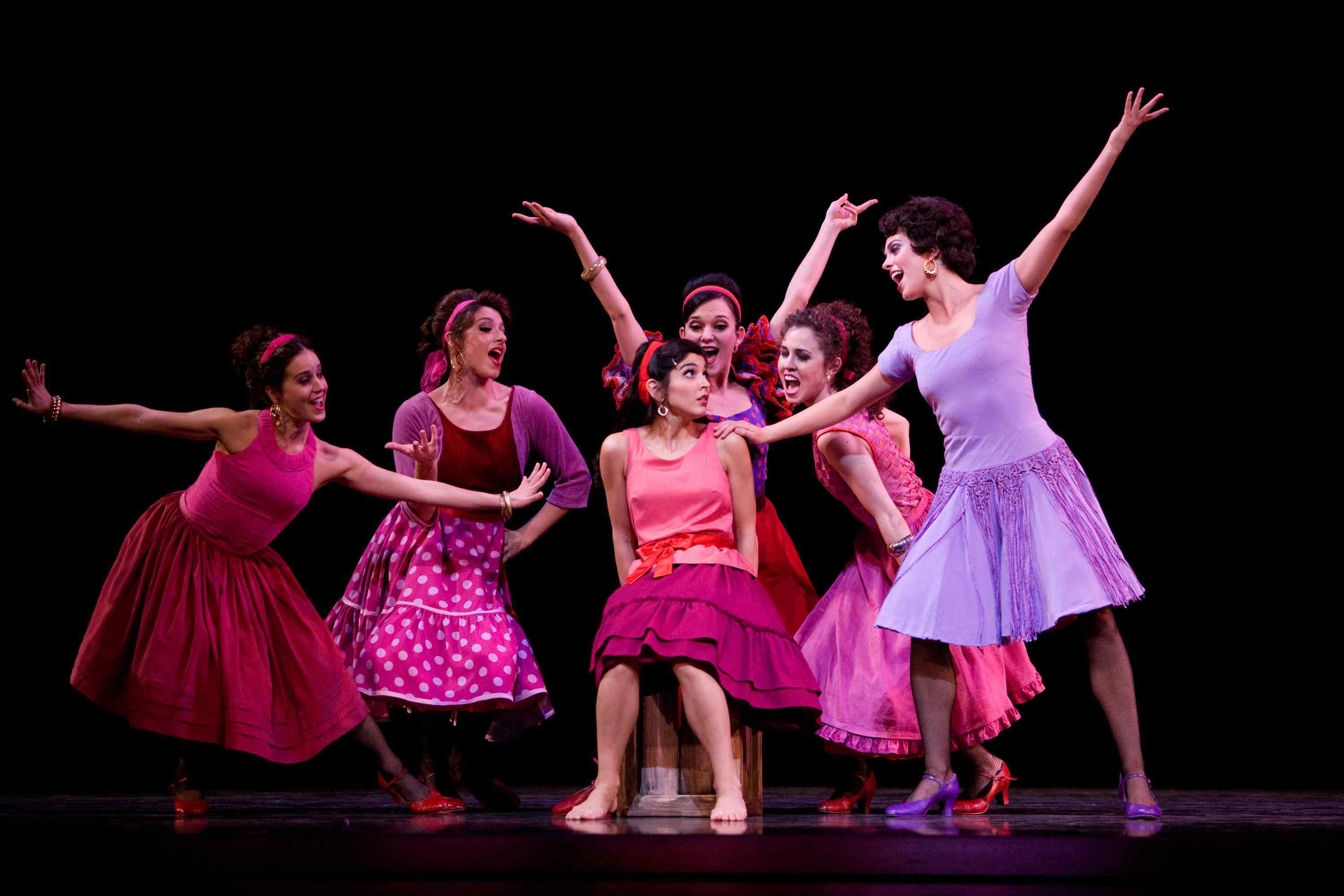
Shannon Roberts as Anita (far right) in "West Side Story Suite," photo credit Erik Tomasson.
It's a triumph a long time in the making. Tomasson has steadily strengthened the company's connection to Robbins, the artistic mentor he once worked with so closely; the whole of Program 4 attests to his progress. Robbins' intimate "In the Night," acquired when Tomasson first took the helm 23 years ago, received exquisite interpretations Thursday, while "Fancy Free," the Bernstein collaboration that made Robbins' name in 1944, fell shy of a fully realized performance yet kept the audience happy. But it was "West Side Story Suite" that drew rock-concert cheers. Even the orchestra seemed to rally, brash and bleating under Music Director Martin West.
This staging by Jean-Pierre Frohlich and Jenifer Ringer uncovers fresh talent in the Ballet's ranks. Two of Wednesday's leads were drawn from the corps: Dores Andre moved as sweetly as a lamb as Maria, while Shannon Roberts sashayed through a rendition of "America" to make even Rita Moreno proud - and let rip a wild and natural voice - as Anita. Soloist Rory Hohenstein has been on the rise for several seasons now, but as Riff he gets to show off his Broadway-baby instincts, crooning credibly and commanding a crackling performance of "Cool." Corps member Matthew Stewart took on the vocals for "Something's Coming," usually reserved for a professional singer. His enunciations weren't nearly as intelligible as those from Natasha Ramirez Leland, the hired voice for "Somewhere"; still, kudos for gumption. Garrett Anderson made a dreamy Tony. Yet to call out names would be an endless exercise: How to stop at gutsy Julianne Kepley, sassy Courtney Elizabeth, wiry Benjamin Stewart? That's the beauty of a ballet that takes a company to a new level, and especially Robbins danced at its best: Everyone matters."
Click here for full review.
And take note: Deborah Dubowy has organized another of her excellent Words on Dance evenings--this time two evenings, both dedicated to Jerome Robbins. On Monday, March 10 Grover Dale (West Side Story), Sheldon Harnick (lyricist for Fiddler on the Roof), Sondra Lee (High Button Shoes and Peter Pan), and Rita Moreno (Oscar winner for West Side Story, and King and I) will talk about Robbins' Broadway work. On March 17, Robert La Fosse (New York City Ballet, American Ballet Theatre, Tony Award winner for Jerome Robbins' Broadway), Stephanie Saland (former New York City Ballet principal dancer), Helgi Tomasson (Artistic Director, San Francisco Ballet, former New York City Ballet principal dancer), and Edward Villella (Artistic Director, Miami City Ballet, former New York City Ballet principal dancer) will talk about Robbins and his ballet career.
Expect revealing, behind-the-scenes talk, illuminating anecdotes, and rare video clips of Robbins' best. Click here for full info.
March 07, 2008 · 04:44 PM · Dance · Comments (0)
Ailey Dancers Back in Berkeley
My review in the Chronicle:
"Alvin Ailey's "Revelations" is a dance everyone should see at least once; the real miracle is that it's stirring no matter how many times you see it. Here in the Bay Area, we've had the chance to see it again and again, thanks to Cal Performance's annual presentation of the Alvin Ailey American Dance Theater -"Revelations" closes almost every Ailey program.
Wednesday the classic was as moving as it must have been when it premiered in 1960. With its hip-shaking spirituals, soul-baring reaches and burning understanding of the joyous struggle for transcendence, "Revelations" seems to fly in the face of that old lament that dance is an ephemeral art. But, of course, even the most timeless of dances is ephemeral - it lives only as long as it's danced in the right spirit. And since Ailey's death in 1989, the keeper of that spirit has been Judith Jamison.
The Ailey troupe's latest run at UC Berkeley's Zellerbach Hall comes on the heels of Jamison's announcement that she'll step down in 2011. It's hard not to watch this engagement as a celebration of her leadership. Even a company as popular the world over as Alvin Ailey American Dance Theater cannot live by "Revelations" alone, and for nearly two decades Jamison has fed her muscular, monumental dancers solid food for body, mind and spirit. In truth, choreographically, there have been far more scintillating slates than this first of three programs continuing through Sunday. But just try telling that to the sold-out house yipping with admiration for these superhuman movers' every step in Camille A. Brown's "The Groove to Nobody's Business." "
Click here for full review.
March 07, 2008 · 12:41 PM · Dance · Comments (0)
Catching up on shows that continue this weekend. My review of Ballet San Jose's "Swan Lake":
"Turns out that during recent seasons of dancing mostly silly spectacles, a crop of credible classical dancers at Ballet San Jose must have been yearning to show us their true chops. On Friday at the San Jose Center for the Performing Arts, the 44-member company took "Swan Lake" - that warhorse that can be sublime in the right hands or self-parody in the wrong ones - and made it a nonstop showcase of movement artistry. Rarely have so many talents in the San Jose roster shone to such advantage. And, in Karen Gabay, they had a Swan Queen to inspire them to yet greater heights.
It can't have hurt that Cynthia Gregory, one of the finest Black Swans of all time, coached this revival of Artistic Director Dennis Nahat's 1987 production, continuing through Sunday. From the moment the four princesses delivered their first-act variations, everyone looked galvanized by Gregory's influence: Beth Ann Namey shaping her small hops with extra lilt, Yui Yonezawa stretching confidently into long arabesques and whirling through clean turns, Catherine Grow giving everything flirtatious grace. Even the large corps of ensemble men jumped with extra power and finesse.
But it wasn't technical skill that powered this performance, though Nahat's choreography doesn't skimp on real McCoy steps. Where "Swan Lake" soars or falters is in the company's musical sensitivity to Tchaikovsky's monumental score, delivered dependably, though with tuning troubles, by Symphony Silicon Valley under Dwight Oltman's baton. These 20 swans breathed as one, led by Haley Henderson and Harriet McMeekin as the tall Swan Princesses.
Three Swan Queens are cast for this run, but the standard was set on opening night by Ballet San Jose's de facto prima, Gabay. She has beguiling facial proportions for the darker side of the duo White Swan/Black Swan role, her huge triangle of a smile projecting devious delight as Odile, the impostor who tricks Prince Siegfried into pledging his love."
Click here for the full review.
And my review of Robert Moses' Kin:
"Robert Moses' choreography, like his talking, tends to come out in blurts. So many ideas, so rapid fire - it's as if Moses can't contain what's on the tip of his tongue. In the 13 years since he founded Robert Moses' Kin, he's given San Francisco audiences a lot to chew on: movement that combines punchy street energy with unexpected eloquence and socially aware dances taking on everything from James Baldwin to youth violence. His concerts have often had an enviable problem: It's all too much.
So it was a surprise to show up at Robert Moses' Kin's latest home season, repeating next weekend at the Jewish Community Center of San Francisco's Kanbar Hall, and find such simplicity of programming. Four dances - two brand new, one new to San Francisco and one a work in progress - 60 minutes, no intermission.
It seemed a deliberate paring back, and in a post-show talk Sunday, Moses professed that he's been restraining himself in other ways. After five years working on "The President's Daughter" - which used Thomas Jefferson's slave affairs as a prism to view race, sex and hypocrisy - Moses wanted to get away from "content-driven" dances, he said. These new dances are an effort to work more simply with pure movement and music.
The best is "Approaching Thought," a six-person showdown that serves as a capsule of the inimitable vocabulary that's propelled Robert Moses' Kin to national attention in recent years: hard-hitting, jiving, deliberately ungainly one moment and lyrical the next. The music is by Moses himself, and it's good: fast rhythms and a gung-ho Wild West guitar melody. One by one, the dancers cross from the stage corners to meet in the middle, trading rapid-fire gestures. Katherine Wells, a beguiling combination of grace and grit, has the last word.
But the middle dances suggest that Moses might be thinking about his paring back in hamstrung ways. The way I see a Moses dance, it's not the content that needs weeding but the movement itself. His density of surprising steps is both his strength and his Achilles' heel, and in the middle dances, "Hush" and "Rose," I wish he'd let the movement breathe, and the content hidden inside its overwhelming rush emerge."
Click here for full review.
February 22, 2008 · 11:13 AM · Dance · Comments (0)
Maria Kochetkova did not disappoint in San Francisco Ballet's "Giselle" last night. Yes, she is tiny, porcelain-skinned, and feather light, but the key to her interpretation was this: You could see how much trust she was putting in her Albrecht, and just how dangerous and exhilarating that trust was. When Albrecht sat on the bench next to her, when she counted out the "he-loves-me-he-loves-me-not" flower petals--none of this happened with a coy flutter of lashes, but instead with swallows of fear. Even little passages like the series of piques where she kisses her fingers and they touch hands became not mere flirtations, but tests--can I trust you?--followed by not just romantic elation, but relief. Her Albrecht Joan Boada nuzzled her like a kitten he'd taken in from the cold, while in his rakish excitement we saw the mounting danger, that he did not realize the magnitude of sin he was committing in toying with such a delicate soul.
The first act was pure drama, and rightly so, Kochetkova's technique unostentatious--even her fleet jumps seemed an expression of Giselle's irrepressible joy in dancing, not feats for their own sake. Surprisingly, Kochetkova does not have a huge arabesque penchee to dazzle us with, but in the second act, she called on that buoyant jump again, a benevolent wisp in the air on that series of changements with one foot in coupe. Meanwhile, Boada was in good form with beautiful feet and a stretch that reaches well beyond his small proportions. He was an extravagantly penitent Albrecht, replacing the fluttering beaten jumps that so pierced the heart in Tiit Helimets' interpretation with an odd run of frenzied brisees.
The final moments were telling. In Yuan Yuan Tan's performance, as Giselle sunk back into the grave, Tan lolled her head as though to protest leaving him, almost like Odette in the second act of "Swan Lake." In Kochetkova's final moments, she gazed upon Albrecht lovingly, but she did not shake in protest of their separation. She accepted it--and everything: his betrayal of her, his penitence. This was not a tragic final parting, but a bittersweet one. It seemed to me perfectly in character. And it made this performance of "Giselle" one I will never forget.
Kochetkova and Boada will dance "Giselle" again Saturday evening. I'll be back at the opera house on Friday to see Vanessa Zahorian and Ruben Martin.
February 20, 2008 · 11:21 AM · Dance · Comments (0)
My review of San Francisco Ballet's opening night "Giselle" in today's Chronicle:
"Yuan Yuan Tan has dominated the start of San Francisco Ballet's 75th anniversary season, which should be no surprise. With her liquid limbs and cool glamour, she is a wonder of the ballet world. Yet Saturday, at the opening of the company's "Giselle," Tan's first-cast prominence began to smell a little fishy.
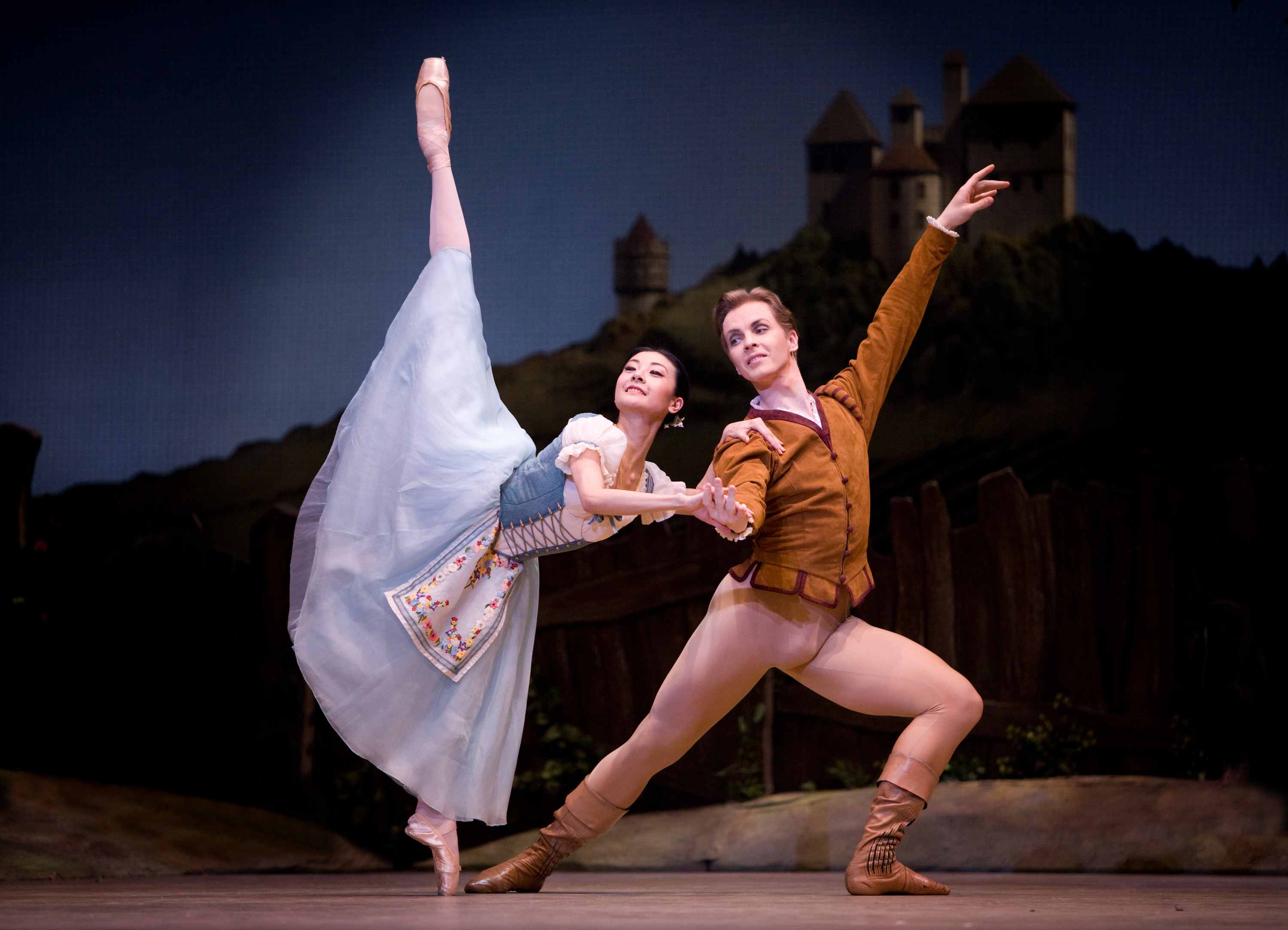
Yuan Yuan Tan and Tiit Helimets in "Giselle," photo credit Erik Tomasson.
In physicality and temperament, Tan is hardly a dancer you'd typecast as the title role's rustic peasant girl - her arms are so long, they practically can't help unfurling in aristocratic flourishes, her natural demeanor so elegant, it seemed she'd be right at home in the courts of Albrecht, the deceptive prince who breaks Giselle's heart.
But the bigger problem was that Giselle must be a flesh-and-blood character, and Tan didn't seem to have thought out who, beyond a pretty flirt, her Giselle was. And so Saturday, with the corps women in top form as the ghost maiden Wilis of Act 2, this revival of Artistic Director Helgi Tomasson's 1999 production - the best of his many story ballet stagings - remained a finely danced vessel awaiting a worthy heroine to reveal its full pathos."
Click herefor the full review.
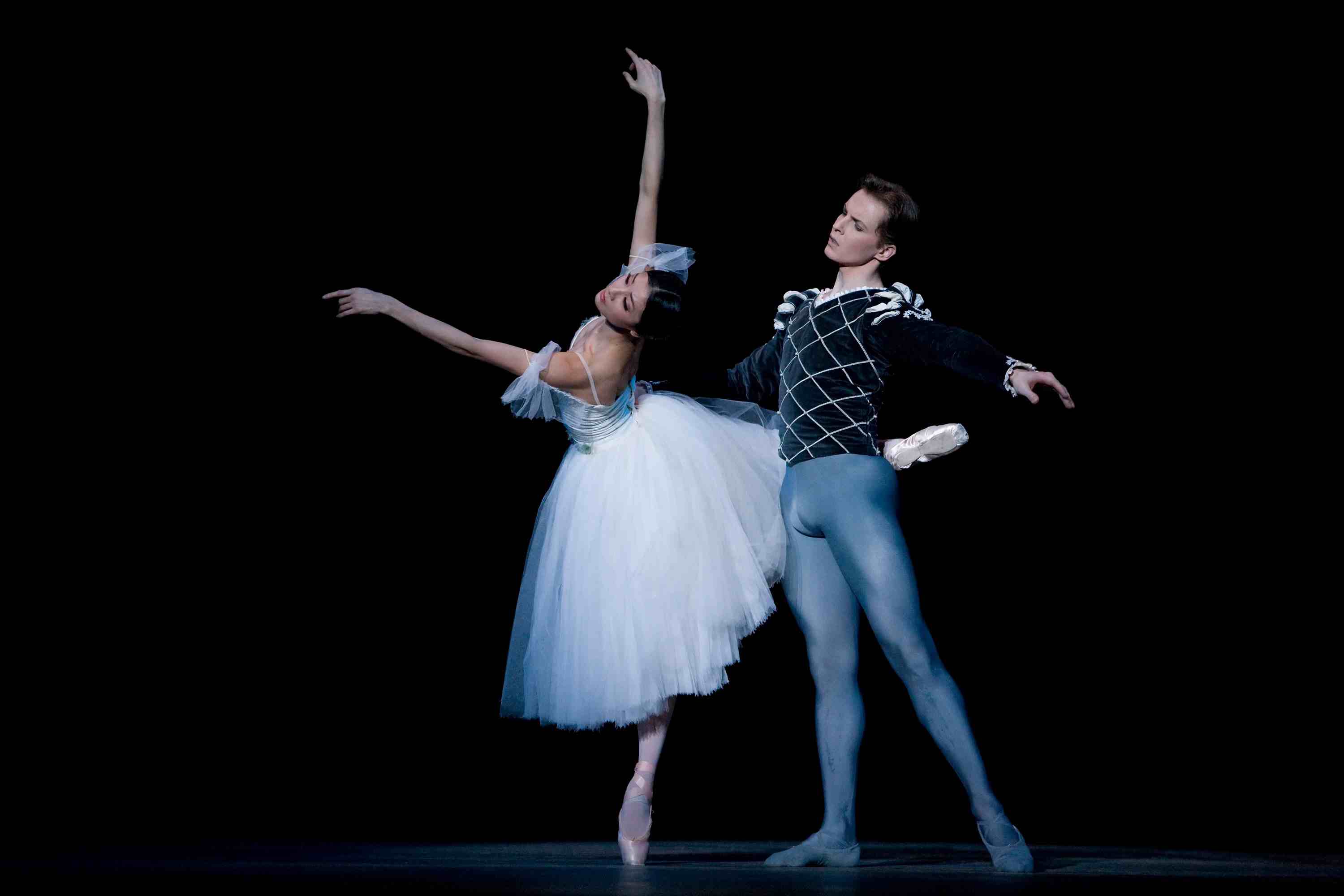
Yuan Yuan Tan and Tiit Helimets in "Giselle," photo credit Erik Tomasson.
February 18, 2008 · 02:34 PM · Dance · Comments (0)
Catching up after a run of four review assignments in four days (reviews of Ballet San Jose's "Swan Lake" and Robert Moses' Kin should appear tomorrow and the next day). I checked out the Georgia State Ballet for the Chronicle on Thursday:
"But if Thursday's opening did not deliver, thankfully, an "Ananiashvili and Friends" pony show, we got something more interesting: a troupe being rebuilt lovingly by hand. Ananiashvili, like the titanic 20th century choreographer George Balanchine, hails from the former Soviet state of Georgia, and in 2004 her now-independent homeland summoned her to direct its national company, long established but also, because of civil hardship, long dormant.
Her choices for this opening mixed-repertory program pointed to her range of artistic interest as a dancer, but also to her acumen in feeding developing dancers what they need. There were two Balanchine ballets (the company now has at least 10) and two U.S. premieres by names in the news: Alexei Ratmansky, the soon-to-step-down artistic director of the Bolshoi, who recently declined New York City Ballet's offer of choreographer-in-residence; and Yuri Possokhov, who happily accepted San Francisco Ballet's offer for the same post in 2006 and will contribute to the company's ambitious New Works Festival in April. The results were often overreaching - but only in the most heartening of ways.
Balanchine's "Chaconne" is no modest undertaking. A first intimate, then grand vision of heaven that floats atop Gluck's ballet music for "Orfeo ed Euridice," "Chaconne" requires fleetness, clarity and confidence. The Georgians had handicaps - murky lighting that plagued the entire evening, and lugubrious tempi from the Berkeley Symphony Orchestra, provided under Robert Cole's baton presumably at the company's request. But what these dancers need most is authority, gumption."
Click here for the full review.
February 18, 2008 · 02:30 PM · Dance · Comments (0)
My review of the Black Choreographers Festival opening in today's SF Chronicle:
"For the past three years, it's been good to have the Black Choreographers Festival on the scene, but it hasn't been clear whom the festival's performances are for. Was BCF, picking up where the defunct Black Choreographers Moving Toward the 21st Century left off, trying to stimulate another national dialogue on race in dance? Instilling local pride? Pitching itself to aspiring African American dancemakers or to a more general dance audience? If the latter, why were the performances so frustratingly uneven?
At Friday's opening of the festival's fourth annual installment, BCF's purpose seemed to crystallize in a word co-founders Laura Elaine Ellis and Kendra Kimbrough Barnes use a lot: community. And BCF has built a wide and wonderful community indeed. Opening at Oakland's Laney College Theater, the festival moves on to second and third weekends at San Francisco's Project Artaud Theater and Dance Mission Theater, which - along with ODC Theater - are all sponsors. There'll be symposia, family matinees, an art exhibition and a master class with sensational tap dancer Jason Samuels Smith, out from New York.
All of this is tremendous for the community. For the average dancegoer at one of BCF's concerts, though, it means a huge range in quality. The bad news is you'll have to sit through sub-par work to get to the good stuff, like Smith's appearance Friday and Saturday, when the festival moves to Project Artaud (look forward, too, to the roof-raising West African stampings of Oakland troupe Diamano Coura). The upside is the chance to find standout choreographers whose work should be seen far more often. And at Friday's opening, the clear winner in that category was Reginald Ray-Savage (commonly known as Reginald Savage).
Savage has led his Savage Jazz Dance Company in Oakland since 1992, but it's never broken out much beyond a cash-strapped local season. That should change. Not only is Savage a master teacher, producing taut, controlled dancers as well trained as any on the Bay Area modern dance scene. But he's also a fine choreographer.
He proved this in two pieces that broke from his usual mission statement - "Not jazz dance. Dances to jazz music." - to take on intense classical scores. This being Savage, though, the look was sexy, from the sculpted sultry postures and teasing deep plies to the women's V-neck leotards."
Click here for the full review.
February 11, 2008 · 06:10 PM · Dance · Comments (2)
"Dance is like Israel: You don't just live there, you have to support it."
--Joan Acocella on writing about a low-status art form during her Stanford University critic-in-residence lecture Wednesday
February 08, 2008 · 02:17 PM · Dance · Comments (0)
Site Sponsor
Vividseats.com is your one-stop source for all Concert Tickets, Theater Tickets, and Ballet and Dance Tickets. Use Redemption Code RACHEL and get 5% off all tickets, including Dirty Dancing Tickets, Romeo And Juliet Tickets, Lord Of The Dance Tickets, and Wicked Tickets!
Balletomanes are raving about Sarah Van Patten's debut in "Diamonds" Sunday, and I can't help but add my voice to the chorus. This is the cast I wish the NY Times' Alastair Macaulay had seen. I wasn't in New York (or born yet) to see Suzanne Farrell in the 1960's, but in my imagination Van Patten has Farrell's spirit freshly incarnated. She gave "Diamonds" an air of tragedy in everything from the regretful, slightly petulant tilt of her head (more Farrell comparisons, anyone?) to the sudden stab into that "Swan Lake"-like attitude with piercing arm at the music's climax. Everything became an expression of longing, even the necessary push-pull tension in the connection between her arms and partner Tiit Helimets' as he steadied her in the arabesque penchee in which he lowers to one knee. Both were utterly in the music. Van Patten is no technician, and probably never will be--that circle of little hops to a small side extension that pull up into pirouette remained decidedly un-crisp. She has no technique for its own sake, but only in service to her musicality--but this to me is fine, even preferred to emotion-less automatons. And Van Patten acquires more technical assuredness every day. In the past, on an off day, she could fall to pieces--I've seen her fight through a second movement of "Symphony in C" and a performance of the Sugar Plum Fairy in "Nutcracker" so nerve-rattled and rushed I half-wondered if she'd taken too much Sudafed. But there was no hint of uncertainty in "Diamonds" Sunday, only luxurious command.
Six years ago, when Van Patten first arrived at San Francisco Ballet, Helgi Tomasson tossed her into the finale of "Diamonds" to top off the season-opening gala. She was young, in a new company, out of her depth; she looked preening. But the potential was there, and Tomasson saw it--and nurtured it through the unevenness of her early seasons here. I've spoken of Van Patten "coming of age" before--in her "Romeo and Juliet," in the grand pas of Tomasson's "Nutcracker." She just keeps on growing. She's the kind of ballerina who makes following a company closely so worthwhile.
February 05, 2008 · 09:54 AM · Dance · Comments (0)
Site Sponsor
Vividseats.com is your one-stop source for all Concert Tickets, Theater Tickets, and Ballet and Dance Tickets. Use Redemption Code RACHEL and get 5% off all tickets, including Dirty Dancing Tickets, Romeo And Juliet Tickets, Lord Of The Dance Tickets, and Wicked Tickets!
My SF Chronicle review of San Francisco Ballet's program two is now online. I have no idea why the headline says it's the season's first program, when "program 2" is right there in the lede. I'm also not sure why "the Bay Area's only major troupe" got changed to "the Bay Area's dominant troupe." Still, here's the top:
"Thursday at the opening of San Francisco Ballet's Program 2, the East Coast critics were in the aisles, curious on the occasion of the company's 75th birthday to see how far Artistic Director Helgi Tomasson has taken this once-regional troupe. Meanwhile, some of the company's most sparkling classicists were onstage, dancing not as though they had something to prove but as though they had much they wanted to show. The New York critics will see San Francisco Ballet through their lens, colored by regular exposure to American Ballet Theatre and New York City Ballet. And a local critic can only see the company through hers, colored by the fact that San Francisco Ballet is the Bay Area's dominant troupe, which lends a certain element of civic pride. But anyone who follows the company would have seen this: San Francisco Ballet was at its finest Thursday. These dancers showed the world their best.
They did so in a slate that showcases one of Tomasson's special strengths: assembling a diverse, something-to-please-everyone repertory. You could hardly arrange a greater contrast than the forthright, modern-dance-ethos-meets-ballet-steps hybridism of Mark Morris' "Drink to Me Only With Thine Eyes" juxtaposed with the goofy theatrical flair of Yuri Possokhov's "Firebird." But the ballet that matters to serious ballet lovers, the ballet that tests not just the company's technical mettle but also its poetic gravitas, is George Balanchine's "Divertimento No. 15."
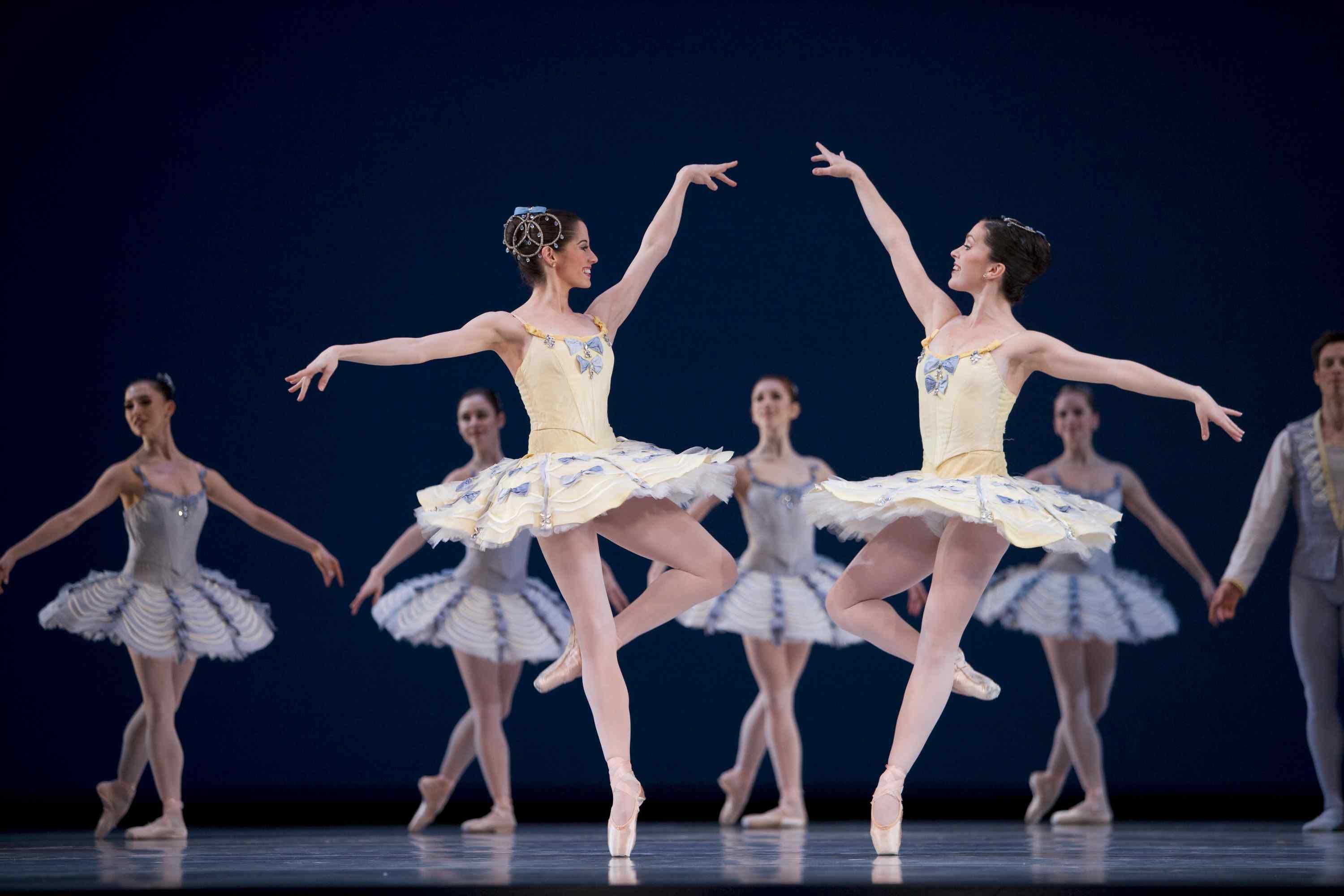
Vanessa Zahorian (L) and Kristin Long in "Divertimento No. 15," photo credit Erik Tomasson.
With its civilized manner and bedecked tutus (more fetching now that the Ballet has ditched its purple togs for muted yellows and blues after Karinska's original designs), "Divertimento No. 15" may look like a stereotype of ballet. But pity the viewer who shrugs it off as pretty. As with everything Balanchine, the meaning is in the music - the sublime spiritual serenity of Mozart, conducted by Martin West - but the steps are not just gloss on the music. When done with depth of understanding, they bring the unsayable in that music, that stirring harmoniousness, to flesh-and-blood life.
That was the case Thursday. Each soloist offered a wealth of musically sensitive details - Rachel Viselli's hovering rubato as she lowered her arabesque leg, Frances Chung's zesty spring en pointe, Vanessa Zahorian's lush stretch through her chest as she stepped forward as though through water. These details aren't ornaments; they're the soul of the dance, celebrating a way of living that makes every moment beautiful, even in small ways."
Click here for the rest.
More photos:
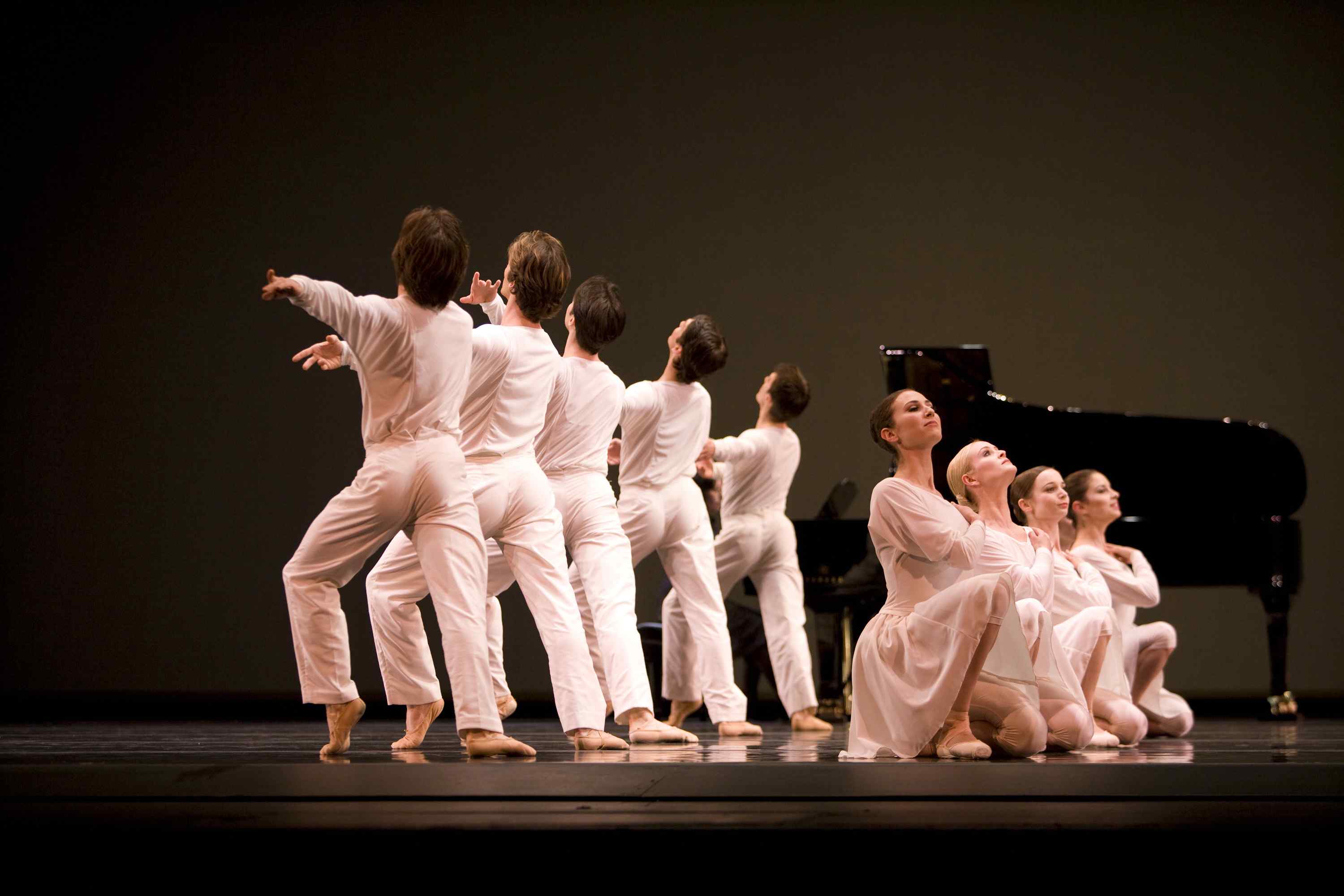 Mark Morris' "Drink to Me Only with Thine Eyes," photo credit Erik Tomasson.
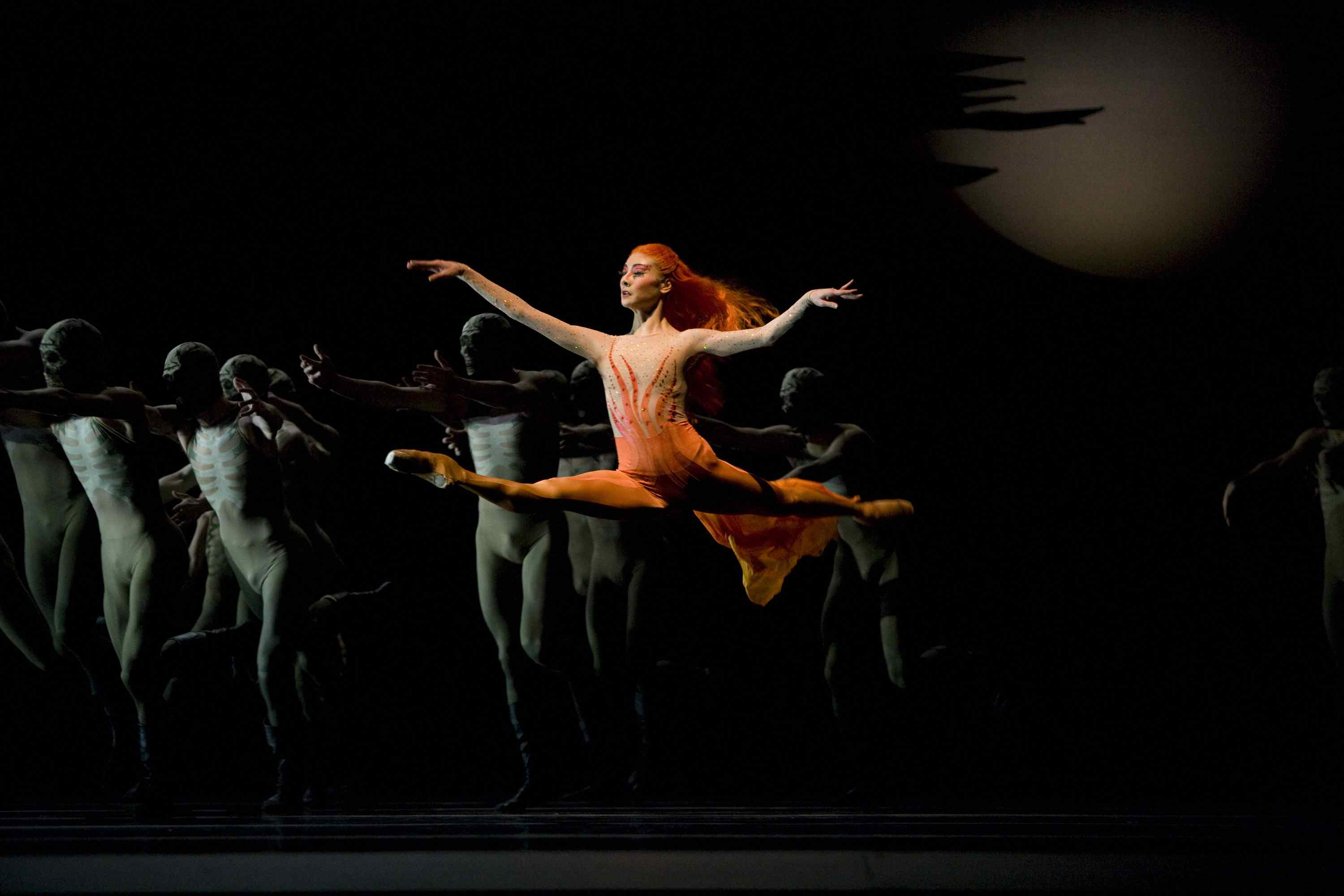
Yuan Yuan Tan in "Firebird," photo credit Erik Tomasson.
February 01, 2008 · 05:07 PM · Dance · Comments (1)
My review of SF Ballet's program one for the Chronicle is now online:
"Ah, maturity. San Francisco Ballet opened its 75th anniversary season Tuesday with the dance equivalent of a gloriously grown-up dinner party. There's nothing cutting edge or challenging to interfere with the digestion on Program 1, only great dancing that flows with the ease and civility of fine conversation. If you're looking for innovative choreography, this is not the evening for you. But if you like walking out of the opera house gently glowing from the pleasure of two hours in charmed company, you could hardly do better.
There was no shortage of exceptional dancers a guest would want to spend more time with - Rory Hohenstein in Lew Christensen's "Filling Station," Tina LeBlanc and a freshly confident Elizabeth Miner in Artistic Director Helgi Tomasson's "7 for Eight." But the heart of the evening was Yuan Yuan Tan presiding like a generous hostess over George Balanchine's "Diamonds."
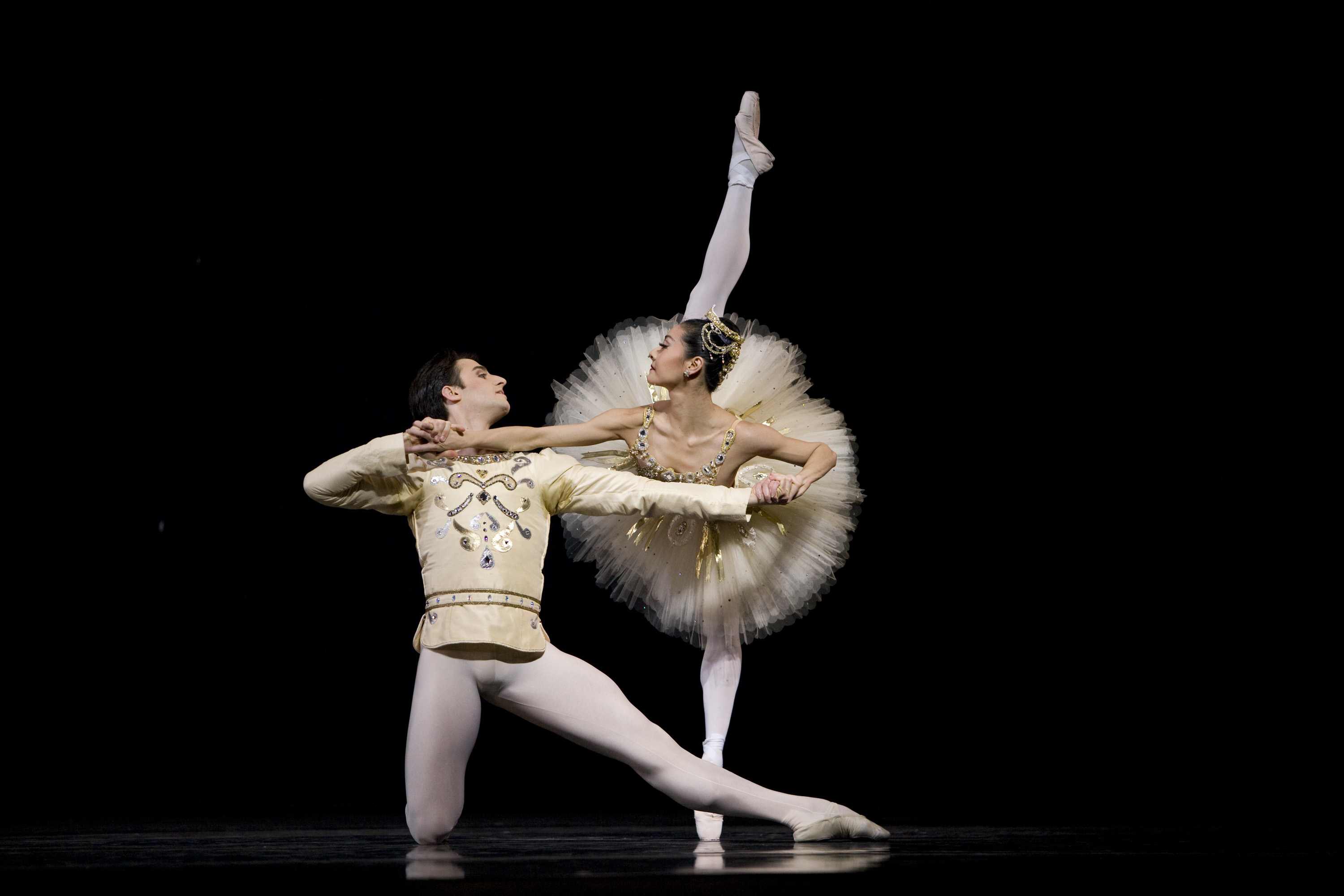
Yuan Yuan Tan and Ruben Martin in "Diamonds," photo credit Erik Tomasson.
That Tan could make "Diamonds" an event speaks to her position as the Ballet's most glamorous star principal, a bird-boned wonder of fluidity from her impossibly long fingers to her sweetly puppyish big feet. "Diamonds" is only as good as the ballerina dancing it - despite its huge corps arrayed in baubles and its enchanted Tchaikovsky score, this is the weakest panel of Balanchine's evening-length 1967 triptych "Jewels," lacking the deeper poetry of "Emeralds," the naughty verve of "Rubies." But with Balanchine's muse Suzanne Farrell performing the role created on her, "Diamonds" had drama. And with Farrell coaching these latest performances, Tan gave it drama, too, though it was a drama all her own."
Click here for the full review.
More photos:
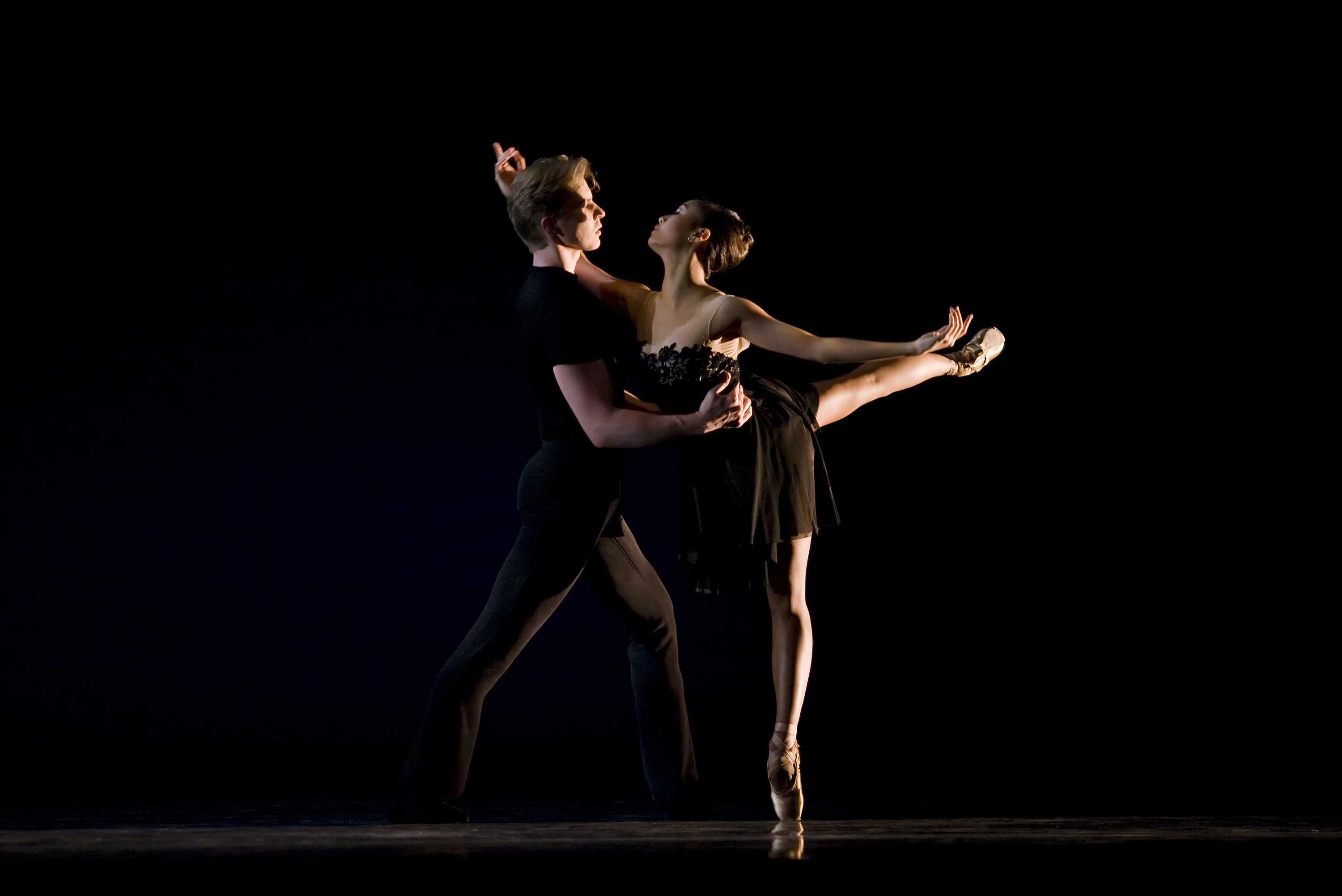
Nutnaree Pipit-Suksun and Tiit Helimets in "7 for Eight," photo credit Erik Tomasson.
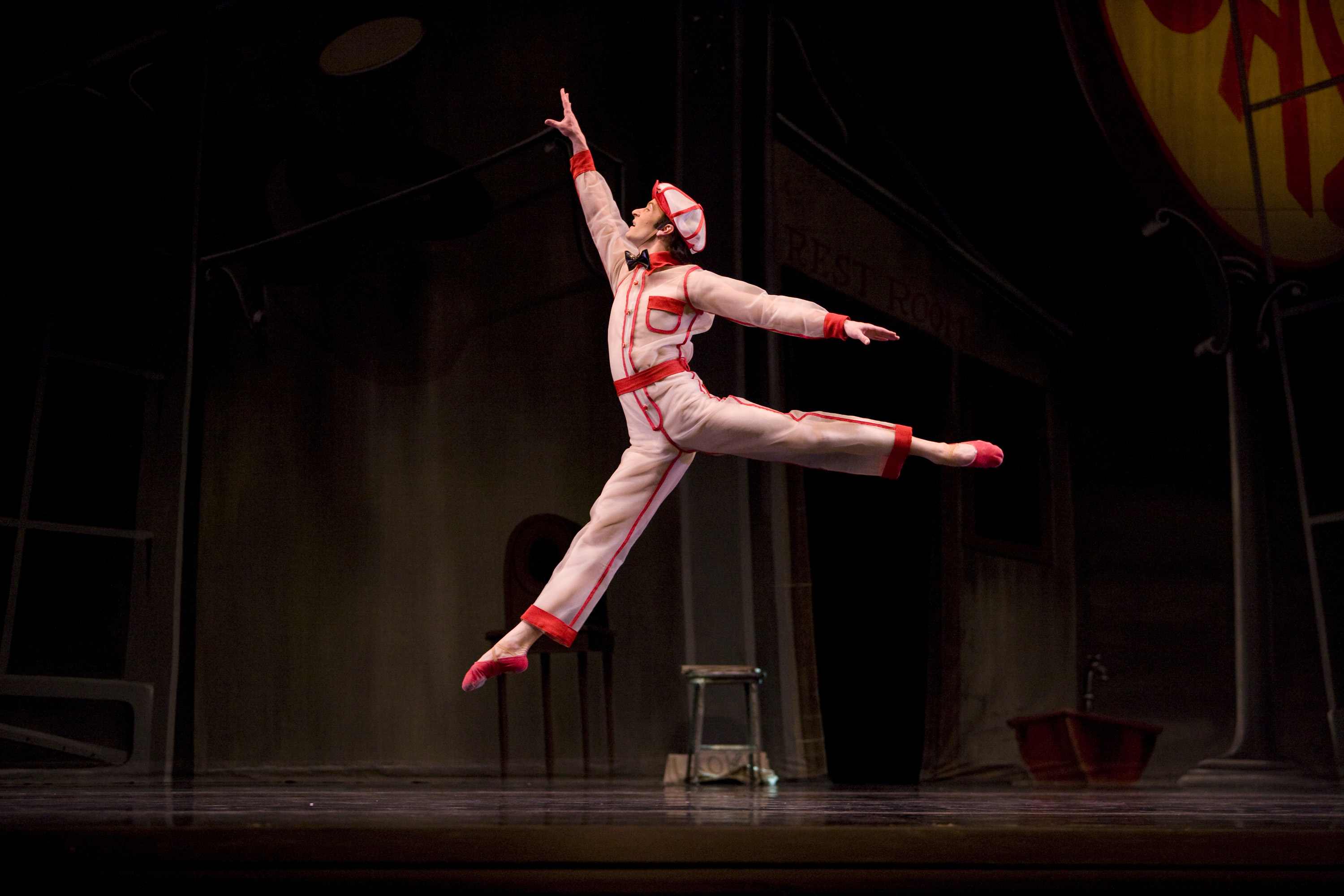 Rory Hohenstein in "Filling Station," photo credit Erik Tomasson.
January 30, 2008 · 06:50 PM · Dance · Comments (0)
Today, a little behind-the-scenes peek into the world of arts journalism. First, critics don't write their own headlines. Copy editors do. And fortunately for me, at the Chronicle they usually do a pithy and succinct job, far better than I could hope to. But every now and again, the headline doesn't quite sync with what I meant to communicate in the review, and that was the case today with my review of Company C, which ran with the headline "Company C enters A-list ballet scene."
Certainly my review was enthusiastic. Here's the top of it:
"Attention Bay Area ballet fans: There's a new contender in town. The progress that the East Bay's Company C Contemporary Ballet has made in the six years since its founding has surely been slow and gradual, but Saturday at Walnut Creek's Lesher Center for the Arts, the transformation seemed sudden and complete.
Company C's latest program, which repeats at San Francisco's Cowell Theater Feb. 9 and 10, puts the chamber troupe in league with such other local favorites as Smuin Ballet and Diablo Ballet, while also carving a distinctive niche. It is a full, lively program, with plenty of lightweight diversions and one heavyweight classic. It is also handsomely danced.
The classic is Antony Tudor's "Dark Elegies" from 1937, and it illustrates the strategy that has set Company C apart. Founder Charles Anderson, a former dancer with the New York City Ballet, is reportedly an inspiring teacher but frankly an uninspired choreographer. Yet, rather than make Company C his vanity project, he has set to balancing his own works with dances by luminaries. In the past two years, Company C has taken on two dances by Twyla Tharp and one by Paul Taylor - but the performers, though clearly motivated to rise to the level of the works entrusted to them, still looked a little green.
That changed Saturday with a credible and often stirring performance of Tudor's mournful masterpiece."
And here's the link to the full review.
Am I happy for little Company C? Certainly. Would I label them (or Smuin or Diablo) A-list? Hardly, no offense intended. They're great companies for what they do. So chalk that headline up to a lucky score for Company C's PR materials.
Behind-the-scenes revelation number two: I don't always have say over how to cover shows. Though generally the Chronicle changes very little of what I write (and almost always for the better--thank you to every editor who has ever saved my butt from committing an error or just an inanity of phrasing), I am sometimes called to cover shows in ways I wouldn't myself have chosen. That was the case with my coverage of the Merce Cunningham Dance Company at Stanford over the weekend. My editor asked for a review-feature hybrid with audience quotes, and thus in addition to my opining, you get a little sampler of crowd reactions to using the iPods deployed for "eyeSpace":
"It could have seemed gimmicky in the hands of almost any other choreographer: a dance set to music played on each audience member's individual iPod.
But the concept is this: Each viewer presses "shuffle" on a personal iPod simultaneously, randomizing the tracks of composer Mikel Rouse's music and creating his or her own private experience of the dance unfolding onstage. And the choreographer was Merce Cunningham, the 88-year-old maverick who revolutionized movement's relationship to music and decor.
So the crowd at Stanford's Memorial Auditorium on Friday night was game for Cunningham's 2006 "eye- Space," happily queuing to use their cell phones or credit cards to borrow an iPod, tickled by what for many was still a newfangled technology. "It looks manageable, and I'm willing," said 77-year-old Tom Trier of Belmont, who had never used an iPod before.
For the younger generation, the experiment made perfect sense. "I like how I can take it off or put it back on," said Stanford undergrad Claire Slattery, before her friend Laura McDonald offered, "I like that there's shared control of the piece." But then Stanford audiences get Cunningham better than most, their grasp bolstered by 2005's weekslong, university-wide "Encounter: Merce" project, the Merce Cunningham Dance Company's last visit before this latest Stanford Lively Arts presentation. The Stanford crowd knows that for more than half a century, Cunningham has used everything from a roll of the dice to a consultation of the I Ching to juxtapose what music or sets might accompany which dance - and to liberate viewers with the heady responsibility of making from the chance combinations what they will.
And what audiences learned Friday was that an iPod was simply the latest tool to realize an artistic mind-set that never grows dated. For, in truth, the real excitement of this engagement came long before the program-capping "eyeSpace," in two Cunningham classics that were created three decades apart, but both looked as though they could have been made yesterday."
here's the full review.
More than a little ungainly in form, in my estimation, but I hope reasonably informative. As always, reactions welcome.
January 28, 2008 · 08:34 PM · Dance · Comments (0)
Helgi, In-Depth
You can actually click here to read the full text of my in-depth profile of San Francisco Ballet artistic director Helgi Tomasson for San Francisco Magazine. I really do recommend picking up the hard copy issue, though; the photographs and the layout are gorgeous and you can't see either online.
January 26, 2008 · 06:57 PM · Dance · Comments (0)
My review of San Francisco Ballet's gala for the SF Chronicle is now online:
" "Maestro!" Pascal Molat shouted with a mischievous grin before launching himself into a dizzying whirl of jetes. Soon Nicolas Blanc rushed the Opera House stage to give Molat a run for the money, stopping pirouettes with the surreal physics of a cartoon character, capering effortlessly through an excerpt from Italian choreographer Renato Zanella's zany "Alles Walzer."
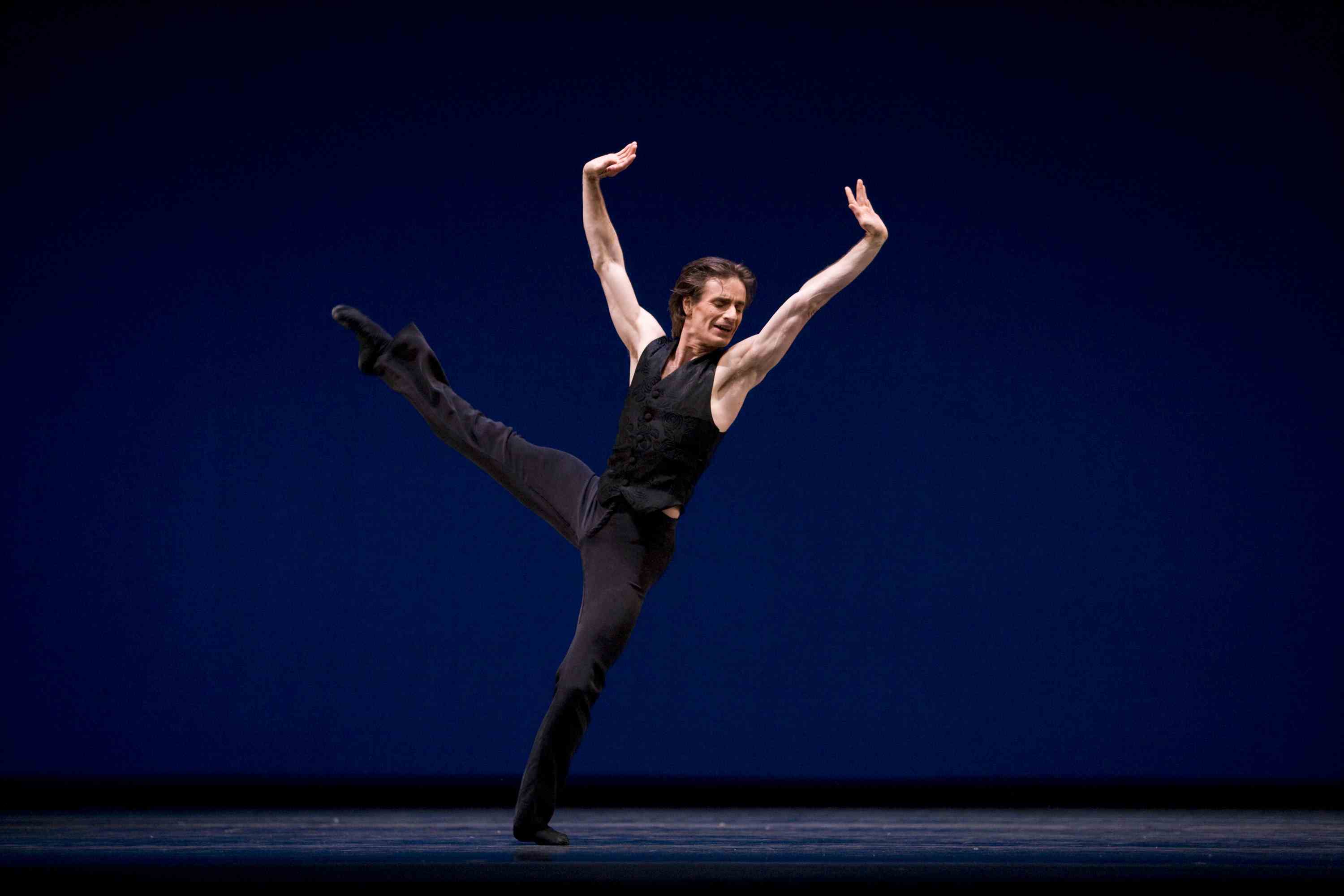
Pascal Molat in "Alles Walzer," photo credit Erik Tomasson.
It was the kind of moment to make you sit up and realize that San Francisco has one of the world's leading ballet companies, a revelation that Wednesday's San Francisco Ballet gala supplied in overwhelming variety. From the company's consummate actress, Sarah Van Patten, girlishly swooning in the duet from Christopher Wheeldon's "Carousel (A Dance)" to the tiny Russian recruit Maria Kochetkova teasingly tambourine-tapping through the tricks of "La Esmeralda" and the debut of guest artist Sofiane Sylve, there was no shortage of star turns to remind us why San Francisco Ballet's 75th anniversary is a big deal: Not because of its novel past (America's oldest professional ballet company, as you'll hear ad nauseam this season), but because of its promising present.
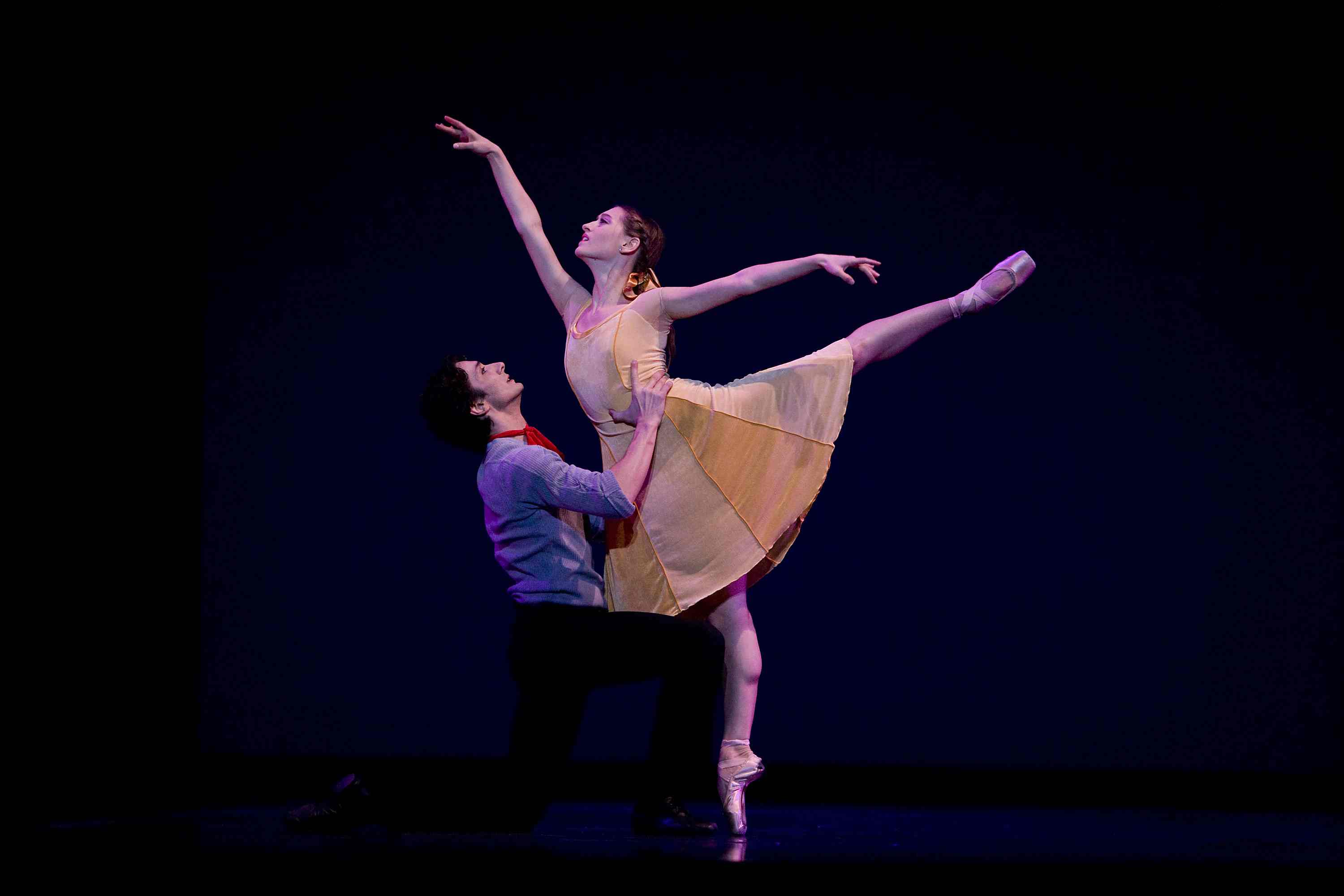 Sarah Van Patten and Pierre-Francois Vilanoba in "Carousel (A Dance)," photo credit Erik Tomasson.
These were welcome moments in a Champagne-fueled celebration that suffered a curious Big Moment by-product: big anniversary bloat. It wasn't that the Ballet indulged undue pomp, with balloons and confetti raining upon the final curtain call. The speechifying was brief, with a rightfully beaming Artistic Director Helgi Tomasson flanked by recipients of the company's Lew Christensen Medal before board co-chair James H. Herbert was inducted into their ranks. Never verbose, Tomasson let the dancing speak to all that he has accomplished since taking the helm in 1985, reshaping a once-regional company into a collection of internationally distinctive dancers. But the dancing spoke haltingly, hampered by programming that never hit the whiz-bang pacing that ballet galas trade in."
Click here for the full review.
In the perennial struggle to cover the season opening gala without creating a laundry list of every tidbit, I left out Rachel Viselli and Damian Smith in the final bowler-hat-girl pas from Kenneth Macmillan's "Elite Syncopations." The omission wasn't intentional; I'm warming to Viselli slowly, and was pleased to see an unexpected playful side of her emerge in the tush-shaking ragtime.
Meanwhile, if you pick up the newest (February) San Francisco Magazine and open it dead center, you will find a gorgeous, glossy 10-page spread full of photos of Helgi Tomasson and the company. The layout is stunning; whether my in-depth profile of Tomasson captures him and does him justice I leave you to judge.
As always, I love hearing your reactions, good and bad (but please not ugly). You can email me at rachel at rachel howard dot com, or better yet if you have thoughts to share on the gala and the season to come, post them on the "comments" feature at the top of the review after you click through.
Photos of my other personal highlights, courtesy San Francisco Ballet:
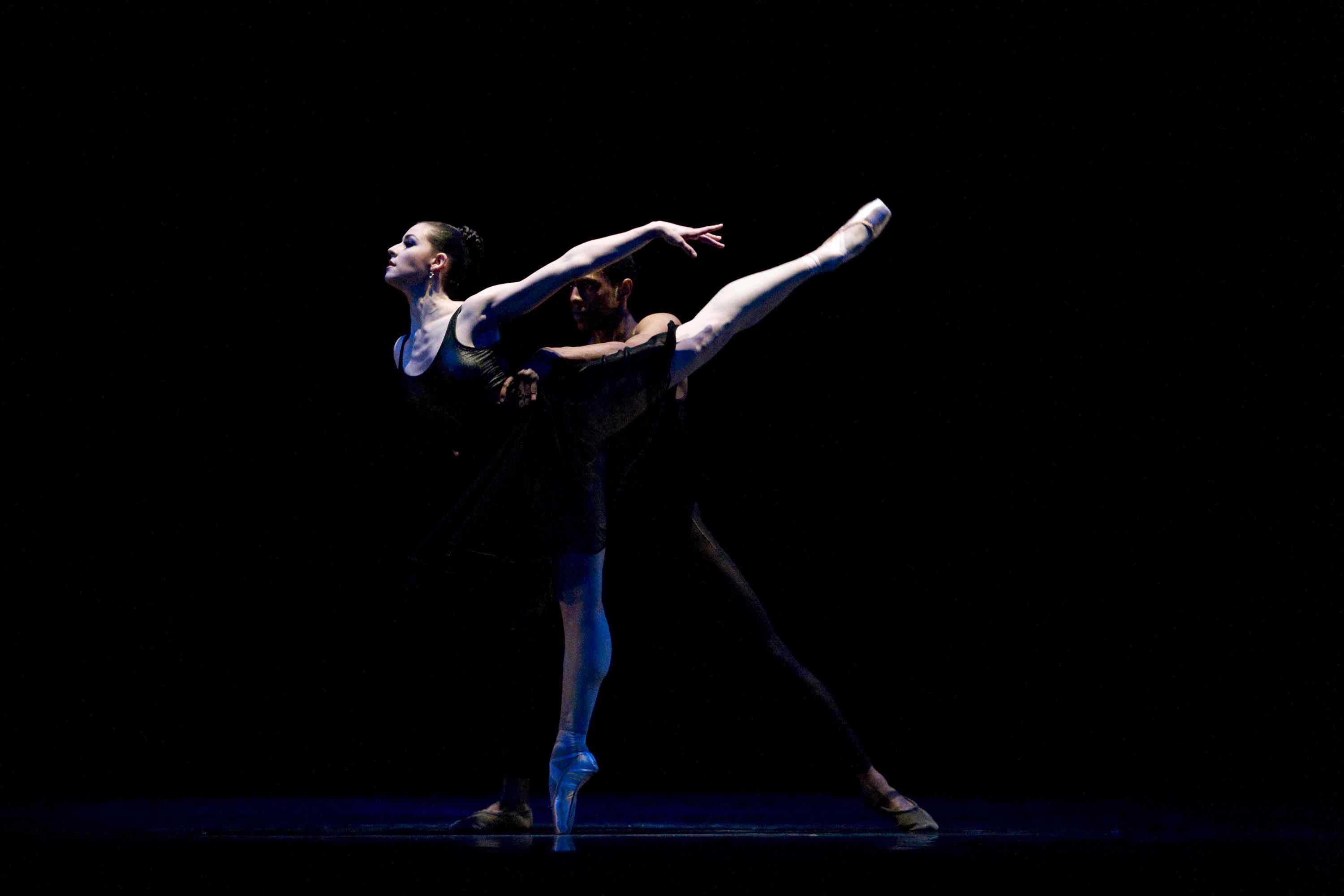
Sofiane Sylve and Anthony Spaulding in "Two Pieces for Het (For Rachel)," photo credit Erik Tomasson.
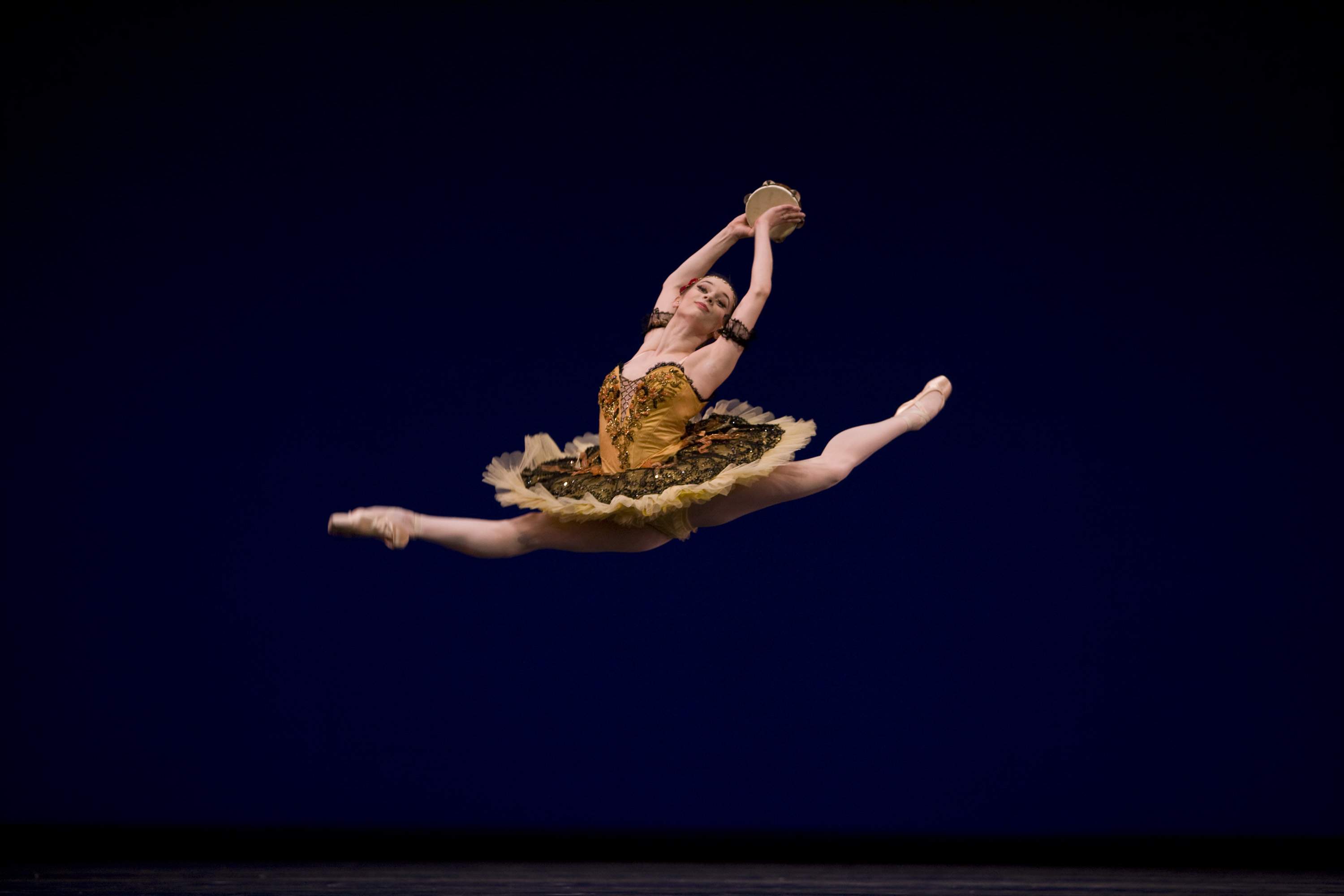
Maria Kochetkova in "La Esmeralda," photo credit Erik Tomasson.
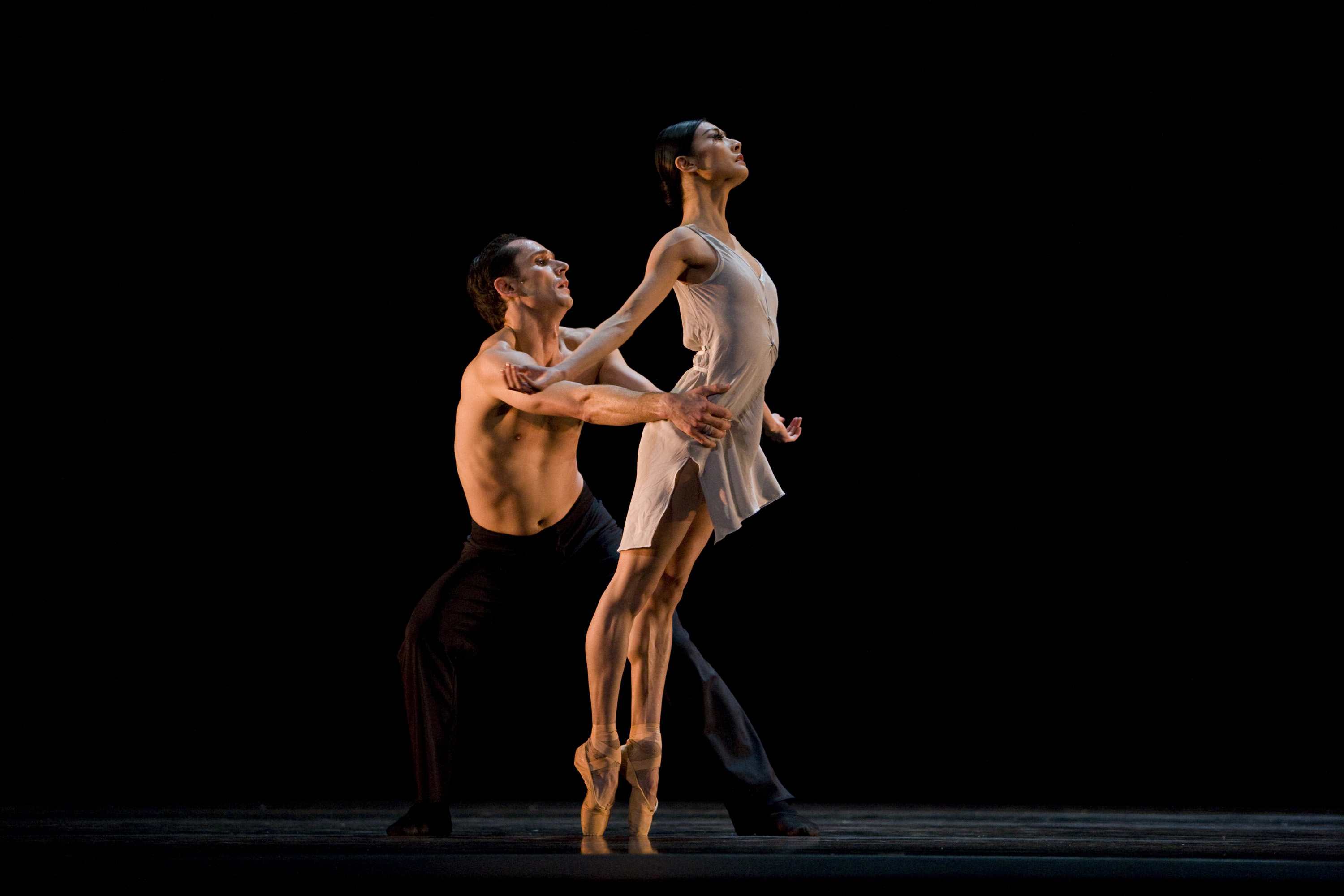
Yuan Yuan Tan and Damian Smith in "Distant Cries," photo credit Erik Tomasson.
January 24, 2008 · 08:07 PM · Dance · Comments (0)
I'm back--back from graduate school residency in North Carolina at Warren Wilson College, back into the intensive work of a second semester, and happily back out reviewing dance for the Chronicle. It's nearly the start of the San Francisco Ballet's big 75th anniversary season, of course--the gala kickoff comes next Wednesday--and February and March are looking busy, with appointments to see Robert Moses' Kin, the State Ballet of Georgia, Alvin Ailey American Dance Theatre, Nacho Duato's Compania Nacional de Danza, ODC, and many others.
After nearly a month since my last review, I jumped in again with Keith Hennessy's Circo Zero:
"If you're not a follower of the more subversive side of the San Francisco dance scene, Keith Hennessy may be the most revered dancer/performance artist/self-proclaimed prophet/political provocateur you've never heard of. A member of the rabble-rousing collective Contraband in the late '80s and early '90s, he's probably best known for once gathering spit from his audience, mixing it with black pigment, and pasting it on his naked body in a visceral rejection of AIDS fear-mongering. In the past decade, though, he's turned from quasi-rituals to a new form - circus - with increasingly successful results.
"Sol Niger," performed by his troupe Circo Zero, was so popular during its premiere last fall that Hennessy has brought it back for another two-week run at Project Artaud Theater. During Wednesday's opening, it was obvious why the Hennessy faithful have been passionate about this production. To a less converted viewer, though, the 70-minute show leaves a residue of reservations alongside its striking images.
The title "Sol Niger" is Latin for "black sun," a poetic description of solar eclipse that here cuts two ways: as a symbol for dark times and as a belief that sometimes the deepest truths are glimpsed in shadow. Cirque du Soleil, of course, this is not. "Welcome to the circus where bodies are metaphors and every gesture is symbolic!" Seth Eisen's creepy ringmaster shouts, cleverly winking at the relatively low-rent nature of the spectacle: "Watch Emily tread upon the world's poor," he says as Emily Leap steps across her castmates' hands, "four feet above the ground!" "
Click here for the full review in today's SF Chronicle.
January 18, 2008 · 10:45 AM · Dance · Comments (1)
I'm in Asheville, North Carolina for my graduate school residency in the Warren Wilson College writing program all week. Meanwhile, my list of dance performances to look forward to in the first half of 2008 is in tomorrow's SF Chronicle. Here's a sampling:
Merce Cunningham Dance Company (Jan. 25-26, Stanford University's Memorial Auditorium): The 87-year-old maverick - who revolutionized dance's relationship to time, space and sound - is astonishingly au courant. Along with Cunningham classics, Stanford Lively Arts' two programs will include "eyeSpace," in which each audience member experiences his or her own soundtrack while listening to an iPod set to "shuffle."
Shen Wei Dance Arts (March 6-8, Yerba Buena Center for the Arts): Chinese-born Shen Wei has attracted a lot of attention here in recent years, and for good reason. His large-scale visions, which draw upon his background in Peking Opera and as a painter, are overwhelming sensory experiences. His company will bring "Re," which transforms the stage into a giant Buddhist mandala.
inkBoat (April 24-26, Yerba Buena Center for the Arts): Next wave butoh maverick Shinichi Iova-Koga bases his international collaborative in both the Bay Area and Berlin, creating theater experiences that are absurd and haunting, tender and demented. His newest, "c(H)ord," features music from the director of Seattle's Degenerate Art Ensemble, and - as always - surreal visual design.
The Oakland Ballet Company (April 12, Paramount Theatre): Founding Artistic Director Ronn Guidi continues the resurrection of his plucky company with two performances of his ballet "The Secret Garden," set to Elgar; Michael Morgan will conduct the Oakland East Bay Symphony.
ODC Theater Festivals (April 24-May 10 and June 5-28, Project Artaud Theater): The indispensable ODC Theater is going dark for a major rebuilding and expansion in 2008, but director Rob Bailis is hardly sitting idle. Instead, he's moving the shows a few blocks over to Project Artaud, where ODC will produce four major festivals. The first, "For the Record: Dancers Debate the Body Politic," features new work by aerialist Jo Kreiter, butoh artist Ledoh and others; the second, "The Big Picture: ODC Hosts Los Angeles, Minneapolis and Philadelphia," brings cutting-edge multidisciplinary work from those cities. Later festivals in July and October will challenge our ideas of "traditional" dance, and team with the literary festival Litquake to investigate "Stories That Move."
For my other five picks, click here.
January 05, 2008 · 03:08 PM · Dance · Comments (0)
My look back at the year in Bay Area dance for the San Francisco Chronicle is now online. In addition to a Top 10, the Chronicle asks its critics to choose a High, Low, Most Improved, and Most Valuable Player. My picks:
"HIGH: Gonzalo Garcia farewell performance: War Memorial Opera House (May). Fans of this irresistibly warmhearted San Francisco Ballet dancer knew saying goodbye would be emotional, but we could never have expected a leave-taking like his "Don Quixote." When partner Tina LeBlanc came down hard on a jump and couldn't stand, Garcia gallantly carried her off the stage. Fellow principals Molly Smolen and Tiit Helimets filled in for Act 2, while Vanessa Zahorian rushed across town to dance with Garcia for Act 3. At curtain call, Artistic Director Helgi Tomasson looked choked up, and LeBlanc stood in a leg brace applauding. The triple cast, the palpable concern and affection in the audience for LeBlanc when she fell, Garcia's high-flying bravura - it was the kind of night at the ballet that you never forget. Another tear-jerker: the retirement of the Ballet's incomparable Muriel Maffre (who has since resurfaced guesting with Lines Ballet) just days later.
LOW: The sudden death in April of ballet showman and former San Francisco Ballet co-director Michael Smuin saddened dedicated fans and detractors alike. Fortunately, the Smuin Ballet lives on under his right-hand woman, Celia Fushille-Burke.
MOST IMPROVED: The term "service organization" sounds too bland to describe the revitalized Dancers Group. Again under the leadership of Wayne Hazzard, Dancers Group has surged as a rallying force in the dance community, not only providing fiscal sponsorship (i.e., a nonprofit umbrella) to dozens of local companies but also organizing festivals, collaborating on a statewide initiative to promote dance on the Web and revamping its monthly newsletter, InDance (full disclosure: I am an occasional contributor). The upshot for dance lovers? Check out the comprehensive performance listings at www.dancersgroup.org and you will discover a Bay Area dance scene more lively and diverse than you probably ever imagined.
MOST VALUABLE PLAYER: Now in his fifth year as director of ODC Theater, Rob Bailis is hitting his stride as a presenter, nurturing fresh local talent and bringing in exciting companies from New York and beyond. His taste is smart and sophisticated, his empathy for artists is instinctive and his enthusiasm is infectious. Look for him to make an even bigger splash with a series of major festivals at Project Artaud Theater as ODC Theater temporarily closes fora major rebuilding and expansion in 2008."
Winnowing down a Top 10 was far more difficult this year than last. Other high points that vied for inclusion: Miami City Ballet dancing Twyla Tharp's "In the Upper Room," Spain's Andres Pena in a searing solo with Yaelisa's Caminos Flamencos, next-generation Butoh maverick Shinichi Iova-Koga in his solo "milk traces," and San Francisco Ballet in Balanchine's "Divertimento No. 15."
To find out who did make the Top 10, click here.
My colleague Allan Ulrich has put together his own highly informed Top 10 for Voice of Dance, sending well-earned kudos to Counterpulse executive director Jessica Robinson. To check out Allan's highlights, click here.
December 28, 2007 · 11:16 AM · Dance · Comments (0)
Catching up after travels. The San Francisco Ballet "Nutcracker" is underway, and I reviewed Maria Kotchekova's delightful debut in in for the Chronicle:
"News flash for you lingering holiday dance Grinches: The fusty, old San Francisco Ballet "Nutcracker" you remember from Christmases past is long gone. In its place since 2004 is a sparkling still-new miracle: one of the most beautiful "Nutcrackers" on the planet.
If you're just discovering this, you will not be alone. On the eve of the company's 75th anniversary, San Francisco Ballet's "Nutcracker" is going global. A "digicast" of Artistic Director Helgi Tomasson's sumptuous staging will soon be screened in more than 70 theaters throughout North America and Europe, and this year's performances are being filmed for broadcast next winter on PBS.
At Thursday night's opening, cameras weren't yet rolling, but everything looked ready for its close-up. Flower maidens waltzed with extra lilt, the snow scene's confetti flakes came down in a blizzard, and Tchaikovsky's eternal score sounded supremely sprightly under Music Director Martin West's baton. There were surprises to fuel little-girl ballerina dreams and grown-up balletomane ravings alike, and sometimes - especially in the sensational debut of the new Russian-trained principal Maria Kochetkova - both at once.
Kochetkova, a 23-year-old recruit from the English National Ballet, is tiny and light, a sparrow. In the closing Grand Pas de Deux, she seemed hardly to touch the floor, and when she leapt toward her Nutcracker cavalier, Davit Karapetyan, for a diabolically difficult shoulder-sit, she landed as though she'd simply flitted to a fresh branch."
Click here for the full review.
And just when you thought nothing more could be said about Mark Morris's "The Hard Nut"--well, at least I tried:
"There are three certainties in American life - death, taxes and "Nutcracker" - and more than 15 years ago, Mark Morris took the sting out of one of them, replacing sugarplum sweetness with a raunchy 1960s suburbia house party, Dairy Queen-hatted snowflakes and friskily fertile, splay-legged waltzing flowers. No wonder then that "The Hard Nut," which had premiered in Brussels, quickly became a hit and a nearly annual ritual in this country. But as the years pile on and "The Hard Nut" becomes more familiar, the question builds: Can an antidote to the "Nutcracker" as cod-liver-oil tradition avoid becoming cod liver oil itself?
The answer, it turned out Friday at UC Berkeley's Zellerbach Hall, is yes. The Mark Morris Dance Group is no stranger to Cal Performances in this production - they've danced it here for eight of the past 11 years - and many in the opening-night audience (including this critic) had seen it three or more times. Yet the laughs were fresh and frequent. If, like many arts fans in the Bay Area, you've been there, done that and wonder if it's worth seeing "The Hard Nut" again before the run ends Sunday, let my smile-weary face answer affirmative.
The reasons why the show still tickles might seem obvious. Does anyone need it explained why a Christmas cocktail hour that features a polyester tree, a TV fireplace and a teenage daughter who can hardly keep from dry-humping the drunken guests is funny? Surely no other choreographer has mined Tchaikovsky for as many punch lines, and they speak for themselves, from the groovy Afro with hair pick firmly ensconced to the sideburn-laden hipster (Morris himself in an often scene-stealing walk-on) who returns from the loo with toilet paper attached to his pimp-height heels.
But the real reason "The Hard Nut" never loses its laughs runs far deeper than sight gags, and it has to do with Morris' musicality. In "The Hard Nut," his response to Tchaikovsky is often so simple that it's deep. Almost every movement is both parody and tribute to the score. I can't tell you why the way the waltzing flowers slump is funny - to understand that, you would have to see it, and the way the posture both captures and mocks the brooding swirl of emotions in the strident chords. I can't fully explain why Morris' most common comedic tack, note-for-note mockery, is a crackup: To get it you would have to see Craig Biesecker, as Drosselmeier, bouncing the Nutcracker doll dutifully along to every lilt in Tchaikovsky's melody, affectionately revealing its near-inanity."
Click herefor the full Chronicle review.
December 18, 2007 · 11:16 AM · Dance · Comments (0)
I reviewed Margaret Jenkins' newest for today's Chronicle:
"In the inevitable ebb and flow of a long, rich dance-making career, Margaret Jenkins is reaching high tide. She just finished a piece to premiere as part of San Francisco Ballet's New Works Festival in the spring, and 2006's blockbuster "A Slipping Glimpse" - created in collaboration with dancers in India - recently wrapped an acclaimed nationwide tour.
With the grande dame of Bay Area modern dance so busy, perhaps no one should feel surprised that "Other Suns," unveiled Thursday at Project Artaud Theater, feels like a minor event. It isn't that Jenkins' latest, which the Margaret Jenkins Dance Company continues performing through Sunday, seems rushed into the world or unfinished. It just might take a while to see quite where "Other Suns" fits within the Jenkins oeuvre.
Partly, that's intentional. Clocking in at only 45 intermissionless minutes, "Other Suns" is billed as the first part of a trilogy to be completed in 2009. The inspiration, Jenkins says, arose from a past residency in China, and parts 2 and 3 will be created with the Guangdong Modern Dance Company of Guangzhou. As with most Jenkins works, though, "Other Suns" is so abstract that the specific cultural reference seems incidental. Aside from the Asian influences in the music of Bun-Ching Lam (the rest of the soundtrack is by Paul Dresher), there is nothing recognizably Chinese here.
Instead, this will probably be remembered as "the Jenkins piece with the water," though water is just one element of the arresting visual design by longtime Jenkins collaborator Alexander V. Nichols. "
Click here to read the full review.
December 08, 2007 · 01:45 PM · Dance · Comments (0)
Memo to the Bay Area Dance Community
It's that time of year when the Chronicle asks me to look back on 2007, and ahead to 2008. I'm just starting to assemble a "forecast" of dance events in the first half of 2008, to appear in the Chronicle's Pink section next month. If you've got a dance event coming up and you'd like me to consider it for this preview, please send me details. What, when, where, and a quick description of what you're up to will suffice. Please email information to rachel at rachel howard dot com within the next week and a half. Thanks very much!
December 04, 2007 · 05:20 PM · Dance · Comments (0)
The Chronicle asked me to check out the live tour of the TV show "So You Think You Can Dance?" Friday, and I gamely obliged:
"It was an astonishing sight Friday: Oakland's Oracle Arena packed with screaming fans who had shelled out handsomely to see not the latest Disney tween machine or some overproduced pop starlet, but dance. Just dance.
Or rather, the U.S. tour of "So You Think You Can Dance," the Fox show that, unlike "Dancing With the Stars," boasts not a single celebrity yet regularly draws upward of 10 million viewers. The show that, alongside the inferior parade of ballroom B-listers on "Dancing With the Stars," is being embraced by anyone who cares about dance - sometimes reluctantly, sometimes excitedly - as marking a new Golden Age of dance in popular culture, and a great hope for drawing new audiences to dance as high culture, too.
And so, among the unceasing stage fog, the preshow "American Idol" alumni videos, the $4 Pepsis, and, oh yes, plenty of truly impressive dancing Friday from Season 3's top 10 finalists plus a few special guests, the question remained: Is "So You Think You Can Dance" God's gift to the dance world?
One thing you couldn't question Friday was whether these are talented dancers. The high points of last season's competition look even more impressive live: Sabra Johnson and Neil Haskell cold-staring through the table dance set to the Eurythmics; Pasha Kovalev and Sara VonGillern lightly quickstepping to Fat Boy Slim; Pasha and Lauren Gottlieb popping their way through that fabulous Shane Sparks robot routine; Danny Tidwell doing absolutely anything.
Sure, ragged jumps, circus extensions and melodramatic flailing sometimes count more than control and line. And sure, a few contestants have allowed themselves to become trick ponies, especially Bay Area local Shauna Noland, who whipped out her patented turn-with-one-leg-overhead at every opportunity. But whether it was Dominic Sandoval spinning through B-boy head spins or Anya Garnis flinging herself across the stage in yet another Mia Michaels three-hankie special, these are dancers who move with precision and professionalism, not slickly produced reality TV personalities.
As to whether they might inspire crowds to check out less commercial choreography, a highly unscientific crowd poll yields uncertain results."
Click here to read the rest.
November 26, 2007 · 04:29 PM · Dance · Comments (0)
Pina, Sean Dorsey, and Hip Hop
The Chronicle had me experiment with a new form over the weekend, writing three reviews in one. One unfortunate consequence is the story's generic headline, and perhaps there are others--I'd like to hear what you think of this approach. Doing three-in-one was the only way I could get the paper to fit a Pina Bausch review into its pages, believe it or not. My relentless advocacy and my admission to less than absolute knowledge of the Bausch ouevre did not win favor with this indignant Chronicle reader. Nevertheless, thoughts on Bausch:
"To hear the buzz, you might have thought the messiah was returning to UC Berkeley's Zellerbach Hall on Friday, and, to her followers, that may not be too exalted a description for Pina Bausch, whose Tanztheater Wuppertal made its first Cal Performances appearance in eight years. Bausch is a choreographer so iconic that people in the dance world tend to forget that other reasonably culturally educated people may not know who she is. And for more than 25 years she's been a choreographer so influential that to see her work is also to recognize the legions of emulators and imitators she's spawned.
"This is just absurd!" cried the woman behind me as dancer Helena Pikon announced, "This is a bear, I am naked, we are in the forest, and it's a little dark," then threw a fur rug over a hunched man and rode off on his back. Um, yes. Absurdity, surrealism, existential non sequiturs - Bausch didn't introduce these elements to dance, but she combined them in her patented way.
I am not a longtime member of the cult of Bausch; I can't tell you how "Ten Chi," created in 2004, stacks up to her mud-heaped "Rite of Spring" (though I did enjoy it less than her carnation-carpeted "Nelken"). I can tell you that "Ten Chi," supported by a consortium of Japanese cultural organizations, is part of a series of dances inspired by place, and that the Japanese references come in the middle: Nazareth Panadero turning a compendium of words like "Fuji" and "sushi" into baby babble; Azusa Seyama running around snapping pictures like a Japanese tourist; two men taking fierce samurai stances only to sit when chairs are placed beneath them.
Whether this captures any essence of Japan is dubious. It all seems raw material rather than subject matter. If there is a staple subject, it's Bausch's usual - love and sexual manipulation - often rendered unforgettably."
(More if you click here.)
And on Sean Dorsey:
"Sometimes deeply transgressive material is most powerful when it's channeled into non-transgressive, almost conventional form, and that's the case with San Francisco's Sean Dorsey. Dorsey is gender-ambiguous, tilting toward male, and uses the pronoun "he." His dances are usually about the female-to-male transgender experience, as were the two premieres on "Lost/Found" Saturday at Dance Mission Theater, rounded out with storytelling by writers Kirk Read and Max Wolf Valerio.
Dorsey tells stories too, in a plainspoken, warmhearted style. He then records them and lays them over a collage of sweet, warm-hearted music. His further brilliance is to bring these stories to life with an uncanny knack for matching movement to the rhythms of speech and planting simple but pungent gestures that have the innocent charm of a parent reading to you at bedtime."
Again, more if you click.
And finally the SF Hip Hop Dance Fest:
"Meanwhile, across town, bass was pounding through the Palace of Fine Arts Theatre, and the San Francisco Hip Hop Dance Fest was pumping. Hot tip for 2008's 10th anniversary edition, which founder and inspired producer Micaya is already cooking: The earlier you arrive, the more you get to watch of the opening freestyle, and the more you realize that the soul of hip-hop is wit.
Every group on Program A had its distinctive style: from the Chicago FootworKINGz with its mad, fast steps to Oakland's Neopolitan convincingly merging Afro-Caribbean forms with funk. New York's Mop Top staged a "Wizard of Oz" with master of popping Buddha Stretch as the Tin Man, and Colorado's Elements of Motion won my vote for overall excellence, marrying unreal B-boy head spins to consummate theatricality."
(Yet again, a smidge more if you click.)
And I've just noticed that the editing cut off my last sentence and added some random text below. Chalk it up to attempting an awkward solution to that ever-worsening problem of finding column inches for dance.
Please, if you'd like to comment--I've had to disable comments on this site to avert spam. But you can comment away on the Chronicle link. Good or bad, go for it.
November 20, 2007 · 02:29 PM · Dance · Comments (0)
My review of American Ballet Theatre at Berkeley:
"There was a moment at American Ballet Theatre on Wednesday night when everything changed. Herman Cornejo came tearing out of stage left at UC Berkeley's Zellerbach Hall and launched himself so high you wondered if he'd used an invisible vaulting pole. It was the kind of jump in which the dancer seems to have created a ladder out of air.
The "Corsaire" pas de deux that followed was an intoxicating combination of recklessness and control. Cornejo's pirouettes torpedoed right through the moment where most dancers give themselves a little break with the waltz step known as balancé. He threw himself into the next set of pirouettes, threatening to veer across the stage like a Tasmanian devil - but when he centered himself by turn four or five, he looked as if he'd known what he was doing all along. Cornejo is small and muscled - he has a body like a Corvette. And watching him vroom through "Le Corsaire" was like watching an expert race car driver in the Grand Prix. No wonder his partner, Xiomara Reyes, no slouch in the technical department herself, looked on top of the world riding high aloft in his hands.
It was one of the more remarkable dance moments I've seen, all the more so because it created such a clear dividing line during a very odd show. The first half of this first of two repertory programs (Program B opens tonight) was so lackluster - almost like a graduation recital with the world's most precocious students - that you wondered what had happened to American Ballet Theatre in the six years since it last visited Cal Performances. The second half was so scintillating that you wondered how the Bay Area has lived without seeing this troupe for so long."
Click here to read the rest.
November 10, 2007 · 10:40 PM · Dance · Comments (0)
My SF Chronicle review of the Faustin Linyekula:
"Pain is all-consuming, but the intensity doesn't always translate. Ken Foster, executive director of Yerba Buena Center for the Arts, has brought us a steady series of African contemporary dance companies in recent years, and in each of them you see the same image: piles of bodies. But more than that, you feel the same disconnect.
You know the image must be powerful to artists from these war-torn countries; you feel a twinge of guilt because it isn't instantly powerful to you. But it's just a pile of bodies, and you don't share the experiences behind it. There's a bridge between you and the image that the artist, immersed in how much it means to him, hasn't led you across.
At first, Congolese choreographer Faustin Linyekula's "Festival of Lies" looks as if it's going to fall into this trap, despite some novel attempts to counteract the distance. Billed as part installation, part dance performance, the show (continuing with an expanded six-hour rendition tonight) turns the YBCA's Forum into a party, with free African food, a bar and a grooving band, Soukous Connection, from Oakland.
Gradually, Linyekula and the three members of his company, Les Studios Kabako, take over the dance floor as the crowd settles into the tables and chairs placed on two sides. It's a Brechtian removal of that theatrical "fourth wall," and the practical effect works: You feel closer to these performers, immersed in the environment. Thursday a healthy crowd of attendees even got up and danced during the intermission.
And yet, for the first half, a disconnect persists. "
Click here to read the rest of the review.
November 10, 2007 · 10:37 PM · Dance · Comments (0)
Lines Ballet at 25
My review of the Lines Ballet fall season, in Monday's Chronicle:
"Lines Ballet threw itself a big party Friday night, and for a big occasion. The troupe is officially 25 years old, but longevity is just the start of what's worth celebrating.
In a quarter-century, Alonzo King's small, sleek company has risen from playing tiny theaters to touring the country and now the world; worked with a dazzling array of musical collaborators hailing from Morocco, Central Africa, Japan and beyond; and essentially, through these nine dancers' twisted, tangled movement and King's earnest yet urgent spirituality, broken the mold of what ballet can be. With its bustling dance center, Lines has also - alongside San Francisco Ballet and ODC/Dance - become one of the hubs of the San Francisco dance scene, one of its great successes and its magnets.
Rest assured all this was marked with due pomp at the Yerba Buena Center for the Arts: fancy dinner, sparkling dresses, Champagne. And yet, if at some galas festivity trumps substance, that just isn't possible with King in charge. The man does not know how to be frivolous. There were luxuries aplenty Friday: fabulous live music and a guest appearance by former San Francisco Ballet ballerina Muriel Maffre. But the greatest richness was the dancing: purposeful, powerful and luscious. And that's a richness that should only deepen as the home season continues through Sunday.
There are two King world premieres on this program. "Irregular Pearl," to a smattering of Baroque composers with music from the pit by members of the Philharmonia Baroque Orchestra, has moments but will probably not go down as King at his best. On the other hand, "Rasa" is extraordinary. The music for "Rasa" is a mesmerizing commissioned score by the tabla master Zakir Hussain. The heart of "Rasa" is an epic pas de deux for two of King's most touching dancers, Laurel Keen and Brett Conway.
King's finest duets have an arresting way of moving between superhuman ballet curvatures and all-too-human postures of vulnerability, and that is the case with "Rasa," but taken to new heights. As Hussain's score floats through mournful cries and atmospheric effects that sound like footfalls in the distance, Keen and Conway cling and entwine. She cradles his calf and foot; he straightens his leg to eject. She climbs back up his legs; they roll pressed to one another all the way across the stage. Romantic desperation this is not - some solemn, struggling communion is happening."
Click here for the full review.
November 04, 2007 · 09:10 PM · Dance · Comments (0)
Miami City Ballet: Much More Than Balanchine
I was mightily impressed by Miami City Ballet at Cal Performances:
"There's long been plenty of buzz about Miami City Ballet, but usually it follows a certain story line. The company's artistic director, Edward Villella, is a dance icon replete with a famous, stereotype-busting life tale: scrappy Brooklyn boxer becomes George Balanchine's greatest male star, known for his athleticism and - as his own program bio now puts it - "virility."
Then in 1985, two years after Balanchine's death, Villella goes to Florida and starts building a new company. At a time when many of the leading interpreters of Balanchine's masterpieces are becoming persona non grata at Balanchine's own New York City Ballet, Villella brings in those shunned greats, like Suzanne Farrell, to maintain the flame by coaching in Miami. Thus a reputation is born: Though Miami City Ballet might not be quite a world-class company, it's the place to see Balanchine done with rare spirit.
Turns out this is only half the story. It was no surprise Friday to see the Miamians deliver Balanchine's stunning milestone of modernism, "Agon," with verve and bite. Perhaps it should have also been no surprise to discover that the troupe's verve extends well beyond Balanchine.
The bookends of this program were two hugely contrasting Twyla Tharp ballets, part of the Cal Performances salute to Tharp that continues next week with a visit from American Ballet Theatre, also at UC Berkeley's Zellerbach Hall. Tharp's relentless invention is thrill enough, but the real spectacle was the Miami City Ballet's nonstop energy and unfailing clarity. If this isn't world-class dancing, I don't know what is."
The rest of the review is here.
October 28, 2007 · 09:41 PM · Dance · Comments (0)
Lines Ballet's Silver Anniversary
Alonzo King's Lines Ballet is turning 25. My story for this Sunday's Chronicle:
"Alonzo King motions to the pianist to cut the music, then steps to the center of a musty Market Street studio.
"I am not limited," he says in a soft but strident voice. "Get that in your head! I am not a victim of habit."
Two dozen sweaty dancers stare as King gathers the fingers of his right hand and draws them in front of his face, down his broad, thick chest, toward his heart.
"You're not living in the moment," he says. "How do you make new what you are going to do with the rest of your life? This is huge!"
The room is motionless.
"If any of you are in relationships, which you are - with yourself, with your art ..."
King's enormous, curly-lashed eyes flutter wide.
"You want to be what?"
Heads nod, and King throws his long arms open.
"A galaxy!"
Is this a ballet class or a spiritual-improvement seminar?
Technically, this is daily practice for the students of the Lines Ballet Ensemble and Training Program, a school for serious teenagers drawn to King and his demanding teaching style as well as to the sleek, sculpted beauty of his company, Lines Ballet.
But as always with King, the physical is the vehicle to the transcendent.
"Line, circle, cross," he says after class, pausing in the middle of a hasty lunch of a ham sandwich and some chocolate truffles to make classical ballet shapes with his arms. "That means horizon, sun, crucifix."
He takes the fifth position en bas, arms rounded low.
"This has to be the sun. It's radiance from that inner world. Not fake, not playing at ballet."
He sits in his office on the third floor of Lines' bustling San Francisco Dance Center at Seventh and Market streets in San Francisco, where his nine-member troupe rehearses, and where every month more than 800 students take classes in everything from hip-hop to flamenco. On King's desk sits a framed portrait of Paramahansa Yogananda, whose "Autobiography of a Yogi" serves as King's constant inspiration. On the other side of a locked door are the administrative offices of Lines Ballet, the company King founded, along with two die-hard believers in his artistic gifts, 25 years ago.
The changes that quarter century have brought are astonishing: Lines is now internationally renowned, touring Europe yearly, dancing two home seasons annually at the Yerba Buena Center for the Arts and offering a bachelor of fine arts degree through Dominican University of California in San Rafael.
King's style, so nascent 25 years ago, is now fully formed and instantly recognizable: classical, yet tangled and twisted, exquisitely weird shapes melting into vulnerable human gestures. He's worked with a dazzling list of musical collaborators, from saxophone master Pharoah Sanders to a tribe of Pygmies from the African rain forest, and has created works for such companies as the Frankfurt Ballet, Dance Theatre of Harlem and Alvin Ailey American Dance Theater. His troupe is one of the great successes of the San Francisco dance scene, and one of its greatest anchors.
But King doesn't dwell on all that, except to say that "those 25 years passed like a blink of the eye" and "the work has just gotten deeper."
He doesn't have time to revel in past glories.
Lines' silver anniversary season, opening Friday, will present two new King ballets - one set to Baroque music and featuring live musicians from the Philharmonia Baroque Orchestra, the other to a new score by Zakir Hussain, to be played by the tabla master."
Click here for the full story.
October 26, 2007 · 12:01 PM · Dance · Comments (0)
Oakland Ballet Reborn
My review in today's Chronicle:
" "Welcome back, Oakland Ballet!" a man called during the standing ovation at the Paramount Theatre on Saturday. Onstage stood the city's native son, Ronn Guidi, 72 years old, beaming after an unlikely resurrection. It was hard to know what was more heartwarming: that ballet was back in Oakland, or that Oakland Ballet was back in the world.
Guidi tested the waters for a comeback with performances of his "Nutcracker" last year, but Saturday's two shows marked the inauguration of his reborn Oakland Ballet Company, and the first repertory program staged under his direction since his sudden retirement in 1998. This was a well-chosen, eagerly danced selection showcasing the warmth and humanity that brought Oakland Ballet such unlikely international repute in the 1980s and '90s, when Guidi hit his stride reviving rare Ballets Russes masterpieces and Americana classics. The show also drove home how much was lost while the old Oakland Ballet - which shut its doors in 2005 - foundered under Guidi's successor, Karen Brown.
Saturday's matinee was class all the way, from the live music by the Oakland East Bay Orchestra to the thoughtful program notes. And the most encouraging sign was that these 23 dancers clearly knew what - and whom - they were dancing for.
Take Vaslav Nijinsky's 1912 "Afternoon of a Faun," one of those lost masterpieces with which Guidi built the Oakland Ballet's name. It was good to see the curtain rise on Leon Bakst's lush, gorgeous backdrop (repainted by Ron Steger) and Greek-inspired costumes. It was even better to see Ethan White as the Faun and Jenna McClintock as the Nymph invest the revolutionarily spare choreography with its full eroticism, saying so much with a stare or a tilt of the chin while the Debussy score swirled and swelled. When White returned to his Faun's nest with the Nymph's scarf, the clarity of his arching back and gasping mouth left little doubt just what kind of climax (ahem) Nijinsky meant to suggest.
White, moonlighting from Smuin Ballet, has never danced better, and his performances say much about what Guidi does best. Under him, the Oakland Ballet found its niche not through technical virtuosity, but through theatricality, passion and heart."
Click here for the full review.
October 22, 2007 · 12:56 PM · Dance · Comments (0)
My review of Bill T. Jones' "Chapel/Chapter" for the Chronicle:
" "I have to get out of here," a man said as he fled Bill T. Jones' "Chapel/Chapter" at the Yerba Buena Center for the Arts on Thursday. Soon, another person slipped out, then another. "It's too disturbing," a woman whispered to her friend.
There are things we don't want to see, but ought to. The Bill T. Jones/Arnie Zane Dance Company's YBCA engagement, running through Sunday, is one of them. An icon of American dance since the 1980s, Jones is no stranger to walkouts, but Thursday's were different.
There is no political provocation in "Chapel/Chapter," no tackling the alarmist issue of the day, as Jones has done with everything from AIDS to the Iraq war. "Chapel/Chapter" is about murder, about death both natural and unnatural, or whether the distinction even exists, about the evil and the need for redemption within us. It is not about the prison system or justice - its concerns are dark ones from the deepest corners of the soul.
Proximity is part of its horror. Created for a small Harlem performance space last December, "Chapel/Chapter" is staged in the YBCA's Forum. Blood red curtains frame a square filled with a shape like a cathedral window. (The set design is by Bjorn G. Amelan.) Pews sit on one end, and the audience on all sides.
As it begins to tour nationally, "Chapel/Chapter" is also being adapted for proscenium stages, but up close is the way to see it, though this will not be pleasant. It brings you face-to-face with the murder of a family: mother, father, children; tied, strangled, asphyxiated. This is re-enacted by the dancers (and nimble Erick Montes as the family dog) in two ways. First, brutally, with the murderer describing his actions to an interrogator in a cool, collected tone. Later the murder is replayed more like a series of biblical tableaux, with Alicia Hall Moran singing that same gruesome account in a piercing clear chant, like a High Catholic mass."
Later in the review, I could not help but mention that "Chapel/Chapter" struck me particularly hard:
"Violent crime and incarceration are things Jones must know about intimately through his sister Rhodessa, who leads the Medea Project, which stages theater by imprisoned women. In full critical disclosure, murder is something I also know intimately, having woken up one night at age 10 to find my father slain in an unsolved crime nearly as grisly as those in "Chapel/Chapter." Whoever the murderer is, I would wish transcendence and redemption for that person as much as any other.
"Chapel/Chapter" made me think on this, but in a new way, because of its refusal to offer anything remotely redeeming or humanizing about the murderers. It left me with the awful feeling of having become the murderer, and it left me feeling the holy had become dark rather than the dark holy. It left me with questions only a second viewing could help answer, and that is certainly one sign of art worth wrangling with, whether or not you finally embrace the answers you find."
Click here for the full review.
October 19, 2007 · 10:12 PM · Dance · Comments (0)
Catching up: I reviewed LEVYdance for Tuesday's Chronicle:
"LEVYdance has the appeal of youth: fresh-faced, chiseled dancers with the urban cool of club kids, sexiness infused with smarts and a young choreographer, Benjamin Levy, worth getting excited about.
His style makes a drama out of anatomical chain reactions, energy zipping from joint to joint like an electrical current. And he knows how to create an emotional arc. In his 2002 duet, "Falling After Too," two men manipulate each other's knees, shoulders and hips with relentlessly deflective intimacy. When at last they knock chests but their arms flail past each other, unable to hug, you feel the oomph of that tragedy like a statement of the human condition.
Small wonder, then, that Bay Area dance watchers have been waiting for Levy to break out in a big way. His company's fifth annual home performances on Friday and Saturday seemed designed to do it. The crowning premiere "Bone Lines" had all the trappings of the next big step: a bigger-than-usual venue at the Jewish Community Center's Kanbar Hall, costumes by haute couture designer Colleen Quen, set by sculptor Rick Lee and a commissioned score by Keeril Makan recorded by the Kronos Quartet.
But this proved a case of getting too much too fast. Levy's solemn dance for four looked overwhelmed by all these elements, with movement serving merely as glue to keep it all together."
Click here for the full review.
October 19, 2007 · 09:53 AM · Dance · Comments (0)
My review of Julie Kavanagh's new Nureyev biography, appearing this Sunday in the SF Chronicle's book review:
"Ballet biographies are getting raunchy: Meredith Daneman's insightful 2004 portrait of that bastion of British dignity, Margot Fonteyn, taught me more than I ever expected to learn about the great dancer's Kegel muscles, and Julie Kavanagh's 1997 study of choreographer Frederick Ashton hardly shied from exploring his more profane inspirations. Now Kavanagh is back with a revealing 782-page tome on that most mega of ballet stars, Rudolph Nureyev. But one can hardly blush at its sexual descriptiveness. It was, after all, not only technical feats but ballet as a channel for that wild, amorphous sensuality that fueled Rudimania for decades after his headline-making 1961 defection, that had women and men alike sleeping on sidewalks for tickets to his performances, that enthralled everyone from Jackie Kennedy to Mick Jagger. And Nureyev himself never hesitated to boast about his exploits, claiming (probably falsely) to have impregnated several ballerinas. You can imagine Nureyev looking on from the afterlife with that mischievous smirk of his as you read Kavanagh's dishy, detailed treatment, for he emerges as a prodigious and insatiable lover.
But there is much more than bedroom gossip to smile about, because Kavanagh, trained from childhood in ballet, knows the art. "Nureyev: The Life" earns the definitive article of its subtitle, weaving deftly together, for instance, the difference between the Vaganova and Bournonville schools of ballet training, and the torrid passion between Nureyev and the famed Danish star Erik Bruhn. From the age of 7, when his mother smuggled him into a ballet performance in their provincial Bashkirian town of Ufa, Nureyev knew dancing was his life; after his exhausting dramas with Bruhn, he even swore off committed relationships in servitude to his career. That didn't end his offstage adventures, from being arrested at a Haight-Ashbury weed party in the 1960s to trashing film director Franco Zeffirelli's mansion in the 1980s. But in Kavanagh's hands what happened behind the curtain becomes illumination for the mesmerizing spectacle that Nureyev created in front of it."
Skipping down, the best quality of the biography is this:
"If Nureyev was later widely known to pick up hustlers, he made love with mostly one person, and that was himself. He emerges on these pages as a raging narcissist, shamelessly using fans and friends and casting them aside if they make any emotional demands in return, living only for the glory of performing and therefore dancing embarrassingly beyond his prime. But narcissists are often supremely charming and charismatic, and that is certainly the case with Nureyev in Kavanagh's portrayal. She not only tells us about the many admirers who became Nureyev's surrogate families after his defection left him homeless and motherless; she also makes us see why they loved him, because you can feel in her prose that she loves him, too."
Click here for the rest of the review.
October 12, 2007 · 12:38 PM · Dance · Comments (0)
I reviewed the Smuin Ballet for today's Chronicle:
"Death privileges the living. Had Michael Smuin survived the heart attack that felled him during company class in April, he would be incensed to see me reviewing the latest Smuin Ballet show. Never a darling with the critics, Smuin was happy to return the disdain, but he and I were a special case. As a young dance writer itching for a nemesis, I was only too pleased to sneer at his populism. I hope if he could read these words he would also take satisfaction in seeing me apologize for my tone.
I hope too that he'd be happy to know the Smuin Ballet program that opened Friday and continues this week at the Palace of Fine Arts Theatre may be an ideal representation of his legacy. It proves why thousands of fans sell out his company's engagements, and why reviewers routinely harped on his unsubtle ways. It also proves that to fault Smuin's choreography for lacking nuance and sophistication is to miss the point."
Click here for the full review.
October 09, 2007 · 10:00 PM · Dance · Comments (0)
I wish I could say I was more excited about the Joffrey Ballet program that repeats today at Cal Performances. My review in today's Chronicle:
"It's less than two weeks since the news hit, and there in the program Thursday night was his name: Ashley Wheater, artistic director, Joffrey Ballet. A visit from the Joffrey is always notable - the Chicago troupe is rarely seen in the Bay Area, and hasn't played UC Berkeley's Cal Performances in decades - but the fresh appointment of Wheater, ballet master and assistant to the artistic director at San Francisco Ballet, made it something more.
This was a chance to check out what he'd be inheriting: an energetic and spunky 51-year-old company known for its richly diverse repertory and a penchant for breaking rules. Unfortunately, the rules being broken in the program continuing tonight are circa 1973. And although rule breaking can be timeless - think Balanchine's 1928 "Apollo," as fresh now as the day he made it - everything on view at Zellerbach Hall looks dated and stale.
That's not these capable dancers' fault. With American Ballet Theatre and Miami City Ballet also visiting soon, and all dancing Twyla Tharp, Cal Performances decided to build something of a festival around her work. Alas, "Deuce Coupe" is one Tharp dance I'd rather read about in the history books than see.
A sensation in the '70s, it was the first "crossover" ballet by a modern dance choreographer, setting its 15 dancers in little halter dresses and "Saturday Night Fever"-issue pants shimmying to a Beach Boys medley with typical Tharpian attention deficit.
To underscore its then-eyebrow-raising street cred, there's a backdrop of spray-painted graffiti.
There's also a lone soloist (Heather Aagard) in silver dancing classroom ballet steps, a prissy visitor from the other side of that modern dance/ballet Berlin Wall. Perhaps this could all come off as winking good fun (as Tharp's "The Golden Section" does when Alvin Ailey American Dance Theater performs it). But the Joffrey dancers don't seem to have their heart in this. The delectable wit of Tharpian phrasing is missing, along with the slouchily virtuosic insouciance. Only Valerie Robin in her sultry "Got to Know the Woman" solo gets in the spirit."
Click here for the full review.
October 06, 2007 · 10:22 AM · Dance · Comments (0)
My latest dance review, in today's Chronicle:
"f you've never heard of the North Indian classical dance form Kathak, San Francisco's Pandit Chitresh Das has one word for you: rhythm. As in, bring-the-house-down, feel-it-in-your-bones rhythm.
Two years ago, on his never-ending quest to take Kathak to the American masses, the 62-year-old Das teamed with tap dance phenom Jason Samuels Smith for a cross-cultural conversation. In "India Jazz Progressions," unveiled Friday at the Cowell Theater before a national tour, he's brought more voices along for the ride. Watch out, Savion Glover; you may have "Da Funk," but you don't have Chitresh Das.
No matter that one form uses five pounds of ankle bells and the other metal taps; no matter that one evolved centuries ago in the Mughal palaces, the other much more recently on the streets of New York. Das brings East and West together and lets them talk straight. At stage left stands the jazz ensemble - drums, bass, piano. At stage right, the Indian musicians - tabla, sitar, sarangi. When their voices first begin to mix, it is strange talk indeed.
But then Das' leading disciple, Charlotte Moraga, comes whirling on, stamping out ear-teasing percussive patterns in that vigorous, upright Kathak way. She calls out the tal - or rhythmic cycle, which in Kathak can be anything from your standard eight-count phrase to more mind-bending variations, like nine and a half beats - and she chants her variations - taka di, taka di, da, da. When tapper Chloe Arnold comes hoofing on, she's doing a very different thing, arms flying, hips swinging, feet sliding and hitting. But they have an instant rapport, and they're trading riffs in no time.
The solos and duets that follow are an embarrassment of riches."
Click here to read the rest.
October 02, 2007 · 10:20 AM · Dance · Comments (0)
I reviewed Nora Chipaumire's solo show "Chimurenga" Saturday--not for the Chronicle, but for the Dancers Group publication InDance. If you're at all interested in Bay Area dance and have never checked out that paper, you should. It's been reinvigorated under its latest editor, Bonner Odell (in fact, Dancers Group as a whole has been reinvigorated by the return of Executive Director Wayne Hazzard), and though it's now available by subscription only, the comprehensive performance listings alone make it worth the price. InDance has granted me permission to also post my review here (see below), but please also consider chipping in for a subscription. Click here to learn all about Dancers Group.
Next week I'll be reviewing the Erika Shuch Performance Project's new "51802" at Intersection for the Arts, and Chris Black's new outdoor baseball-themed show, "Pastime," at a park near you. See you at the theater, or in this case, at the ballgame.
And without further ado:
"Chimurenga"
Nora Chipaumire
ODC Theater, San Francisco
September 8, 2007
I don’t think anyone breathed during the last twenty minutes of “Chimurenga,” Zimbabwe-born Nora Chipaumire’s one-woman show. You could feel the audience grow rigid with suspense as her entrancingly roiling shoulders gave way to joyous African shakings and stompings, as she stood at the front of the stage shouting ugly epithets—“kaffir,” “woolie”—that slowly morphed into softly whispered remembrances—the smell of rain on sand, the taste of Mazowe orange juice. That last item brought knowing hisses of “yes” from the fellow Zimbabwe natives present at ODC Theater, a final burst of release. The standing ovation was immediate.
It was a powerful return for a singular dancer well known in the Bay Area, a Mills College grad who performed with a host of local companies before joining New York’s Urban Bush Women in 2003. Tall, shaven bald, arrestingly muscular and yet feminine, Chipaumire is her work’s own best asset. And yet “Chimurenga” does not merely showcase her beauty, and does not rely on sociological topicality. Though Chipaumire lived through Zimbabwe’s war for independence, and through much of Robert Mugabe’s subsequent regime, there are no discernible politics in “Chimurenga,” only anger, grief, and hope. At its best, “Chimurenga” transforms these into pure movement imagery.
The dance was made in three sections over the last five years, partly at ODC’s own Pilot program, and it progresses from the oldest and most amateur material to the newest and most accomplished. Consequently, the first two-thirds of “Chimurenga” are slow going. In the opening section, “Kaffir,” you can see Chipaumire taking first steps towards discovering her own movement vocabulary, and more importantly her own movement dynamic—she toys with a crooked raised leg, doesn’t do much interesting with it, then resorts to miming throwing rocks, a motif that is too literal in execution to reward so much repetition.
In “Convoys, curfews, and roadblocks” that raised leg becomes more interesting, hovering to tip her torso towards a square of light, and Chipaumire’s shoulders take on their own character, sensuously rolling, like the movement of muscles through a snake. But it isn’t until the final section, “Pungwe/musingoutloud about the revolution,” that we see the distinctive Chipaumire, and it turns out she is a master of subtle illusion, in a starkly Expressionistic way that hearkens to the early moderns.
Here in the final section what was earlier a red shirt, stretched in Graham-esque “Lamentation” pulls, becomes a billowing red dress, hiding Chipaumire’s legs as she kneels in funereal ritual, so that she seems to be hinging via slow levitation towards the ground. Sidelights play shadows with her arms, splaying symmetrical black splotches like butterfly wings behind her.
Chipaumire is aided enormously by Alex Pott’s sound score—as Beethoven’s “Ode to Joy” first emerges on tinkling music-box notes, then a chorus singing the Rhodesian national anthem, and finally resolves into African drum rhythms, the effect is chilling, then triumphant.
At the end, surrendering to her verbal purge, Chipaumire speaks like a woman possessed, her voice rich and sonorous, her chin jutting in outrage, her face finally shape-shifting into a smile of delirious love for her troubled homeland. It is the voice of a woman immersed in her material, confident of her absorption in it and her mastery over it. And well she should be. The last third of “Chimurenga” shows us the transformation from arresting dancer to promising artist.
September 10, 2007 · 03:43 PM · Dance · Comments (0)
My fall dance preview for the SF Chronicle is now online. It's a big fall for ballet. American Ballet Theatre, Miami City Ballet, and the Joffrey are all making appearances at Cal Performances (and all dancing Tharp). Oakland Ballet is mounting a comeback under founding artistic director Ronn Guidi. Smuin Ballet is pressing onward after the death of Michael Smuin. And Alonzo King's LINES Ballet is marking a 25th anniversary with world premieres using live music by Zakir Hussain and members of the Philharmonia Baroque Orchestra. Phew! Off the ballet-track, here are a few personal picks I have high hopes for:
Chitresh Das Dance Company: The cross-cultural chemistry was dazzling two years ago when Indian Kathak master Chitresh Das teamed with tap phenom Jason Samuels Smith. Now the two rhythmic virtuosos continue the conversation, and add new voices, in "India Jazz Progressions." Sept. 28-30. Fort Mason's Cowell Theater, Marina Boulevard at Buchanan Street, San Francisco. (415) 345-7575, www.kathak.org.
LEVYdance: Talented young choreographer Benjamin Levy's five-dancer troupe is athletic and edgy. His ambitious new work is "Bone Lines," exploring his Persian Jewish heritage and his family's exile from Iran, and featuring impressive collaborators: composer Keeril Makan and couture designer Colleen Quen. Oct. 12-13. Jewish Community Center of San Francisco's Kanbar Hall, 3200 California St., San Francisco. (415) 292-1233, www.levydance.org.
Sean Dorsey: Sean Dorsey's storytelling dances about the transgender experience tend toward the tender and touching, and are beginning to attract an ardent fan base. Nov. 15-17. Dance Mission Theater, 3316 24th St., San Francisco. (415) 826-4441, www.dancemission.com.
See you at the theater.
August 28, 2007 · 10:16 AM · Dance · Comments (0)
The San Francisco Ballet danced at Stern Grove Sunday. My review in the Chronicle:
"It was awfully accommodating of the San Francisco Ballet to take a day out of preparations for their staggeringly ambitious 2008 season and treat more than 8,000 fans to free ballet alfresco Sunday. It was even more generous of them to dance as though they'd just come back from a long, refreshing vacation.
Perhaps the dancers can't be thanked for everything; perhaps it only seemed as though their warmth chased away the clouds shrouding Sigmund Stern Grove during this penultimate offering of the Stern Grove Festival. But this was dancing of enough lightness and energy to shine through the foggiest of San Francisco summers. And it was a very good omen for bright things to come next spring during the company's 75th anniversary.
Of course, it helps that Artistic Director Helgi Tomasson's programming skills extend to perfect picnic fare. Paul Taylor's "Spring Rounds," not among that modern master's finest creations, looks better in the open air, where the green-clad cast seems to frolic onto the stage right from the meadow. And "Elemental Brubeck," Lar Lubovitch's sometimes swinging, sometimes weirdly turgid jazz whirl, seems like just the thing to send you off into a Sunday sunset groove.
But the heart of the afternoon was George Balanchine's "Divertimento No. 15," to Mozart. When done right, it is not merely pretty but life affirming. And at Stern Grove the nearly moral conviction of its well-manned beauty could make you forget the bucolic surroundings.
The casting was mostly familiar from last spring's repertory season, but everyone seemed in especially good graces. Lorena Feijoo led the gathering with stately aplomb, her turns perfectly controlled in speed and placement, while Frances Chung enlivened the drawing-room atmosphere with her unusual style, big and buoyant. Katita Waldo and Vanessa Zahorian were in crisp form, while Julianne Kepley made a good first impression as a newly hired soloist: blond, confident, all-American.
But the gentle pathos of the ballet came through in the subtle presence of the men. Jaime Garcia Castilla's line was pure gentility. Nicolas Blanc's jumps landed softly right on the end of a musical phrase, the way your head might hit a pillow at the end of a satisfying day. Blanc, especially, brought out the dance's emotional core, in the ardor of his arms when he stepped back from his ballerina, in the angle of his head as he partnered. When Kepley extended her leg in a front développé, then leaned back upon his chest, you could see in Blanc's face the idea of civility as a luxury - and as a luxury easily lost. You could see something cherished, something at stake."
Click here for the full review.
August 14, 2007 · 10:30 PM · Dance · Comments (0)
Thanks to everyone who answered my call for performances to include in the Chronicle's fall dance preview. The response was tremendous and tremendously helpful, not just for making the preview as complete as possible, but for alerting me to shows to keep on my radar in the months to come. The fall dance preview won't be comprehensive, but I've tried to make it damn close. Look for it in the Chronicle's Sunday Pink section on August 26.
The open call was so useful--and I was so surprised to find some people timid about submitting information--that I thought perhaps I should state publicly: I'm always happy to receive press releases about events on the Bay Area dance scene via email (please no hard copy). Send them any time of the year to rachel at rachelhoward dot com.
Meanwhile, we're in the deadest dance month of the year, and I'm using the slowdown to work my tail off in grad school and press forward on my fiction. Aside from a review of San Francisco Ballet's Stern Grove performance this Sunday, you won't be seeing much of me in the Chronicle until September. But then the dance season gets busy--and after finishing the fall preview, I know there's much to look forward to. See you in the theater next month.
August 06, 2007 · 02:18 PM · Dance · Comments (0)
Oakland Ballet founder Ronn Guidi is back full tilt. My report in the Chronicle today:
"Ronn Guidi rises from the restaurant table, leg suddenly stretching into full développé as he recounts a rehearsal with the famous choreographer Leonide Massine.
"You see, half the dancers were doing this," Guidi demonstrates with a sweeping arm, nearly knocking into the next table. "And half were doing this. And I said to Massine, 'Which is it?' And he turned to me and said, 'Ronn, it's not the steps. It's the integrity behind the movement.' "
Guidi is somewhere between 70 and 73 years old - he says he's lost track - but with his spry frame, wiry black hair and thick beard, he could pass for someone in his 50s. His face is wild-eyed and puckish, as it always is when he talks about the glory days of the Oakland Ballet, but today he looks especially excited. He's about to attempt a remarkable resurrection. Forty-two years after founding the Oakland Ballet, 20 years after raising it to unlikely international repute, nine years after suddenly retiring, and seven years after watching his beloved creation begin a steady slide toward death, Guidi is bringing the Oakland Ballet back.
The resuscitation started cautiously, with four performances of his "Nutcracker" last year, danced by a swiftly assembled ensemble of Oakland Ballet alumni and other freelance dancers. But with those shows well attended and cash-flow positive, Guidi says he's ready to go full tilt. The new Oakland Ballet Company will give its inaugural performance at the Paramount Theatre on Oct. 20, under the auspices of the Ronn Guidi Foundation for the Performing Arts.
The program will include a reconstruction of Vaslav Nijinksy's 1912 watershed "Afternoon of a Faun," Marc Wilde's "Bolero" and Guidi's own "Trois Gymnopedies" and "Carnaval d'Aix." Then, in December, "Nutcracker" will return for six performances before touring to Lake Tahoe. All shows will feature live music from the Oakland East Bay Symphony. Rehearsals will be at the Oakland Ballet Academy, where Guidi still teaches 13 classes a week.
Twelve dancers have been hired, and further auditions will soon be announced. Chevron and Target have signed as major sponsors. The city of Oakland's Cultural Funding Program has also pitched in on the $80,000 currently secured toward a $350,000 fundraising goal.
"I want to work in the black, no deficit spending," Guidi says. With that caveat, he's looking further into the future. "Nutcracker" dates have been reserved at the Paramount for 2008. Guidi plans to program smaller March shows to begin rebuilding a subscription base. His most cherished goal is a 2009 festival marking the 100th anniversary of Serge Diaghilev's Ballets Russes, the groundbreaking company whose masterpieces Guidi so lovingly brought back to life."
Click here for the full story.
July 28, 2007 · 04:58 PM · Dance · Comments (0)
The new and improved West Wave Dance Festival is underway. My review of Week One in the Chronicle:
"The standing ovation for Amy Seiwert's ballet troupe Im'ij-re had a movie-moment sense of triumph Sunday. More than a handful of noted choreographers and star dancers sat among the sold-out audience, fans who have become Seiwert believers during the six years since she started making strikingly of-the-moment, thrillingly inventive ballets in San Francisco.
She's fielded commissions for companies from Oakland to New Jersey, and found a regular outlet for her work with Smuin Ballet, the company in which she dances. But until Sunday, Seiwert had never presented an entire evening of her own ballets. That changed at Project Artaud Theater, in an urgently danced program boasting two world premieres. It was a major accomplishment.
It was also a major turnaround for the West Wave Dance Festival, rebounding from a 2006 season so amateurish and dreary that you had to wonder if even the dead summer months would be better off without it. But Executive Director Joan Lazarus believed in her mission: giving emerging choreographers a chance to show their work without shouldering crushing production costs. So she took a hard line on high quality and a hard look at the festival's format. Gone is the random programming. Instead, the festival's second week, launching Thursday, groups choreographers into stylistic slates: ballet, modern dance, "world forms" and dance theater.
Lazarus' boldest reform, though, was kicking off with "4 X 4," a series giving four choreographers each a night of their own work. Of the four - all except Seiwert, notably, based in New York - only one, Christopher K. Morgan, was an overearnest dud. Bay Area transplant Kate Weare opened the festival with an impressively mature style - rangy, primal, often crouched like a tiger - and one dance to make you sigh with feeling, a sweet duet of sorority with the fabulously dramatic redhead Leslie Kraus. On Saturday, Monica Bill Barnes proved herself also the real deal - a space-devouring mover who works in an absurdist, smartly detailed, often Chaplin-esque mode. But "4 X 4" was really an opportunity tailor-made for Seiwert, who ran with it."
Click here for the full review.
July 25, 2007 · 11:42 AM · Dance · Comments (0)
memo to the Bay Area Dance Community
My deadline for the San Francisco Chronicle's Fall Arts Preview is August 8. If you'd like your show to be included, please email information to rachel at rachelhoward dot com by August 1. Thanks!
July 19, 2007 · 10:38 AM · Dance · Comments (0)
I'm just back from ten days at Warren Wilson College in North Carolina, where I've started the low-residency Master of Fine Arts program in writing. The program requires at least 25 hours a week, which means I won't be writing much on this site from here out, though I will continue to post my newest articles and reviews in the Chronicle. Speaking of, I previewed the revamped West Wave Dance Festival for the pink section last week in this piece. The festival's much-needed new format will give the very talented ballet choreographer Amy Seiwert her first full-evening show, this Sunday. I'll be attending that, and the festival's launch with a full evening of work by Kate Weare tonight. Look for the review early next week.
July 19, 2007 · 10:27 AM · Dance · Comments (0)
Must-See: Scott Wells and Dancers
Interested in getting a Fine Arts degree from an
online college? If
so, check out the many art related
bachelors
degree programs offered through many
online university options today! Now even working people can get their
bachelors or online MBA
degree with flexible schedules.
*********************************************************************************************
The more I see of scrappy stuntman Scott Wells, the more I become an evangelizer for his work. It's the best-kept secret on the San Francisco dance scene: wild yet carefully crafted, slouchy yet smart--and oh, yes, as you can see from the photo above, it's a spectacle. His company's 15th anniversary season continues at ODC Theater this weekend, and I can't imagine who wouldn't relish it. There are two new giggle-inducing dances for eight men, one involving balance beams and lovingly satirizing everything from Mary Lou Retton to "Les Sylphides;" in the other, the guys sit around grunting as though on a New Age male-bonding retreat, then cheer on a contact improvisation jam as though calling out a boxing match.
Voice of Dance's Allan Ulrich loved the show; I profiled Wells for Sunday's Chronicle. The deepest and most thoughtful appreciation, though, comes from Paul Parish in this month's San Francisco Magazine. He writes about Wells as only one who "follow{s} Wells as some movie-goers followed Kieslowski," as he once admitted, could--and he explains how Wells manages to make an inherently non-theatrical form like contact improv wittily, side-splittingly theatrical. So pick up the magazine if you can, but by all means check out the show.
June 27, 2007 · 04:10 PM · Dance · Comments (0)
Pity the dance critic who raises the ire of James Wolcott. From Wolcott's Vanity Fair blog:
"When Alastair Macaulay springs a leak, it's a gusher.
Gush--gushy praise and tender teardrops--has been Macaulay's chief export since being named first-string dance critic of The New York Times, replacing John Rockwell, who had ironing to do. I first became acquainted with Macaulay's dance criticism--probably most of us strapping balletomanes did--when he subbed for Arlene Croce twice at The New Yorker during her tours of duty with the Israeli Air Force, first in 1988 and again in 1992. What I remember about his New Yorker reviews was their frictionless, informed, unforced urbanity; his prose had a smooth, even spread, like Brendan Gill's minus Gill's boisterous, gentleman's-club bonhomie. I also followed Macaulay after he joined the salmon pages of the Financial Times, where his reviews were distributed in smaller doses. There, like most Brit crits, he doled out the praise and demerits with smart, light little dabs, seldom making large claims but seldom sticking in a gratuitous dig either. When it was announced that Macaulay would take over the dance spot at the Times, I assumed he was bringing his elegant sheen with him, that he might class up the dump. Such foolish hopes. Yet again I overestimated the human animal, as I so often do when I extend the benefit of the doubt. Sometime during the transatlantic flight Senor Suavity seems to have transformed into a complete hayseed who writes as if he's pinning corsages with each compliment and who inserts himself into the nougat center of every review. Perhaps the pale enamel of Croce's Mother Superior austerity inhibited Macaulay during his first American sojourns, but now that she's vacated the scene to her mink ranch in Rhode Island, he's free to express every quivering sentiment and glandular effusion he once stored below deck, lathering and slathering his prose with palmfuls of the "simple creamy English charm" that was the blight and despair of Anthony Blanche in Brideshead Revisited. Worse, the cream has curdled, and the charm is so unctuous it seems to be begging for applause."
Lest you wonder how Wolcott finds the time to be so au courant in dance criticism, he is married to New Criterion dance critic Laura Jacobs.
Via Ballet Alert.
June 26, 2007 · 01:15 PM · Dance · Comments (0)
Back from Chicago, where I had a wonderful time meeting Dance/USA members from around the country and hearing Vanderbilt sociology professor Steven Tepper discuss his forthcoming book (co-edited with Bill Ivey) “Engaging Art: The Next Great Transformation of America’s Social Life” at Friday morning’s opening session. From the synopsis provided, the book seems to synthesize a great deal of research as well as an astute understanding of trends from blogging, online communities, and the ease of producing art due to cheaply available technologies (think Mac’s “Garage Band”) to propose that art in America is entering a new “folk art” period of “amateur art makers” who are happy to pursue their music or writing or dancing or painting in their free time and no longer see art-making as such a rarified professional realm. The message Tepper offered for choreographers and presenters was that audiences today don’t want to simply enter the theater and consume art like a product; they want to engage with it, have the curtain drawn back on the process of creating it, be in relationship with it. He talked about the popularity of shows like “Dancing with the Stars” and “So You Think You Can Dance” (and took an interesting impromptu poll—about half of the choreographers and presenters detested “Dancing with the Stars” and about half liked it) as reflecting this new ethos that anyone can be an artist. And he offered a lesson: The old model for presenters and dance companies, Tepper said, was offering audiences value; instead they should be offering the chance to create meaning.
I haven’t read the book yet, and so can’t offer much response to its theories, but I was especially struck by Tepper’s yoking of three obvious trends: the rise of the amateur, the audiences’ desire to be in relationship or dialogue rather than spoken to from on high, and the desire to have the “curtain drawn back” and be behind the scenes. I wondered what they meant for me as a dance writer.
The panel I served on, just after Tepper’s, was practically oriented, so I didn’t theorize much. Instead, as the representative blogger speaking on “Connecting with Audiences via the Press, the Web, and In-Person,” I pointed out some of my favorite dance blogs (culled from the list of 70 and growing on Doug Fox’s Great Dance): The Winger, Apollinaire Scherr, Ann Murphy, for starters. I talked about the ease and cheapness of blogging, the way it allowed me to sustain a dance writing presence back when the Chronicle wasn’t using me much, and the way it’s allowed me to be in direct dialogue with my readers, even though I haven’t exploited this fully for some time. And I exhorted choreographers and companies to try launching their own blogs.
Meanwhile, the Boston Herald’s Theodore Bale gave nuts and bolts tips on getting your dance company covered in the newspaper (that old chestnut, have strong photographs), and our moderator Suzanne Carbonneau talked about offering program notes and pre-performance talks, etc. Doug McLennan, founder of the indispensable arts news aggregating site Arts Journal, laid out the new media landscape for the crowd: newspapers are suffering because they haven’t figured out how to monetize the web, and we’re in an awkward phase of not knowing what model will replace them.
I hope the panel was useful. But I kept thinking of all that Tepper had said during the earlier panel. And I wondered if, despite all my evangelizing, the migration of dance writing from newspapers and onto the web weren’t so bad for dance and dance writing at all, but only for me personally. After all, the unpaid writing found at the online DanceView Times is as informed and insightful or often far moreso than what can be found printed in the dailies, even if it speaks directly to a dance audience rather than a broader public. Do dance reviews in newspapers ever draw general readers to dance anyway, or is that a naïve fantasy? Perhaps it is simply more efficient to let dance lovers find what they want to read directly online, and write directly for them.
Perhaps I mostly bemoan the leeching of arts coverage from print publications because I happen to want to make a living at it, and happen to cherish an ideal of writing for the widest audience possible.
But with many competent and even dazzlingly talented dance writers willing to write for free, is the dance world any worse off?
And, a forecast: Perhaps the writers who will make it through this new media/old media shakeout are the ones who take full advantage of blogging and the web to relentlessly self-promote, to build their audiences directly instead of relying on print publications as portals, to cultivate their personal “brand” as a writer. Perhaps the writers who make it are the ones who figure out how to convert their web presence, via advertising or some other channel, to income.
I don’t think I’m enterprising enough for this new landscape.
INCIDENTALLY: Doug’s Arts Journal is hosting a group blog conversation about the new book “Engaging Art,” in anticipation of the Nashville conference “Every City, Music City,” here.
June 19, 2007 · 12:12 PM · Dance · Comments (0)
I'm at the Dance/USA Spring Council in Chicago, speaking on a panel titled "Connecting with Audiences Via the Press, Web and In-Person." I'm the panel's representative blogger, a role I find ironic since, although I was one of the first dance bloggers when I launched this site in 2003, I've hardly written any posts over the last year, using this venue instead to link to my Chronicle stories. I also find it ironic since, even though I was here relatively early, I've never been a blog evangelizer. I've always been an advocate for keeping dance prominently in the pages of print publications instead, clinging to the perhaps nostalgic notion of that general reader who might happen upon a dance review over her morning coffee, get sucked in by that first sentence, and start reading about dance even though she had no intention of doing so when she picked up the paper.
That notion seems even quainter this week as the San Francisco Chronicle continues to hand pink slips to the 100 newsroom employees who won't survive the paper's latest round of budget cuts. For once, I'm in a relatively cushy position as a freelancer, watching the layoffs from the outside even as I wonder what future the paper can possibly hold for me in the midst of such a crisis. It's dark times at the Chronicle, and though I know few editorial employees there beyond my direct editors, I feel for those losing their jobs, and I can't help but share the grim mood. Remember when the San Francisco dance community was actually mounting a pressure campaign upon executive editor Phil Bronstein to hire a full-time Chronicle dance critic? How luxurious those days now seem.
So: blogging. It's cheap, it's easy, it's quite good depending on the individual writer, it's unpaid, and it's read by specialized, fragmented audiences. Is this what dance writing is left with?
Also, I'm hearing murmurs of discontent among the dance community with new Times chief dance critic Alastair Macaulay. To which I say: Macaulay is the best thing to happen to American dance coverage in at least 15 years, a voice at the Times who writes passionately and for a wide audience. He's given me a fresh level of liveliness to aspire to--I believe my own dance reviews are improved now that I'm regularly reading his. To lament Macaulay's hiring because he's shaking things up, or beacuse of one particular cringe-inducing review is, I believe, incredibly short-sighted at a time when professional dance writing can't afford myopia.
So enough with the funereal grumblings. My intent on tomorrow's panel is to be as practically useful to the attendees as possible. Who knows where the Q and A might lead. If the excursions prove interesting, I will post about them here.
June 14, 2007 · 09:39 PM · Dance · Comments (0)
The San Francisco Ethnic Dance Festival, always one big happy party, starts this week. My preview in yesterday's Chronicle:
"Charya Burt fans her fingers like an exotic flower, lowers to her knees with her back leg bent skyward and bounces gently to the xylophone-like tones of a Cambodian roneat ek. It's a warm spring day in a Santa Rosa high school auditorium, but Burt is wearing traditional Cambodian attire: tight silk bodice, folded sarong pants -- and, far more unusual -- a microphone pack with a black wire snaking up her back.
Her throaty voice sounds natural as birdsong, but for a dancer to also sing is revolutionary in Cambodian classical dance. Even more extraordinary are the words that follow: "Isolated from tomorrow, surrounded by beautiful antiquities, surrounded by loneliness," she says, then takes tiny soft steps as her arms form exquisitely sculpted arcs.
This is Burt's new Cambodian dance take on Tennessee Williams' "The Glass Menagerie," titled "Blue Roses" and depicting the fearful loneliness of a Cambodian princess instead of a fragile Southern belle. That may sound bold enough, but some of the real risk-taking is in the subtleties. In addition to musicians on the roneat ek and sompho drum, a violinist and cellist sit onstage, playing melodies created for Cambodian Pinpeat orchestra on Western instruments. "This was a way to merge the two cultures together, because I'm influenced by Western culture and Cambodian," Burt explains during a rehearsal break, her softly smiling face as serene as in performance. "I want to create living art, not a museum where you can't touch."
Burt is far from the only "traditional" dance artist acting on this sentiment. At this month's 29th annual San Francisco Ethnic Dance Festival -- during which Burt's "Blue Roses" will premiere on the second of three programs -- you can see just about every dance form imaginable: Chinese lion dances and Spanish flamenco, hip-shaking Tahitian spectacles and smoothly gliding Korean rituals. But much of what you will see this year will be brand new. Of the 29 Bay Area groups taking over the Palace of Fine Arts Theatre's stage, eight will present world premieres. Four of these are commissioned by the festival's producer, World Arts West, but the new works are also coming forward unprompted, in traditions as differing as Mexican folklorico and Indian odissi, West African and Filipino folk.
"Something's happening across the field," says Worlds Arts West Executive Director Julie Mushet. "So many of the performances this year are thrilling because you see a shift in perception, that these are not static forms. Anyone who sees Charya's piece will understand that Cambodian classical dance is still evolving." "
Click here for the full piece, including the story of Charya Burt's training in Cambodia, where an estimated 80 percent of traditional dance artists died under the Khmer Rouge.
June 04, 2007 · 02:23 PM · Dance · Comments (0)
Ballet etiquette makes it to Craigslist. Via Criticaldance.
It's June, the deadest dance time of the year, and though I'm off to Joe Goode's latest tonight and Mary Carbonara Dances next week, I'm mostly seizing the downtime for my non-dance writing--nine pages yesterday, five thus far today. I'm not talking much about what I'm working on these days, and I'm trying not to fret about the nosedive my income will take without the freelance pay coming in. Wish me luck, faith, and momentum, and you'll hear more from me on dance later this month.
May 31, 2007 · 03:13 PM · Dance · Comments (0)
Catching up on this week's dance writing for the San Francisco Chronicle. First, Diablo Ballet:
"The case for survival was in the dancing Saturday.
Diablo Ballet needs half a million dollars by July 1 to carry on; the chamber-size East Bay company, which for 13 years has been heavily funded by Ashraf Habibullah, the founder of an engineering company called Computers and Structures Inc., recently lost most of his sponsorship. So far $100,000 has come in, and the troupe is resolute, according to co-Artistic Director Nikolai Kabaniaev, who took the stage between ballets at Walnut Creek's Lesher Center for the Arts. "It's going to be a difficult road, but we're confident and determined," he said. "We're here to stay."
That looked like good news indeed during a revival of KT Nelson's hip 2000 work "It's Not What You Think," to the pop music of Björk. I've long thought that Nelson's flirty, high-voltage commissions count among the things Diablo does best, along with respectable stagings of Balanchine and certain family-friendly one-act story ballets of Kabaniaev."
With the good comes the ugly, further down:
"It was an up-and-down night at a crucial crossroads for the company, for if "It's Not What You Think" is Diablo at its best, Kabaniaev's 2005 "The Legend of Taj Mahal" is Diablo at its worst. Forget the silly necrophiliac story -- dying Shah dances with long-dead wife -- forget the PG-rated sex, the pastiche soundtrack. The real sin here is the absolute absence of choreographic interest, the vapid, paint-by-numbers phrases. And the only real redemption was the steely dancing and chiseled torso of Bohnstedt."
Click here for the full review.
Next up, the debut of a new collective by two stars of SF modern dance:
"As up-and-coming choreographers, Bliss Kohlmyer Dowman and Kara Davis enjoy more advantages than most. Unlike so many would-be dancemakers who graduate from college and blithely put on a show, Dowman and Davis have spent years of apprenticeship as stars of the San Francisco scene: Dowman in the companies of Janice Garrett and Robert Moses, Davis dancing with Margaret Jenkins, Kunst-Stoff, Garrett and -- well, just about everyone else.
Both women are riveting presences, and they count among their willing friends many of the Bay Area's finest dance performers. This made Friday's opening for their newly formed Project Agora at Dance Mission Theater far more rewarding than most debuts.
"Agora" means "a public forum" in Greek, and this self-described curatorial organization comes with a grandly stated ambition: to "promote creative dialogue between artists." Grammar sticklers might want to correct that preposition to read "among artists" (as in, three or more) but perhaps "between" is really correct since, at this point, Agora counts only two.
Sure, there was also a dance film from Greta Jorgensen, but it was dull and felt like filler. The meat was that Dowman and Davis each had a premiere, and Dowman reprised a work from last year.
It's too early in their careers to crown one of these women the real talent, but Davis stole the evening with her "Second Infinity." It had the best music of the program -- a doleful score by Sarah Jo Zaharako, performed live on violin, bass and cello, then augmented with feedback and electronic distortion -- but, more important, for a fledgling choreographer, "Second Infinity" had keen structure and mounting tension."
Click here for more.
And finally, a feature on a ballet teacher who actually got my butt back into class for the first time in four years last week--a humbling but gratifying experience:
"Sally Streets opens her arms into an elegant second position, her face with its crown of spiky hair raised nobly to the mirror. "One, two, three," she counts, feet moving in tidy tendus as her students watch carefully. "Five, six, and a seven and ... what happened?"
She marks the steps with narrowed eyes, catches the missing piece of logic, smiles grandly. "I made a mess. That's part of the experience."
Looking spry in purple leggings at 73, Streets has a rich trove of ballet experience, but she rarely makes a mess. Her classes are so concise and clear that flop-footed hobbyists and polished retired professional dancers alike flock to them, making their way from a quiet, leafy stretch of Berkeley's College Avenue to a studio tucked in the back of the Julia Morgan Center for the Arts.
This morning, Streets' devotees include former Diablo Ballet dancer Erika Johnson and past Oakland Ballet star and choreographer Michael Lowe. But by far, Streets' most famous onetime student is her daughter, New York City Ballet principal Kyra Nichols, who retires next month after an astonishing 33 years as one of that company's most beloved ballerinas.
It's not the only milestone on Streets' mind: Last month the school she founded, Berkeley Ballet Theater, celebrated its 25th anniversary. Once a neighborhood operation, BBT now counts 275 enrolled children and sends alumni to prestigious programs like Juilliard and SUNY Purchase. And though Streets is artistic director emerita, she shows no signs of slowing, teaching five days a week and demonstrating combinations -- even thigh-busting développés -- full out."
Click here to read on.
May 24, 2007 · 04:13 PM · Dance · Comments (0)
Another show worth seeing during a busy dance week--my review in today's Chronicle:
"Those who think postmodern dance sounds about as fun as a root canal need to get themselves to ODC Theater tonight to see the final performance of David Gordon's "Dancing Henry Five." Yes, those Judson Church rebels of 1960s New York could be an ascetic, left-brained bunch ("No to spectacle!" Yvonne Rainer famously railed), but Gordon was always one of their wittiest members, and his delight in the simple magic of theater is fresh as ever. "Henry Five" was an instant hit in Manhattan three years ago, and it was both a pleasure and a provocation Thursday, when it stopped on national tour as the anchor of ODC's newly reenergized presenting program.
Watching this hourlong reduction of "Henry V," you remember how much of what we consider "postmodern" -- the reflexive calling to awareness of how a work of art is working -- is latent in Shakespeare, and appreciate how Gordon has run with it. After all, Gordon's narrator (and wife), Valda Setterfield, is only quoting the Bard's own prologue when she beseeches the audience to use their imaginations, then adds that in this production "we have only seven dancers, three dummies and me."
The fun is in watching this cast -- clad in rugby gear -- bring the story to life using only a ladder, folding chairs and cardboard-looking placards. Their soundtrack is William Walton's cinematic score, interspersed with dialogue from the Laurence Olivier movie version, and Gordon's own text. "We're going to have to move this along pretty fast," the grand matron Setterfield says, providing cues like "Here follows a short court rubber ball dance" in appropriately Shakespearean intonation."
Click here for the full review.
May 19, 2007 · 04:42 PM · Dance · Comments (0)
Worth a trip to the airport: My latest review in today's Chronicle:
"A few years ago, Joanna Haigood named one of her entrancing installations "Ghost Architecture." The title could easily describe her entire body of work. A Haigood piece is not so much a dance as it is a haunting, plumbing the spectral traces of a location's past through meticulous research. True, there's spectacle -- Haigood's use of aerial rigging sends performers scaling the sides of old granaries or crawling along the Ferry Building's clock tower. But the shock of airborne acrobatics wears off quickly as you watch dancers float ghostlike toward the earth, and the lulling effect is intentional: Haigood's work is all about calmly contemplating what has come before.
You might wonder whether she could find much to contemplate in a space as spit-shined and modern as the San Francisco International Airport's International Terminal, where her Zaccho Dance Theatre continues to perform "Departure and Arrival" through Saturday. But instead of looking back, Haigood has looked up -- to the hull-like structures that loom high above the vast lobby. These reminded Haigood of ship hulls that once carried slaves to the Americas. It's a perfect conceptual fit with the theme of this year's San Francisco International Arts Festival, "The Truth in Knowing/Now: A Conversation Across the African Diaspora." And "Departure and Arrival" made a perfectly thoughtful and thought-provoking way to kick off the festival's jam-packed 11 days on Wednesday night.
Among the large crowd, dozens of tired travelers stopped to gaze at the rafters, where a rope-harnessed Haigood slowly tumbled down toward the most striking element of Wayne Campbell's rigging design, three steel structures shaped like house frames. Below her, an all-African American cast danced on three platforms, Shereel Washington and Raissa Simpson in African-like stampings and hip rolls, Maurya Kerr and Robert Henry Johnson in a molten duet that soon had Johnson pushing her into doglike submission."
Click here to read the rest.
May 18, 2007 · 01:54 PM · Dance · Comments (0)
My Chronicle report on the newly unveiled plans for San Francisco Ballet's 75th season:
"San Francisco Ballet will crown its 75th anniversary season with a New Works Festival of 10 world premieres in 2008, as well as an international tribute to the company with visits by the New York City Ballet, the National Ballet of Canada and Les Ballets de Monte-Carlo, the Ballet announced Wednesday.
The season, which also includes a tribute to Jerome Robbins and the return of the classic story ballet "Giselle," will run Jan. 29 to May 6. San Francisco Ballet will then embark on a four-city national tour in September, including engagements at New York's City Center and Washington D.C.'s Kennedy Center.
It's a strikingly forward-looking celebration for the country's oldest professional ballet company, the one nod to history being a revival of former Artistic Director Lew Christensen's 1938 piece of Americana, "Filling Station." Instead of staging a retrospective, Artistic Director Helgi Tomasson is looking to the company's future with fresh choreography by an eclectic clutch of dancemakers both luminary and emerging.
Some New Works Festival participants, like Julia Adam, Val Caniparoli and Yuri Possokhov, are homegrown talents; others, including Paul Taylor, Stanton Welch, James Kudelka and Christopher Wheeldon, are international figures with long ties to the Ballet under Tomasson's 22-year tenure. One, Jorma Elo, is new to San Francisco. Mark Morris, always news-making, will use a new score by famed minimalist composer John Adams, co-commissioned by Stanford Lively Arts and Carnegie Hall. Also creating a work on the company is local modern dance great Margaret Jenkins."
Click here for more.
May 11, 2007 · 09:17 AM · Dance · Comments (0)
Muriel Maffre's adieu at SF Ballet--my review in today's Chronicle:
"Muriel Maffre raised her impossibly long arms toward the War Memorial Opera House ceiling Sunday night, then let them drop -- clunk -- hopelessly into her shoulder joints like the limbs of an abandoned marionette. The image was famous -- Anna Pavlova's "Dying Swan" -- and yet in one keenly considered movement, Maffre had made us see it anew. The standing ovation came instantly: This was a charged evening at the San Francisco Ballet, a farewell gala for a dancer of international singularity.
Some ballerinas are especially loved for their charisma, some for their musicality, some for their technical prowess. During her 17 years at the Ballet, Maffre has been something else. A majestic presence at more than 6 feet tall en pointe, she has neither fought her height nor relied on the length of her legs for sheer spectacle, though they certainly provide that. Instead, she has rallied her formidable intelligence to investigate every mechanical possibility of her unorthodox physicality. Each role she tackled in her parting sampling of short showpieces offered a stunning study in kinesthetic logic."
Click here for the full review, and scroll down for this bit about Saturday's momentous "Don Q" performance, which I happened to catch:
"It wasn't the only dramatic bow of the weekend: On Saturday, Gonzalo Garcia graced the Opera House a final time in "Don Quixote." When his partner, Tina LeBlanc, injured her knee in the first act Garcia carried her off. Molly Smolen and Helimets rushed over to dance the second act and so Garcia could have his last dance, Vanessa Zahorian was called in to partner him in the third. At curtain LeBlanc was back, but in a knee brace, bearing flowers that Garcia accepted before again carrying her across the stage."
May 08, 2007 · 10:58 AM · Dance · Comments (0)
Gonzalo Garcia gives his last performance in San Francisco with SF Ballet this Saturday. I interviewed him for the Chronicle:
"Gonzalo Garcia rises on tiptoe, brown eyes wide, chest reaching. He opens his arms for his ballerina, Tina LeBlanc, and she melts inside them, giggling.
It's the same swooning reaction legions of ballet fans have to Garcia's Spanish good looks and bighearted dancing, but there's an undercurrent of regret this afternoon in one of San Francisco Ballet's studios. The "Don Quixote" performances LeBlanc and Garcia are rehearsing for, with their final show scheduled for Saturday evening, will mark Garcia's last dance in San Francisco.
"I'm losing my favorite partner!" LeBlanc laments as they rewind the tape to run their romantic pas de deux once more. "We really feel each other," she explains.
"We breathe together," Garcia interjects in his sibilant Castilian accent.
"I wouldn't say we're one entity, but it's the closest I've come to that," LeBlanc says.
LeBlanc, the company's most sparkling veteran ballerina, knows just what she's losing. So do the Ballet's audiences. Garcia, 27, is a special case in San Francisco Ballet history, a joyful boy who grew up in the company's school to become a personal protege of Artistic Director Helgi Tomasson. His jumps are soaring, his musicality engrossing, his puppyish enthusiasm irresistible. But most all, his pure love of dancing is magnetic.
"Some people in the audience say, I feel like I own you," Garcia says during a rehearsal break, in a conference room with sunny views of the Civic Center. "And they do. They see things in my dancing I can't see. And I'm so happy they stuck with me from beginning to end."
But with familiarity comes fierce attachment, and small wonder fans were shocked and crestfallen at the announcement, a month ago, that Garcia would leave at the end of this season. The news came just as Garcia was hitting a high point of his career, secure as the company's leading male dancer in roles as iconic as Balanchine's "Apollo" and "Giselle's" Prince Albrecht.
His plans weren't revealed, except for a summer stint with Morphoses, star choreographer Christopher Wheeldon's new pick-up venture. And no reasons were given, prompting gossip and incredulous speculation. Had there been a falling-out with Tomasson? With other dancers in the company? After Garcia's wildly successful guest appearance with New York City Ballet in 2004, was he finally jumping ship for that troupe?"
Click here for the full story.
May 02, 2007 · 02:39 PM · Dance · Comments (0)
My review of SF Ballet's "Don Quixote" in today's Chronicle:
"Committed San Francisco Ballet fans will want to know this first: Lorena Feijoo and Joan Boada aren't performing in the current run of "Don Quixote," which closes the 2007 season this week. Boada, our happiest Basilio, is out injured, and Feijoo, the company's iconic Kitri, has understandably opted not to learn the role with a different partner.
But discoveries are made through just such casting deprivations.
Saturday, in their absence, two things were clear: The Ballet's "Don Quixote," though far from perfect, is a lively and lighthearted spectacle, satisfying in its own right. And Vanessa Zahorian has the role of her career in it. She was dazzling as Kitri, and not just because she possesses the perfect technical arsenal: freeze-frame balances, pirouettes so joyful and secure that she can't help tossing doubles and even triples into the famous Act III fouettés.
Often polished but distant in other ballets, she was full-blooded here, sashaying through every step with sensuality in her shoulders and a vivacious energy in her smile. "Don Quixote's" Kitri, when not performing great physical feats, must be a wily teenager, walking in that loose-limbed adolescent way. Zahorian made the dance steps the natural expression of Kitri's nondancing confidence and mischievousness."
Click here for the full review.
Usually my reviews aren't trimmed much, but this one got cut a lot. Here's what I originally wrote:
"Committed San Francisco Ballet fans will want to know this first: Lorena Feijoo and Joan Boada aren’t performing in the current run of “Don Quixote,” which closes the 2007 season this week. Boada, our happiest Basilio, is out injured, and Feijoo, the company’s iconic Kitri, has understandably opted not to learn the role with a different partner.
But through such casting deprivations discoveries are made. Feijoo and Boada, both born and trained in Cuba, were the real story when SF Ballet unveiled its first “Don Q” in 2003. They were made to dance this ballet, and dance it together, and their American debuts in it provided high drama: just before the premiere, the company announced it would not renew the oft-injured Boada’s contract; he lit up the stage and the decision was promptly reversed. Feijoo and Boada’s performances that night were so charged that they have seemed to own the ballet here ever since, continuing to constitute its local raison d’etre even as other fine dancers blossomed during the ballet’s return in 2004. But Saturday, in their absence, two things were clear: SF Ballet’s “Don Q,” though far from perfect, is a lively and light-hearted spectacle, satisfying in its own right. And Vanessa Zahorian has the role of her career in it.
She was dazzling as Kitri, and not just because she possesses the perfect technical arsenal: freeze-frame balances, pirouettes so joyful and secure that she can’t help tossing doubles and even triples into the famous Act III fouettés. Often polished but distant in other ballets, she was full blooded here, sashaying through every step with sensuality in her shoulders and a vivacious energy in her smile. The key in a story ballet is consistency: in the same way that “Sleeping Beauty’s” Aurora must be a princess, walking pristinely on half-toe between every dance passage, “Don Q’s” Kitri must be a wily teenager, walking in that loose-limbed blasé way of teenagers when not performing great physical feats. Zahorian made the dance steps the natural expression of Kitri’s non-dancing confidence and mischievousness. And that made “Don Q” not just a collection of ballet tricks, but real theater."
April 30, 2007 · 08:02 AM · Dance · Comments (2)
I'm already receiving quite a few emails from SF Ballet fans about last night's "Don Quixote." The disappointment is that Lorena Feijoo and Joan Boada won't be dancing the leads in this run--for reasons which I reveal in the first paragraph of my review set to appear in tomorrow's Chronicle. Unsurprisingly, the Cubans have developed a passionate following here. Check out the paper tomorrow to see what I thought of the replacement first cast.
And please, keep the emails to me coming--but if you have time, please CC the folks at the Chronicle, too. It lets them know that you care about dance and value reading about it in the paper, and it's important that the management know that during these difficult times for newspapers. Whether you wholeheartedly agree with me or think I've lost my head, let the paper know you're reading.
The official contact info, in case you feel so inclined:
"Send letters to Daily Datebook, The San Francisco Chronicle, 901 Mission St., San Francisco, CA 94103, or e-mail to datebookletters@sfchronicle.com. Include your name and city for verification. Letters may be edited for length and clarity."
April 29, 2007 · 06:26 PM · Dance · Comments (0)
Last week was subsumed by the sudden death of Michael Smuin. A populist and popular choreographer, former co-director of the San Francisco Ballet, and founder of his wildly successful chamber troupe Smuin Ballets, Smuin was teaching company class on Monday when he collapsed in heart failure. Steven Winn wrote a thorough and excellent obituary for the Chronicle, which you can read here; I contributed some reporting, but in truth not much. The next day the Chronicle had me round up appreciations of Smuin, which resulted in this article; I'm told it turned out well, but I wouldn't know. Chronicle classical music critic Joshua Kosman ended up reporting from the Smuin studios, and most of the material in the story, I suspect, is his, as I assume the byline rightly should be too. Because of guilt over this, I suppose, I haven't been able to bring myself to read it.
There is probably another reason I haven't read it, which is that my participation in any tributes to Smuin is awkward. Six or seven years ago, still very immature as a critic, I thought it good sport to savage Smuin's crowd-pleasing razzle-dazzle; my reviews started out mildly disappointed and confounded by his audience's ardor, and became increasingly and unnecessarily mean-spirited. Growing up and seeing the useless ugliness of sneering, I stopped going to his shows altogether. I figured I'd seen what he was about and didn't care for it; if I found it pandering and vulgar, I didn't need to keep harassing the company with that opinion. Recently, realizing what an unfair target I'd made of Smuin and embarrassed by my past penchant for snobbishness, I'd begun to think I should take in another Smuin Ballet performance to see how my reactions to his unabashedly showy dances had evolved. I wish I'd done this during his lifetime. His dances delighted hundreds of thousands of people. Perhaps if I had not been so bent on proving my own rarified taste, I would have seen why.
I was very sorry to hear of his death. I know the 16 members of his company are in tremendous grief and shock. I hope the Smuin Ballet will continue, and wonder if it might not be turned over to associate director Celia Fushille-Burke, perhaps with the young choreographer Amy Seiwert, whose creative talents Smuin so enthusiastically supported, as resident choreographer.
Smuin was many things--flashy, fun, drawn to theatrical spectacle and over-the-top glitz. But he was never a snob, and for that and much more I admire him, and make my own belated apology.
April 29, 2007 · 02:25 PM · Dance · Comments (0)
I've got a review in the Chronicle today:
"For those who don't know, it's worth stating plainly: Alonzo King is the real deal as a choreographer, one of the few bona fide visionaries in the ballet world today, and we are fortunate to have him and his Lines Ballet in San Francisco.
It's especially worth stating lest the deeper wonders of his latest project, which opened Friday at the Yerba Buena Center for the Arts, be overshadowed by sheer novelty. For this 25th anniversary spring season, King has engaged seven Buddhist monks from China's Shaolin Temple. Renowned for their martial arts, they have lived in San Francisco since 2004 under the auspices of their monastery, and they are spectacular. The older monks flow through Wushu lunges with feline grace, then throw their legs into the air with explosive power; the youngest -- two of three 10-year-old triplets -- toss themselves into backflips that land them on their heads. In another move, they kick their shins to their eyeballs in full splits and then the twins drop -- whap! -- to the floor, like a plank.
Amazing feats, to be sure, but perhaps only King could have merged them with ballet in such a way that illuminates the honor and dignity of both forms, instead of engaging in cheap pageantry. He can do this because he's spent more than two decades stripping ballet of aristocratic veneer and presentational haughtiness, twisting its elemental geometries into a strangely recognizable, strangely alien language that converses with any culture -- and speaks earnest, sometimes overly earnest, truths about the human heart."
King's collaboration with the Shaolin monks is not without a significant flaw. To find out what, read the full review here.
April 16, 2007 · 11:09 AM · Dance · Comments (0)
Don't you love it when your not-so-clever lead gets mangled into something absolutely stupid? The second sentence of my review of San Francisco Ballet's program seven used to read: "a name as unknown in these parts as it is unpronounceable." Ah, well:
"San Francisco Ballet Artistic Director Helgi Tomasson attracts a roster of international choreographers to rival any company in the world, but he's always ready to take a chance on young talent. His latest pick is Matjash Mrozewski, a name that is unknown in these parts and not easy to pronounce either.
He's 31, a former dancer with the National Ballet of Canada, and from the looks of "Concordia," which premiered Wednesday on the Ballet's Program 7, he still has a lot of growing to do. But there is no shame in producing a modestly scaled ballet that teaches you new lessons while keeping your audience reasonably engaged. And there is certainly no shame in being upstaged by a rousing performance of an ebullient masterpiece like George Balanchine's "Symphony in C," which closed the evening on a note of triumph.
"Concordia" has the aura of a "learning ballet" rather than an artistic statement. Kristin Long and Gennadi Nedvigin play the classical couple parading through stately promenades and ports de bras, she in a tutu; Muriel Maffre and Pierre-François Vilanoba are the contemporary couple, limbs melting like hot wax or contorting like the branches of some gnarled old oak."
Click here for the full review.
April 13, 2007 · 01:30 PM · Dance · Comments (0)
Catching up . . . My interview with SF Ballet soloist Rory Hohenstein in the Chronicle yesterday:
"Rory Hohenstein sets down his coffee and raises his arms, and suddenly it's as if he's a different person.
"It's weird internal movement all the time," he says, describing the steps in the ballet "Eden/Eden," stretching his chest wide and undulating his shoulders to demonstrate. His pale face, with its dusting of freckles, no longer looks so boyish; his slight 5-foot-10 frame becomes larger than life.
"I don't know how to explain it," he says, his brown eyes excited. "Some ballets your body just goes crazy for."
Hohenstein looks transformed -- and it is a transformation that San Francisco Ballet audiences have been seeing a lot of lately. Six years ago, as an 18-year-old corps newbie, Hohenstein had an onstage persona more like his presence in real life: friendly, sweet, a little shy. But when Hohenstein steps out in the Opera House these days, he is something else: impassioned, unabashed and possessed of leading-man intensity. Choreographers have taken note.
"Christopher Wheeldon, Mark Morris, William Forsythe -- everyone has singled him out," says company ballet master Ashley Wheater. "Whenever a choreographer new to the company watches rehearsal, they always say, 'Who's that boy in the corner?' And, inevitably, it's Rory."
No surprise, then, that Hohenstein is suddenly all over the place, dancing everything from a charming Frenchman in "Aunis" to one of the lusty sailors in Jerome Robbins' "Fancy Free." Currently he's stealing scenes as the head roper in Agnes de Mille's "Rodeo." This week he reprises his go-for-broke solo as the Red Man in Lar Lubovitch's "Elemental Brubeck."
It's the Red Man solo that launched Hohenstein toward his promotion to soloist in 2006 -- and not just because its razzle-dazzle steps drew on his childhood love of jazz and all things hammy. Exposed and all-out, the role pushed this normally reserved native of small-town Maryland past any last traces of bashfulness."
Click here for the full story--and to learn how Hohenstein got SF Ballet artistic director Helgi Tomasson to rush backstage after a Jeune Ballet de France performance and offer the 18-year-old a contract on the spot.
April 09, 2007 · 11:16 AM · Dance · Comments (0)
I've got an on-the-scene little ditty in the Chronicle today:
"Forget the Big Game. A new rivalry was raging in San Francisco on Thursday night, and you could hear bloodlust and trash talk in the air. Dance, dance, baby. You know, you know, came the rallying cry. Dance, dance, baby. We told you so.
Throughout the Concourse Exhibition Hall, a well-heeled but revved-up mob sipped "Gatortinis" and munched mini corn dogs. They had paid $125 apiece to support ODC Dance Commons, the $9.5 million, 23,000-square-foot dance center opened by ODC/Dance, the city's most established modern dance company, in the heart of the Mission District last year. But the crowd also came looking for a showdown.
For years, millionaire investment banker Warren Hellman -- whose wife, Chris, is a former chair of the San Francisco Ballet board -- wanted to test the question: Who are the better athletes -- sports stars or dancers? The fantasy matchup sprang to mind after taking too many under-appreciative visitors to his box at the Ballet. As Hellman told the audience Thursday: "My wife and I would usually take another couple, and the man would usually be an overweight businessman. During the intermission, I'd ask him, 'So what do you think?' and I got so tired of hearing their responses -- 'It's so effete.' I'd say, 'You focus on one male dancer for five minutes, and you tell me if you've ever been able to do a single thing that they're doing in your life.' "
So with a worthy cause in hand, Hellman approached Sandy Barbour, UC Berkeley's director of athletics, who volunteered her student athletes for "Toe to Toe," a night of intense competition. Cal versus Stanford or UCLA or Southern Cal this was not, but a thirst for victory was clear. The Golden Bears brought out their Straw Hat marching band and cheerleaders decked out in blue and gold; ODC's "coaches" dressed their competitors in silk red and black robes, "Rocky"-style, and assembled their own, markedly funkier, spirit squad. "Work it out!" Corey Brady shouted to fellow dancer Yukie Fujimoto pregame, punching the air as she downed bottled water."
For the full story, and to find out who won--by a landslide--click here.
April 07, 2007 · 02:40 PM · Dance · Comments (0)
Bad news about San Francisco Ballet's program six. My review in today's Chronicle:
"Apparently even the San Francisco Ballet isn't immune from the midseason slump. Granted, program five's crowd-pleasing extravaganza made a hard act to follow, but the sixth repertory slate that opened Wednesday is a bona fide dud. There's a pleasant-enough encore airing of Agnes de Mille's "Rodeo" and a warmed-over revival of Julia Adam's "Night." But what should have been the meat of the program is a world premiere by Artistic Director Helgi Tomasson. I'm sorry to report that "On Common Ground" is the worst ballet by him I've yet seen.
It's a shame because when Tomasson makes intimate ballets tailored to showcase the strengths of favored dancers, the results can be elegant, and sometimes stirring. And in this case, Tomasson began with talent worth exploring. On the veteran side, Tina LeBlanc and Lorena Feijoo share a duet, while Joan Boada and Davit Karapetyan get space-devouring solos. On the emerging side, the slinkily musical soloist Rory Hohenstein shares some teasing interludes with glamour girl Elana Altman and with Jennifer Stahl, a first-year corps member graced by striking long lines and a cool confidence.
Alas, Tomasson seems never to have discovered what he would like to say with this stellar bunch, for rarely has such an inharmonious confusion of theatrical elements appeared on the Opera House stage. The music for "On Common Ground" is by Ned Rorem: swelling, ominous strings, competent but forgettable. Or perhaps you never get a chance to fully hear the score, so quickly are you distracted by Sandra Woodall's visual design.
A layer of giant white gingko leaves, or so I'm told they are, floats high above the stage; they look suspiciously similar to the hovering lotus leaves seen last fall in the butoh troupe Sankai Juku's "Kagemi." The costumes Woodall has paired with this vista are truly flummoxing: black-and-neon leotard dresses that resemble bicycling jerseys for the women; burgundy-and-neon leotards for the men."
Click here for the full review.
April 06, 2007 · 07:43 AM · Dance · Comments (0)
I'd heard whispers of this for weeks, but the San Francisco Ballet just made it official. Gonzalo Garcia--the company's big-hearted Spanish principal, and truly its main male star--is leaving the company. I'd figured the company was awaiting confirmation of his next endeavor before announcing his departure, but the press release states only that Garcia will guest with Christopher Wheeldon's new pick-up company Morphoses this summer and fall. The press release also makes no mention of why Garcia is leaving.
To say his departure is a surprise is an understatement--and it is also a major loss. Garcia rose up through the San Francisco Ballet school and became a clear protege of artistic director Helgi Tomasson. As a student he won the gold medal at the Prix de Lausanne--the youngest dancer ever to do so--but he was so fastidious that when Tomasson first offered him a contract, he deferred in order to train an extra year. His early performances had puppyish excitement --I'll never forget the sweat spraying from his brow like a sprinkler head in the whiz-bang finale of Tomasson's "Prism." From the start he had an incredible jump and clear technical prowress coupled with a wild, almost ragged energy. But what really endeared him to the audience was his obvious, irrepressible joy in dancing. Few dancers give so much of themselves so exuberantly onstage.
I'll never forget his performances as the Brown Boy in Robbins' "Dances at a Gathering," or in Balanchine's "Rubies." I always especially loved his hands, which were big, more like paws, so natural and without artifice. I won't speculate on why he's leaving. I just know we'll all miss his presence so much.
April 03, 2007 · 07:08 PM · Dance · Comments (0)
The Paul Taylor Dance Company is in San Francisco through Sunday. My review in today's Chronicle:
"The Paul Taylor Dance Company's annual San Francisco Performances engagement is one of the happier harbingers of spring, but this year the troupe's visit to the Yerba Buena Center for the Arts arrives with twinges of sadness. For one thing, after this week's three programs close, the Taylor dancers won't come our way until 2009, so see them while you can. For another, it's impossible to watch Taylor's newest work and not be moved to mourning. "Lines of Loss," the centerpiece of Tuesday's opening program, is gut-wrenching, and gorgeous. It leaves a weight in the heart. And it leaves no doubt that, at 76, Taylor is far from coasting.
Like many of the best Taylor works, the subject of "Lines of Loss" seems so evanescent, and the staging is so deceptively simple that you wonder how the dance can seem so distinct from all the other wonderful Taylor dances that have preceded it. The answer is the music -- an assemblage of elegiac selections by Alfred Schnittke, Arvo Part, John Cage and others, all on a recording by the Kronos Quartet -- and Taylor's responsiveness to it. Santo Loquasto contributed the white costumes and striking set, a backdrop of charcoal lines that evoke water, or striations of stone; Jennifer Tipton created the shadowed lighting. As usual, they considerably enhance the whole. But the emotional depth is in the movement.
It is sometimes monklike, as the 11 dancers pace the stage with meditatively folded hands, and sometimes ragged. Lisa Viola's hinges into deep backbends become swifter and lower until, upon rising, she is clutching her abdomen as though stabbed. Michael Trusnovec's solo is the beating heart of the piece, as he stretches his arms like a mole groping through darkness."
Click here for the full review.
March 29, 2007 · 09:49 AM · Dance · Comments (0)
Apparently San Francisco Ballet artistic director Helgi Tomasson agreed with my assessment of Sarah Van Patten in "Carousel (A Dance)" and "The Fifth Season," because she and Rachel Viselli have just been promoted to principal. Thanks to the sharp-eyed balletomanes at Ballet Alert for the tip-off.
Here's Van Patten in "The Fifth Season," opposite Pierre-Francois Vilanaoba:
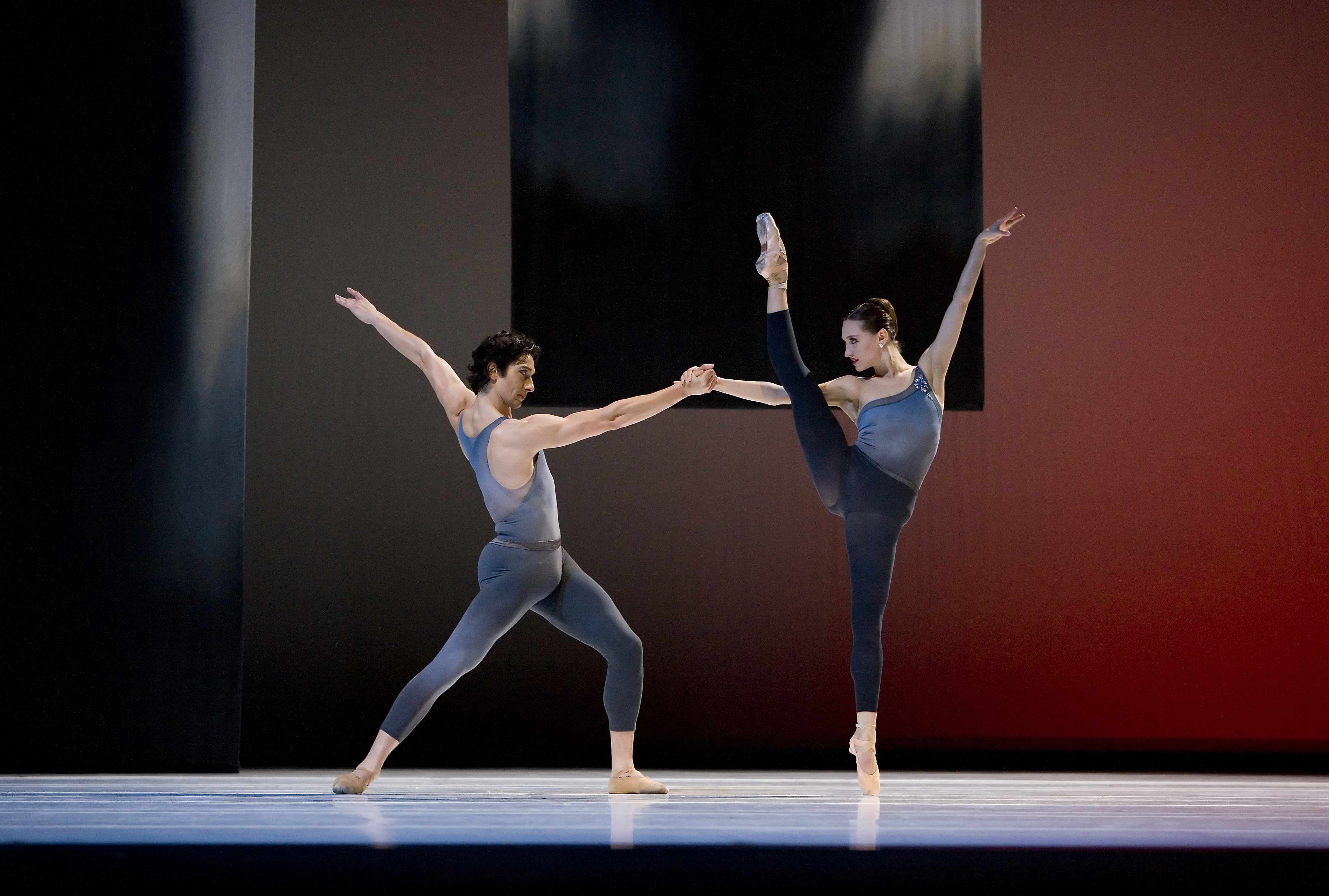
And in "Carousel," also with Vilanoba:
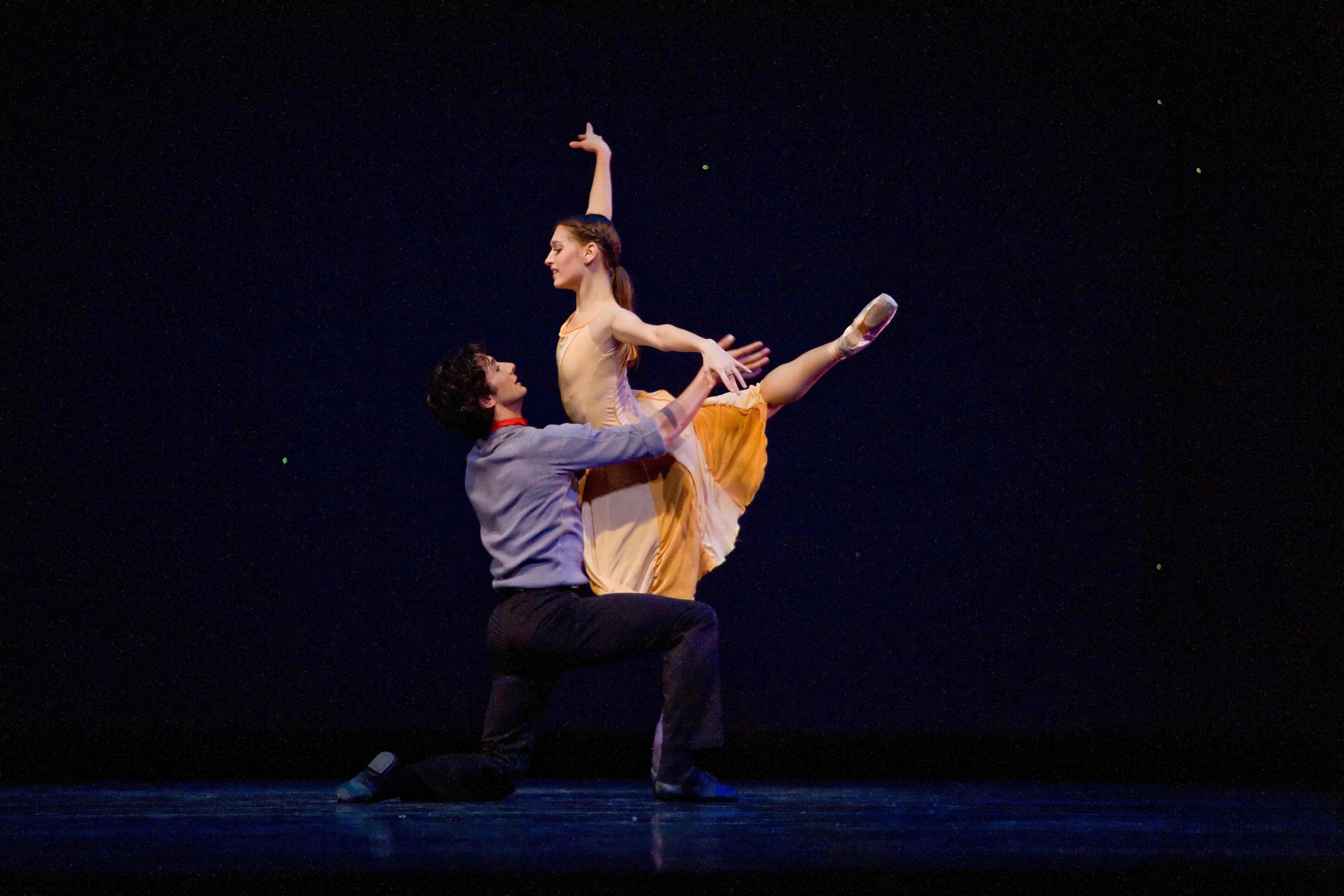
Of course neither image really gives you any idea of the originality of her dancing.
Both photos by Erik Tomasson, courtesy SF Ballet.
March 24, 2007 · 04:42 PM · Dance · Comments (1)
My review of San Francisco Ballet's program five in today's Chronicle:
"On paper, the big news for San Francisco Ballet's Program 5 on Thursday was the company premiere of "Fancy Free," the charming 1944 ballet that launched Jerome Robbins' career, and indeed it looked delightful. But delight was in abundant supply well before this sweet tale of sailors on shore leave arrived to cap the evening. There are three other ballets on the bill, all of them mighty fine, and finely danced. A pleasanter time could not be had at the Opera House.
Part of the gratification is sheer variety. Mark Morris' "Pacific," the opener, is windswept and magisterial; Christopher Wheeldon's "Carousel (A Dance)" (like "Fancy Free," a company premiere) is romance and glee. The return of Artistic Director Helgi Tomasson's elegantly brooding "The Fifth Season" lends the program a melancholy gravitas. It was also a big night for the passionate young soloist Sarah Van Patten, who ought to be given a chance to steal the spotlight more often.
She was the lovely girl in yellow at the center of Wheeldon's "Carousel," a distillation of the Rodgers and Hammerstein musical set to a suite orchestrated by William David Brohn. Whether you know the show's plot makes no difference, as Wheeldon captures not its action but its essential feeling -- and does so with remarkable imagination. A large corps whirls round the stage, the women even riding high on their partners' shoulders and holding poles to bring the carousel image to full life.
The ensemble work is full of whimsy -- cartwheels that look like Ferris wheels, and of course lots of carousel waltzing. But the heart of the ballet is a long, lush duet for Van Patten and Pierre-François Vilanoba as a carnival barker.
Van Patten is an unusual dancer who has been slow to receive her full due here. Two years ago, she danced a startlingly realistic "Romeo and Juliet" opposite Vilanoba, but it was third or fourth cast; "Carousel" is the first role to showcase her talent so fully since. She is at her core an actress who works through pure movement, and every step she took in "Carousel" was suffused with emotional motivation, from her tottering, ambivalent run away from Vilanoba's embrace to the woozy loll of her head as she swooned in his arms."
Click here for more of my thoughts on Van Patten, as well as a terrific first cast for "Fancy Free."
March 17, 2007 · 03:01 PM · Dance · Comments (0)
Catching up on dance reviews I wrote for the Chronicle over the weekend: ODC program two and Janice Garrett & Dancers, both of which repeat this coming weekend.
Here's ODC:
"The members of ODC/Dance looked a little wide-eyed and taken aback by the vigorous ovation at Yerba Buena Center for the Arts Theater on Friday, but they really shouldn't be so surprised. They're performing with such clarity and abandon that's it hard to decide which game is more fun: watching how the ensemble feeds off the intoxicating group energy or picking favorites. To see these 12 dancers slash through co-Artistic Director KT Nelson's "Stomp a Waltz" like the detritus of some renegade tornado is to understand why ODC deserves its status as San Francisco's most established modern dance company. And if there's one thing this 36th anniversary home season will be remembered for in years to come, it's the fierce fineness of the dancing.
It would be nice to say this season will also be remembered for its choreography, but while the performing is top-notch, the premieres are not. There are two new works on Program 2, which repeats this weekend. Nelson's is ambitious, earnest and unintentionally silly; Artistic Director Brenda Way's is modest, pleasant but less than potent. Lest all the glory go to the dancers, it's worth remembering that great companies do not assemble themselves -- directors do. And you can hardly fault those directors for occasionally coasting or taking big risks.
The latter is what Nelson has done in "The Water Project," which is clearly a labor of love, and intended -- you knew the pun was coming -- to make a splash. The visual design, by Kim Turos, hangs coiling tendrils, hoses and sheets of plastic from the rafters. Linda Bouchard's sound collage juxtaposes dripping noises with interludes of clanking industrial calamity, usually without interesting effect."
Click here for the full review.
And here's Janice Garrett:
"Janice Garrett seemed to burst onto the San Francisco dance scene fully formed, sprung from the brow of Zeus. That's because Garrett, who is now in her 50s, danced in the Bay Area in her youth before leaving for New York and then cutting her teeth as a freelance choreographer throughout Europe. She spent more than a decade in this peripatetic way, and when she finally resettled on our shore, in 2001, her "Ostinato" was revelatory: a lush, sculpturally gorgeous, thoroughly accomplished modern dance.
Garrett founded Janice Garrett & Dancers the following year. It's been one of San Francisco's finest companies from its first performances, and its fifth season, which opened Friday at the Cowell Theater and repeats this weekend, proves again why. Few choreographers can match the rich beauty of Garrett's movement, her unerring gift for flowing, complex line. Every step Garrett sets -- and there are lots of them -- arranges her dancers' joints and muscles into the kind of loveliness one could only learn from studying, say, Michelangelo. There is nothing static about her physicality -- it just pours on and on.
But as it pours onward, it raises issues. The truth is, none of Garrett's subsequent works, for all their loveliness, has matched the singular spirit, the heart, the raison d'etre, of "Ostinato." Garrett tends to choreograph by the yard, with sufficient formal ideas but few dramatic ones, and the result is that within those two camps -- comic and lyrical -- all of her dances tend to feel the same. So the question is this: Can a choreographer at this mature stage of development break out of her ways enough to lend her dances meaning, not just prettiness?
Garrett seems to be trying this in "10 Studies on the Vicissitudes of Grief," one of two premieres, and the results are encouraging. "
Click here for the full review.
More readers have been writing in lately to debate my take on things--I love this. Possibly the most important purpose of a review is to spark dialogue--so good or bad (but please not ugly), keep the letters coming. Here's the official info:
"Send letters to Daily Datebook, The San Francisco Chronicle, 901 Mission St., San Francisco, CA 94103, or e-mail to datebookletters@sfchronicle.com. Include your name and city for verification. Letters may be edited for length and clarity."
March 13, 2007 · 12:25 PM · Dance · Comments (0)
My review of the opening of ODC/Dance's home season in yesterday's Chronicle:
"Brenda Way is a choreographer with no shortage of smart ideas. The trouble comes when she tries to throw them all into one dance.
"A Pleasant Looking Woman in Sensible Clothes," her latest, has a clear and timely subject: the political terrorization of ordinary people in their own homes. It also has a lot of accoutrements: video by the Japanese artist Hiraki Sawa, '50s suburban costumes by Cassandra Carpenter, chairs for dancing on as part of Alexander V. Nichols' evocative stage design and a hodgepodge recorded score by David Lang. There are men in suits representing the intrusion of government surveillance into our private lives, a rolling steel door to symbolize our imprisonment within fear, and a generous helping of movement invention. The one thing the dance doesn't have is an emotional arc.
Don't let that keep you from catching ODC/Dance's Program 1, unveiled Thursday during the gala opening of this 36th annual home season, at the Yerba Buena Center for the Arts. The troupe, full of young talent, has probably never danced better -- both in Artistic Director Way's new piece and in the two very fine dances that flank it. Co-Artistic Director KT Nelson's new "Scramble," set to Bach, is a baroque delight, while Way's 1999 "Investigating Grace," also to Bach, showcases performances worthy of its serene beauty. In fact, the exquisite clarity of these bookends sets the conceptual clutter of "A Pleasant Looking Woman" in stark relief."
Click here for the full review.
March 04, 2007 · 03:01 PM · Dance · Comments (0)
I took my mother and grandmother along to Alvin Ailey Wednesday night. It was my grandmother's first encounter with modern dance, and I thought I couldn't go wrong starting her on "Revelations." She loved it, but then, who doesn't?
My review of program A in today's Chronicle:
"What makes one dance dated and another a delightful reflection of its times? "The Golden Section," the all-dance finale to Twyla Tharp's otherwise problematic dance-drama "The Catherine Wheel," screams '80s. "Solid Gold," roller rinks, Jazzercise: It's all there, in the "Wonder Woman" costumes, in the dazzling turns that burst into shimmying shoulders, in the leaps that stop on a dime before a sprint of "Flashdance"-style running. "The Golden Section" is a time capsule in the best sense, because it doesn't reflect its era so much as reveal Tharp's culturally omnivorous ability to capture it. Or maybe it just seems that way because the members of Alvin Ailey American Dance Theater perform it with such infectious playfulness.
Ailey is back at Cal Performances all week with three programs, two of which close with the eternally soul-stirring "Revelations." That classic is reason enough to rush to see them, but as added incentive, Program A, which opened Wednesday and repeats Saturday and Sunday, is one of the stronger Ailey offerings to visit the Bay Area in years -- and "The Golden Section" is a hoot."
Click here for the full review.
A note on the writing: I've been experimenting with these long, more essay-like or narrative-leaning ledes lately--check out the huge block of text that constitutes the first paragraph of this review--and the Chronicle editors have been going for them. Does the approach work? You tell me, but I've been having fun with it.
March 02, 2007 · 07:26 AM · Dance · Comments (0)
My review of SF Ballet's "Sleeping Beauty" in the Chronicle yesterday:
"Yuan Yuan Tan let go of her cavalier's hand in "The Sleeping Beauty's" Rose Adagio and held her attitude balance one second, two seconds, three seconds, four. It's a famous feat, and other esteemed ballerinas have managed it, but the twittering applause Saturday had to do with more than circus tricks.
Tan has long inspired love-hate reactions among San Francisco Ballet fans: love for her elegant, spindly lines and irrepressible glamour, and hate for her icy reserve. She's started to thaw in recent seasons -- her Odette in "Swan Lake" last year was as tender as she was tragic, but almost no one would have expected Tan's unfailing warmth as she bust onstage as Princess Aurora. From her first pas de chat, she was joyous, vulnerable, exuberant and, as she considered her suitors, downright bashful. You couldn't help but share in her triumph. And the transformation from Ice Princess to Princess Aurora was complete.
"The Sleeping Beauty" has a way of revealing transformation in ballet dancers and in ballet companies, and right now -- it runs through Sunday -- it's revealing some attractive things about the San Francisco Ballet. The crown jewel of 19th century Russian classicism, boasting the most shimmering of Tchaikovsky's ballet scores, "Sleeping Beauty" is the supreme test of a company's style. In that regard, the Ballet fails: The company's focus these days is on contemporary ballets, and though you don't get the sense that the corps is ingesting its lessons like broccoli -- they look like they're enjoying themselves -- their approach is eclectic at best.
But "Sleeping Beauty" is also, among classic story ballets, the best showcase for an array of soloists -- all those fairies and divertissements. It hasn't been seen at the Ballet since 2001, and a new crop of talent is ripe for it.
Artistic Director Helgi Tomasson's 1990 production gives them a classy, efficient vehicle. The late Jens-Jacob Worsaae's visual design moves the story to Russia, contrasting the Tsarist fashions of the first act with the powdered wigs and French influences when the court awakens 100 years later. The historical approach is all wrong for a fairy tale, but you forget about it quickly enough while still luxuriating in the painterly sets and opulent detail.
Meanwhile, Tomasson's staging moves speedily -- too speedily. Tomasson's latest adjustment is to eliminate the intermission between Acts 2 and 3, sending us barreling from the Prince's kiss and Aurora's awakening straight through the nuptials. The emotional effect is blunted, and it's too much to take in at one sitting. A good "Sleeping Beauty" should let you savor the dancing, especially when the dancing is this fine."
Click here for the full review.
A sentence got removed in copy editing; its gist was that Tomasson (following Peter Martins' lead in streamlining NY City Ballet's "Beauty") has cut a lot of the Fairy Tale character divertissments from Act III, and ought to restore some of them. Having only the White Cat and Puss in Boots and the Bluebird Pas feels like a pretty stingy invite list.
I turned around and went right back to see the soloist Rachel Viselli make her debut as Aurora Sunday; a lot of balletomanes were there eager to see what she'd do with it. You can't really fault her: she has that beautiful physique with that long torso, such pretty lines, such technical assuredness, such a sweet face. She looked nervous in the Rose Adagio, understandably, but didn't flub anything, then opened up into a bit more lyricism in the Vision Scene. The ballerina-oglers in attendance seemed to approve.
But--but. I still don't get her. I still don't understand the spark that Tomasson must see. Because what I saw in that Rose Adagio was a technically accomplished dancer giving me pretty steps. You can chalk this up to nerves, but it's been consistent throughout her performances--all the equipment is there, but I don't feel her sharing anything with the audience. I don't see any surprises on stage, any on-the-spot decision-making in her phrasing and musicality, and most elusive of all, I don't feel who she is.
Yet she danced an Aurora she should be proud of. I just can't say it's a performance that will linger in my mind, or my heart.
I was, however, rather impressed with Davit Karapetyan as her Prince. Temperamentally and physically, he's not a stereotypical fit for the role: He's an athletic guy, with big powerful thighs more suited to a body-builder than an aristocrat. So his dancing was far flashier than Tiit Helimets, but also big and exciting--such jumps! Such turns! And most of all, such clear, generous mime. Hardly a textbook interpretation, but a thoroughly credible and enjoyable one.
I would have loved to have seen Tina LeBlanc tonight, but we can't live at the opera house, can we?
Please leave a comment if you're a Rachel Viselli fan. I really would like to understand the appeal. And I would love to see her take her gifts and share them in a more human way with us.
February 27, 2007 · 11:49 PM · Dance · Comments (1)
I profiled ODC/Dance founder Brenda Way for yesterday's Chronicle; ODC's 37th annual home season opens Thursday:
"Brenda Way is not the kind of woman you'd think of as flitting, but that's what she's doing this gray morning in the kitchen of her Oakland home. She twirls to put on the teakettle and reaches for sugar on a high shelf with an agility that belies a recent hip operation. She takes a seat at the table almost giddily, eager to share her reactions to Trisha Brown's latest dance at Cal Performances. But when the conversation turns to her own work, her blue eyes become serious and her makeup-free face assumes its usual expression of formidable thoughtfulness.
"I feel so compelled by what's going on around me," she says, cradling her mug in both hands. "The political situation has just been dire. And what you're doing when you make new work is saying, 'Consider this.' "
Way, 64, who founded the company now known as ODC/Dance 36 years ago, has been uncannily prescient in what she's asked her audiences to consider. In 2000, her "Crash" evoked the irrational exuberance that preceded 1929's Black Tuesday -- and the dot-com stock market faltered soon after. But Way's most arresting moment of topicality came in 2004, when her "On a Train Heading South" adorned the stage with hanging blocks of slowly melting ice -- two years before Al Gore made us all acknowledge a certain inconvenient truth.
Normally, after such a socially charged piece, Way would retreat to pure movement invention, but last year she pressed onward with "Time Remaining," an allegory about religious extremism. Now she's unveiling what she conceives as the final installation of a trilogy. "A Pleasant Looking Woman in Sensible Clothes," premiering during ODC's annual home season this week, uses video by the Japanese artist Hiraki Sawa. In the early frames, a toy plane flies around a house. Soon more join it to form a horde.
"I thought that was how I felt about the use of terror in our lives," Way says. "It's invaded our homes. And this fear debilitates us."
The title comes from a New York Times story on Supreme Court confirmation hearings.
"It's the phrase they used to describe Samuel Alito's wife," Way says. "And it's such a slam of every woman that I thought, 'Well, excuse me!' And I think it's that kind of person who's terrified by what's going on, an ordinary housewife."
If Way takes the Times' phrase so personally, that might be because it evokes aspects of her. Way, who had two children before age 20, has always been domestic. And like a good wife and mother, she has often stood quietly in the background of great accomplishments -- not only her children's but also her dance company's.
Way is rarely front and center, choosing to flank herself with ODC co-Artistic Director KT Nelson and Kimi Okada, school director and associate choreographer -- even though Way has been the primary force behind this successful and influential modern dance institution, now with a school, a theater and a $9.5 million headquarters in the Mission District.
"There's no major development regarding dance in this town over the past 30 years that Brenda hasn't been a part of," says Stanford University dance Professor Janice Ross, who first saw Way's work when ODC, then in Ohio, toured to San Francisco in 1974. "She's one of the great unsung teachers in the way she's raised the level of conversation about dance here." "
Click here for the full story.
February 26, 2007 · 10:06 AM · Dance · Comments (0)
My review of William Forsythe's "Three Atmospheric Studies" is in today's Chronicle:
"Much fuss has been made over William Forsythe's decision to tackle the Iraq war in his "Three Atmospheric Studies," which had its keenly anticipated U.S. premiere at UC Berkeley's Cal Performances on Thursday. The issue isn't whether choreographers should make dances about the war, but whether William Forsythe should.
Forsythe has long attracted such scrutiny: He's an American who left for the headier intellectual climate of Germany, where the Forsythe Company, which rose last year from the ashes of his celebrated Ballett Frankfurt, is based; and he's a former savior-apparent of the ballet world who instead forsook classroom steps for relentless experimentation. He's also the only dance artist I can think of capable of evoking war with such visceral devastation. "Three Atmospheric Studies" is sobering and deeply disturbing. It is incredibly difficult to watch, which is exactly why it ought to be seen.
There is much that is striking about "Three Atmospheric Studies," but most important is this: It unfolds entirely from the innocent civilian's point of view.
Forsythe builds his triptych of scenes around four images. Two are 16th century crucifixion paintings, one by Lucas Cranach the Younger, and one by Cranach the Elder; Forsythe's interest in each is the bereaved Mary mourning her slain son. The other two images are recent photographs of mayhem on the streets of Iraq. The analogy is not subtle: Mary as an Iraqi civilian grieving over her child; the Roman Empire as -- no, this is not a new idea -- the American occupation. But even if one takes issue politically with the comparison, there is no arguing with the realities of carnage and suffering Forsythe puts on stage."
Click here for the full review.
Generally, as I'm sure you'll gather, I'm a Forsythe admirer. But my response was also very personal. I have a brother, Emmet, serving as an Army sniper currently in Baghdad. It's the soldiers who have to see this suffering up close--and they hate to see it. They are doing their jobs as best they can, and they know the reality of this war, as we back home watch from afar. Emmet comes home on leave for two weeks March 15; he had been scheduled to end his deployment (and his employment in the Army) in June, but now may be held over for four to six months. Obviously my family is anxious to bring him home.
As to the more trivial discussion of whether "Three Atmospheric Studies" is dance, I don't see why it matters. It is dance, and it is theater, and it is sound art and it is visual art. It is deeply upsetting, which is exactly what it is intended to be, and dismissing it as "not dance" seems to me myopic.
February 24, 2007 · 09:07 AM · Dance · Comments (1)
It's 2:30 in the morning and I've just finished writing my review of William Forsythe's "Three Atmospheric Studies." GO SEE IT. You have only one more night. My review will be in Saturday's Chronicle.
February 23, 2007 · 02:28 AM · Dance · Comments (0)
So everyone in the dance world has had a chance to chime in about Alastair Macaulay's appointment to the top dance critic spot at the New York Times. I haven't said much because I prefer writing about dancers and dances to playing insider baseball, and because I'm not extensively familiar with Macaulay's work, though I like what I've read (and used to read him in the Times Literary Supplement while an undergrad student in London). But a few words must be said about Apollinaire Scherr's overheated reaction, which, if you haven't read her hot-off-the-presses post, boils down to this: The Times should have hired a woman critic, even though no better qualified female candidate emerged.
Scherr's reasoning runs thus: 1. Most players in the dance world--dancers, choreographers--are women. 2. Female critics need the affirmative action because women have a hard time being assertive enough to make it in journalism.
Her argumentation is especially specious. The headline of her post says it all: "Man leads 'girls' at the Times." The real reference here, lest you be misled by Scherr's methods, isn't to Macaulay. It's to outgoing chief critic John Rockwell who, Scherr reports, would refer to the female freelancers as his "girls." To tar Macaulay by association for his mere maleness is outrageous.
As for her other points, number one seems equally sexist as the attitudes Scherr decries. Number two I think has far more substance to it. I do think women, for all kinds of cultural reasons, generally have a harder time being as opinionated as men--I see this every day in the lunchroom gender dynamic of the Writers Grotto, the office co-op where I work. But the way to correct this is coaching for female critics early in their careers, not through hiring less-qualified candidates into top positions. Also, I've seen younger female critics be quite opinionated indeed: Gia Kourlas clearly has no troubles stating her mind (which I thoroughly enjoy), and the female interns I had under my watch at the Examiner were so eager to slash and burn that I actually had to teach them judiciousness, not coax them out of meekness. Which leads to one final thought: Why assume good criticism ought to rely on the sterotypical male qualities of bombast and imperiousness? Deborah Jowitt's work--and her career and reputation--have done very well without them. As much as I admire the intellectual energy behind Scherr's writing, she might do well to shed a little bombast and imperiousness, too.
I've been hard-pressed to find dissenters who claim Macaulay is anything but wonderfully qualified. This is a controversy in search of a target. I look forward to seeing what he does at the Times.
UPDATE: Doug Fox at Great Dance widens the discussion beyond griping and insider cattiness, thank God. To quote Doug:
"The discussion about Alastair Macaulay's qualifications to be the new New York Times chief dance critic and whether or not a woman should have been appointed instead, fails to address a much more pressing issue about the future of dance criticism.
Essentially from a business and practical perspective, dance criticism is a dying art form in the US. There are now fewer and fewer paying opportunities for dance writers because many newspapers have cut back (or eliminated) the number of articles devoted to dance. . . .
. . .It appears that dance writers would rather argue over the remaining handful of dance writing gigs that pay real money than join forces to explore new, more lucrative opportunities for a larger numbers of dance writers."
I whole-heatedly agree, and share his vexation, even if I may count among the dancer writers who fail to fully explore how new media could change the profession. Doug goes on to detail how dance writers could be working with online video, and more tagging, and linking. Personally I'm not ready to trade in the notion of "dance critic" for "dance facilitator," and to me producing quality thought and writing must remain utmost, but there's a lot of useful technical information here and much to think about, and I thank Doug for his indefatiguable efforts.
February 20, 2007 · 10:25 PM · Dance · Comments (0)
Alastair Macaulay is the new chief dance critic of the New York Times! Balletomanes rejoice. Apollinaire Scherr goes off the deep end.
And I, having no dance shows to review this week after a busy two weeks, rush off for tango class.
February 16, 2007 · 07:49 PM · Dance · Comments (2)
I reviewed the Stephen Petronio Company for today's Chronicle:
"For fans of music star Rufus Wainwright, Stephen Petronio's latest dances sounded like a dream match: One of America's hippest choreographers takes on Canada's hippest nasal-voiced singer-songwriter.
But the early word from the Stephen Petronio Company's native New York was not warm, and over the weekend the troupe's San Francisco Performances engagement at the Yerba Buena Center for the Arts proved why. The problem was not that Petronio's hard-edged aesthetic -- bodies that slash through space, legs and arms that work like switchblades -- stands emotional worlds apart from Wainwright's warm, witty pop-folk-opera mash-up. The problem was that Petronio uses Wainwright's music like wallpaper.
The cleverest element of "Bud Suite," set to four of Wainwright's best songs, was Tara Subkoff's costumes: half a blazer held on by straps for the two men in "Oh, What a World," campy tutus in "Vibrate" and post-coital-looking white men's shirts above red underwear for the women in "This Love Affair" and "Agnus Dei." Petronio himself had little to add to the music: His rocket-propelled couplings and signature closing tableaux neither contrasted meaningfully with the songs nor made any comment upon them. Lest this seem a mere pitfall of choreographing to contemporary pop music, let the record show that another New York choreographer, Doug Elkins, has made a wonderful toreador-inspired solo to "Vibrate."
Petronio's lack of a fruitful connection -- or disconnection -- to Wainwright's music only intensifies in the more ambitious "Bloom." Here the commissioned score is Wainwright in operatic mode, setting Whitman, Dickinson and a Latin Mass to droning choral harmonies (mostly his voice, recorded)."
Click here for the full review.
February 13, 2007 · 01:01 PM · Dance · Comments (0)
I reviewed Robert Moses' Kin for today's Chronicle:
"It's not easy to break out of the middling modern-dance pack here in San Francisco, but Robert Moses has done it. The reasons are many: an edgy but eloquent style that roils from jive to jete in an instant, a brilliant facility for carving space, and a confrontational way off addressing the absurdities of race in America without ever simplifying or sermonizing.
A similar bounty marks the 12th annual outing of his company, Robert Moses' Kin, at the Jewish Community Center of San Francisco's Kanbar Hall. There are two world premieres by Moses, three revivals and a new work by the gifted young ballet choreographer Amy Seiwert. It's an overstuffed slate, too rich to digest in one sitting. It's also this troupe's most impressive home season in at least five years, and it repeats next weekend.
The substantial new Moses work is "Penance," set to a score by Daniel David Feinsmith, performed live by his Feinsmith Quartet. After several years of revising the conceptually cloudy "The President's Daughter" to uneven success, Moses has returned to pure movement invention with a vengeance. "Penance" is a primal battle of the sexes in which no one wins but the audience. The motifs here are falling and flailing, the men tossing the women about like ships on stormy waters. At one point, Katherine Wells is hoisted into the air to become a battering ram; the effect is truly disturbing. Later, men spar with men; tribal lines grow hazier; no hopefulness or happy answers are provided.
Feinsmith's music gives Moses a richly textured engine, churning fast, complex rhythms among piano, cello, electric bass and acoustic guitar. The whole machine loses a little momentum two-thirds through. But it never loses bite."
Click here for the full review.
February 10, 2007 · 10:48 AM · Dance · Comments (0)
This is what happens when a critic doesn't feel quite ready to pronounce judgment and writes a largely descriptive, diplomatic review: the opinions get supplied for you. Thus the headlines for my Chronicle review of Yuri Possokhov's new "Firebird" would leave you to think I felt rather upbeat about it, when in fact I left the theater feeling mildly unsatisfied, but wanting to see it once more to confirm this and pinpoint why. The review:
"The good news about Yuri Possokhov's "Firebird" at San Francisco Ballet is that the production really moves, as one pleasantly surprised luminary of the local dance scene enthused while dashing from the Opera House on Thursday.
Possokhov, the company's principal dancer-turned-choreographer in residence, was born in Ukraine and began his stage career at the Bolshoi. Russian through and through, he folds folk elements into his group dances with native naturalness, and the ensemble moments in this "Firebird" are filled with an exuberance to match Stravinsky's majestic score.
But the fact that this ballet should be lauded for being merely "dancey" says a lot about "Firebird's" problematic nature. Beloved musically since the 1910 Ballets Russes premiere, "Firebird" has, in the myriad versions that followed Fokine's, proved far more memorable as a star vehicle than for its choreographic interest. Ballerinas from Karsavina to Fonteyn to Kirkland have graced it, and the same intractable challenges have remained: The story is both simple and perplexing, difficult to stage with continuity and even more difficult to make emotional sense of. In memory, "Firebird" tends to condense to a glittery bird-woman flitting about, a lot of weird stuff with monsters and a sorcerer, and suddenly everyone's dancing and happy. The End.
Possokhov's tack in this staging, expanded from a 2004 production for the much smaller Oregon Ballet Theatre, is to run with all that. This is "Firebird" as a children's tale, though more cartoon than storybook. Prince Ivan -- danced with beautiful form by Tiit Helimets -- is a dolt; the princess -- sweet-faced Rachel Viselli -- is downright goofy. The evil Kaschei (go-for-broke Pascal Molat) is more silly than menacing. The cartoon approach finds its most over-the-top expression in the climactic fight scene, when Ivan gets hold of the magic egg and Kaschei and his horde of monsters chase after him in slow motion -- running in place like Wile E. Coyote before he realizes he's going to fall off a cliff. The opening-night audience ate this up."
Click here for the full piece.
I did return for a second look last night. I liked it far better then, for reasons of casting: Corps member Lily Rogers made a stunning Firebird, assured and glamorous. Rogers is a tall, fine-boned dancer made more fascinating by paradox: She looks frail but dances fierce. Sarah Van Patten danced the princess, lending the role her singular dramatic skills. One is tempted to say she missed her true calling as an actress--but when you see the unfurling of her legato line, you have to wonder if mere words could supply such a channel for her emotionality. Ruben Martin was the prince, and because he is younger than Tiit Helimets, his naivete seemed more natural than manufactured.
I walked away with a new appreciation for the invention of Possokhov's ensemble choreography, too. But even with an ideal cast, I am no fan of this "Firebird." It lacks sophistication. I'm all for comedy in the opera house, especially when it comes with the cutting, naughty edge of, say, Mark Morris--but Possokhov's "Firebird" lacks an adult knowingness; it comes across like a children's production. Several colleagues have said this "Firebird" would make a wonderful outreach ballet for elementary students, and I agree. As the marquee attraction for a company of San Francisco Ballet's caliber, it doesn't cut it.
Also, the scenery is downright ugly.
There. I said it.
Busy day, must dash---
UPDATE: Helimets is the same age as Martin (see comment below), which I never would have guessed. So Helimets' princely refinement and Martin's puppyish sweetness are entirely reflections of their stage personalities, not age--and I apologize for the presumptuousness.
February 08, 2007 · 10:52 AM · Dance · Comments (4)
I reviewed Manuelito Biag's "The Shape of Poison" for today's Chronicle:
"There was nothing gimmicky or trendy about "The Shape of Poison," the new full-evening work by young Manuelito Biag that premiered at ODC Theater over the weekend -- no multimedia conceptualizing, no self-important sociological statements, no cleverness. The dance is absorbing from start to finish for one reason: absolute craftsmanship. If that sounds unexciting, the results are anything but.
That's because each step Biag conceives for his company, called SHIFT >>>Physical Theater, springs from deep emotional motivation. Watching "Poison's" central duet for Biag and Erin Mei-Ling Stuart is like coming across a couple fighting in the street -- you can't help eavesdropping even as you cringe at every half-whispered recrimination, every carefully calculated barb. When Stuart slinks away and Biag launches into a passage of explosive failing, you feel it more acutely than the loudest screams. Bay Area dance followers have been alert to Biag's carefully controlled intensity for several years now, but this is his first full-length attempt, and it marks the full arrival of a major new talent."
Click here for the full review.
February 05, 2007 · 01:35 PM · Dance · Comments (0)
My review of San Francisco Ballet's program one is in today's Chronicle:
"William Forsythe's "Artifact Suite" is designed to slap you in the face, but the startling thing last year was how the San Francisco Ballet corps danced it. They gave themselves to the limb-tearing extremes as though lives were at stake, teetering above gaping échappés like would-be suicides at the edge of a skyscraper.
Arms reached from torsos as though blown in a gale storm; legs stretched to the breaking point. The corps had enjoyed triumphs since Helgi Tomasson became artistic director in 1985, hitting new benchmarks in classics such as "Swan Lake." But "Artifact Suite" was the first work they seemed to possess in the way the Kirov might claim the works of Petipa, or the New York City Ballet, those of Balanchine. Their fierceness made a group statement: This is the San Francisco Ballet under Tomasson.
"Artifact Suite" is now a year old at the War Memorial Opera House, but the thrills were still fresh Tuesday, when the opening of this first repertory slate was a revelation of undiminished commitment."
Click here for the full story.
I wish I'd had more space to write about "Divertimento," which I saw again last night with a second cast. Not only is it one of my favorite Balanchine works, but it's the perfect test of young talent, and the scoop this year is that several of Helgi Tomasson's chosen favorites are coming into their own. It's a delicate proccess, grooming a new generation: at first the youngsters get cast in the roles of veteran dancers they physically resemble, and fans of the old guard (like myself) may bristle at the inevitable comparisons. For a while, Tomasson seemed to be developing Rachel Viselli to replace the irreplaceable Julie Diana, and while Viselli is lyrical and lovely, she lacked Diana's depth of vulnerability. Similarly, tall Elana Altman kept getting thrown into Muriel Maffre's roles--and if you've seen the ever-commanding Maffre, you know that seeing a sweet-faced thing like Altman as, for instance, the tall girl in "Rubies" just can't measure up.
But in "Divertimento" this week, comparisons were out the window. Viselli was absolutely radiant, and a touch glamorous with that exaggerated line through her neck. Likewise Altman, whose upper-body is beginning to find a creamy fluidity. Both were warm, gracious, and at ease in that way a dancer can only be when she is dancing like no one but herself.
In other reports on the new guard, I'm beginning to wonder what will happen with Sarah Van Patten. She has an actress's instinct, a natural drama that oozes from her legato dancing, but that quality often evaporates when the tempo picks up. Her upper and lower halves don't seem to want to move as a unified whole under brisk paces, and in her variation she seemed brittle. All was redeemed in her andante pas de deux. I don't even remember her partner, to be honest, but I remember her sense of spiritual yearning in it. There is more than drawing-room pleasantries beneath the surface of "Divertimento," and she alone plumbed its depths.
Nutnaree Pipit-Suksun stuck more to the pleasantries--but how pleasant they were. I think I've figured out the secret behind her bright, easy smile--her tawny skin. It makes those white teeth shine all the more winsomely. Outrageously fluid extensions don't hurt, either, along with pliant feet and perfectly plumb balances and turns. Let's face it--she has it all.
February 01, 2007 · 01:26 PM · Dance · Comments (1)
The Chronicle commissioned me to write a series of articles on African Americans in dance in advance of the third Black Choreographers Festival, which I preview here. I also talked to a sampling of black choreographers from both the Bay Area and beyond about the lingering assumptions behind that old genre label "black dance":
"A lot has changed since Katherine Dunham and Pearl Primus took the 1940s concert dance world by storm, since Arthur Mitchell startled audiences by partnering white ballerinas at the New York City Ballet, since Donald McKayle created "Rainbow 'Round My Shoulder" to protest injustices in the South.
Hip-hop dancing, with its roots in the African diaspora, is an international phenomenon. Alvin Ailey American Dance Theatre is now one of the most popular troupes in the world, and contemporary choreographers as distinct as Bill T. Jones and Ron K. Brown are at the forefront of their field.
And yet when UC Davis Professor Halifu Osumare leads a panel discussion next month as part of the Black Choreographers Festival, she hopes to revive an old question: "What is black dance?"
The terminology has long bothered her. "The label buys into the racial divide in America: 'white dance' versus 'black dance,' " she says. "But we're a culture of sound bites and shortcuts. It's so easy to say 'black dance' and think people know what you're talking about. If black choreographers are doing anything and everything in dance, 'black dance' is a misnomer. I say 'dance by black choreographers.' "
Osumare is hardly alone: 'Black dance' as a genre label is no longer used as a crutch as it was through most of the 20th century. But conversations with leading black choreographers suggest that the concept still provokes heated debate.
The Chronicle asked four black dancemakers, working in San Francisco and beyond, a deliberately open-ended question: What do you think are the main challenges to African Americans in dance today? Their answers were as individual as their aesthetics, and yet the recurring themes made clear that the assumptions behind "black dance" may still be with us, even if the label is not."
Click here for the full story.
And I talked with Aesha Ash--formerly of New York City Ballet and now with Lines Ballet--and Ikolo Griffin--formerly of San Francisco Ballet and now with Smuin Ballet--about what it's like to be a black dancer in the American ballet world. Click here for that story, and for a particularly beautiful photo of Aesha. Incidentally, according to my site stats, "Aesha Ash" brings more ballet fans to this site than any other ballerina (strong runners up being San Francisco Ballet's Yuan Yuan Tan, Lorena Feijoo, and Sarah Van Patten, with Nutnaree Pipit-Suksun quickly gaining ground).
The Chronicle, you'll notice if you visit sfgate.com lately, is becoming much more multi-media. One immediate perk is this video footage of highlights from Black Choreographers Festivals past. Click through for some great clips of New Style Motherlode, Jason Samuels Smith, Diamono Coura, and others.
January 29, 2007 · 07:45 PM · Dance · Comments (0)
My review of the San Francisco Ballet gala in today's Chronicle:
"Galas take the temperature of their times, and the tone was subtly sober Wednesday as the San Francisco Ballet started its 74th season. A subdued audience claimed its seats with surprising promptness, depth of feeling marked the most affecting dancing, and individual artistry trumped odd programming choices. The austerity was strangely refreshing: This was a gala in which works of substance, and not the usual sugary bonbons, most satisfied our appetites.
That's not to say there weren't moments over the two hours of virtuosic movement to prompt smiles. Who wouldn't grin at the crisp spontaneity of Kristin Long and Joan Boada in Artistic Director Helgi Tomasson's "Soirees Musicales," or giggle at Tina LeBlanc's whirlwind phrasing in Gerald Arpino's "L'Air D'Esprit"?
Yet an elegiac intensity marked the finest performances. Lorena Feijoo, always a committed artist and often a gala standout, danced the second act pas de deux from "Giselle" with such pathos that even viewers unfamiliar with the story could not help but feel for her Albrecht, the princely Tiit Helimets. He mourned at her graveside with beautifully placed extensions and feather-soft landings; she pleaded for his life with urgent, fluttery jumps and arms gently rounded in the Romantic style. From the worry on her striking face, you could almost picture the full corps of ghostly Wilis behind her, commanding that she dance her lover to death."
Click here for the full review.
January 26, 2007 · 12:06 PM · Dance · Comments (0)
In the midst of all the ballet bustle, my review of Shinichi Iova-Koga's new solo show is also in today's Chronicle:
"It's always heartening, as an observer of the local dance ecology, to find a young maverick artist so gifted that audiences seem to discover him through natural buzz about his talent. Such has been the case with Shinichi Iova-Koga, who divides his time between Berlin and the Bay Area, and who founded his performance collective inkBoat in 1994.
Iova-Koga is part of the Bay Area's butoh boom; he studied with Berkeley's famed Koichi and Hiroko Tamano, themselves disciples of Japan's Tatsumi Hijikata, one of the two progenitors of this darkly absurd, apocalyptic dance form. Like many of his generation, Iova-Koga has cast off butoh's calcified cliches -- the shaved head, the white body paint, the glacial pacing and practically patented look of horrified despair -- and yet retained its expressionistic, grotesque essence. He's also found a circle of brilliant avant-garde collaborators in sound and design. Call what Iova-Koga does butoh or post-butoh or whatever you want; it amounts to great movement theater. And judging from the crowds at his 2005 duet "Ame to Ame," the word seemed to be getting out about that.
So it was surprising, Friday night, to witness the engaged but small turnout at Brava Theater for "Milk Traces." Granted, "Milk Traces," which repeats next month at the cozier NOHspace, is small-scale, a 75-minute solo. But each of its simple elements is deeply thoughtful and apt, from Sheila Antonia Bosco's spine-tingling soundscape to Allen Willner's fog-drenched lighting to Cassie Terman's poetic fragments (printed only in the program). And the images and provocations Iova-Koga conjures with just his body and a few props amount to a worthy teaser for inkBoat's more ambitious premiere with experimental music group Nanos Operetta coming in July, and a brilliant performance in itself."
Click here for the full review.
January 26, 2007 · 12:00 PM · Dance · Comments (0)
The San Francisco Ballet's 74th season launches Wednesday with the opening gala. Allan Ulrich profiles departing ballerina Muriel Maffre in today's Chronicle. Meanwhile, the paper asked me to highlight some up-and-coming young dancers. I chose Jaime Garcia Castilla, Frances Chung, Rory Hohenstein, Nutnaree Pipit-suksun, Lily Rogers, and Sarah Van Patten. Click here to find out why. And look for my review of the gala in Friday's Chronicle.
January 21, 2007 · 11:31 PM · Dance · Comments (0)
This was a fun little ditty to write for the SF Chronicle--and Penni Gladstone snagged some colorful photos:
"The rest of San Francisco may have been frigid Sunday afternoon, but it was positively tropical in the Palace of Fine Arts' Dressing Room B, where two dozen women in bikini tops and towering headdresses practiced hip swivels and fluffed the pom-poms on each other's grass skirts.
"They're saying it's a good crowd out there," called Lisa Aguilar, director of the Te Mana O Te Ra, a Tahitian dance company. She wore a batik-printed robe and a priestess-style hat, and she looked like she meant business. "You set the momentum. You're going to make this rock 'n' roll for the rest of the afternoon. All right?"
"Five, six, seven, eight," the dance captain shouted as Aguilar looked on sternly, and the room filled with the swish of straw and muffled calls of "Oh sorry, sorry" as the women ran through their steps -- and into one another -- in the too-tight space.
But what are close confines to keep you from rehearsing when an appearance in the 29th annual San Francisco Ethnic Dance Festival is on the line? More than 100 dance groups from across Northern California converged to compete for about 25 spots Friday through Monday.
The auditions were packed with "It's a Small World" moments: flamenco dancers in polka-dot shawls charging to their warm-up room, while Indian folk dancers folded sari pleats; a Polish dancer in embroidered black pants stopping a 14-year-old Peruvian star to check out his badge, which bore a picture of the Virgin of Guadalupe.
Korean performers floated onstage with feathered fans, while Mexican folklorico mujeres high-fived around the water cooler. Tango vixens waved their hands -- the silent backstage stand-in for clapping -- as a Bharatanatyam practitioner rushed for the wings, panting. It could have been a pep rally for the United Nations.
But it was all local. And the pressure was on. The house was nearly full, packed not only with friends and family, but also curious dance fans happy to check out the smorgasbord of styles for just $7 a day. And in the center row sat the eight expert panelists there to decide which groups would win a coveted spot in June's big show."
Click here for the rest.
January 18, 2007 · 10:57 AM · Dance · Comments (0)
This has to be one of the most memorable theater-going experiences of my career:
"You expect wild sights when you go to something billed as a "fire ballet." So it took a while, at Wednesday night's opening of "Romeo and Juliet," to realize that the torrential onstage downpour wasn't just part of the spectacle.
One minute, a giant flaming chandelier draped with aerial dancers was rising toward the ceiling; next thing you knew, attendees of the Capulet ball were strutting through a Category 5 hurricane. The first few rows of audience members remained gamely seated, like SeaWorld visitors who couldn't complain about being splashed by Shamu.
Only when one of the slippery-handed aerial dancers cried out, "Someone let us down!" did it dawn on many viewers that the emergency sprinklers had just been accidentally triggered.
The Oakland Fire Department rushed over to replace the broken sprinkler -- and a large crowd cheerfully waited an hour and a half in a frigid warehouse for the show to go on. Both responses are a tribute to the reputation of Michael Sturtz, executive director of the Crucible.
In 1999, he founded the West Oakland workshop to offer community classes in the "fire arts": welding, blacksmithing and less practical applications like flame throwing and fire swallowing. In 2004, he produced his first "fire opera," "Dido and Aeneas"; he's also since produced "The Seven Deadly Sins." But "Romeo and Juliet" was his first foray into ballet. And it was worth the wetness, and the wait."
There was real dancing, with Maurya Kerr of Lines Ballet as Juliet. Click here for my full review in today's Chronicle.
January 12, 2007 · 10:01 AM · Dance · Comments (2)
"You know how people say, 'crawl, walk, run'? Well, for me it was always 'crawl, walk, ballet'."
--Democratic Caucus Chair and former ballet dancer Rahm Emanuel today on Fresh Air.
January 11, 2007 · 06:52 PM · Dance · Comments (0)
My "forecast" of 2007 dance events to look forward to appeared (much truncated) in yesterday's Chronicle. Three less obvious picks that I'm especially optimistic about:
inkBoat ("The Crow Line": Jan. 19-20, Brava Theater; Feb. 8-11, Noh Space. Nanos Operetta collaboration: July 12-28, Yerba Buena Center for the Arts) Founder Shinichi Iova-Koga is a third-generation butoh artist whose psychological insights reach right into the deepest, scariest parts of your brain. I've been impatient to see more of his work since 2004's explosive duet, "Ame to Ame." Koga is back in a big way in 2007: first with a new solo, "The Crow Line," that will tour to the New York Butoh Festival. Then, in July, a large-scale ensemble collaboration with Nanos Operetta, a San Francisco experimental music group with a macabre wit that should make an ideal fit with the inkBoat sensibility.
David Gordon (May 9-13, ODC Theater) David Gordon, the wittiest of the 1960s' Judson Church rebels, and the Pick Up Dance Company will bring the hit "Dancing Henry V," Gordon's off-kilter take on Shakespeare.
Scott Wells and Dancers (May 17-20, ODC Theater) Scott Wells is one of the Bay Area dance scene's best-kept secrets, a daredevil dancemaker who turns the freewheeling form of contact improvisation into a vehicle for astonishing acts of physical and emotional stuntmanship. For this 15th anniversary show, he'll premiere a new work for eight men, "Wrestling With Affection."
Since space on the web is infinite, here's the stuff that got cut:
Presenter Cal Performances saved all this season’s hot dance attractions for spring: William Forsythe’s new company visits Feb. 22-23; the painterly works of Shen Wei Dance Arts return Mar. 23-24, and superstar French ballerina Sylvie Guillem brings her collaboration with Kathak-trained British choreographer Akram Khan May 5-6.
Diablo Ballet: This Walnut Creek-based chamber troupe’s most promising spring offering presents a new “Hamlet” set to Shostakovich and choreographed by Viktor Kabaniaev, whose previous works have shown an astute musicality and a keen taste for drama. Also on the bill: twin brother Nikolai Kabaniaev’s “Grand Pas D’Action,” to Glazunov; and the pas de deux from Balanchine’s fun and fizzy “Stars and Stripes.” (Mar. 23-24, Dean Lesher Regional Center for the Arts).
ODC Theater director Rob Bailis has assembled a terrific dance slate for spring, with a new work by Shift Physical Theater’s enormously talented Manuelito Biag in February, postmodern luminary Deborah Hay in March, and evenings from local choreographers-to-watch Alex Ketley in May and Mary Carbonara in June.
Joe Goode is the grand finale of a Yerba Buena Center for the Arts-presented lineup that includes African Diaspora-influenced Reggie Wilson in February; a collaboration between local veteran Kim Epifano and Oakland’s AXIS Dance Company that same month; and Chinese-born Yin Mei’s “The River” in March. (Joe Goode: May 31-June 9, Yerba Buena Center for the Arts).
San Francisco Performances also brings the whiplash Stephen Petronio Company in its new work set to Rufus Wainwright music in February.
Other dance events to anticipate: Robert Moses' Kin's 2007 season runs February 8-18. And ODC/Dance brings its 36th season to the Yerba Buena Center for the Arts March 1-18.
January 08, 2007 · 10:21 AM · Dance · Comments (1)
Christopher Wheeldon is starting his own ballet company. Nice to see that SF Ballet played a small part in this. From the NY Times:
"The idea began taking shape last summer when the San Francisco Ballet presented one of his pieces at the Lincoln Center Festival. The choreographer William Forsythe had a work on the same program, and the two spoke at length.
“He basically told me that I needed to take a step forward on my own and do something different, and coming from him — he is a man who has continued to invent himself — it was immediately resonant,” Mr. Wheeldon said."
January 05, 2007 · 01:07 PM · Dance · Comments (0)
I was very sorry to learn that Sara Linnie Slocum, lighting designer much appreciated and loved in Bay Area dance circles, died December 27. Appropriately, her memorial service will be held at the Cowell Theater this Sunday.
January 03, 2007 · 10:25 PM · Dance · Comments (0)
the dance year that was
I recap the Bay Area's year in dance for today's Chronicle:
"HIGH: ODC Dance Commons ODC/Dance opened a gleaming 23,000-square-foot, $9.5 million center for dance in the Mission. With classes for young and old, rehearsal space for up-and-coming San Francisco companies, a physical therapy clinic, community lounge and -- every dancer's ultimate dream -- clean showers, this bustling hub is a boost to the entire dance community.
LOW: Oakland Ballet Just months after a 40th anniversary comeback, the company announced in January that it would dissolve after floundering under Artistic Director Karen Brown. But then in December, Oakland Ballet's beloved 70-year-old founder, Ronn Guidi, brought his "Nutcracker" back to the Paramount Theatre -- a move he hopes is prelude to starting a new ballet troupe in Oakland.
MOST IMPROVED: Erika Shuch. Her intuitive style of dance theater is tender, hip and unafraid to ask big, childlike questions. Her talent announced itself early -- but then the growing pains came. Intersection for the Arts let her keep exploring, even when the immediate results were distanced and diffuse. Then in July she unveiled "Orbit" -- sweet, silly and serious all at once, and her best work yet.
MOST VALUABLE PLAYER: Yuri Possokhov. The San Francisco Ballet principal dancer retired from dancing, but not before being named resident choreographer. This dramatic Bolshoi alumnus has too much talent for the company to let him get away."
A list of top 10 performances follows, and I'm rather pleased with it. My personal seared-into-memory favorites: Kathak master Birju Maharaj, San Francisco Ballet in Forsythe's "Artifact Suite," and the kinesthetic superheroes of Batsheva Dance Company.
I deliberated long and hard about the rest of the field because it was, locally, a better-than-average year for dance. Just six years ago the San Francisco dance scene was in crisis, forced out of its real estate by the dot com boom, angry, and panicked. Now Margaret Jenkins has her own space again--and one of her best works in years, "A Slipping Glimpse," soon to embark on national tour. Brenda Way at ODC has given us a light-filled dance center, home to the come-as-you-are classes of Rhythm and Motion, to local companies, and indeed to the whole dance commuity.
Over on Market and 7th, the San Francisco Dance Center is filled not just with professional dancers but also the students of LINES Ballet's new BFA program--and artistic director Alonzo King has just won a prestigious new USA Artists grant. Rob Bailis is now at the helm of ODC Theater, bringing us smartly curated programs of Bay Area and national talents alike. San Francisco Ballet is dancing better than ever, and gearing up for a 75th anniversary season in 2008.
Could we be entering another Bay Area dance boom? 2007 is looking awfully good. I'll have a list of 10 dance performances to look forward to in next Sunday's Datebook. The obvious picks are there--San Francisco Ballet, Alvin Ailey, Paul Taylor--but so are several lower-flying San Francisco-based talents I've had my eye on. Watch out for the link here next Sunday, and in the meantime let me know your own highlights from 2006.
Here's to much more great dancing in 2007. Happy New Year.
December 31, 2006 · 12:03 PM · Dance · Comments (0)
the "Nutcracker" cure
I was in an utterly foul mood before I entered the Opera House Thursday night, and within twenty minutes of San Francisco Ballet's "Nutcracker," all felt right with the world. Here's my review in the Chronicle:
"Everyone loves unwrapping shiny new things at Christmastime, but the true test of a "Nutcracker" is how it ages. San Francisco Ballet's $3.5 million production looked dazzling when it premiered two years ago. It looked even better Thursday, when the company gave it an opening-night performance full of spirit and warmth.
To say that Martin Pakledinaz's elegant costumes still sparkle and Michael Yeargan's stunning Edwardian-era sets look freshly minted is to miss this "Nutcracker's" deeper satisfactions. Artistic Director Helgi Tomasson placed a shrewd bet on civic pride when he set his "Nutcracker" in San Francisco circa the 1915 World's Fair -- but he did so much more right besides.
It's easy, and common, to transpose the action embedded in Tchaikovsky's eternal score to a novel time and place, but far more rare to make such emotional and storytelling sense of it. I can only imagine Tomasson's excitement when he hit upon the device -- too clever to reveal here -- that allows a grown-up ballerina to dance, as Clara, with her Nutcracker Prince. The moment lifts this "Nutcracker" from mere fantasy to a richer plane, the sweet tale of a not-so-little girl's first brush with maturity. The whole production, already bathed in lighting designer James F. Ingalls' luminous pastels, glows more brightly because of it."
And you have to click through to see this photo of the snow scene by Chronicle photographer Katy Raddatz. Beautiful.
December 16, 2006 · 10:30 AM · Dance · Comments (0)
This is fun . . . and sort of treacherous. Time Out New York lets the New York dance community review the New York dance critics. The Village Voice's Deborah Jowitt comes out on top, followed by the Wall Street Journal's Robert Greskovic, the Times' Jennifer Dunning, and the New Yorker's Joan Acocella. Newsday's relative newcomer Apollinaire Scherr makes a strong showing, and Time Out's own Gia Kourlas gets good marks but also draws commentary nastier than anything ever printed in her controversial reviews. (What were the editors thinking when they printed that bit about her being a "fashionista and a bitch"? That they didn't want to be seen as going soft on their own?)
Over on her blog, Apollinaire leaps on the list and deems it a potentially serviceable undertaking. I share her issues with the methodology, and I too wondered, where is Tobi Tobias?
I'm not brave enough to call for a similar ranking of West Coast critics.
December 07, 2006 · 06:12 PM · Dance · Comments (0)
Memo to the Bay Area Dance Community
I'm putting together a list of ten dance performances to look forward to in 2007. My deadline is December 20. If you'd like to be considered, please email information about your performance to rachel at rachel howard dot com no later than December 13.
Many thanks!
December 07, 2006 · 10:11 AM · Dance · Comments (0)
I reviewed Ivory Coast troupe Compagnie TcheTche for today's Chronicle:
"Pain has probably never displayed itself so authentically as on the faces of Compagnie TchéTché, a quartet of female dancers from Ivory Coast. Suffering was inescapable Friday night at the Yerba Buena Center for the Arts Forum as the 9-year-old troupe made its Bay Area debut, throwing themselves into each other's arms, clutching their throats as though strangled and then offering their hands to the sky in desperate, disintegrating prayer.
The real drama, though, was in the eyes: tense, watery, constantly on the verge of tears. At the end of the hourlong "Dimi" -- which translates roughly to "sorrow" -- the women broke down into audible sobs, and their mournful expressions at curtain call suggested this was no Herculean feat of acting.
Rarely, though, did the power of their feeling come across in movement. In one of the more effective episodes, Nina Kipre flies backward across the floor as though shot, clutches her hands to her crotch, then removes her corduroy blazer and rolls it so tightly against her stomach you almost feel it's a baby she might crush out of a sheer desire to shield it. It's chilling when she then saunters off, hand swinging as though to an imaginary beat.
But, mostly, founder Béatrice Kombé's choreography comes off as a series of disconnected studio exercises, lacking through-line and structure."
Click here for the full review.
December 04, 2006 · 02:48 PM · Dance · Comments (1)
I was surprised and saddened yesterday to receive a press release announcing that Summerdance Santa Barbara, the fantastically smart and provocative festival of contemporary dance founded by Dianne Vapnek, is suspending operations after ten years. I followed this festival from its start, when I was a twenty-year-old would-be dance critic writing for the Santa Barbara Independent and Vapnek brought out Doug Varone and Dancers, the first company of real sophistication I'd ever had a chance to watch in rehearsal and lecture demonstrations. From the beginning, the festival’s biggest asset was Vapnek’s good taste, which leaned toward the brainy and slightly naughty: Doug Elkins, Larry Keigwin, and Aszure Barton, for instance, with forays into flamenco and tap. The festival’s other major asset, of course, was setting: There is nothing quite like watching the Brian Brooks Moving Company dance on the lawn of the Santa Barbara Mission with the view stretching towards mountains on one side and the ocean on the other on a balmy July day.
Vapnek didn’t just import companies: She gave them time and space to work, and commissioned new dances. She also brought kids from the impoverished Orange County town of Santa Ana to take class with world-class teachers. At last July’s festival, everything looked full-tilt: Mikhail Baryshnikov stopped with his Hell’s Kitchen Dances program as part of Summerdance, Robert Battle set a work on local company State Street Ballet, Doug Varone and Dancers began a new piece, and Aszure and Artists danced sold out shows.
The festival was a labor of love for Vapnek, who invested so much of her own money in it. Perhaps she needed a rest, and she deserves it. No doubt she’ll continue feeding the national dance scene in myriad behind-the-scenes ways. The festival never got the wider attention I felt it deserved, perhaps because L.A. didn’t have a substantial enough dance scene for Summerdance Santa Barbara to become a satellite to. But it helped change Santa Barbara from a sleepy resort town into a destination for truly sophisticated art, and it gave me and thousands of other audience members some of the most charmed dance experiences of our lives. I’ll be in mourning come next July.
December 01, 2006 · 03:08 PM · Dance · Comments (0)
Interested in a
fine arts
degree, but don't have time to go to a traditional school? Consider
looking at online degrees to
fulfill your educational needs. There are many
online
universities that offer programs such as an online bachelor degree and much
more! Check out online school
options today!
********************************************************************
I reviewed the SF Hip Hop Dance Fest for today's Chronicle:
"The idea of a hip-hop dance festival may seem gratuitous in an age when everyone from Justin Timberlake to a squeaky puppet named Elmo is doing it. But there was no festival dedicated exclusively to the form in 1999, when San Francisco dancer Micaya created the SF Hip Hop DanceFest.
Do we still need a hip-hop dance festival? Absolutely. You'd have to do more than surf through countless music videos to come up with a survey of hip-hop dancing as wide ranging, fresh and -- oh, yes -- roof raising as the two programs that kept the beats pounding and the bodies shaking over the weekend at the Palace of Fine Arts Theatre.
Friday's opening night was a party. It was also eye-opening exposure to hip-hop gone global. Who knew that in Montreal, a sextet of women calling themselves Extreme freak furiously while wearing '80s-esque acid-washed jeans and flinging Jon Bon Jovi-worthy feathered hair? And who could imagine a talent as sui generis as Japan's Takahiro Ueno, a skinny, Chaplin-esque fellow who krumps and pops -- hilariously -- to everything from Richard Rodgers to Verdi."
Click here for the full review.
November 20, 2006 · 12:55 PM · Dance · Comments (0)
I felt both dazzled and skeptical about Sankai Juku's recent visit, which I reviewed for the Chronicle yesterday, and I can't say I've yet resolved my ambivalence:
"It's not hard to see why Sankai Juku is the leading popularizer of Japanese butoh, so wildly loved that co-presenters San Francisco Performances and the Yerba Buena Center for the Arts counted themselves lucky to book a sold-out, two-night midweek run at the YBCA Theater.
Bald and covered in white body paint per now-standard butoh cliche, these dancers look like eerily wise, ancient tortoises.
And yet they have the alabaster allure of mannequins in a Neiman Marcus window, so bathed is their every deliberate movement in brilliant light.
In "Kagemi," the 2000 work now on national tour, they also have a stunning set: a ceiling of giant white lotus leaves that hover as though floating on water. Choreographer and founder Ushio Amagatsu has subtitled his work "Beyond the Metaphors of Mirrors," and apparently he intends us to see the dancers as though peered through the reflection of a lake, swimming in some primordial subconscious state. But whether you see "Kagemi" as flowing with watery meaning or flooded with empty butoh stereotypes may depend on the consciousness you bring to it."
For the full review, click here.
November 17, 2006 · 01:48 PM · Dance · Comments (0)
I reviewed Lines Ballet's latest home season for today's Chronicle:
"Alonzo King is not the kind of choreographer who can operate on autopilot with passable results. His concern is nothing less than the transcendent possibilities of the human heart, which his sleek, eminently rubber-jointed dancers explore in intensely allegorical, New Age-tinged encounters.
In a King pas de deux, the man doesn't support the woman as she twirls through perfectly centered, regal pirouettes. Instead, he folds her limbs like elaborate origami, she presses her hands against his chest as though pleading for emotional distance, he bends her at the waist until she's on all fours, she throws herself upon his back, spasming with vulnerability. When King is on, such a duet can leave you in awe of its profundity. When King is going through the motions, it can look like the world's most pretentious game of Twister.
Both effects are on display now at the Yerba Buena Center for the Arts Theater, where King's Lines Ballet opened its fall home season Friday with two recent pieces new to San Francisco. "Migration," a commission for Germany's Wolfsburg Festival, is a heavenward journey laced with virtuosic dancing and tender, touching moments -- King at his best. "Sky Clad," which uses live music by Hindustani vocalist Rita Sahai, is a soulless trudge through half an hour of vague exoticisms and empty symbolism. The contrast is fascinating."
Click here for the full review.
November 06, 2006 · 10:06 AM · Dance · Comments (0)
Joan Acocella's latest New Yorker column on British choreographer-of-the-moment Akram Khan is one of her best pieces of work, in my opinion. After grappling with the musical complexity and historical intricacies of kathak myself for the past month, I'm dazzled by how simply but masterfully she breaks the form down for a general audience. Speaking of 68-year-old kathak master Birju Maharaj, she writes:
" He showed us how to lay a three-count foot-stamping phrase over a four-count musical phrase, and how to fit fives into sixteens. Saswati Sen did a dance to a count of nine and a half, a feat few people would have dreamed of. She accomplished it by taking some of the beats at double speed, and that is something else about kathak: how fast it gets, with no sacrifice of clarity. The dancer may be spinning like a rotary blade, but, from second to second, the head and arms are making exactly this shape, then exactly that. You can’t believe it—that so many different things are coming out of one source. And that’s not to speak of the mime dances, usually based on Hindu mythology, that are done in alternation with the rhythm studies. In these routines, the kathak performer often plays several characters In a tale from the Ramayana, Sen was now virtuous wife, now the god who seduced her, now the enraged husband, and also the river flowing by. Kathak is probably at least eight hundred years old, and in that time it has developed extraordinary subtlety.
Occasionally, for this reason, it is confounding. "
She goes on to contend that Khan is overwhelmingly popular because, in combining "ethnic" dance with modern, he gives audiences something now rare in modern dance: a driving beat. I could have used a few examples of how modern dance purportedly eschewed musicality long prior to the Judson Church rebels (she's talking about Cunningham, I suppose, though I'd like to know how far she thinks the rift with musicality reaches back), but I'm intrigued by the assertion. Definitely read Acocella's full column, here.
October 28, 2006 · 01:29 PM · Dance · Comments (0)
Good news for ballet in Oakland . . . My story in the Chronicle today:
"Ballet in Oakland is a long saga that revolves around a single man: Ronn Guidi. He founded the Oakland Ballet in 1965, led it to international notice with revivals of rare masterpieces, and watched along with a heartsick community in recent years as the ballet faltered after his retirement.
Now, as Oakland arts lovers are still smarting from the Oakland Ballet's closure, Guidi is back. "Ronn Guidi's 'Nutcracker' " will run four performances, Dec. 22-24, at the Paramount Theatre, with live music from the Oakland East Bay Symphony. The return of this 33-year tradition is also the first glimmer of possible regeneration for ballet in Oakland.
"So many people on the street were saying, 'You better come back with your 'Nutcracker' this year, we're waiting,' " said Guidi, who recently turned 70. "My batteries are recharged to make this happen. I'm in for the long haul."
Guidi has so far raised $110,000 toward a $200,000 budget, with a $25,000 donation from the Chevron Corporation. He plans to channel ticket profits toward future performances, and he already has his sights on a 2009 festival marking the 100th anniversary of the Ballets Russes, the artistically revolutionary Paris company whose landmark ballets he so lovingly revived."
Click here for the full story.
October 06, 2006 · 10:08 AM · Dance · Comments (1)
My review of "Kathak at the Crossroads" is in today's Chronicle:
" "The 'one' is Krishna," Birju Maharaj told an entranced audience Friday at the Yerba Buena Center for the Arts Theater. "All the beats want to reach toward Krishna, to one, to home," said the 68-year-old master of Indian Kathak dance. "You are going everywhere, but you are coming back home."
By "one" he meant the downbeat, the start of a new rhythmic cycle and the mystical moment of wholeness in Kathak, which is as much about musicianship as movement. And over the next hour he took his audience on ever more surprising journeys there, toying with time so that you could almost hear it in three dimensions, testing silence to the point that you wondered how he could ever reconnect, and always, astonishingly, arriving home with perfect surety.
His rhythms were an education in recognizing order in seeming chaos, like hearing music in rainfall or suddenly seeing a stunning design in the night stars. They seemed to promise that everything in life will be revealed to have pattern and purpose, if you have patience to wait for the downbeat.
Maharaj was the banner attraction of Kathak at the Crossroads, a landmark international festival organized by San Francisco's own esteemed Kathak guru, Chitresh Das. His performance revealed why the ancient art form thrives, and why its future is worth worrying about. The three-day festival was a celebration, to be sure, with dozens of gurus and disciples flown in from India, and crowds of connoisseurs from the Bay Area's large Indian community in attendance."
Click here for the full review.
October 03, 2006 · 01:15 PM · Dance · Comments (0)
Apollinaire Scherr, one-time Bay Area dance-watcher and now a feistily individualistic (and sometimes controversial) dance writer for Newsday, has just started a blog at the invaluable Arts Journal.
Among the topics her first post poses for exploration:
"--Do I have to leave my brain at the door? Some definitions of "stupid" in dance, and why people don't need to tolerate it
--Blackface in ballet: some definitions of "offensive" in ballet, and why people don't need to make excuses for it
--Civility in criticism: what would that be and what's it worth?
--The complaints about New York City Ballet's Peter Martins, and why he's not listening
--The trend in modern dance of using untrained dancers, and the trial it puts us through
--The contempt some modern-dance choreographers have for critics: do we deserve it?"
San Francisco's own Paul Parish has already jumped in. Go here to check it out.
September 28, 2006 · 10:56 AM · Dance · Comments (0)
My review of "Classical Savion" appeared in yesterday's Chronicle:
" "Can you get rid of that?" Savion Glover called to a harried stagehand at UC Berkeley's Zellerbach Hall on Friday night. And then, after the speaker's hum persisted, "Ladies and gentlemen, we're going to do this next number ex-amplification."
No one worried. Just 10 minutes into Glover's latest touring show, "Classical Savion," it was clear the onetime "Bring in 'Da Noise, Bring in 'Da Funk" prodigy doesn't need mikes. In fact, it takes a while to adjust to the thunderous boom of Glover's taps on a hollow wood stage as behind him a nine-piece string ensemble plays everything from Mendelssohn to Shostakovich. But even when Glover's rhythms were as light and crisp as castanets, the crowd was rapt .
It's hardly news that you can put a fresh beat under Bach and come up with something swinging, and "Classical Savion" is no longer so novel. The show played Marin Veterans' Memorial Auditorium in November before coming to Cal Performances for this one-night stand. But to hear the way Glover absolutely infiltrates Vivaldi's "Four Seasons" -- sliding a sunny Latin rhythm beneath the last flutters of "Spring," letting the lull in "Winter" sway before hitting eighth notes like a sudden storm -- is to witness deep musicianship, not gimmickry. This show has reportedly been retooled since its January 2005 unveiling; whatever the past failings, Glover can now keep a vast auditorium spellbound for the better part of two hours without an intermission."
Click here for the full review.
September 26, 2006 · 01:17 PM · Dance · Comments (0)
Kathak at the Crossroads
Dozens of Kathak gurus and disciples straight from India are about to take over the Yerba Buena Center for the Arts for a major international conference. I wrote about the man behind the gathering, San Francisco's own Chitresh Das, for today's New York Times:
"IN most classical dance forms, effortlessness is an illusion, but in Indian Kathak it’s a force of will. That seemed the only way to explain the strained, determined smiles of a dozen women as they stamped and spun, tunics soaked with sweat and feet laden with five pounds of bells. At the front of the room Chitresh Das, the wild-eyed man who styles himself the George Balanchine of Kathak, slapped the tabla. “Taka dimi, taka dimi,” he shouted, chanting the beat. “Come on, I’m not hearing you. Louder!”
The rhythms rushed to an ecstatic explosion, and as the climax faded, Mr. Das’s face softened from the stern authority of Shiva to the mischievous confidence of Krishna, two Hindu deities he has portrayed countless times in six decades devoted to his ancient art.
“This is a recent thing in Kathak history,” he said, nodding proudly at the panting women in the cultural center where he gives his classes. “You see, because our form is classical doesn’t mean it doesn’t evolve.”
He was talking about his proudest achievement, Kathak Yoga: not the latest exercise craze, but rather a practice of movement meditation that updates one of India’s eight official classical dance forms, as deemed by the Sangeet Natak Akademi, India’s rough equivalent to the National Endowment for the the Arts.
Traditionally Kathak has been passed on through intensive study with a single teacher and performed in long solo improvisations that can last for hours at a stretch. But this more modern form features dancers continually reciting the basic rhythm while embellishing upon it with their feet.
Kathak, a northern Indian dance tradition and the country’s only classical dance form with both Muslim and Hindu influences, has undergone many evolutions in the last 20 years. These include Martha Graham-like abstractions, Bollywood-esque spectacles, even a lavish Kathak “Romeo and Juliet.” Akram Khan, who melds Kathak and contemporary dance, is one of the hottest choreographers in Britain, and fusion is a buzzword among Kathak practitioners in India.
That’s a far cry from the intimate performances of kathakas (the word literally means storytellers) who delighted 17th- and 18th-century Mughal rulers by acting out Hindu tales and riffing with virtuoso tabla players."
Click here for the full story.
September 24, 2006 · 05:26 PM · Dance · Comments (0)
I was at the Savion Glover show at Cal Performances last night and found it--no surprise--mostly brilliant; the review will be in Monday's Chronicle. In the meantime, just a reminder that David Dorfman Dance is also at the Yerba Buena Center for the Arts this weekend; I'll be there Sunday. Dorfman's rare visit to San Francisco in 2005 was one of the highlights of that dance year for me; He achieves a real interplay between text and movement that many "talky" choreographers don't, and he's challenging and funny all at once. The subject of his latest, "Underground" sounds a little dicey to me--it uses the 1969 activists the Weathermen as a launching point for exploring the line between political agitation and terrorism. But it's hard to imagine Dorfman getting preachy or heavy-handed, so I'll happily take my chances. Unfortunately, the Chronicle's not covering the show, but Allan Ulrich should soon have a review up on Voice of Dance.
September 23, 2006 · 09:34 AM · Dance · Comments (1)
Fall Dance Preview
Here's the online version of my fall dance preview for the Chronicle. The dance season looks a bit slower than usual this year, sadly; No blockbuster ballet companies at Cal Performances, and the Oakland Ballet, which folded in January, is especially missed. I'm most looking forward to Taiwan's Cloud Gate Dance Theater at Cal Performances, and Batsheva Dance Company at San Francisco Performances. Locally, I've got hopes for the young choreographer Erin Mei-Ling Stuart, and I know that Jo Kreiter's live billboard project for Flyaway Productions will surely be a spectacle.
August 28, 2006 · 09:09 AM · Dance · Comments (0)
Is the Lewis Segal "I hate ballet" fuss still brewing? In the end, I was in too overwhelmed a moment in life to organize my own arguments or follow the blow-by-blows. But Allan Ulrich has summarized the issues most astutely at Voice of Dance:
"Segal, I know, gets around a lot. But he is primarily addressing a local readership that may have sat through more than one lackluster Romeo and Juliet or droopy Swan Lake than is good for the health or soul of any ballet public. It must sometimes be dispiriting for a dance critic to ply his craft in one of the few major world cities that ballet forgot. Still, you need to have the ballet company at hand before you demand innovation or relevance from it. If Segal’s polemic can arouse his city to produce the kind of company that meets his high and not unreasonable standards, it will have fulfilled its mission."
It's a balanced response that studies Segal's argumentation carefully instead of devolving into insider cat-fights, and for that, I recommend it.
August 20, 2006 · 09:46 PM · Dance · Comments (0)
Flatulent, Trivial Ballet
I've been so busy working on stories for the Chronicle and elsewhere, pushing forward on a novel, moving, and preparing to lead a writing workshop at the Parents of Murdered Children conference that I entirely missed Lewis Segal's jaundiced wholesale disparagement of ballet in the L.A. Times:
"Ballet has given us visions of limitless human potential and a sense of grace as profound as anything we have ever thought, felt or believed. But all too often, it now commandeers a disproportionate amount of money and attention in the dance world and returns only an increasingly self-satisfied triviality.
Yes, Miami City Ballet looked mighty fine in two Music Center programs a month ago. But significantly, the only work created since the dancers' infancy was borrowed from the world of modern dance. In this country, ballet simply will not address the realities of the moment, and its reliance on flatulent nostalgia makes it hard to defend as a living art."
Here's the full rant.
And here's the New York Times' John Rockwell's reasoned response:
"Despite the absence of major ballet company in the Los Angeles basin, Mr. Segal has seen a lot of ballet over the decades. He surely knows that ballet is indeed trying to adjust to the modern world, to find new thematic and choreographic relevance without abandoning its technique and traditions, however shallow and distorted in Mr. Segal’s view. He could have made the same arguments about traditional ballet’s failings in a context supportive of contemporary ballet. Perhaps he has been soured by the hackneyed touring programs the big ballet companies take into Los Angeles.
“Does any star these days lobby artistic directors for better choreography or dare to say, ‘I just don’t want to be seen in that ‘Swan Lake’ ”? Well, yes. Carlos Acosta, the Royal Ballet and American Ballet Theater star, is only the latest to call for modernization and for a de-emphasis on 19th century story ballets. Sylvie Guillem has done the same.
Dancers in Europe (as with the Kirov Ballet’s William Forsythe program) and the United States yearn for exciting new choreography, and artistic directors do their best to provide it. Mikhail Baryshnikov stands as a one-man symbol of ballet’s (and dance’s) quest for renewal. When it comes to new work (as opposed to fancily modernized new productions of old work), ballet is far more contemporary than opera. Ballet masters and administrators spend half their time searching for the new. Which is not to say that all new ballet is good ballet, but they try."
Though he finds Segal's disdain "salutary," Rockwell's ultimate outlook is one of appreciation for ballet's enduring beauties, and optimism.
I have my own thoughts, of course: That I wouldn’t argue with Segal's targets, only with the caustic way he's chosen his examples. That it’s the form of ballet that makes it timeless, not its pedigree, which is what makes his argument about Shakespeare et. al. predating ballet absurd. That the ethnic stereotypes and soap opera plot of “La Bayadere” may not, thankfully, endure, but does the formal beauty of that third act lay a claim to transcendence? Absolutely.
I see the same signs of decline that he does, but I also see such hope in the lush emotionality of dancers like Sarah Van Patten, the depth of coaching in Suzanne Farrell’s efforts. Ballet will go through ups and downs just as opera and classical music will, but the worth at its core will persist.
And I agree that naming promising choreographers is harder than naming promising dancers, but it only took one Petipa and one Balanchine. Haven’t audiences been just as conned by pretentious modern or post-modern dance performances, swallowed just as much “cutting edge,” “progressive” dance that was nothing but political ranting or obscure physical noodling in the name of edification? What’s worthwhile in any genre can be hard to find. I’d say Segal's job should lie in helping his readers find it, instead of digging up his most egregious examples to turn them off the art form altogether.
I should add that Lewis Segal has seen more ballet and absorbed more encylopedic knowledge about it than I could ever hope to. Perhaps my position is one of youthful naivete. I prefer that to a reactionary denouncement of a form of art that has filled my life with inspiration and often awe.
I'd like to organize my thoughts into more of a through-written argument, but I think I'll collapse from overwork first.
UPDATE: Leigh Witchel rebutts both Segal and Rockwell. Scroll down beyond a wonderful picture of the Balanchine ballerina Melissa Hayden, who died yesterday, and notes from a past interview with her. Incidentally, this obituary from Anna Kisselgoff has a stunning photo of Hayden in an uconventional retire, looking both commanding and glamorous.
SOME FURTHER DISORGANIZED THOUGHTS: The more I think about Segal's rabble-rousing approach, the more I warm to it. I would like to see a dramatically cohesive "Swan Lake" in my lifetime, instead of cobbling together favorite bits from different productions in my head. I do prefer to watch the third act of "La Bayadere" on its own rather than suffer through hours of empty pageantry.
I'd say it's a shame that Segal made his points in such hyperbolic style, but he has suceeded in the one thing he surely aimed for above all: kicking up a fuss. (Whether such a fuss will actually have an impact on the direction of ballet, I wonder. I think back to all that ink and fury expended over the Krissy Keefer "body image" debate, another expert provocation. After all that arguing, did the standards for thinness change much, or the unhealthy pressures placed on many dancers ease? I doubt it.) The ultimate weakness in most of Segal's arguments is that they could be applied to most other art forms. "When other forms of concert dance — not to mention movies, TV or the theater — are this empty and useless, it's easy to openly dislike or even despise them" he admits, then cites ballet's "intimidation factor" as deserving the extra ire. But the only real reason he's singled out ballet, of course, is because he loves it.
I hear whispers that Mr. Allan Ulrich may soon jump into the fray. I certainly hope so.
August 08, 2006 · 02:25 PM · Dance · Comments (3)
Summerdance at 10
Summerdance Santa Barbara
Aszure and Artists
Center Stage Theater, Santa Barbara
July 27, 2006
A decade ago, I cut my teeth as an upstart dance critic writing about a new festival called Summerdance Santa Barbara. (Thankfully, those were the days before the Santa Barbara Independent started archiving their stories online.) The company inaugurating the festival was Doug Varone and Dancers, and they arrived like a welcome shot of sophistication upon Santa Barbara’s red-tiled tourist haven downtown. I’ve attended the festival most years since, in part for an excuse to visit the city I consider my second home, in part out of nostalgia, and in large part because my taste agrees with that of Summerdance executive director Dianne Vapnek. She’s made forays into flamenco and tap, and even imported a boot-clad dance theater troupe from the Netherlands, but mostly she likes New York modern dance companies with a bit of edge and a dash of sexiness, and she has a good eye for them. Her past choices include such mischievous talents as Doug Elkins, former Mark Dendy dancer Larry Keigwin (whose work struck me as green but promising), and Streb-alum Brian Brooks, whose campy minimalism is one of the freshest things I’ve laid eyes on.
For Summerdance’s 10th anniversary, Vapnek’s marquee attraction was the work of Aszure Barton, the young Canadian-born choreographer whose dances were recently featured on the program Baryshnikov put together to tout the fruits of his new Baryshnikov Arts Center, where Barton is one of the first artists in residence. I arrived in Santa Barbara during the festival’s busiest week: Doug Varone was creating a commissioned piece at lightning pace (16 minutes finished in five days); Robert Battle was setting one of his earliest works, the hard-driving “Rush Hour,” on the local State Street Ballet, whose choreography-starved dancers were taking to it with grateful commitment; and Brian Brooks was leading the Summerdance Kids Connection, wherein Santa Barbara dance students mingle with kids from the less affluent Orange County city of Santa Ana for a week of all-day dancing. All of this came together rather movingly for Friday’s Choreographers Showcase, where Varone, Battle, and Brooks unveiled what they’d accomplished. But I’d really come to see more of Barton, and her program proved worth it.
It started with “Come/Over,” the disaffected-hipster-romance romp I’d seen weeks earlier on the Baryshnikov slate, but a second viewing did not diminish its potency. I was still bowled over by sudden spasms of heartbreak; by the almost casually clever touches, like the guy standing on his head in the corner for no discernible reason; by the exquisite moment of tension when Barton stood on Doug Letheren as he executed a push-up, the eerie masochism of her wickedly smiling face heightened by the very real tenuousness of maintaining her balance. But now I was able to inventory more factors of how her choreography works. The vocabulary is fabulous, for starters. Barton trained at the National Ballet of Canada, and moments of ballet precision (a quicksilver arabesque penchee; a tidy rond de jambe executed with perfect clarity) punctuate her movement like sudden fireworks. Outrageously flexible backs and shoulders roll and roll like rivers; hands claw the air or suddenly reach for crotches; and faces melt from cruel laughter to despondency in a matter of well-calibrated moments. (Barton’s dancers, as you may have now surmised, are all wonders of fluidity and plastique.) But this only begins to explain what keeps Barton’s dances so unexpected. In the way she builds phrases and structures her dances, she is a trickster and a tease. She knows how to insert a dancey rhythmic passage here, a non-sequitur pause there, giving you just enough breathing space to be totally caught off-guard by what happens next.
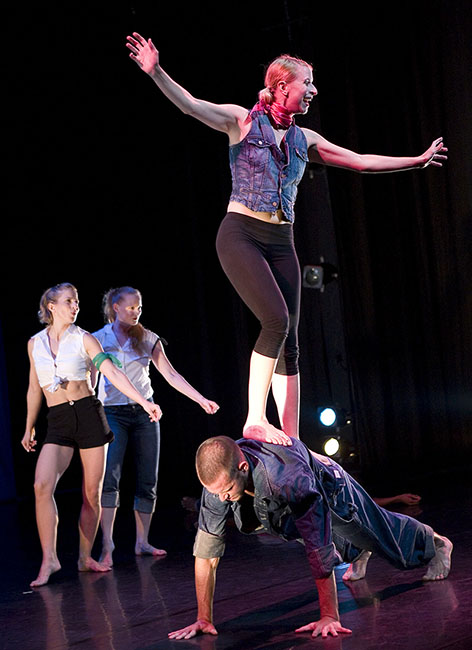
Barton and Letheren in "Come/Over." Photo by David Bazemore.
The extent to which she draws on every structural resource at her disposal became even clearer in two movement from 2006’s “Short-Lived” that sent Letheren, Todd McQuade, William Briscoe, and the virtuosic Jonathan Alsberry prowling like panthers to tango-esque music. Their very walk was very simple but very specific: rolling down from the toes, hips sashaying in a way that looked absolutely sensuous but never campy. Certain solos toward the front of the stage went on too long, but just when you’d had enough, Barton would rearrange the space in off-kilter ways. Why, for instance, do two men do simultaneous solos with their backs to one another, facing separate wings? The space between them seems perfectly measured to upset any expectations of how these men relate to each other. And yet throughout the piece the men do pair up, one lifting another with his hands held in prayer around his lovers’ slick chest. So many contemporary choreographers are trying on tango these days, but usually in winking, undangerous ways. The sensuality in “Short-Lived” had spiritual, morbid undertones. I loved it.
But I loved that same sense of morbidity less in 2005’s “Lascilo Perdere,” where it veered on portentousness. “Lascilo Perdere” is a long piece, set to Vivaldi arias, stitched together with some gorgeous Gothic film by Kevin Freeman. The theme is loss, but it quickly gets played out: In an early section, chairs are placed across the stage, and Briscoe moves among them as a spotlight dawns on empty seats, moving from absence to absence; the point is quickly grasped and the musical chairs goes on and on without development. The many sections, some much more successful than others, feel as though they could have been rearranged in any other order.
But the final section is something I will never forget. Letheren dances to stage right, parts his mouth with wild pain, and sticks his tongue out; Ariel Freedman, Barton’s most spectacular dancer, makes her way to him and puts her mouth over his. You think they’re going to kiss—compelling enough—but then instead, Freedman clamps her teeth on Letheren’s tongue and uses it like a lever to draw him to the floor. She twists him into odd embraces and drags him across the room; the dynamic shifts and suddenly he is leading her, still connected by that tongue, into Baroque arrangements of limbs. It probably goes on for about three minutes, but the tension is so unrelenting that it feels like ten, and by about one minute in, that flagrantly pink wet tongue takes on very phallic overtones and the whole exchange becomes the most pornographic dance moment you have ever seen. When finally Freedman and Letheren separated, a thick string of saliva stretched between them, and that felt right. What such a brilliant theatrical device had to do with loss I never divined, but I was absolutely riveted, and felt that one duet had made the drive to Santa Barbara well spent.
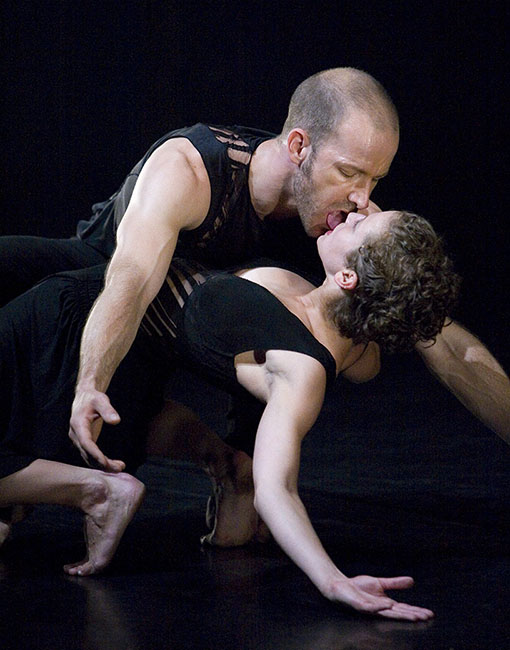
Letheren and Freedman in “Lascilo Perdere.” Photo by David Bazemore.
Apparently I am one of few out-of-towners to undertake that drive; though Summerdance now has a ten-year track record of tapping intriguing companies, not much interest seems to extend beyond the Santa Barbara county line, and I have a few thoughts on this. Summerdance does much more then import companies from New York; the festival holds master classes, gives choreographers space and time to create new dances, and hosts open rehearsals and lecture-demonstrations. But to the outsider, Summerdance may look like just another presenter taking a few risks on interesting companies, and dance audiences in L.A. and San Francisco most likely would rather chance whatever UCLA or Cal Performances choose to bring in the fall than drive to Santa Barbara for a few isolated performances.
As it stands, the Summerdance calendar is not packed enough for a dance fan to make a week of it. As for the festival’s reputation, I think they’ve limited the word-of-mouth by commissioning only New York choreographers; one wonders if anyone in New York beyond the companies that directly benefit know what Summerdance Santa Barbara is. The festival has never brought in a West Coast-based company, and that should be remedied. The possibilities for artistic cross-pollination between artists on the two coasts would be well worth reporting on, and Summerdance could build more of a West Coast platform for itself rather than getting lost in the national picture. As it stands, Summerdance is a boon to the handful of choreographers it commissions and to the dance-curious residents of idyllic Santa Barbara. If it tapped both East and West Coast talent, it could be much more, and much more (I wager) well-known. Dianne Vapnek has spent ten years building an energizing, eye-opening festival, and God knows she’s not one to lose ambition. Who knows what the next ten years of Summerdance could bring.
August 02, 2006 · 10:26 AM · Dance · Comments (0)
SF Ballet in New York
I wrote about artistic director Helgi Tomasson's transformation of the San Francisco Ballet for today's New York Times:
" "SAN FRANCISCO BALLET is the best ballet company in North America,” Mark Morris, the choreographer, declared last year in a video presentation celebrating Helgi Tomasson’s 20th season as the troupe’s artistic director.
Mr. Tomasson himself would never make such a claim. A mild-mannered native of Iceland, he seemed dispassionate as he sat in his office here one afternoon in May, looking out on the stately War Memorial Opera House.
“It’s been a great season this year,” he said, as if remarking on the weather. But asked to think back to the start of his tenure, he furrowed his brow. “I just knew that I wanted this company to be better,” he said. “A lot better.”
Not even Mr. Tomasson could have imagined what better might mean when he took over this country’s oldest professional ballet company in 1985. In recent seasons the San Francisco troupe has won glowing appraisals for its international roster of star dancers and choreographers at tour stops from Los Angeles to London. Even balletomanes who might differ with Mr. Morris’s enthusiasm expect to see a major company on Tuesday, when the San Francisco Ballet opens a run at the New York State Theater as part of the Lincoln Center Festival.
Over its 73-year history the company has enjoyed bursts of recognition as a sunny, admirable regional company and suffered pans for the slick spectacles choreographed by its former co-director, Michael Smuin. In 1978 The New York Times greeted an East Coast appearance, then rare, with the headline “San Francisco Ballet Conquers New York.” Yet when Mr. Tomasson, still green, prepared to unveil a full-evening “Swan Lake” for the company a decade later, many fretted that the dancers might not be up to the challenge.
“I rolled up my sleeves and went to work,” he said of his overhaul, which included instituting soloist and principal ranks in the previously unranked company, teaching every day and insisting that women wear toe shoes in class. “There was talent here. But most of all I felt there was such great support from the board, from the community. When I was hired, I was asked to take this company to another level, and that’s what I planned to do.” "
Click here for the full story.
July 23, 2006 · 05:24 PM · Dance · Comments (1)
Memo to Bay Area Dance Community
I'm in the midst of putting together the Fall Dance Preview for the SF Chronicle. If you've got a dance event coming up in the Bay Area between September and December, please send details ASAP to rachel at rachel howard dot com. Deadline for consideration is August 5. Thanks!
July 20, 2006 · 03:53 PM · Dance · Comments (0)
Yuri Possokhov's new role
As the San Francisco Ballet prepares for the Lincoln Center Festival, and Yuri Possokhov prepares to give his final performances, I talked with him about his new role as the Ballet's choreographer in residence:
"Yuri Possokhov rushed through the San Francisco Ballet building's halls like a frenzied character from a Dostoyevsky novel, dodging publicists and ballet masters, finally settling his muscled body into a corner sofa in the deserted dancers' lounge. On a day when most of the company was on break after a grueling spring season, Possokhov had photos to take, a visa to arrange for a gala in Japan, scheduling conflicts to untangle. Such is the pace of life for a star dancer who happens to be a rising choreographer. No wonder he'd felt numb at his farewell performance weeks earlier.
"The night of the farewell I was completely empty," Possokhov said, graying curls framing his famously chiseled jaw. "I thought I would cry -- no. No tears, no laugh, nothing. Then on our last day off, nobody here, I come to studio and rehearse. I was sitting in my locker room. I just sit there -- shooom!" He drew his hands in front of his crystalline blue eyes to illustrate the torrent. "It was like pouring."
Emotion has a way of pouring out of Possokhov in both his dancing and his dances, and right now those emotions must be intense. Though he took his final bow in San Francisco on May 5, the 42-year-old principal will give his last performances next week in New York during the San Francisco Ballet's Lincoln Center Festival engagement. Then he'll return to the unknown: a position as the company's resident choreographer and high expectations as one of the most promising dancemakers now working in classical ballet.
"I don't know what does 'choreographer in residence' mean?" he said. "Time will show." But if the duties of the job are vague, the announcement of Possokhov's appointment came as reassuring news to local ballet fans who have watched him evolve from dreamy danseur noble to a choreographer with a great gift for drama. "
Click here for the full story.
July 19, 2006 · 12:15 PM · Dance · Comments (0)
Keeping Patience at WestWave
I reviewed the first three programs of the WestWave Dance Festival for today's Chronicle:
"Must the WestWave Dance Festival feel like such a slog? Now in its 15th year, it's the anchor of the slow summer dance calendar and a useful survey of what's happening in Bay Area dance. Transcendent discoveries can be made -- I remember first seeing Janice Garrett's soul-stirring work at the WestWave four years ago -- but only by the truly patient. Executive director Joan Lazarus strives to keep an open door for choreographers in all stages of development, arranging them on programs driven more by logistics than curatorial vision. She should close that door more often. Dance in San Francisco is far more vibrant than the festival's first three programs would make you think.
That's not to say that involving, promising, even accomplished dance works weren't to be found last week at Project Artaud Theater, where the festival continues with six more programs through July 30. Erin Mei-Ling Stuart's "You and You and You" artfully draped the topless bodies of Damara Ganley, Noel Plemmons and Julie Sheetz in elegantly sculptural arrangements. Marlena Penney Oden and Isabelle Sjahsam stepped chicly through Leyya Tawil's highly stylish "Breakdown to Now," to sensuous electronic music by Tawil's longtime collaborator, Topher Keys. Sean Dorsey and Courtney Moreno swayed tenderly in Dorsey's well-crafted and touching "In Closing."
The problem was that these are artists who can rightly be called "emerging choreographers": committed, talented dancemakers whose work is in early stages of development and just beginning to find its audience. Whereas the WestWave Dance Festival chose to set the bar a rung lower, with a special program Thursday for choreographers -- several of whom appeared to have made work only for their own living rooms -- who could fairly be classed amateurs. "
This review is unusual for me; I usually devote far more space to describing the actual dances, giving some visual sense of their qualities. But after three programs, I felt something in the curating was askew and decided to write about the structure of the festival itself. Apologies to those choreographers whose works therefore got shorter treatment, and to those whose works didn't make it into the review (I saw something like 18 works over those three nights, so omissions had to be made). I regret not getting Christy Funsch's piece into the review, as her vocabulary has an appealing softness and her performances are always lovely. I also regret not having space for Kerry Mehling's clever solo set to a text by Dorothy Parker. But I know other critics noticed the piece, and I'm sure kudos will be coming her way.
Anyway, for my full review of the West Wave, click here.
July 18, 2006 · 01:45 PM · Dance · Comments (0)
Shuch's "Orbit" Makes Contact
I reviewed Erika Shuch's new "Orbit" in today's Chronicle:
"What makes Erika Shuch's work so arresting isn't the way she intuitively melds movement and theater, or the knack she has for attracting brilliant collaborators, or the Gen Y appeal of her slouchy, all-too-human performers. What's made this still-young choreographer a standout since she emerged in San Francisco six years ago is her childlike audacity in the face of big questions.
Shuch is a maker of metaphors, an existential explorer whose characters consider their place in the galaxy through poetic symbols. When Shuch's ideas get away from her, the product can be ponderous. But when her philosophical free association focuses on flesh-and-blood relationships, the results can be utterly disarming.
"Orbit," which just opened a three-week run at Intersection for the Arts, is mostly a case of the latter. It is profound but not pretentious, spectacularly clever and arguably Shuch's best work yet.
The metaphor this time is the search for extraterrestrial life, examining the human need for connection and the high odds against truly achieving it. Shuch and fellow cast member Danny Wolohan rush onstage, kissing madly, then repel one another. A voice-over tells us that "Orbiting is missing the target. One object doesn't see or feel the effects of the other object" -- a concept reinforced by the bright bull's-eye adorning the side of Shuch's dress. "
Click here for the full review.
July 17, 2006 · 10:59 AM · Dance · Comments (0)
Wells' Well-Crafted Suntmanship
Last night at an art opening, a woman who’s been disappointed by one too many undercooked Bay Area dance shows asked me what I’d recommend in town, and I was happy to have an enthusiastic answer on the tip of my tongue. Scott Wells and Dancers’ “Over You,” which opened Friday at cozy Counterpulse, is one of those shows that reminds me why I’m so glad to live in San Francisco. It’s raucous, it’s devil-may-care, it’s full of community spirit—but it’s also deceptively well made.
Scott Wells and one of his fellow dancer/stuntdivers.
Wells is one of the country’s leading Contact Improv teachers, which means he sends his dancers flying into one another's arms, surfing atop each other's shoulders, and otherwise peeling off of and vaulting onto one another in startling displays of trust. His dances are packed with stuntmanship, but he also knows how to craft a mean musical phrase. “Goodbye, Goodbye, Goodbye” isn’t great only because Nirvana’s “Smells Like Teen Spirit” makes Contact Improv-derived partnering look like a convincing stand-in for a mosh pit, but because in the midst of seeming chaos Wells punches you out of nowhere with steps so catchy you want to get up and dance them yourself. “Home,” a reworking of Wells’ first commissioned piece (for the Bates Dance Festival), also benefits from a rock-out soundtrack, turning a couch into a trampoline for Hallie Aldrich, Lindsay Gauthier, Suzanne Lappas, and Kegan Marling to the music of the Talking Heads, Jane’s Addiction, and others. Wells’s longtime cohort in craziness Jesselito Bie makes one of his most memorable appearances, lounging in a Hugh Hefner-style smoking jacket before slamming himself, with sumo-wrestler worthy grunts, into a kitchen table.
According to Wells himself, this show is just a warm-up for next year’s 15th anniversary season, for which he has more ambitious plans. But while the dances now on offer aren’t made for the ages, they’re smartly built and thrillingly executed. I’m glad I didn’t miss them.
Scott Wells and Dancers’ “Over You” continues July 21-23 at Counterpulse, 1310 Mission St. (at 9th). Tickets are $15 and reservations are essential: (415) 435-7552.
UPDATE: Danceview Times' Paul Parish enjoyed the show as well, and dedicated some time to a headier analysis of it:
" "Over you," the clever title of Scott Wells's new concert of contact-improv-based dance, had its opening night at Counterpulse in San Francisco. Wells has become over the last fifteen years the Paul Taylor of Contact Improv — that is, the first to make dances in this idiom that are deeply musical, somehow "normal," imaginative, witty, often hilarious, sometimes fierce, but always respectful enough of the concerns of the general public so that the audience in Peoria would feel they had something at heart in common. In Wells's case, perhaps as in Taylor's, it's rooted in a profound need to reconcile deep oppositions, softened and lightened by a Zen attitude towards the impossibility of it. For Wells, it looks like to me (and I follow Wells as some movie-goers followed Kieslowski) these oppositions are between art and athleticism, the masculine and the feminine, the almost disembodied breath of music and the deeply muscular nature of movement, and the aggressive and the passive modes of being. "
Click here for Paul's review.
July 09, 2006 · 04:37 PM · Dance · Comments (0)
Baryshnikov's Young Talents
Mikhail Baryshnikov's latest touring project, Hell's Kitchen Dance, is an absolute delight, mostly thanks to the talent of young Canadian-born choreographer Aszure Barton. From my review in today's Chronicle:
"It used to be Mikhail Baryshnikov kept getting older while the dancers around him kept getting younger. But with his latest project, Hell's Kitchen Dance, the ballet superstar is younger, too -- at least on-screen, where footage of him as a nimble Kirov Ballet student looms as oversized as his fame.
Onstage at the intimate Zellerbach Playhouse, where this Cal Performances engagement continues through Sunday, the present-day Baryshnikov took one look at the pliant knees and fearless jumps of yesteryear and shrugged in joking defeat Thursday night, even though his current physical state is hardly impoverished. He looped through the deceptively slouchy phrases of Benjamin Millepied's "Years later" with consummate control, and even chanced a high-flying moment or two. At 58, his kinesthetic intelligence is so refined that it is possible to choose a single element of his dancing -- his hands, for instance -- and spend an entire night fascinated by the choices he makes with them.
And yet his performance is not the primary reason this program rates a must-see. Hell's Kitchen Dance is named after the Manhattan neighborhood of the recently opened Baryshnikov Arts Center, where Millepied and Aszure Barton are the first beneficiaries of Baryshnikov's initiative to foster fresh dance-making talents. Millepied may be gifted; it was difficult to tell from "Years later," which was enhanced greatly by Olivier Simola's extensive videography, but lingered in mind more as a clever star vehicle than a statement of choreographic originality.
Barton is clearly brilliant.
This became obvious toward the end of "Over/Come," the work for 13 dancers (sans Baryshnikov) that opens the evening. It's set to love songs one might imagine spilling out of a Bohemian cafe on a warm summer evening and populated by romantically disaffected hipsters in casually chic clothing. But it's the punchy movement rather than the atmosphere that keeps the dance compelling. Barton dissects phrases into tiny parts, rearranging and manipulating them into physical non-sequiturs. The result is an unpredictable chain of precise motion, punctuated by physical explosions more complex and outrageous than the best Jim Carrey impersonation."
Click here for the whole review.
June 17, 2006 · 05:13 PM · Dance · Comments (0)
Everybody Loves Remy
The feedback I'm already receiving on this article in today's Chronicle just further confirms how beloved Remy Charlip--choreographer, founding member of the Merce Cunningham Dance Company, children's book author and illustrator--is in the Bay Area:
"The first time I saw Remy Charlip, he was 71, wearing a yellow raincoat and hat, and riding aloft upon the hands of a dozen beaming, stark-naked men. The work was "A Moveable Feast," Charlip's commission for the 2001 Lesbian and Gay Dance Festival, and what truly made the dance memorable was not the contrast of muscled bodies with Charlip's lightly liver-spotted skin, not the perfect comic timing as Wagner's "Tristan und Isolde" swelled. The unforgettable element was the youthful joy radiating from Charlip's face. The crowds loved it.
San Francisco choreographers have loved Charlip since he moved here in 1989. A founding member of the Merce Cunningham Dance Company and the author and illustrator of 33 children's books, Charlip quickly became a mentor, advising the risk-taking collective Contraband, collaborating with Margaret Jenkins, lending choreographic ideas to everyone from Axis Dance to Oakland Ballet.
Naturally, then, choreographers were the first by Charlip's side when he suffered a potentially debilitating stroke last Halloween.
"He's not connected to his family of origin," said performance artist Keith Hennessy, one of a dozen friends on a roster of 24-hour attendants who cared for Charlip after his release from the hospital. "What we discovered after the stroke was, guess what, we're his family."
One of Remy Charlip's "Air Mail Dances." The drawings show the dance's key moments. The performers are then free to choreograph the spaces in between.
At first Charlip could hardly speak or move. The friends set up a committee to make decisions about health care and living costs, provide physical therapy in the Alexander Technique -- of which Charlip is a practitioner -- and to visit and read to him. Today, Charlip can speak and write, though he often confuses words and numbers, and is beginning to use the telephone. But his admirers are not content to stand idle. "The way we know how to help," Hennessy said, "is to put on a show."
The range of performers in Saturday's "Every Little Movement: A Benefit for Remy Charlip" testifies to the breadth of artists he's inspired. The lineup includes everything from the raucous political diatribes of Dance Brigade to the serene aerial work of Joanna Haigood to the quirky dreamscapes of former San Francisco Ballet principal dancer Julia Adam. The dancers hope to offset Charlip's medical bills, but just as passionately, they want to spread appreciation for a singular artist they adore. "
The story includes a great photo of Remy in all his irrepressible whimsicality; for the whole thing, click here.
June 15, 2006 · 10:04 AM · Dance · Comments (0)
Margaret Jenkins' "Slipping Glimpse"
The good news about the Margaret Jenkins Dance Company’s latest show is that it contains some of the best dancing I have ever seen in San Francisco: Heidi Schweiker with her unfailing clarity of shape and intense doll face; Levi Toni with his broad-shouldered dignity; Deborah Miller with her long lines and gentle glamour. The whole company is firing on all pistons for the full 75 minutes of Jenkins’ new “A Slipping Glimpse,” ricocheting through the Yerba Buena Center for the Arts Forum like electrons, phrasing every roll to the floor, every urgent leap into each others’ arms. This is testament to Jenkins’ kaleidoscopic inventiveness as much as the dancers’ commitment. “A Slipping Glimpse,” as longtime Jenkins fans will not be surprised to hear, is formally brilliant. It is also conceptually muddy. And for all the fine dancing on display, it begins to feel relentless.
The work’s title comes from Willem de Kooning, but the work’s key element, four guest dancers, come from Kolkata, India, where last year Jenkins traveled to work with the Tanusree Shankar Dance Company. These dancers use a contemporary amalgam of classical Indian styles, and Jenkins draws subtly and keenly on their vocabulary, the American dancers taking on flexed feet and delicately arrayed fingers while the Indian dancers sculpt their bodies into modern dance shapes. Jenkins is too sophisticated to offer this as an “It’s a Small World” celebration. But just what “A Slipping Glimpse” is saying, either politically or emotionally, is never clear.
Voluminous program notes talk of the work’s “vertiginous moment in history, when it’s often difficult to tell on which side of the looking glass we’re standing—or dancing. Public, private, inside, outside—all such terms seem open to questioning and exploration.” Alexander V. Nichols’ visual design plays on that outside/inside—and on the stunning work he did for Jenkins’ 2004 “Danger Orange.” This time the fractured stage is a huge red diamond, with seating on all four sides, and platforms at the corners and behind the audience.
Sometimes the Indian dancers are on the outside of the square; sometimes the American dancers are; usually it’s far more subtle. Too subtle, or layered with meanings accessible only to Jenkins and her collaborators. Poet Michael Palmer’s narrative interludes were stirring in their own right, but aided my interpretation of the dancing not one whit; evidently text from Eliot Weinberger’s essay “What I Heard about Iraq” was used as choral fragments, but my ear failed to latch onto that. Paul Dresher’s live score gave the dancers swathes of sound, sometimes jazzy and sometimes rock-tinged, enhanced considerably by cellist Joan Jeanrenaud.
What Jenkins is trying to do is evoke timely political and emotional questions in a formalist framework, and it’s fascinating to consider why “Danger Orange” succeeded so well at that and “A Slipping Glimpse” does not. In “Danger Orange” the conceptual hook (the country’s “terror alert” system) was simple; the movement imagery (militaristic crawls, violently clutched throats), clear. With those concrete elements set, our minds felt free to wander and make associations. In “A Slipping Glimpse,” we’re never given the ground rules. Everything remains abstract.
“A Slipping Glimpse” starts with an outdoor prelude in the Yerba Buena Gardens. The night I attended, last Friday, the grass was too wet for the dancers’ safety and the prelude was omitted. Perhaps it is the key to everything. I sort of doubt it. Whether it unlocks the work for you or not, the current company should not be missed. Jenkins’ dancers are more fierce, while the Indian dancers—Debjit Burman, Jaydip Guha, Rahmi Karmakar, and Sulagna Sarkar—are more fleet. They mingle well. “A Slipping Glimpse” continues tonight (Wednesday) through Saturday; for info, click here.
May 24, 2006 · 10:47 AM · Dance · Comments (0)
No, I'm not returning to full-blown blogging (she doth protest too much?), just popping in to highlight a show flying low under the radar. With so many Bay Area choreographers gaga over arts-funding conditions in Germany, the gutsy San Francisco venue Counterpulse is taking a big risk on bringing Cologne-based choreographer Silke Z here. You might remember Silke Z from her trans-Atlantic work with Jess Curtis, one of the more successful Bay Area choreographers to try his luck in Europe. Silke Z's San Francisco stay begins with two performances of the raucous dance/performance/graffiti/video work "DARE 3" next Sunday and Monday; she'll then spend the next month creating "DARE 5" before unveiling it June 30-July 1. I really have no idea what to expect, but then, that seems appropriate. Check out the postcard below or click here for the Counterpulse site.

May 23, 2006 · 01:00 PM · Dance · Comments (0)
SF Ballet 2006 Wrap-up
The San Francisco Ballet season is coming to an end, and I can't help blogging about it.
The season closed with a farewell gala, which I reviewed for the Chronicle:
"Cheers and confetti rained upon the Opera House stage Friday as three of San Francisco Ballet's most beloved male dancers took their final bows there.
Stephen Legate has danced with the company for 15 years, Peter Brandenhoff for 14 and Yuri Possokhov, 12. Possokhov especially has been an artistic force at San Francisco Ballet, lending Russian passion across the repertory, staging "Don Quixote" alongside Artistic Director Helgi Tomasson, and launching his own highly promising choreographic career.
Yet something more than these dancers' collective contributions was being marked as the audience shouted and the red roses flew. Together, these three men are emblematic of the new San Francisco Ballet under Tomasson, who took the reins in 1985, and their departures point to others soon to come. Muriel Maffre, for instance, has talked of retiring for years; her smile at the curtain calls for Jerome Robbins' "In the Night" Friday may have been fueled not just by her exquisite performance alongside Damian Smith, but by the relief -- hers and ours -- that it is not yet her last. An era was passing. But the mood was as celebratory as it was wistful.
"I don't doubt that each and every one of you has special memories of these dancers' performances over the years," Tomasson told the audience, and for the next two hours we relived many of them.
The most gratifying moments were in the small details: Possokhov's open palm and curled fingers as he fled fiery Lorena Feijoo during the tempestuous final pas de deux of "In the Night"; Legate's inimitable tenderness as he cradled Tina LeBlanc to the ground in an excerpt from Lar Lubovitch's "... smile with my heart"; Brandenhoff's insouciant swinging arms as he strutted toward the wings in Hans van Manen's "Solo." "
Details of the 2007 programs will be out any day now. As my review notes, it will be a season of rebuilding, with dancers throughout the ranks making departures, and most likely a pivotal year in the company's development. But 2006 was hardly a holding pattern, which I must admit is what I had expected.
"Swan Lake" proved to be not just a box office hit, but a smashing way to start the season, with the corps dancing strong and three ballerinas leaving distinct stamps on Odette/Odile: Tina LeBlanc sweet and empathic, Lorena Feijoo impeccably stylized, Yuan Yuan Tan elegant and surprisingly tender, my favorite of the three (sadly I missed Kristin Long). Gonzalo Garcia made a strong acting debut as Prince Siegfried, but Tiit Helimets left the most striking impression with his innately noble presence, while thick-muscled Davit Karapetyan showed his lofty jump to far better advantage in contemporary works like Helgi Tomasson's "Chaconne."
As for the mixed rep, Lar Lubovitch's "Elemental Brubeck" emerged as the most flattering of the three premieres created for last summer's Paris engagement, a Cyd Charisse-tinged jaunt whose trajectory was sometimes as loopy as Lubovitch's movement style. But the casts--especially radiant Katita Waldo, Frances Chung, and Gonzalo Garcia in three solos that had certain viewers screaming like girls at a Beatles concert--swung through it with verve.
The all-Jerome Robbins evening should become a season staple. I didn't care for Yuan Yuan Tan as the mirror-entranced girl of "Afternoon of a Faun" (too much of an otherworldly creature, not enough human erotic tension), but soloist Sarah Van Patten was ravishing opposite Moises Martin. Joan Boada charmed in "Other Dances" before an injury took him out of the season, and the corps made the return of "Glass Pieces" anything but pedestrian.
I found Tomasson's new "The Fifth Season" entrancing, and his "Blue Rose" an utter bore. Neither was the season's dancing always inspired: Balanchine's "Rubies" looked rote. And then there was William Forsythe's "Artifact Suite," slapping you awake from nowhere like the work's sudden curtain falls. The corps dancers gave themselves to Forsythe mind, body, and soul. This was a new level of achievement for the company.
Perhaps now I will institute my first-ever "Corps Dancers to Watch":
--Rory Hohenstein (just promoted): Leading-man looks, that gorgeous plastique through the torso, neck, and head. A man among boys in "Elemental Brubeck."
--Courtney Elizabeth: A punchy, go-for-broke dynamism in "Brubeck."
--Brooke Taylor Moore: A tough, solid gal with will to spare and a forceful presence.
And among the soloists, I wish I had come back to the opera house more often to see Nutnaree Pipit-Suksun, with that effortless extension and that supple back. I hope to watch her flourish next year.
May 09, 2006 · 01:09 PM · Dance · Comments (1)
I've got a short talk with Oakland Ballet founder Ronn Guidi in San Francisco Magazine this month, getting his from-the-gut take on the company's demise. It's not available online, but it's accompanied (or rather, dominated) by an emotionally evocative photo of the puckish Mr. Guidi--well worth flipping to if you see it on a newsstand near you.
May 03, 2006 · 04:03 PM · Dance · Comments (0)
Sylvia, Take Two
I haven't been posting my dance reviews, but I am (briefly) coming out of the dance blogging netherworld to link to this review of Mark Morris' "Sylvia," and to whisper a secret: Critics have second thoughts. Even two days after the performance.
Perhaps you're bound to reconsider just a bit when you write that "San Francisco ballet artistic director Helgi Tomasson is sure to have a national hit on his hands when the company takes 'Sylvia' to New York this summer." In fact, I stand by that statement--I predict that "Sylvia" will do swimmingly in Manhattan, world capital of Morris worshippers, though it will be fascinating to see how it fares back-to-back with the Royal Ballet's performances of Ashton's version.
I also stand by my points of praise for Morris' staging and choreography; the rightness of the symbolism and the steadiness with which he layers meaning upon his movement motifs is deft. His physical characterizations--the skittering water creatures, the prancing huntresses--are nothing short of brilliant. And yet I walked out of the theater filled with more admiration than excitement. I had entered with expectations (very rarely do I not arrive with at least slight expectations, though I strive mightily against this) that the ballet would leave me vaguely unstirred, as it had last year. So I was pleasantly surprised to find myself deeply impressed. I was happy to chalk up any hazy dissatisfaction to the mildness of the story's morals.
But hindsight is the critic's occupational hazard. If I had it to do again, I would add a few caveats. This is not a production of classical spectacle. The ensembles are kept deliberately small--no cadres of pointe-shoe clad otherwordly creatures working with mesmerizing sychronicity. But more to the point, there is little "dancey" dance. Morris is working mostly in postures and deliberately deployed symbols here. His ballet vocabulary is not vast and certainly not inventive. His style is weighted, unadorned, and straightforward. None of this much bothers me. But, thinking about the ballet today, I do feel a lack. Never in "Sylvia" do we feel a joyous flow of movement, a number that sweeps us up into kinesthetic pleasures. I'm thinking of "The Hard Nut," of those daffy, exuberant snowflakes whirled across the stage by the Tchaikovsky score, of that stage full of mopey flowers tossing themselves about to the waltz. I'm thinking too of "L'Allegro" and those thrilling, hand-in-hand chains of group motion. Those are the moments that sweep you into an emotional pitch whose goodwill radiates upon the entire evening. "Sylvia" has no such moments. If its movements are smartly arranged, you could also call them stilted.
A critic is nothing without her opinions, and even writing these caveats feels dangerous. But let's be honest: I liked "Sylvia" upon second viewing quite a lot, but I see how you might not. In fact, if you would like to judge for yourself (and I believe that you should), I am joining a group of fellow congregation members from Grace Cathedral for the May 2 performance. I believe tickets are still available, though limited. Click here for information.
UPDATE: Stephanie von Buchau and Paul Parish blame the dancers' performances for their "Sylvia" let-downs. I could see nothing materially different in Miner's performance or any of the other dancers' this year, and think Morris' production simply couldn't live up to last year's hype. But Parish nearly persuades me, particularly with his theory that the corps "shot their wads" (colorful phrase) on Forsythe's "Artifact Suite."
April 24, 2006 · 09:01 PM · Dance · Comments (1)
Bourne's "Swan Lake" in SF
Want to study Art through an
online college? Check out the many online
bachelors
degree programs available, such as fine arts, graphic design, and even
online MBA
programs that are now available. Remember to look at all your
online education options here
today!
***********************************************************************************************
Matthew Bourne's male-swan version of "Swan Lake" is finally coming to San Francisco. I talked to Bourne for the Chronicle:
"It's played Paris and Tokyo and kept London audiences queuing around the block. It's been a smash hit on Broadway and in Los Angeles and left an impression on millions of viewers who loved the film "Billy Elliot." And yet Matthew Bourne's "Swan Lake" -- the famous version featuring powerful, bare-chested men instead of the usual flock of ballerinas en pointe -- has never been performed in the Bay Area. In fact, surprisingly little of Bourne's work has.
"That's going to change, I hope," the 46-year-old British choreographer and director says as he settles into an armchair at the Clift Hotel, parting the drapes to view a city he has rarely had occasion to visit. "I've always felt 'Swan Lake' would do well here. Sometimes people say, 'Please, why don't you come' to someplace or other and you think, 'Er' ... but I'm so glad we're coming to San Francisco now because I feel it's the right place for the work."
"Now" is a decade after "Swan Lake's" wildly received premiere, on an international tour. Why such a long wait for the most popular work by Britain's most popular contemporary choreographer? Strangely, Bourne's oeuvre has never gained a foothold in the Bay Area. In 2001, Cal Performances brought "The Car Man," his noir twist on the Bizet opera, to UC Berkeley, to a warm reception, but when Bourne's "Nutcracker!" came in 2004, ticket sales tanked. So Cal Performances canceled its 2005 presentation of Bourne's breakthrough "Play Without Words" -- and yet again Los Angeles fans lauded a Bourne production while San Franciscans missed out.
"Swan Lake" should reverse that trend. Set in a modern-day England where the Queen keeps Corgis and the Prince takes to a vulgar girl who bears more than a passing resemblance to Sarah Ferguson, "Swan Lake" brought Bourne huge audiences and fame in 1995 and became a contemporary classic. Dozens of choreographers have tinkered with the story, but none have created an image as widely resonant as Bourne's menacing winged men pecking mercilessly at an aristocrat who yearns for freedom.
"It's proved to be a great trailblazer for our work," Bourne says. "It constantly amazes me, the audience reaction. Always we get this roar -- we call it 'the "Swan Lake" roar' -- at the end of the show. It's an incredible thing that happens, and it doesn't matter who's playing the lead, what bobbles we had, anything. It always gets that reaction." "
Click here for the full story.
March 12, 2006 · 09:08 PM · Dance · Comments (0)
SF Ballet's "Faun"
My review of San Francisco Ballet's all-Robbins program hit the stands in the Chronicle today; the paper's website gives it the unfortunate headline "Mediocre Faun." That sounds harsher than what I wrote, which was simply that Yuan Yuan Tan was not the best pick for the part:
"These are famous roles boasting a long line of illustrious interpreters; small wonder Tuesday's cast looked tentative. Ruben Martin made a solid first effort, fittingly naive as the beguiled boy, arching languorously into the poses that recall Nijinsky's orgasmic faun. But Yuan Yuan Tan's interpretation stressed narcissism over vulnerability, and the full risk of Martin's impulsive peck on the cheek missed its impact. I'm keen to see Rachel Viselli and Sarah Van Patten try the part. "
I saw Van Patten in the role last night opposite Moises Martin; the pair was ravishing, the "fragile atmosphere" of the ballet, as Deborah Jowitt called it in her lecture last night, was restored, and I felt confirmed in my disappointment on opening night. With her impossibly long, lithe lines and elegant reticence, Tan is too much an idealized creature to be believed as a flesh-and-blood young dancer. Her gymnastic developpes at the bar made you gawk at her flexibility, not feel the tension of the story unfolding. Whereas Van Patten, one of the most naturalistic dancer-actresses I've ever seen, was a rich character: naive, self-absorbed, even a little bobbling in her unsupported developpe a la seconde. She and Moises Martin had wonderful chemistry, and when he kissed her you felt the shock of the idealized sexuality of ballet made corporeal. This was truly the cast to see.
March 09, 2006 · 10:15 AM · Dance · Comments (0)
Speaking of Deborah Jowitt--and with San Francisco Ballet's All-Robbins program opening tomorrow night--it's well worth noting that Jowitt will be lecturing on Jerome Robbins Wednesday at 6 at the Main Library's Koret Auditorium. Jowitt's biography of Robbins cane out in paperback last year. The lecture is free; click here for more info.
March 06, 2006 · 07:16 PM · Dance · Comments (0)
Entrances and Exits at ODC
My review of ODC's opening gala hit the Chronicle today:
"ODC/Dance Artistic Director Brenda Way may run her company with a socialist, counterculture spirit, but she knows a marketing coup when she sees one. For the troupe's 35th anniversary season, which opened with a gala Thursday, she invited former San Francisco Ballet principal Joanna Berman to dance the duet in Way's "Part of a Longer Story." It's a tribute to both Berman and the company's artistry that her performance was exquisite without ever overwhelming the considerable ensemble charisma now on display at the Yerba Buena Center for the Arts Theater.
Worthier star vehicles are difficult to think of; Way's 1993 duet (the opening section was added in 1995, the closing in 2002, hence the title) ranks among her finest works. Set to Mozart's Clarinet Concerto in A, it uses whimsical gesture like throwaway seasoning -- a dash of wiggling hand here, a pinch of bobbling head there -- yet it's the accrued movement motifs that steadily tug at the heart.
The tentative, testing dance of intimacy Berman shares with Brandon "Private" Freeman is built around a turn in attitude -- one leg bent behind, arms reaching straight as an arrow until one hand grabs the foot. When, after Berman has begun to succumb to his pull, she grabs that back foot and then releases it as though she's touched a hot stove, it communicates more clearly than the most passionate embrace. That's the suggestive power of masterful formalism.
Berman and Freeman gave the duet the dramatic shadings of love in all its complexities. Both have technique to spare, but the virtuosity here was in the subtle emotional shifts, she at first fighting her attraction but ultimately panting with longing; he tender and then, in the way even caring men can be when they've won what they wanted, retracting. And it was all in the dancing, not the acting. When Freeman pulled Berman into a balletic supported retiré on a surge in the music, the clarity of shape and intention was captivating.
With a duet of such intensity, perhaps it's natural that the first and second movements would feel like incidental bookends, even with a spirited solo performance by retiring 15-year veteran Brian Fisher. In truth, the choreography does not rise to the standard of Way's own pas de deux sets. And in fact, the rest of the program will probably be remembered more for the dancing than the dances. "
Click here for the full review.
March 04, 2006 · 12:52 PM · Dance · Comments (0)
Critics and Choreographers
I'm giving a guest lecture on dance criticism tomorrow afternoon at San Francisco State University, and while I'll be taking a mostly nuts-and-bolts approach, it's rather nice timing that Deborah Jowitt's interview with Tere O'Connor should come out this week. Its hook is O'Connor's angry letter to New Yorker critic Joan Acocella and his contention that critics should enter into in-depth conversation with choreographers so as to approach reviewing the work through the lens of the choreographer's intentions. Jowitt respectfully objects to this methodology, while Acocella, John Rockwell, and Jennifer Dunning weigh in with their ideas of the critic's role. I'll be passing this article out to the students. It's a must-read.
UPDATE: Downtown Dancer follows up with further provocations.
March 02, 2006 · 11:38 PM · Dance · Comments (0)
Recommended this Week
I know, I know--I've been remiss about posting here. I've been out of town, I've been working on last revisions on a short story, and on my novel. But I've got lots of dance-going recommendations up my sleeve, starting with this: the Nrityagram Dance Ensemble Friday and Saturday at the Yerba Buena Center for the Arts. Contemporary stagings of classical Odissi dance from India.

I haven't seen this company yet, but I've been hearing about them all year. The New Yorker's Joan Acocella loved them (scroll down toward the bottom), and so did Dance View Times' Leigh Witchel, along with a raft of other trusted sources. I'm looking forward to seeing for myself Saturday. See you there.
February 28, 2006 · 11:08 AM · Dance · Comments (0)
Joanna Berman's Mistaken Identity
I'm in Santa Barbara taking a much-needed mini-vacation with my husband, walking along the cliffs above the beaches, and checking out from email and this website and professional life in general until Monday. But I am in the Chronicle today with a story about retired San Francisco Ballet principal Joanna Berman returning to the stage for ODC/Dance's upcoming home season:
"A love story is playing out in a first-floor studio of the ODC Dance Commons, where two dancers push and pull and fretfully embrace as the strains of Mozart's clarinet concerto waft through the room. The man walks toward the studio mirror and lies on his back, bent legs in the air; the woman climbs atop them and curls up like a cat. Then she stands again and, never taking her eyes off the man's, takes slow, tender, regretful steps away.
"That was perfect at the end," ODC/Dance Artistic Director Brenda Way says, clasping her hands with pleasure. "But don't walk back like this." She bows her legs like a duck and waddles, an unmistakable parody of the ballet dancer's customary turnout.
"Really?" Joanna Berman says teasingly. "I was going to ask if I could finish like this." She rises high on her toes, arms forming a halo around her face, and takes tiny nibbling steps, bourreeing like a perfect toy dancer in a jewelry box.
It's an image many dance fans would pay dearly to see: Berman, one of the most beloved ballerinas in San Francisco Ballet history, looking like "The Sleeping Beauty's" Aurora reawakened by a kiss. Or perhaps the role her gently tilted torso and enormous, kind eyes most vividly evoke at this moment is Giselle, which is fitting. She danced "Giselle" for the final performance of her 18-year career at the Ballet, gliding like a benevolent spirit across the Opera House stage in 2002.
She was 36 then -- young to retire, even by ballet's unmerciful standards. But she wanted to have a family with her husband, violinist Rene Mandel. "I just knew the days of full-length ballets and pointe shoes and all that pressure were over," she says after rehearsal, her soft voice a breathy whisper. "I was a little fatigued and didn't want to deal with it anymore."
But she never said she wouldn't dance again. And so here she is four years and twin sons later, having traded a tutu for jazz shoes, dancing the central duet in Brenda Way's "Part of a Longer Story" for ODC/Dance's 35th anniversary season. "
Too bad the Chronicle photo department seems to have a hard time ID'ing their photos these days. The dancer in this shot, which ran with the story, appears to be Tina LeBlanc. Thanks to David Hicks, Diablo Ballet marketing manager and longtime Joanna Berman watcher, who gave me the heads-up even before I knew the story had run.
See you back in San Francisco.
February 23, 2006 · 09:34 PM · Dance · Comments (0)
SF Ballet's Joyous "Rodeo"
San Francisco Ballet's "Rodeo" is a must-see. From my review in the Chronicle:
"Mirth and whimsy reigned in all of the offerings on San Francisco Ballet's third program Thursday night, but rarely has the War Memorial Opera House been filled with so much sheer joy as upon the return of Agnes de Mille's "Rodeo." Bighearted, unabashedly theatrical and not performed by the company in more than a decade, it's the kind of work that makes dancers put aside the pyrotechnics and get back in touch with their basic humanity. The whole cast looked as if they were having a hoedown of a time in it.
They just don't make them like "Rodeo" anymore. Premiered in 1942, de Mille's tale of a loveless cowgirl was created when ballet in this country was reaching toward realism and American themes, when dance could be as much about storytelling as about steps. Today's choreographers would blush at the idea of ranch hands chasséing around on invisible horses. And yet still today when the waddle-legged dancers skip across the stage, we see the broncos and the dust.
Just as magical is Aaron Copland's stirring score, with the orchestra sounding appropriately mythical under Martin West's baton. Little wonder "Rodeo" is also enjoying renewed popularity in New York, as part of American Ballet Theatre's current season.
In recent years, San Francisco Ballet, increasingly more accustomed to dancing Balanchine and the 19th century classics, has looked self-conscious in this earnest kind of early 20th century work. To get a truly chilling take on Lew Christensen's "Jinx," for instance, you had to cross the bay to Oakland Ballet. But Thursday the dancers, directed by noted past Cowgirl Christine Sarry, seemed to relish the change of mode. "
For the full review, click here.
February 18, 2006 · 09:00 AM · Dance · Comments (0)
Allan Ulrich reviewed San Francisco Ballet's program 2 for Voice of Dance:
"The scent of revolution, ancient and modern, hovered in the air Tuesday (Feb. 14) at the War Memorial Opera House, where the San Francisco Ballet opened its first mixed repertory program of the season. Juxtapose George Balanchine’s Apollo, a virtual manifesto of neoclassicism, with the American premiere of Christopher Wheeldon’s Quaternary, a peek at the shape of neoclassicism in the 21st century, and you’ve already got a substantial banquet. In the middle and somewhat overshadowed by the titans surrounding it, came the world premiere of artistic director Helgi Tomasson’s Blue Rose, an affable trifle danced by a sextet of A-Team wonders. The program runs in alternating repertory through Feb. 25."
Janice Berman's review will appear in the Chronicle tomorrow; criticism-wise, I sat this out. I will say frankly that I was almost glad not to be writing about this program. It was one of those slates that was impossible to be passionate about, either positively and negatively. Aside from Gonzalo Garcia's turn in "Apollo," which was absolutely scintillating, I found this to be rather dull going. Unsurprisingly, all the dancers were wonderful. But Tomasson's "Blue Rose" can't hold a candle to his better recent works, like "7 for 8" and "Concerto Grosso." The music by Elena Kats-Cherin is for piano and violin, a mash of tango, ragtime, Baltic influences and more in which all the flavors blend into blandness. Tina LeBlanc has some wonderful whirling top solos, and Nicolas Blanc and Pierre-Francois Vilanoba have a high-flying showdown that throws off some sparks. But where are these people? In a dance hall or out in the fields? What's the milieu? Judanna Lynn's busy and gaudy silk calico dresses and Lisa J. Pinkham's dated lighting design don't help.
I was also less than bowled over by Christopher Wheeldon's "Quarternary," which I found also strangely dated. The final section, set to Steve Mackey, reminded me of some Joffrey rock ballet resurrected from the 1970's. I suppose I might not have minded this if there had been some sense of irony, of knowing quotation, but as it was I felt I'd entered a time warp. The saving grace was Katita Waldo, looking young and fiery. Muriel Maffre and Yuri Possokhov were exquisite in "Summer," which has several compelling images, though I've seen this Arvo Part music more movingly handled by other choreographers (the Bay Area's Janice Garrett among them). The Bach "Spring" was a wash of vague pastoralism for me, redeemed by top-notch dancing. "Winter," set to one of John Cage's crazy-clockwork-sounding prepared piano scores, was the strongest section to my mind, with its waggling hips and arms and its rather Alwin Nikolai-like, other planet atmosphere (Yuan Yuan Tan and Damian Smith danced the leads). But though I'm a steady admirer of Wheeldon's talents, I don't think this ballet is one for the ages.
I'm keeping my remarks short and inadequate because it's late, because I've just returned from a very helfpul critique of one of my new short stories at my writers group and I want to think about my fiction, and because Allan Ulrich makes the pro- case for "Quarternary" more animatedly than any objections I can raise here. So it's onward to program three, which contains one of my favorite ballets, Agnes de Mille's "Rodeo," and opens tomorrow (Thursday) night. Look for my review in the Chronicle on Saturday.
February 15, 2006 · 11:20 PM · Dance · Comments (0)
Yannis Adoniou's up-and-coming experimental dance company Kunst-Stoff made its debut at the Yerba Buena Center for the Arts Theater over the weekend. As I write in my necessarily succinct review for the Chronicle:
" "As we close their eyes," created with input from two representatives of the LightHouse for the Blind and Visually Impaired, had moments of promise. At one point Kara Davis and Jose Campos danced a clingy duet while Sheldon Smith and Nicole Bonadonna provided absurdly inadequate verbal descriptions. At another, Austin Forbord traced Bonadonna's body with a video camera, the live images imitating the sensation of touch. Jennifer Vogt's stage design drew a red string above the audience like a laser beam. It was anchored to the stage by a red drum that made mysterious noises when the string was touched.
But for most of the work, the effects remained too distant to compellingly engage the senses. When four mikes lowered to amplify the dancers' panting breath, when sounds continued as they moved through darkness, the ideas were understood rather than felt. I wondered if Kunst-Stoff weren't having trouble transferring their avant-gardism to a larger venue. "As we close their eyes" might have worked better as an installation at one of the more intimate spaces Kunst-Stoff usually plays, where the dancers are so close that you can feel their energy and smell their sweat. "
Click here for the full review.
February 13, 2006 · 02:18 PM · Dance · Comments (1)
Oakland Ballet Post-Mortem
Allan Ulrich analyzes the factors behind Oakland Ballet's demise in today's SF Chronicle, giving a vivid catalogue of the company's past glories, and sparing artistic director Karen Brown no criticism:
"For those of us who experienced the Oakland Ballet in action during its heyday, those of us who remember the significant chapter in Bay Area dance history written by founding Artistic Director Ronn Guidi, the mourning is mixed with rage. This didn't have to happen . . .
Guidi frequently ran up deficits, and by 1999, the board reportedly balked. But he had a vision and had left a substantial repertoire behind for his successor.
Brown was an unusual choice for the job. Although she had danced for many years with Dance Theatre of Harlem, she had never run a company (neither had Helgi Tomasson at the San Francisco Ballet, but that organization's extensive infrastructure provided a cushion). She does not choreograph, and, from all reports, rarely gave company class. It was disappointing that, at the beginning of her tenure, Brown tapped so little of Oakland's existing repertoire, but it wasn't entirely her fault. The stage at the Paramount Theatre, where the Oakland Ballet then performed, was always too narrow to accommodate many of Guidi's reconstructions.
Still, any company that radically changes its artistic personality overnight flirts with failure. Ironically, Brown's last season opener in October, an evening that juxtaposed revivals of Loring and Nijinska with her own commissions from Michael Lowe and Donald McKayle, was exactly how she should have programmed during her first season. She had made no previous attempt at imposing continuity and leading a gradual evolution, and if Guidi's wisdom was sought, it wasn't much heeded. Is it any wonder the dance crowd and funding sources were confused?"
Click here for the whole commentary.
February 08, 2006 · 09:50 AM · Dance · Comments (0)
The Black Choreographers Festival is back for 2006. I wrote about it in today's SF Chronicle:
"Laura Elaine Ellis' face is bright with energy, and her glow has more to do with innate optimism than with the sunlight pouring into the lobby at Dance Mission Theater. "It's all about legacy," she says, leaning deeply.
"Longevity is just part of the African American culture," her colleague Kendra Kimbrough chimes.
"Each one teach one," Ellis says.
"And responsibility to the community," Kimbrough finishes.
These women know whereof they speak. Last year they took a dormant festival that had once galvanized the African American dance community and brought it roaring back to life. The Black Choreographers Festival: Here and Now picked up where the discontinued Black Choreographers Moving into the 21st Century had left off a full decade earlier -- and the new festival hit the ground running.
BCF 2005's two weeks of shows, overflowing with everything from hip-hop to Congolese tribal dancing, nearly sold out. Master classes and symposia were packed with eager and intrigued dancers. The new festival turned a profit: the seed money that would allow it to thrive, not just survive.
Now it's back for 2006, and it's bigger. Two slates of dancing -- featuring top Bay Area talent like Joanna Haigood and Robert Moses, along with hot visitors like prodigy tapper Jason Samuels Smith -- will run two weekends, first in San Francisco and then in Oakland. Ellis and Kimbrough also have cooked up a Dance on Film series, a symposium and a photography exhibition. And because so many artists were clamoring to participate, they've created a Next Wave Choreographers Showcase for African American choreographers just starting their careers. "
Click here for the full story.
February 05, 2006 · 04:59 PM · Dance · Comments (0)
Thanks to those who have written to me to express gratitude for being listed in the A-Z guide, and equal thanks to those who were not listed but wrote to bring their companies or studios to my attention. It's just further testament to the size and vibrancy of the Bay Area dance community. Here are a few more groups that didn't make it into the guide, but are well worth checking out:
City Dance Studios
Company C contemporary ballet
Mark Foerhinger Dance Project
Mahea Uchiyama Center for International Dance
Nancy Karp and Dancers
Click through to their websites to discover even more Bay Area dance.
February 02, 2006 · 08:57 PM · Dance · Comments (0)
My take on Ron K. Brown/EVIDENCE, in the Chronicle:
"To appreciate the stir Ronald K. Brown's "Grace" made when it premiered at Alvin Ailey American Dance Theater in 1999, you have to understand the situation the company was in. For more than a decade since Ailey's death, the predicament remained the same: fabulous dancers, unworthy new dances. And then Brown's movement exploded onto the stage. Urgent and reverent, streetwise and soulful, it took the deep spirituality that makes Ailey's "Revelations" so enduring, and allowed it to speak in a completely contemporary tongue.
Talents of that magnitude don't announce themselves every day, and Brown reasonably became a great new choreographic hope. But last weekend's engagement of Brown's own New York-based company, Evidence, at the Yerba Buena Center for the Arts worryingly suggested that Brown's promise is not being fully realized. To be sure, his work should be seen more often in San Francisco, and in longer runs (these two performances, presented by the center's performing arts series, sold out). But this was not the revelation of a bold American voice at its most articulate or eloquent. Most of the works looked like they had nothing much specific to say.
If speech metaphors come to mind, it's because Brown's movement language is so dazzling, and never more stunning than in "Grace," which the exceptional eight-member company danced as a closer. Imagine if heaven were a New York City nightclub, where the angels danced their way toward salvation to bass-thumping house music. Now imagine their steps seamlessly blend the earth-consecrating stampings of African tribal forms, the rhythmic fierceness of hip-hop, the polish and expansiveness of modern technique, and the ecstatic throes of gospel. Can't picture it? Then you know why Brown is such a phenomenon.
The problem is that even the most arresting new aesthetic, if rolled out by the yard and not anchored to ideas or shaped by formalism, becomes mind-numbing after a while. The only significant way to differentiate the two newer dances on the program, 2005's "Order My Steps" and 2003's "Come Ye," is to say that one was danced mostly to eerie string music by Terry Riley (heard taped), and the other to Nina Simone tunes; that one was costumed in street clothes, the other in white T-shirts and denim pants."
Click here for the full review.
February 01, 2006 · 02:59 PM · Dance · Comments (0)
Oakland Ballet's Demise
Monday I got a call from Oakland Ballet artistic director Karen Brown asking me to attend a meeting the next morning at which the company had "important news" to announce. I went, naively hopeful that she was about to unveil a major new grant or sponsorship. The meeting was in a small conference room with only four journalists present, and the mournful atmosphere made it immediately clear that the news was bad.
Here's my report in today's Chronicle, in which I tried to provide some context for the bigger-picture history being lost:
Oakland Ballet, the spirited troupe once internationally acclaimed for rousing revivals of rare classics, announced its dissolution Tuesday. The decision comes after a critically lauded 40th anniversary season intended to mark the company's comeback from financially troubled times.
"We're all heartbroken about it," artistic director Karen Brown said Tuesday in a meeting at downtown Oakland's East Bay Foundation. "We chose to look at our situation realistically. And coming off of an artistically successful season, it was a hard thing to look at."
Brown described the factors behind the closure as a "perfect storm." Ticket sales at the company's November shows fell $129,000 below target. The insolvent Calvin Simmons Theater, which Oakland Ballet had moved to for its fall season, is being closed by the city, leaving the company without a suitable home . . .
The dissolution came as sad news to many who followed the company's storied past. Oakland Ballet began as a scrappy community troupe in 1965, but entered the annals of dance history when founder Ronn Guidi decided to mount neglected American classics and lost milestones from Diaghilev's Ballets Russes. Working with legends like Leonide Massine and Agnes de Mille, and with key historical figures like the daughter of Bronislava Nijinska, he brought Oakland Ballet international renown for resurrecting major ballets with attention to detail and theatrical flair.
"This news (of the closure) wasn't unexpected, sadly," Guidi said, reached by phone. "My life's work is not gone -- the Joffrey Ballet, American Ballet Theater, the Royal Ballet and the Kirov all dance these works we brought back. Of course it's disappointing to see the home where we brought them back to life disappear. But I do understand times change."
Click here for the full story.
February 01, 2006 · 02:34 PM · Dance · Comments (1)
A Few More A-Z Entries
With more than 100 entries, the A-Z Dance Guide I wrote for the Chronicle was a mammoth project, and a few groups fell through the cracks. Please know that no group was intentionally excluded. A guide of this size could not possibly have been comprehensive. But I would like to acknowledge three omissions in particular that have come to my attention today.
The first is the website Voice of Dance. The site is chock full of photo galleries, event listings, discussion forums, advice columns for dancers, but the main reason I return week after week is to read the opinions of resident critic Allan Ulrich, in the face of whose expertise I am frequently humbled. Voice of Dance is also active in the Bay Area dance community, having partnered with Bay Area National Dance Week and the Isadora Duncan Dance Awards to create the Bay Area Dance Awards, which will be held this April at the Yerba Buena Center for the Arts.
The second omission is Ballet San Jose Silicon Valley, Dennis Nahat's lively 30-member company. BSJSV's next production is Nahat's staging of "Romeo and Juliet," opening in March.
Finally, a nod to Company Chaddick, the modern dance company led by choreographer and popular teacher Cheryl Chaddick. Company Chaddick marked its 20th season in San Francisco last year.
If I've overlooked your company or group, do drop me a line to make sure you're on my radar for the future. My email is rachel at rachelhoward dot com.
January 30, 2006 · 04:46 PM · Dance · Comments (0)
I reviewed San Francisco Ballet's opening night "Swan Lake" in today's Chronicle. Most memorable for me was Gonzalo Garcia's promising debut as Prince Siegfried:
"Four ballerinas are slated to tackle the dual role of the spellbound heroine Odette and her wicked impostor Odile, but Saturday Prince Siegfried reigned. Anyone familiar with Tina LeBlanc's crystalline technique and earnest acting would have expected her to turn in a commendable performance, but the command of Garcia's touching portrayal came as a surprise and a gift.
Garcia is that rare thing: a virtuoso who seems to dance simply for the unbridled joy of it. He's not out to prove anything to himself or to you. He seems propelled into bravura enchaînements by outbursts of uncontainable emotion, and even standing still he radiates bigheartedness. As Siegfried, his acting was initially cautious, but by Act 4 his throes of regret seemed so urgent and sincere that you half wanted to run to his side in consolation.
What tiny LeBlanc lacks in mystique as Odette she makes up for in empathy. Her natural aura of innocence made early encounters with the Prince look more like teenage puppy love than doomed romance, and her black swan is more flirty than bewitching. But during the final swells of music -- rendered grandly under conductor Martin West -- it was entirely believable that she would throw herself into the lake in despondency and that a distraught Garcia would follow. "
For the full review, click here.
January 30, 2006 · 02:58 PM · Dance · Comments (0)
SFB Burning Bright
Ah, the San Francisco Ballet season is upon us! My review of the gala in the SF Chronicle:
"Absent a major milestone to fuel giddy whispers Wednesday at San Francisco Ballet's gala, the real celebration was in the dancing. Helgi Tomasson's 20th season at the helm passed last year; the company's 75th anniversary won't arrive until 2008. But why wait for a big number to toast when you're watching dancers of such overwhelming caliber?
After all, galas are for trotting out stars, and San Francisco Ballet is bursting at the seams with them. To say this was one of the company's most thrilling openers in recent memory would be disingenuous. But not to say that the current roster of dancers is one of the most compelling in the world would be remiss.
Lorena Feijoo proved that pungently in "Swan Lake's" Act 3 pas de deux, tossing effortless double pirouettes into the role's famous Cuisinart of fiendish fouetté turns. Her partner Davit Karapetyan's rocket-launched double cabrioles and stratospheric grand jetés were the sensation of the evening. True, she seemed a mite more intent on seducing the audience than enthralling her Prince Siegfried, and he -- although gifted with one of nature's most extraordinary jumps -- looked more good-humored than entranced. But if you want to score dramatic effectiveness, wait until this couple tackles the regular run of "Swan Lake" next week.
It's pyrotechnics that burn brightest at galas, and this pair was blazing. Yet the evening was not one of nonstop fireworks. Tomasson took a few risks in selecting showpieces for his favorite talents. Some offerings looked explosive as ever even ripped from context, but others lost their spark. "
Click here for the full review.
January 27, 2006 · 10:04 AM · Dance · Comments (0)
In Memoriam: Crystal Mann
It came as a shock last week to learn that Crystal Mann--dancer, teacher, force of will--has died, of a recently diagnosed cancer. Crystal began her dance life as a member of Welland Lathrop's company and went on to become a generous and popular teacher, but I did not know her until five years ago, when I joined the Isadora Duncan Dance Awards committee. Crystal stepped up as chair when no one else had the guts or masochism to. The awards were in an intense time of reorganization and finanical disarray, and Crystal seemed to realize that if she didn't keep the Izzies going, no one would. She believed in the importance of the awards as a source of celebration and artistic encouragement, and as a yearly rallying point for the Bay Area dance community. Crystal was a fine-boned, small woman with an outsized determination. If someone flaked she wasted no time on anger, but simply stepped in to get the job done. She slugged through paperwork, made crucial new relationships with the Yerba Buena Center for the Arts and Bay Area National Dance Week, and paid bills out of pocket when she had to. It's no exagreration to say that without her, the Isadora Duncan Dance Awards would no longer exist.
I admired her work ethic and her altruism, but I also relished her company. We would ride-share to Izzies meetings. We'd talk about the latest dance shows we'd seen, but much more too: Crystal was incorrigibly literate and was always telling me about some commentary she'd read in the Times Literary Supplement or Harper's Magazine. I'll miss her shrewd, slightly ruddy face, her husky laugh, the sharp way she would raise her chin and narrow her huge eyes just before sharing an incisive point. She'll be missed by many in the Bay Area dance world.
It was typical of Crystal to work like a dog for the betterment of the community but shirk acknowledgement. According to her family she has requested that no service in her memory be held. We can't help but remember her anyway, and offer gratitude for all she gave.
January 24, 2006 · 05:40 PM · Dance · Comments (0)
SFB's New Season
The San Francisco Ballet season--one of the biggest perks of my year as a critic--starts this Wednesday with the opening gala. "Swan Lake" begins on Saturday. The Chronicle asked me to give a run-down on all eight programs:
"Helgi Tomasson, entering his 21st year as artistic director, is serving up his usual eclectic mix of classic and contemporary works, starting with that bedrock of 19th century tradition, "Swan Lake," before offering the charm of Agnes de Mille's "Rodeo," the startling postmodernism of William Forsythe and a healthy dose of neoclassical Balanchine.
Those who love the emotional authenticity of Jerome Robbins will be pleased to see Tomasson's tribute with another all-Robbins evening. This spring is also the first chance to see the three world premieres commissioned for the Ballet's rain-soaked summer Paris tour in less soggy conditions. Tomasson himself has two new ballets to introduce, while Morris' full-evening ballet "Sylvia" returns by popular demand.
The company roster -- now standing at 70 dancers -- includes freshly recruited talent from Italy, Estonia and beyond."
Click here for my descriptions of each program.
January 23, 2006 · 10:20 AM · Dance · Comments (0)
Bill T's "Blind Date"
I had a bonanza of writing appear in the SF Chron over the last few days--I'll post the pieces separately. For starters, I reviewed Bill T. Jones's new "Blind Date" Saturday. I'm a big Bill T. Jones admirer--I'm constantly in awe of the sophistication of gesture in his choreography, the complexity and clarity of shape--but "Blind Date" was not one of my favorite Jones works:
"You know things are getting interesting in Bill T. Jones' new "Blind Date" when a man wearing a giant duck head walks onstage. His name, Jones tells us, is Richard, he works for a fictitious burger chain called "Quack a Dack," and he took the mascot job because his father thought wearing a uniform would give him pride and purpose. He marches about his duties with zeal, as sexy burger ads flash on the screen above.
But then Richard's drills turn more menacing; the TV begins a machine-gun assault of porn and war footage. Jones is left to boogie with an Army sergeant in camouflage dress, and the portrait of dystopia is complete. Are we prepared, Jones seems to be asking, to accept our culture's intimate dance with militarism?
Would that the question had arisen sooner and been pursued with a touch more rigor. "Blind Date," which premiered in September and stopped at UC Berkeley's Zellerbach Hall on Saturday during its national tour, is typical Jones: smart, confrontational, strangely elegant and sprawling. Its subject is nothing less than the terror of our times, and yet the two-part, two-hour work is not one of Jones' most provocative. It holds a mirror to our age. Perhaps it's a sad commentary on contemporary numbness to say the reflection seems only accurate, and neither revelatory nor startling. Then again, some editing is in order. "
Here's the full review.
January 23, 2006 · 10:14 AM · Dance · Comments (0)
Recommended this week
You've got to give Rob Bailis, director of ODC Theater, big points for curatorial initiative. Faced with a last-minute cancellation by a struggling dance company last year, he inaugurated an impromptu series for emerging choreographers, The Underserved. Faced with producing The Underserved again this year, he asked eleven talents to drop all pretentiousness and make five-minute dances to their favorite pop tunes. Alma Esperanza Cunningham will be choreographing to Jimi Hendrix, Rebecca Pappas to Weezer, Samantha Blanchard to Chumbawamba. The only catch is that I can't make it--I'll be in Berkeley tonight and tomorrow, for Bill T. Jones.
If you, like me, enjoy nothing more than dancing to your radio in your living room, this should be fun. Click here for details on The Underserved II, "POP!"
January 20, 2006 · 02:14 PM · Dance · Comments (0)
I'm in the Chronicle today with a story on ODC's inviting new Dance Commons:
"The once-abandoned warehouse at 351 Shotwell St. teemed with life on a recent winter day, with amateur ballerinas springing onto pointe while down the hallway a professional modern company worked out the steps of a world premiere. A girl in red sweatpants lounged on a suede armchair, eating an apple. Up the gleaming maple staircase, gossiping teenage dancers sat splay-legged beneath vaulted skylights.
The scene was fresh to ODC/Dance artistic director Brenda Way, who'd just returned from a choreography residency in Florida.
"I really feel I've died and gone to heaven," she said in her corner office, bare toes brushing the nap of just-laid carpet. "I walk in and kids are having lunch in the hall, a dance company is meeting in the corner. I come upstairs and a class is warming up in the studio." She looked at ODC School director Kimi Okada, who raised her shoulders in giddy disbelief. "It's totally working. It almost brings me to tears," said Way.
Way and Okada, along with fellow ODC co-founder KT Nelson, are in the midst of a high-emotion housewarming. What dance company wouldn't be if its new home were a $9.5 million rebuilt 23,000-square-foot warehouse in the Mission? But the ODC Dance Commons isn't just for ODC. With lobby galleries, a convertible low-tech performance space, a Pilates center, a Healthy Dancers Wellness Clinic and -- most important to Way -- a Town Hall space for mingling, the ODC Dance Commons is meant to be a home for artists of all kinds and dancers of all ages."
Click here for the full story.
January 16, 2006 · 10:44 AM · Dance · Comments (0)
Recommended This Week
The dance calendar springs back into action over the next few weeks with Bill T. Jones in Berkeley, the opening of the San Francisco Ballet season, and the official unveiling of ODC/Dance's new building (and consequently my frequency of appearance in the SF Chronicle is about to spike too).
But lest you think the scene dormant in the meantime, be advised that the sixth annual Women on the Way Festival kicks off tonight at Dance Mission Theatre. Of the eight offerings on the programs (each night mixes and matches for a different combo), I can personally recommend Sean Dorsey's tender transgender short-story in movement, "Six Hours," and I'm curious to see the latest works by Alma Esperanza Cunningham Movement and Funsch Dance Experience. The festival rungs through January 29; for the schedule and more info, click here.
January 11, 2006 · 12:20 PM · Dance · Comments (0)
Looking Forward
I'll be spending a lot of time at the Yerba Buena Center for the Arts in 2006, and if you're a San Francisco dance fan you should, too. Not only is it the venue of choice for many of the city's major companies and for San Francisco Performances' top-notch programming, but YBCA executive director Ken Foster is importing several of this spring's most intriguing offerings. Among the shows I'll be seeing there, from my list of dance events worth looking forward to in yesterday's SF Chronicle:
--Ron K. Brown/Evidence
--Kunst-Stoff
--ODC Dance
--Paul Taylor Dance Company
--Doug Varone and Dancers
--Lines Ballet
--Nrityagram Dance Ensemble
--Margaret Jenkins Dance Company
For my other picks, and the when and where on each, read the full story here.
January 02, 2006 · 11:58 AM · Dance · Comments (0)
The Dance Year That Was
Merry Christmas, happy Hanukkah, auld lang syne, and here's to 2006. The Chronicle's Pink section will run my list of 10 dance events to look forward to next Sunday. First, the paper looks back at 2005, asking each critic to pony up a high, a low, a "most improved," and a "most vaulable player," plus a Top 10. Here's the run-down on my picks:
High: Oakland Ballet's return
Low: Lar Lubovitch's "smile with my heart" at San Francisco Ballet
Most Improved: San Francisco Ballet's Sarah Van Patten, though this is a cheat--I don't think she's improved so much as gradually revealed immense talent
MVP: Kara Davis, who dances with Janice Garrett & Dancers, Kunst-Stoff, and Margaret Jenkins Dance Company
Top 10:
--Chitresh Das and Jason Samuels Smith in "India Jazz Suites"
--Compagnie Jant-Bi
--SFB's Tina LeBlanc and Gonzalo Garcia
--Compagnie Marie Chouinard
--Bill T. Jones/Arnie Zane Dance Company
--Kunst-Stoff's "Les Sylphides"
--Choreographers in Action "24+ Views"
--The Kirov Ballet's Diana Vishneva
--Bay Area Rhythm Exchange
--David Dorfman Dance
For the rationale behind my choices, click here, and feel free to chime in with your personal highlights by leaving a comment.
December 25, 2005 · 08:50 PM · Dance · Comments (1)
From Tere O'Connor's final thoughts over at Arts Journal's discussion on New York as the dance capital of the world:
"I am also an advocate for art as an area of existence that doesn’t have to be held up to the moral requirements that society maintains for an overall, non-chaotic, functionality. Indeed it should pound against these."
A Nietzschean view and one I'd subscribe to. To read the whole conversation, now closed, click here.
December 19, 2005 · 08:51 PM · Dance · Comments (0)
Dance Capital of the World?
Over at Arts Journal, the debate about whether New York is still the capital of the dance world--and why or why not, and what this means for the future of dance--is just warming up. The site has brought together key players on the dance scene like former DTW director David White, UCLA Live's David Sefton, Dance Magazine's Wendy Perron, and the New York Times' John Rockwell for an online conversation sparked by Gia Kourlas's much-debated September commentary claiming New York is no longer the center of the dance universe. They're all chiming in thought-provokingly, along with commenters like Rita Felciano and Tobi Tobias, but I'm most taken thus far with the observations of choreographer Tere O'Connor, who sidesteps territorial chest-thumping altogether to instead advocate eloquently for the irreducible nature of meaning in dance:
"The desire to locate a particular capital of dance holds little interest for me as a maker. Talk of power centers is antithetical to the reasons one goes into dance as a life. One enters deeply into a willful state of marginalization the moment one commits to a mute, non-narrative form, one that leaves no product and is not (in the best hands) a translation of anything. It exists, by its nature, outside of the systems of capitalism foisted upon it in futile attempts to "market" it. Artists must fight to avoid being pulled into the land of the explanatory. In both Europe and America there are certain criteria one must answer, centered around the validation of dance through "understandable" terms. The present European penchant for dramaturgical assistance and lofty philosophical sources is not unlike the need here to have the much loved "multi media" or the importance of "collaboration" rule your making. It is a way of saying the form needs to be validated through pre-existing outside information. So whether you are doing this by co-opting the music of a master to enhance your work or using Lacanian thought to source from, you are answering a mandate and you are deeply invested in representation. Trying to make dances that represent ideas in their specificity is like saying "Here, hold this wind " Audiences feel this. The chasm between the explanatory, aggrandizing marketing of these works and the works themselves fosters disinterest."
That's just a taste--admittedly, a long one--of a far-reaching exchange that's just revving up. Click here to jump in.
December 13, 2005 · 10:43 AM · Dance · Comments (0)
I reviewed Janice Garrett & Dancers' 2005 season, closing tomorrow at the Cowell, for the Chronicle this week:
"Here was something rare for San Francisco: traditional American modern dance in the vein of Paul Taylor, dance that believes humankind speaks as eloquently through pure movement as through language. Here was a company that danced like a community. And here was a fully developed style: rapid bursts of crisp energy; complex gestures that use every body part -- shoulder, knee, rib, chin -- to create a sense of kinetic conversation; steps so richly suggestive you could see the lapping of water in the sweep of an arm, the flight of a bird in the raising of a leg.
All those ingredients come together to magical effect in "Ostinato," the 2002 work that opens the company's solid third-anniversary outing, seen last weekend and repeating through Saturday at Cowell Theater. And yet there's something more in "Ostinato" -- the spark of inspiration, the elusive quality that turns an expertly constructed series of steps into a soul-stirring statement. If that quality is missing from the three other Garrett dances now on display, this lushly performed concert still proves that the troupe belongs to the big leagues of Bay Area dance. "
Full review here.
December 10, 2005 · 05:00 PM · Dance · Comments (0)
Levy's Horror
I reviewed LEVYdance for yesterday's Chronicle:
"If you want to know what makes LEVYdance so sexy, it's all there in "Holding Pattern," the opener for the company's third-anniversary home season at ODC Theater. Hip electronic music, piercing stares, dewy-skinned dancers who stunt-dive over one another in tangles of whiplash limbs: This is modern dance for a technological generation, neatly encapsulated in a 15-minute trio.
Blessed with such an audience hit early in his career, young UC Berkeley grad Benjamin Levy could choose to spend the next decade making variations on it. Instead, he's pushed himself -- last year, to comedy; this year, to horror. "Violent Momentum," premiered Thursday and repeating through Sunday, is painful to watch for reasons both intentional and not. "
Click here for full review.
December 04, 2005 · 01:32 PM · Dance · Comments (0)
Recommended this Week
Two great dance shows coming up this week that I'd hate to see get lost in the holiday bustle, both by relatively young San Francisco companies worth watching carefully.
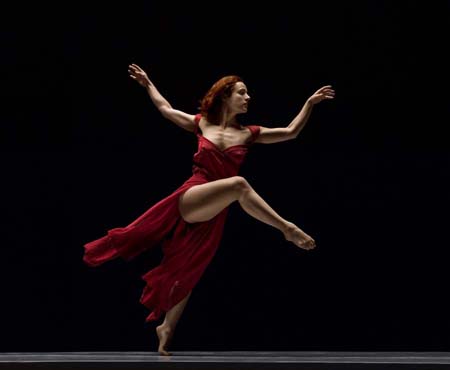
Janice Garrett and Dancers' Heidi Schweiker
--I tend to think of Janice Garrett and Dancers as "old fashioned modern dance" in the best sense: musical, sculptural, deeply human. I've written this before, but the thing I find most compelling in her work is the vibrant sense of community, the way you can see the dancers fully present and responsive to each other. Garrett's tone ranges from the slap-stick to the spiritual, arranged in all cases with a mathematician's attention to structure. Last year her newer works struck me as pretty and solidly constructed but lacking trajectory; I can't wait to see what she comes up with for this third season, which features two world premieres and runs December 1 through 10 at the Cowell Theater. For details, click here.
--LEVYdance is the creation of Ben Levy, a preternaturally accomplished grad of UC Berkeley's dance program. His work is edgy and often futuristic (as in the returning hit, "Holding Pattern"), with dense layers of movement that isolate and torque the joints in mesmerizing ways. His captivatingly committed dancers have the envious strength and freshness of youth. They'll be performing three world premieres, including a Meet the Composer-funded dance set to a new score by Keeril Makan. One-weekend-only run starts Thursday at ODC Theater; click here for more info.
November 27, 2005 · 04:59 PM · Dance · Comments (0)
Nutcracker Season
In the Chronicle's Pink Section today, I talk to Ballet San Jose Silicon Valley artistic director Dennis Nahat, one of America's most colorful Drosselmeyers. Perhaps more importantly, as seasonal consumerism kicks in, I describe 10 Bay Area holiday dance performances.
Already at church today I've been asked to supply my personal recommendations (which I'm always happy to do). And as much as I'd like to avoid simply promoting the big guns, the answer is simple. For kids and adults alike, San Francisco Ballet's "Nutcracker"--a $3.5 million production unveiled last year--is absolutely gorgeous. The sets and costumes just glow, the dancers are stupdendous, and though Helgi Tomasson's choreography doesn't always rise to the feeling of the music, the storytelling works beautifully. As an added bonus for those with out-of-town visitors, this "Nutcracker" is set in Edwardian San Francisco, lending a touristy touch. Depending on casting, I'll probably attend at least three times.
For adults only (it won't offend kids, but they won't get the jokes), if you haven't yet seen Mark Morris's "The Hard Nut," you really should. Set in the 1960's, with set designs by cartoonist Charles Burns, it's hilarious--but being a Morris work, it also has heart. It's returning to UC Berkeley's Cal Performances this year.
November 27, 2005 · 04:42 PM · Dance · Comments (1)
And I can't let another day pass without noting that Fernando Bujones, one of the superstar male ballet dancers of the 20th century, has died of skin cancer at 50. The Washington Post, Daily Telegraph, and New York Times all offer tributes. From the Telegraph:
"Fernando Bujones, who died on Thursday aged 50, was considered the greatest American male ballet dancer of the 1970s and 1980s; but he had the bad luck to make his sensational debut at 19 just as the Soviet star Mikhail Baryshnikov defected to the United States.
The rivalry that followed as the two men battled for the same roles inside the leading American international company, the American Ballet Theatre, took on a bitter personal note. "Baryshnikov has the publicity while I have the talent," declared Bujones, an unwise remark that came back to haunt him when the older Russian became his boss six years later.
Meanwhile, however, the duel for supremacy created unparalleled excitements for the public. Gelsey Kirkland, the ballet partner and girlfriend of both, reported that when the two had performances of Giselle on one day, Bujones deliberately danced Baryshnikov's personal variations in the matinée performance, forcing the Russian to spend a frantic hour inventing something even more spectacular for the evening show. "
November 15, 2005 · 02:38 PM · Dance · Comments (0)
The New Yorker's Joan Acocella writes about the new Baryshnikov Arts Center:
"More than anything, though, Mikhail Baryshnikov intends the center as a meeting place. “I wanted to bring people together in an informal way,” he says. “So many collaborations in the theatre, it’s just some producer thinks, Well, this guy had a nomination for Emmy, so, O.K., let’s have him. But it doesn’t have to be well-known choreographer. Could be fair chance given to a young person. I think better collaborative juices grow when people meet on free turf. You’re a poet; I’m a filmmaker. You’re a choreographer; I’m a playwright. People see each other’s work and exchange telephone numbers, and that’s how it starts.” "
Via Arts Journal and Ballet Talk.
November 15, 2005 · 09:06 AM · Dance · Comments (0)
Headliners
It's not my best writing by a longshot, but I love the headline the Chronicle gave my article on Chitresh Das's latest production: "Bring in 'da noise, bring in 'da classical Indian dance." Here's the lead:
"One man was 23, the other 60. One wore tap shoes, the other four pounds of bells tied to each ankle. But when Kathak master Chitresh Das found himself backstage at the American Dance Festival with tap prodigy Jason Samuels Smith, he knew he had to seize his fate.
"I said, this is my chance, I have to get his attention," Das said recently, his aging but nimble body slick with sweat from his day's discipline. "So I started to dance and Jason says, 'How can you do that with your bare feet?' "
Smith, a rising star in the tap world best known as an alumnus of "Bring in Da Noise, Bring in Da Funk," was so enthralled by his first glimpse of North Indian classical dancing that Das' company members had to restrain him from following Das onto the stage. "It was like two lovers kept apart for centuries finally coming together," Das said, his theatrical eyes wide with passion. "The Divine put me in that hallway with Jason."
It might sound more like a star-crossed liaison: the elegance and mathematical precision of Kathak meets the slouchy streetwise virtuosity of contemporary tap. But when Das and Smith are in the same room, they're just two hoofers. Since that "Festival of the Feet" in 2004, Das and Smith have kept on jamming. The result is "India Jazz Suites," an East-meets-West collaboration premiering this weekend at the Cowell Theater. "
And here's the full story.
November 09, 2005 · 01:25 PM · Dance · Comments (0)
Lines Hits a Groove
I reviewed Lines Ballet's new "Moroccan Project" for the SF Chronicle:
"The dancers of Lines Ballet are contorted, weirdly refined, alien creatures; it's not often you get to see them hit a groove. But the beat ruled Friday night at the Yerba Buena Center for Arts Theater during the unveiling of the company's "Moroccan Project." It may not be Artistic Director Alonzo King's most choreographically ambitious undertaking, but it is probably his most rhythmically infectious.
For more than 20 years now, one of the hallmarks of King's work has been the way he offers up his dancer's extreme extensions and jutting joints as a lingua franca capable of conversing with any culture's music, and it might seem like just a matter of time before he spun his globe and landed his finger on Morocco. In fact, he's worked with musicians Bouchaib Abdelhadi and Yassir Chadly in the orchestra pit several times. What's new is the addition of two female singers, Hafida Ghanim and Mouna Saadini, whose throaty cries and sharp warbles had the audience whooping in appreciative imitation come curtain fall.
King's visual response to their earthy soundscape is richly atmospheric. Two bronze columns of fabric hang stage right; a gray brick wall stands to the left. The dancers wear Colleen Quen and Robert Rossenwasser's now signature squiggly-hemmed culottes in vivid tangerine, and Axel Morgenthaler's lighting bathes them in a desert sun so warm you can almost taste the dust."
Click here for the whole review.
November 07, 2005 · 08:58 AM · Dance · Comments (0)
Ballets Russes
The new film "Ballets Russes," which just opened at San Francisco's Embarcadero Theaters, really is a delight for balletomanes and "dance dunces" (to borrow an Alex Ross coinage) alike. Among my favorite moments: Bejeweled, massively coiffed 86-year-old Mia Slavenska recounting her first Balanchine encounter ("Balanchine who?") and then saying "It's a pity I sent that message because with my looks, he would have fallen madly in love with me."
The Chronicle had me attend the film's gala screening at the Film Arts Festival Thursday night and play social reporter:
"Marc Platt could not have expected to still be receiving standing ovations at age 91, but there he was Thursday night at the Jewish Community Center of San Francisco's Kanbar Hall, leaning unsteadily on his cane as an elevator platform lifted him to the stage. Minutes earlier, his image as a star dancer with the Ballet Russe de Monte Carlo had bounded across the silver screen, the picture of youthful vigor. And now, just as in times past, the audience was on its feet.
Flanking Platt were Dan Geller and Dayna Goldfine, the filmmaking couple who made this ovation possible. "This is really the homecoming," Goldfine said to the capacity crowd at the Film Arts Festival of Independent Cinema's opening gala. "It brings us full circle because the first film we ever made, in 1988, was about Isadora Duncan. We swore up and down that we'd never make another dance film again."
An extraordinary opportunity persuaded them to break their oath. In 2000, the members of two once-warring companies, Leonide Massine's Ballet Russe de Monte Carlo and Col. Vassili de Basil's original Ballets Russes, gathered in New Orleans for a reunion. Mostly white-haired and eccentrically dressed, many of the dancers had not seen each other in more than four decades. And between their vivid recollections and stunning archival footage, Geller and Goldfine found the makings for "Ballets Russes": a documentary that would speak not just to dance fans but also to anyone who appreciates the way the passions of youth persist for a lifetime."
Click here for the whole article.
And click here to visit the film's engaging website, with photos of the Ballet Russe stars in their glory days and now.
November 06, 2005 · 09:33 AM · Dance · Comments (0)
Bebe Miller
Ever go to a dance performance where you sit, absolutely exasperated for an hour and a half, and then at the end people are applauding and leaping to their feet and you wonder if you've lost your mind? So how much more sane did I feel after reading Allan Ulrich's review of Bebe Miller's "Landing/Place," which had a two-night run presented by the Yerba Buena Center for the Arts last weekend:
"The 70-minute Landing/Place, for all its passing excellences and truly stunning dancing, often seems to meander through its elaborate accoutrements, which often threaten to suffocate it. The non-stop projections by animation artist Vita Berezina-Blackburn and video artist Maya Ciarrochu, the arty lighting by Michael Mazzola (which often shrouds the five dancers’ faces in darkness) and the live, computer-generated score by Albert Mathias—the standard, often ear-splitting postmodern wallpaper music, with some odd emendations—seem less collaborative elements than distractions . . .
What has happened on stage for the past hour felt modular in the extreme. Episodes could, you sense, be rearranged without any of it making much of a difference. Expressiveness is not a problem with Miller. Structure and meaning are."
Mind you, Allan and I don't always agree, but you'll notice he went a mite farther than John Rockwell's "trust me, I have good taste" rave in the New York Times in backing up his aesthetic reactions.
You might also notice that the Chronicle did not cover "Landing/Place." Again, I'm not the one who calls the shots, so if you think it should have been covered, chip in your two cents to the editors--politely and with enthusiasm, please. Remember, the paper doesn't know what readers want covered unless you let them know. Heck, I don't know what the dance community wants covered unless the dance community lets me know. So here's an open question: Do you think touring dance companies like Marie Chouinard's and Bebe Miller's need to be covered? What if I told you the coverage would come at the expense of reviewing performances by some smaller local companies? Sadly, space in the paper for dance is a zero-sum game. What do you think should be prioritized?
And if you went to Bebe Miller Company over the weekend and want to stack your own reactions up against Allan's, click here to read the review.
October 31, 2005 · 09:32 PM · Dance · Comments (0)
Aesha Ash at LINES
Former New York City Ballet dancer Aesha Ash is the newest member of Alonzo King's LINES Ballet. I talked to her in advance of the company's fall season, opening Friday, for the Chronicle:
"It wasn't the most orthodox of job interviews. Dancer Aesha Ash first spoke by phone to choreographer Alonzo King.
"I said, 'I don't even know how I'm going to keep dancing,' " the doe-eyed 27-year-old recalls, sitting cross-legged in a studio at the San Francisco Dance Center. "I said, 'I'm so tired. I'm just totally disenchanted with the dance world right now, and I have no inspiration.' "
Her beautiful oval face still looks a bit weary. Just six months ago she was ready to end her stage career, worn down by the ballet world's insistence on rail-thinness and the pressures of being the only African American woman at the New York City Ballet. Now she is the newest member of King's Lines Ballet, dancing in the world premiere "Moroccan Project" at the Yerba Buena Center for the Arts during the troupe's fall season next week, opening Friday."
Incidentally, the lead got chopped in two. I turned in "It wasn't the most orthodox of job interviews when Aesha Ash first spoke by phone to choreographer Alonzo King." No great shakes, I'll admit, but still I prefer it.
To read the whole story (and see some gorgeous photos of Aesha), click here.
October 31, 2005 · 09:25 PM · Dance · Comments (5)
Compagnie Marie Chouinard was simply an eye-opener at the Yerba Buena Center for the Arts last weekend. I had never seen her work before and, like many I heard murmurring in the audience, was thrilled to see such a formalist working with such idiosyncratic mastery. She certainly knows how to get a rise out of people: She's obviously paired "24 Chopin Preludes" and "Le Cri du Monde" as companion pieces because the first is sheer delight, lulling you into warm expectancy before the next shocks you all the more effectively with sheer horror. Oh, and in both pieces the women's breasts were anchored with little more than a strip of black tape across the nipples. What most struck me, though, was how her dancers in their flailing braids and headdresses and their hyper, cartoonish gestures seemed like a strange tribe, "more human than human" as the hard rock song goes. And as an audience member I felt like a National Geographic observer sitting hushed in the bushes as the secrets of an alien yet disquietingly familiar species revealed themselves.
Allan Ulrich reviewed for Voice of Dance, and I pretty much agree with him point for point:
"Chouinard is fighting a trend. She prizes the sheer beauty derived from superior dancers moving through space. She values clarity of gesture. She esteems the combinations that can be gleaned from the architecture of the body afoot and in repose. Musculature gleams in these works, arms and fingers are exploited as much as legs, yet the feeling—how untrendy can you get?—is one of harmonious design. What’s missing, thank heaven, is the gratuitous layering of social concern that Bay Area audiences are fed by canny and manipulative presenters. There’s nothing here of the "affliction of the week" philosophy that most of the local press worships to distraction.
Nevertheless, there’s still something of the rebel about Chouinard (or there was, five or six years ago, when she premiered these works). The Chopin Preludes, Op. 24 (heard in a recording by an uncredited pianist) arrive with associations for dance folks, including Jerome Robbins’ piano ballets and, in orchestrated form, Michel Fokine’s Les Sylphides. Chouinard does, indeed, reference the latter, when the Prelude that accompanies the iconic opening of the Fokine ballet, underscores a fidgety solo for Chi Long, bathed in a crimson light. And the frieze-like postures may remind you of Nijinsky’s surviving ballets."
To read the whole review, go here.
And you may (or may not) have noticed that the San Francisco Chronicle did not review Compagnie Marie Chouinard in its Bay Area debut. Nor did the paper review Senegal's mesmerizing Compagnie Jant-Bi, or Faustin Linyekula's Studios Kabako, from Congo. And so here is my gentle prod, genuinely free of self-interest: If you think it's important for the Bay Area's leading newspaper to cover these visiting companies, make your case and let the paper know. Write or email the editors. Speak with enthusiasm, not castigation. Reader demand decides a lot when it comes to editorial decisions, and you can't complain unless you've piped up. I happen to think it's a shame not to get groundbreaking visiting companies like this into the paper. But I'm just one voice.
October 26, 2005 · 09:56 AM · Dance · Comments (0)
With Oakland Ballet performing Eugene Loring's "Billy the Kid" over the weekend, and American Ballet Theatre dancing Agnes de Mille's "Rodeo," it's a good moment to read Allan Ulrich's essay on Americana "heritage" ballets for Voice of Dance:
"In certain "with-it" circles, the neglect of a portion of the American legacy is almost perverse. You tell me why so many folks salivate at the mention of any and all Ballets Russes reconstructions and revivals, even if some of them, like Fokine’s "Polovtsian Dances" from Prince Igor are scarcely stageworthy in the 21st century. Then, tell me why the same folks roll their eyes and sigh patronizingly when someone drops Rodeo or Eugene Loring’s Billy the Kid into the conversation. Well, one reason is snobbery; anything with a hint of a Russian or French pedigree has gotta be better than anything Amurrican. Then, there’s the question of over-exposure. American ballets to American themes were once prevalent through the stateside ballet world, but not recently. "Dated" and "cornball" are tossed around, but these are adjectives I would sooner apply to the stale psychosexual tropes of Spectre de la Rose . . .
. . . we should not scorn the native tradition, simply because it is narrative based and derived, not from St. Petersburg’s Imperial Maryinsky Theater, but from the tradition of popular culture . . .
And don’t let anyone tell you this material cannot speak to us today. The final tableau of Billy, with the populace expanding inexorably Westward as Aaron Copland’s score sings with its unique rhetoric, is among the most affecting moments in the entire ballet repertoire. Even the snobs reach for their handkerchiefs."
October 17, 2005 · 01:06 PM · Dance · Comments (0)
Oakland Ballet Reborn
Maybe it had to be this way. Maybe the Oakland Ballet had to nearly die in order to be reborn. A year ago the company had no dancers, no studio, no season. Friday night it had energy, sass, and momentum to spare. The Oakland Ballet was indisputably alive.
A quick recap of the rise and fall and (we hope) rise again: In 1965, Ronn Guidi founded a ballet company in industrial Oakland, of all places. For decades it was a scrappy little home-grown troupe. Then, in the late 1970’s, Guidi got a taste for revivals. He started with Eugene Loring’s “Billy the Kid” and progressed to the Ballets Russes repertory, winning worldwide acclaim for resurrecting the startling and chic ballets of Bronislava Nijinska. But in 1998 Guidi suddenly quit, leaving a host of financial problems. Former Dance Theatre of Harlem ballerina Karen Brown took the helm in 2000, but the company seemed to flounder for direction—and funding. In 2004, just as the company’s dancing was starting to rebound, Brown cancelled the year’s season, fired the dancers, and issued an urgent call: Raise $500,000 immediately and launch a comeback 40th anniversary season in 2005, or close forever.
The money came through, and Brown opened this truncated 40th season with a program designed to celebrate the past and look to the future. Nijinska’s “Les Biches” and “Les Noces,” alas, did not show to best advantage in excerpt form; Loring’s “Billy the Kid,” with handsome Gabriel Williams as the outlaw gunman, was perhaps not as tension-charged as it could have been, but fared better. Former company dancer Michael Lowe’s “Double Happiness,” expanded since its premiere two years ago and accompanied by live Chinese folk music, proved the audience favorite.
But for me it was in Donald McKayle’s world premiere, “Ella,” that we saw glimpses of a company with a bright future. Finally Brown has called on a master to give Oakland Ballet what emerging choreographers like Robert Moses and Dwight Rhoden have failed to: a new ballet worth repeating, a ballet with the potential to become a company calling card. Set to—you guessed it—Ella Fitzgerald tunes, “Ella” is simple in concept, absolutely assured in melding the struts and swaggers of African American dance to ballet technique. Even with a nasal and unmusical chanteuse on live vocals, “Ella” had the crowd swinging.
Because the thing is—God knows how he got the rehearsal time and the energy to do it—McKayle has gotten the Oakland dancers to strut like they own it. I dare anyone to take their eyes off Phaedra Jarrett bopping her bouncy, hip-swaying way through “A Tisket A Tasket,” or to so much as check the program during Preston Dugger III’s rippling, stop-on-a-dime rendition of the closer, “In My Solitude.”
To be sure, this is the strongest crop of dancers Brown has fielded in the last five years. The men’s contingent, once a source of edge-of-your-seat unease (will he break his ankle trying to finish that double tour?), now bounds from strength to strength. Williams, the most promising leading man before the company’s closure, has returned with more technique than ever. Matthew Linzer is a tall, beautifully proportioned addition to the roster, and Dugger is an Ailey-esque virtuoso of balance and power. On the women’s side, the MVPs are Jarrett and the fine-boned, ladylike Cynthia Sheppard. Amazonian Ilana Goldman also gets a lot of play, and while I’ve yet to take a shine to her dancing, which strikes me as a bit stiff (she was particularly not suited to the terre-a-terre footwork of the hostess in “Les Biches”), I’m not ruling her out yet.
But perhaps just as important as the new dancers is Oakland Ballet’s new venue. No more funereal evenings in the vast and sparsely populated Paramount Theater. True, the company is still working out the kinks at their new home, the Calvin Simmons: A will-call line to the tiny box office trailed down the windy block, live music from the Marcus Shelby Orchestra for “Ella” was painfully over-amplified, and patrons in the VIP Olympic Club weren’t alerted to the end of intermission, sending dozens of attendees scurrying in the dark for their seats after the curtain had risen on “Billy the Kid.” But the house—which holds about 1,000—was well populated, the sightlines good, the stage ample, and the excitement bouncing back and forth from the dancers and the crowd palpable.
It’s a small shame, then, that these dancers won’t have much chance this year to keep the momentum going. Brown has elected for family fare on the company’s November program: Guidi’s “Peter and the Wolf,” which even he has described as not one of his better ballets, and “The Sorcerer’s Apprentice” by a choreographer I’ve never heard of, Scott Rink. Whether the kid-friendly strategy will help build an audience base remains to be seen, but from a selfish standpoint, how much more thrilling would it have been to see full productions of “Les Biches” and “Les Noces” instead?
Still, for the first time since Brown became artistic director, I had the sense Friday night that she is a woman with a plan. She has the dancers now, and the right space; what she’ll need is more commissions on the order of “Ella,” and more regular and thoroughly coached revivals of the Ballets Russes rep. Can she do it? Was the strength of this comeback program a one-off? I don’t know, but I’m looking forward to finding out.
October 16, 2005 · 03:42 PM · Dance · Comments (0)
Kirov's "Beauty"
I reviewed Wednesday night's performance of the Kirov Ballet for the SF Chronicle:
"It was a wondrous sight Wednesday night: Diana Vishneva en pointe, her other leg held artfully behind her, the whole perfect sculpture twirling beneath the hand of first one suitor, then another. She seemed incapable of wavering; though turning, she became the still point around which the rest of the world revolved. It was the kind of special effect to make even a seasoned ballet lover say "Ah! So that's what that moment can be."
Fortunately for ticket holders to performances by other casts, the Kirov Ballet's "The Sleeping Beauty," presented by UC Berkeley's Cal Performances through Sunday, isn't dependent on the star power of one internationally ascendant ballerina. Running three hours and 40 minutes, this is an Imperial Russian feast to slowly savor (and you'll want to mill about during each of three intermissions to aid digestion). After all, this 1890 ballet -- the first collaboration between Tchaikovsky and the French-born ballet master Marius Petipa -- originated at the Kirov, and the company has been an authoritative caretaker ever since.
The latest installment of that legacy is a sumptuous and painstaking 1999 "reconstruction," but that's not the production on view during the current U.S. tour. Instead the company has brought Konstantin Sergeyev's dramatically thin, redeemingly charming 1952 staging. "The Sleeping Beauty" can be a thematically rich experience, a powerful allegory of mature love. Sergeyev's version is more of a hoot."
For the full review (it's a short one, alas), click here.
October 14, 2005 · 05:30 PM · Dance · Comments (0)
The New Hula
I wrote about Patrick Makuakane's "progressive hula" for today's Chronicle Pink Section.
"U2 blasts on the stereo system as two dozen women shake their hips. Bare feet touch the auditorium's tile floor, skirts sway, hands trace a silent language in the air as Bono sings of "Mysterious Ways."
Patrick Makuakane watches with crossed arms as the women return holding paper flowers. Their movements lull above the drum and bass of a techno track. Then the beat explodes into double-time, and so does the sea of bodies, one mass of rippling torsos changing direction in mesmerizing sync. The women become still as a group of men enter on hands and knees, noses sniffing like animals.
"It's a piece about a flying vagina and a pig who chases after it," Makuakane explains during rehearsal break. "You see, the Fire Goddess Pele has an adversarial relationship with a Pig God. The Pig is getting too amorous. Her older sister has a detachable vagina and sends it over, and the Pig gets distracted and follows it to the other island. And my dancers use the flowers as a symbol of the vagina.
"Of course it sounds humorous," he says. "But it all comes from Hawaiian legends. And when Hawaiians hear this huge epic myth, the whole detachable vagina section isn't snickered at. A lot of hula has to do with procreation."
Welcome to Makuakane's strange, entrancing world of hula mua, or "progressive hula." Cyndi Lauper, Annie Lennox, Roberta Flack -- no music is off-limits. Modern in sound, hypnotic in effect, these dances attract sold-out crowds of hula fans and newcomers alike. But it's Makuakane's immersion in tradition -- not his liberation from it -- that has made him the leading kumu hula, or teacher, in the Bay Area. "
Click here for the full story.
October 09, 2005 · 06:24 PM · Dance · Comments (0)
Oakland Ballet's Comeback
A lot of people are landing on this old entry via Google searches for Oakland Ballet. The old entry is below, but if you want to more know about the return of Oakland Ballet and Ronn Guidi, I suggest you check out this story, which I wrote for the Chronicle in July 2007:
"Ronn Guidi rises from the restaurant table, leg suddenly stretching into full développé as he recounts a rehearsal with the famous choreographer Leonide Massine.
"You see, half the dancers were doing this," Guidi demonstrates with a sweeping arm, nearly knocking into the next table. "And half were doing this. And I said to Massine, 'Which is it?' And he turned to me and said, 'Ronn, it's not the steps. It's the integrity behind the movement.' "
Guidi is somewhere between 70 and 73 years old - he says he's lost track - but with his spry frame, wiry black hair and thick beard, he could pass for someone in his 50s. His face is wild-eyed and puckish, as it always is when he talks about the glory days of the Oakland Ballet, but today he looks especially excited. He's about to attempt a remarkable resurrection. Forty-two years after founding the Oakland Ballet, 20 years after raising it to unlikely international repute, nine years after suddenly retiring, and seven years after watching his beloved creation begin a steady slide toward death, Guidi is bringing the Oakland Ballet back.
The resuscitation started cautiously, with four performances of his "Nutcracker" last year, danced by a swiftly assembled ensemble of Oakland Ballet alumni and other freelance dancers. But with those shows well attended and cash-flow positive, Guidi says he's ready to go full tilt. The new Oakland Ballet Company will give its inaugural performance at the Paramount Theatre on Oct. 20, under the auspices of the Ronn Guidi Foundation for the Performing Arts.
The program will include a reconstruction of Vaslav Nijinksy's 1912 watershed "Afternoon of a Faun," Marc Wilde's "Bolero" and Guidi's own "Trois Gymnopedies" and "Carnaval d'Aix." Then, in December, "Nutcracker" will return for six performances before touring to Lake Tahoe. All shows will feature live music from the Oakland East Bay Symphony. Rehearsals will be at the Oakland Ballet Academy, where Guidi still teaches 13 classes a week.
Twelve dancers have been hired, and further auditions will soon be announced. Chevron and Target have signed as major sponsors. The city of Oakland's Cultural Funding Program has also pitched in on the $80,000 currently secured toward a $350,000 fundraising goal.
"I want to work in the black, no deficit spending," Guidi says. With that caveat, he's looking further into the future. "Nutcracker" dates have been reserved at the Paramount for 2008. Guidi plans to program smaller March shows to begin rebuilding a subscription base. His most cherished goal is a 2009 festival marking the 100th anniversary of Serge Diaghilev's Ballets Russes, the groundbreaking company whose masterpieces Guidi so lovingly brought back to life.
Describing all this, his spirits are much brighter than just a few years ago when, he says, "I watched my life's work be dismantled before my eyes." He has no words of rancor for Karen Brown, the former Dance Theatre of Harlem ballerina who took the Oakland Ballet helm at a moment of financial precariousness and failed to form a fresh identity for the company.
"I knew this could happen if I retired," Guidi says, referring to Oakland Ballet's 2006 closure after a 40th anniversary comeback season fell $130,000 short of its ticket sales target. "They needed to bring someone out of the company to lead it. Without the emotional connection, it won't work." "
Click here for the full story.
With the 40th anniversary return of the Oakland Ballet imminent, I tried to reach a bit deeper into the company's history in my story for the SF Chronicle:
"In a converted warehouse near the port of Oakland, former Dance Theatre of Harlem ballerina Karen Brown sits regally atop her stool, long legs crossed, hair carried high like a crown.
She catches a dancer practicing an attitude turn. "Good Cindy, that's it." Phaedra Jarrett stands at a barre, rehearsing a routine to be performed for potential donors the next day. "Is that a single or a double pirouette?" Brown says with narrowed eyes and a pointed finger as Jarrett spins neatly once around.
"It'll be a single at 8 in the morning," Jarrett says.
"Oh, that's right."
The dancers and Brown laugh easily together in a studio filled with light and camaraderie. In any other ballet company the lack of tension would be impressive; at Oakland Ballet, it's astonishing. Because just a year ago, this spunky little troupe-that-could was a company in name only, with no dancers, no studio, no season to speak of.
The break came in April 2004, after a fall season in which Oakland Ballet canceled a program due to sagging ticket sales and lost $300,000 on its usual cash cow, "Nutcracker." Plans for the 2004 season were scrapped, dancers let go. The message was stark: Raise $500,000 within the next three months to stage a 40th anniversary season comeback in 2005 or close for good. The money came in a trickle of donations from ballet lovers and a flood rush of $200,000 from the William and Flora Hewlett Foundation. And now that 40th anniversary season, opening Oct. 14, is upon us.
"I'd never heard of a ballet company that didn't have dancers and didn't have performances," Brown says during rehearsal break, sitting on a brick wall at the dead-end of Linden Street as trains clang past. "It was one of the most difficult decisions I've ever made. But I was determined that this company was not going down on my watch."
Her eyes are focused, but her voice sounds weary, and no wonder: This 40th year season is shaping up to be a referendum on whether Oakland Ballet can rise again -- or even survive -- under Brown's directorship, which began in 2000. But lost in the debate over Brown's leadership style and programming choices is the fact that Oakland Ballet narrowly escaped oblivion many times before Brown took the helm. And obscured in the emergency campaign platitudes about the beauty of ballet and the importance of art in the community is the fact that Oakland Ballet was -- from the 1980s and through the '90s -- no small-town player, but an internationally acclaimed repository of rare and priceless classics."
About 500 words of the story were trimmed due to a space crunch, but I think the arc of the tale is more or less intact . . .
To read the full piece, click here.
October 01, 2005 · 01:09 PM · Dance · Comments (0)
Dive In
My hunch is most of the dance fans who check this site are in the Bay Area, but if you’re in New York—whether you’re a dance fan or not—go check out Noemie Lafrance’s latest work, “Agora,” extended through October 1. Of the many spectacular things I saw during my East Coast trip last week, this sight has lingered longest: 47 performers kicking and whirling away in the bottom of a vast empty swimming pool.
Lafrance has staged previous works inside vertiginous staircases and—more recently—in a parking garage, where viewers sat in cars and listened to music piped in through the car stereo. This time she’s turned to the McCarren Park Pool on the edge of Brooklyn’s Greenpoint and Williamsburg neighborhoods, given over to vandals and skateboarders since it closed in 1983. She’s mobilized her own forces and the Brooklyn powers-that-be to pull up the weeds and sweep out the glass. And she’s filled the yawning space with an hour of entrancing kinetic images, both comic and haunting.
The dance begins with a ghostly possession and then becomes a panorama of Brooklyn’s social communities, past and present. There’s a herd of 90s hipsters club dancing in a corner of the pool one minute, a clutch of Latinos imitating a flamenco dancer over in the shallow end the next. A clever series of duets has dancers strapped to skateboards, able to drop onto their backs and spin across the concrete. At one point, the lights go out, a disco ball flies in on an unseen wire, and the whole pool fills with shards of light as a lone disco star struts. The sound system is immense, with the medley of pop songs and a creepy ambient score by Brooks Williams projected from two sides. Lafrance excels at carving this wide landscape with theatrical moments big and small. A side bit with a man desperate for privacy as he showered had the audience in giggles. A jumpy unison routine to “Higher Ground” takes on NFL half-time show proportions. Another attraction: Lafrance once worked as a fashion designer, and the costumes by Karen Young are all wonderfully whimsical and hip.
There are shortcomings: It’s not clear what kind of statement this tour of Brooklyn’s history and societies adds up to, and a Middle Eastern bazaar ending, with the audience invited to enter the great bowl of the pool and sample hookahs, left the crowd perplexed on opening night. But the only other site-specific choreographer I can think of who’s currently working with such deep interest in the connections between history and place is San Francisco aerial artist Joanna Haigood. In the end, “Agora” bewilders the senses not just in scale but in scope.
For info on how to attend, click here.
September 23, 2005 · 11:40 AM · Dance · Comments (0)
Catching Up
Flooded with assignments and deadlines and churning out pages of the novel (they're crap for now, but it feels so good to move forward) and so just catching up with this site.
I reviewed the National Ballet of China the other day for the Chron:
"The obligatory pre-curtain announcements had a different flavor Friday night at UC Berkeley's Zellerbach Hall. The usual stream of welcomes and warnings about cell phones ran on and on -- but in Chinese. In the middle of the flowing foreign tongue came a single, blunt English phrase: Wells Fargo. A highly expectant audience, nearly filling the house, chuckled.
Movement has its languages, too, and ballet must have seemed as out-of-place as that "Wells Fargo" when the dance began taking root in China last century. Ballet traces its history back 400 years in Western civilization; the National Ballet of China, presented by Cal Performances over the weekend, was founded in 1959.
Over the decades the company has struggled valiantly to reconcile a Western dance form with Chinese culture, producing Chinese versions of staples like "Swan Lake" on the one hand, and Communist propagandist ballets like "The Red Detachment of Women" on the other. "Raise the Red Lantern," created in 2003 in collaboration with famed film director Zhang Yimou, has been positioned by the company -- and received elsewhere -- as a breakthrough in merging pas de deux with Chinese elements: in this case, Peking Opera."
I wasn't quite blown away. Click here for the whole enchilada.
And, the Mark Morris Dance Group returns to Cal Performances tomorrow night for two weeks and two programs. I interviewed (or attempted to) Mark Morris for last Sunday's Chron:
"Everyone knows Mark Morris gives good interview. He's everything you think the reigning genius of American modern dance should be: confident, imperious, larger than life.
He breezes into rooms trailing a pashmina wrap or billowing in an oddly flattering dress-length tunic. He tosses his head of famously unruly curls (now cropped) and owns the space with the same full-bodied magnetism that made the Mark Morris Dance Group a critical sensation when it debuted in New York in the early 1980s. Morris narrows his eyes as he exposes the ludicrous assumptions underlying your impertinent questions. If you're very lucky, he takes a shine to you and makes you a conspirator in his antics, while casually dispensing gems of insight about everything from obscure Milhaud compositions to the state of American arts criticism.
But woe betide the journalist charged with interviewing Morris via phone, disarmed of eye contact with which to fend against his impatience.
It's not that Morris is cranky, though he has every excuse to be: His Mark Morris Dance Group is in the midst of a taxing 25th anniversary tour, which will take it everywhere from Kansas City to Glasgow, and bring it to UC Berkeley's Cal Performances on Thursday. After Berkeley, the group will tour the United Kingdom for six weeks before returning to the Bay Area to dance "The Hard Nut," Morris' loony, much-loved take on "Nutcracker." In the meantime, Morris has Purcell's "King Arthur" to adapt for the English National Opera and a "big premiere" for next summer, which he "can't talk about yet," to get rolling.
It's just that Morris holds his interviewers to high standards. Some of his demands are invigorating; others are impossible to satisfy. On this particular day, on lunch break from frenzied rehearsals at his $7.4 million dance center in Brooklyn, he's tired of vague questions -- a reasonable enough complaint. So what kind of specific question might an interviewer ask?
"Why doesn't 'Sylvia' travel?" he says, referring to the sumptuous three-act commission for San Francisco Ballet that made such a splash in 2004. "That's a question to ask. Everyone in New York wants to see it."
OK, then: Why doesn't "Sylvia" travel?
"I can't say because I don't get into that part of the business," Morris counters. Subject closed."
We did manage to talk a bit more. Click here for the rest.
September 21, 2005 · 02:31 PM · Dance · Comments (0)
Vassilii Mountian
I'm back in San Francisco, and in the Chronicle today with a story about one of my favorite programs for kids in the Bay Area:
"It's a stampede. Sixteen children marching like toy soldiers on speed, spinning and stomping so hard the floor shakes. And the only thing louder than their footfalls is the voice of the Russian man shaking his feathery gray mane like an impatient lion as he prowls the studio.
"Faster, faster, faster!" Vassilii Mountian thunders as the kids run in place. A gold cross nestled in his ample chest hair shines beneath fluorescent lights. "Why you not smile, eh?" he says to the little girls in the front row, but as they clap their hands above their heads, a grin sneaks onto his lips. "Polka, polka!"
He fixes his eyes on one of the older girls and points to his nose held high. "Emotion! I need more from you." She raises her chin an inch, gaze fiery and determined. Two boys race to the front and drop to hands and knees, kicking wildly as they crabwalk. Mountian shrugs as if to begrudgingly give credit. "This is good!"
It looks like a pint-size Bolshevik boot camp, but the longer you watch, the more you notice: Most of the kids are smiling. And all of them are throwing their bodies around the room as though possessed by the music. They don't have to be here. They love it.
Forget the New York boroughs of "Mad Hot Ballroom." If you want to see children transformed by the discipline of dance, you need venture no farther than 1158 Gorgas St., where the edge of the Presidio National Park touches Crissy Field and the Palace of Fine Arts.
There, in a former Army base convenience store, more than 100 kids learn the folk dances of 32 countries as students of the Presidio Dance Theatre Academy. An additional 100 take dance in the Sunset and Richmond neighborhoods as part of the academy's outreach program, along with 40 kids in Bayview. The most promising and dedicated become members of Presidio Dance Theatre's performing company, taking class three times a week and rehearsing two hours every Friday, dancing everything from the Pennsylvania Polka to the Serbian Tzigane in resplendent, sumptuously authentic costumes each spring. One-third are on some kind of scholarship. Many pay no fees at all."
For the full article, click here.
September 16, 2005 · 10:33 AM · Dance · Comments (0)
Fall Dance
The Chronicle asked me to tackle the upcoming dance season for the paper's Fall Arts Preview, which was published in the Pink section yesterday. My list is not a selection of "critic's picks" or recommended shows, but a roster of just about every quality Bay Area dance performance I could think of or find for the coming four months. It won't whittle things down for you, but it will give you the (nearly) full fall landscape, and I hope my descriptions are helpful.
To see the Chronicle's fall dance preview, click here.
August 29, 2005 · 09:57 AM · Dance · Comments (1)
Recommended this Week
I’ve just returned from the Yerba Buena Gardens in downtown San Francisco, where I led a lecture and Q and A with Yannis Adoniou, artistic director of Kunst-Stoff. The Yerba Buena Gardens have commissioned a fresh take on Fokine’s iconic “Les Sylphides” from Adoniou, which he has set to the original Chopin and titled “Less Sylphedes.” I’ll admit I’m not fond of postmodern puns, and the whole premise might sound either promising or appalling, depending on how sacrosanct you hold your classics, and how well you know Adoniou’s work. But I saw the new piece in the studio yesterday, and again in excerpts on the outdoor stage this afternoon, and I think Adoniou’s approach is quite remarkable. The ethereality of Fokine’s fantasia of romanticism dissolves into carnality—but it does so gradually, with great craft and gathering force.
There will be two versions of Kunst-Stoff’s new “Less Sylphedes”: a lower-tech outdoor setting, and an edition with video projections to be presented during the company’s home season at ODC Theater September 22-October 1. But first you should get yourself to Third and Mission Streets, where the work will be danced at 12:30 p.m. tomorrow, Friday August 26, and at 9 p.m. Saturday and Sunday. All the performances are free; click here for more info.
As for the September home season, one of the luxuries of having three dance writers at the San Francisco Chronicle, even if all of us are freelance, is that I can participate in a lecture like today’s and then recuse myself from reviewing the work until I feel I’ve recovered sufficient objectivity. But I’ll be at ODC Theater for Kunst-Stoff’s season next month, and in my non-objective opinion, you should be too.
August 25, 2005 · 03:33 PM · Dance · Comments (0)
Recommended this week
With all this plugging of my memoir "The Lost Night," you might think I've forgotten about dance--but not so. In fact, before I head to the Central Valley tomorrow for a few readings, I want to make sure to post about a dance show I'll certainly be catching in San Francisco this weekend.
Alex Ketley is a former dancer with Lines Ballet and a promising choreographer of ultra-contemporary, stark yet emotional work, usually presented with striking multi-media trappings. About five years ago he co-founded The Foundry with fellow dancer/choreographer Christian Burns; just recently he won one of the Princess Grace Foundation's first choreography awards. Friday and Saturday at ODC Theater he'll be presenting "Syntax," a duet for ODC dancers Andrea and Justin Flores set to the poetry of Carol Snow. Should be challenging, perhaps even beautiful; for full details, go here and follow the link to "The Foundry/Carol Snow."
Also on the dance-writing front, I've just wrapped up the Chronicle's Fall Dance Preview, which will run in the Pink Section later this month. Thanks to those members of the Bay Area dance scene who saw my call for entries on this site; the preview is far more inclusive because of your response.
August 08, 2005 · 11:23 PM · Dance · Comments (0)
Fall Dance
Memo to the Bay Area dance community: I will be doing the Fall Arts Preview for dance for the San Francisco Chronicle's Pink Section. If you have a dance event coming up that you'd like me to consider, make sure you email the basic info to me at rachel at rachelhoward dot com within the next two weeks. Thanks.
July 19, 2005 · 03:05 PM · Dance · Comments (0)
Brian Brooks Moving Company
“Piñata”
Summerdance Santa Barbara
Center Stage Theater
July 9, 2005
Nicholas Duran in Brian Brooks Moving Company's "Pinata."
Santa Barbara is a town that knows how to party, so it’s not surprising that Summerdance Santa Barbara executive director Dianne Vapnek imports companies (mostly from New York) that offer equal parts sophistication and fun. Last year, Brooklyn-based Brian Brooks Moving Company brought out “Dance-o-Matic,” a minimalist rhapsody in bubble-gum pink. The group also started creating a new full-evening work, “Piñata,” which received its West Coast debut last weekend during the company’s return to the Center Stage Theater. “Piñata” is a fiesta, to be sure, a suite of rigorous musical structures dressed up in confetti and camp. But in its most striking moments, the silliness becomes just a backdrop for a mesmerizing revelation of order in chaos, like reading an elegant geometric proof rendered on purple construction paper.
The conceit for “Piñata” is the exploration of the full color spectrum as it explodes upon a canvas of white. The floor is white, Roxana Ramseur’s clever pseudo-athletic costumes are white, and the confetti is white as Jo-anne Lee bashes the first piñata of the evening. Brooks is a former dancer with Elizabeth Streb, a lineage that shows in the strenuous physical feats he uses as building blocks. The first third of “Piñata” is set on the floor as the dancers lay in a line, rolling into ab crunches and arching backwards to the chord changes of Cesaria Evora’s exotic music; at the trumpet fanfare, their plank-like bodies launch straight into the air like popcorn kernels on a hot pan. Later, legs and arms spiral upwards as though to pierce the surface of water, an effect reinforced by the dancer’s sundry bathing caps (Alexander Gish’s is a hunter’s hat with flaps over the ears; Weena Pauly’s millinery looks like Mennonite garb). It’s like watching the world’s most musically attentive synchronized swimming routine.
Weena Pauly in Brian Brooks Moving Company's "Pinata."
But at last the five dancers stand, and gradually red and blue and yellow and green enter the picture, and here the seams of Brooks’s packaging begin to strain. There are many lovely and entrancing moments. Pauly introduces blue, jumping into the hands of Duran and Gish, treading her legs and arms as though to push through water as they carry her around the floor. Lee and Duran appear in rooster-like headdresses, moshing with mathematical exactitude to the Scissor Sisters in a red square of light. The company crosses the stage in curiously serene scissor steps, dropping orange paper like breadcrumbs though the forest. And the whole gang stacks up to scoot across the floor on their butts, throwing rainbow-hued fistfuls in Brook’s winking idea of a conga line.
Brooks knows how to stage a laugh: The funniest interlude of the evening sends a choir of piñatas skidding across the stage as they appear to lip-synch Cyndi Lauper’s “True Colors.” But then Lee appears in black, with a baseball bat, to wreak piñata carnage. And after this mock-execution, something far more engrossing than any comedy skit commences.
Brooks lines the dancers across the front of the stage in black flamenco dresses, where they begin to swirl their arms in precise patterns. The music is Ravel’s “Bolero,” and your first instinct is to think Brooks can’t possibly pull this off. But the music continues its slow build, and so do Brooks’ canons and counterpoints and his unexpected new gestures that seem to illuminate all the minute wonders that have come before like a flash of light. And soon enough watching the paths of the dancers’ hands is like watching the paths of planets, like watching some kind of Nova science show where the workings of the universe leave you feeling very small and overwhelmed, and then—bang—it’s over.
Brooks’ dancers are as hypnotizing as his calibrated structures. Lee is the resident ingénue; Duran has the chiseled face of a runway model and a lanky grace, while Gish takes deadpan to the edge of self-parody. Brooks is a bit of a ham, not afraid to exchange a confidential glance with the audience. But Pauly tends to steal the eye. She’s as muscled as an Olympic rower, but glamorous, too; she played the “Bolero” section with the drama of a 1940’s silver screen diva.
And yet that final “Bolero” section would have stood stronger on its own. Like other “Piñata” segments, it was a cosmos unto itself, and the pressure of fitting it into the grand scheme of an extended skit only undermined its mysteries. Brooks seems to realize that the chromatic conceit that served him so well with the pink “Dance-o-Matic” and the green “Acre” is wearing a little thin. Monday night, at a Summerdance open rehearsal, the company showed phrases from his new work-in-progress. The movement was expansive, sweeping, even downright “dancey.” When an audience member asked if he’d “abandoned color,” Brooks said that he wanted to start creating without a design concept this time, to see where the movement leads him. Now that’s a party I want to be there to see.
July 13, 2005 · 11:55 AM · Dance · Comments (0)
The Festivals of Summer
San Francisco's West Wave Dance Festival returns this week. The Chronicle's Pink section had me talk with Heidi Schweiker, one of the standouts from last year's season:
"Heidi Schweiker punches the air with her shoulder, makes a thumbs-up and swings her arm, then takes quick steps backward like a sneaky cartoon character on rewind. The combination intrigues her; she stops and scribbles notes, does the steps again with notebook in hand.
She is 29 years old and working alone in a sunny studio at the San Francisco Dance Center. But it's easy to imagine the 10-year-old girl who once made dances in her living room, furniture pushed to the walls. Schweiker's face is round and doll-like, and her compact figure, though fit, might be described as bubbly. Her focused expression belies the cuteness. She bends in a half-lunge, touches hand to her forehead, lets her other arm slice in front of her chest as though to complete the sign of the cross. Is this movement for its own sake, or a cryptic gesture from some ancient ritual?
Either way, it's one of the most compelling reasons to catch the 14th annual West Wave Dance Festival, which begins this week and fills the rest of July with a sampling of the Bay Area's overwhelming array of dance talent. The festival has long been the mainstay of the summer dance calendar, tiding fans over till fall with works by local luminaries and fresh faces alike, giving new audiences a crash course in our region's panoply of styles.
But the programs have often been hit or miss, with a gem by ODC Dance co- Artistic Director KT Nelson following a formless dud by -- well, let's allow the earnest amateur to remain nameless. Fortunately, Executive Director Joan Lazarus has moved to a more tightly curated format in recent seasons, grouping emerging talents into "One Night Only!" evenings for the adventurous at ODC Theater, and banding proven dancemakers together for longer runs at the much larger Cowell. This year, there's a slate devoted to South Bay choreographers. Brand new, too, is an "All Dance/No Tech" night, with minimal lighting design and a roster of participants vetted by sharp-eyed Circo Zero director Keith Hennessy."
Click here for the full article.
I'm afraid I'll be missing most of the festival, though. I'm down south checking out a different dance fest--the delightful Summerdance Santa Barbara, which this year has recruited three New York groups: Brian Brooks Moving Company, Tamango Urban Tap, and AsZure and Artists. I'm also working intensively on my novel-in-progress, and therefore I'm torn: How much to write about the festival at the expense of moving full-speed ahead with my fiction? Last night's performance of Brian Brooks's "Pinata" was fabulous, a temptation not to work on the novel if ever there was one. I will probably post about "Pinata" tomorrow, but today moving ahead with a long-stalled chapter feels urgent.
July 10, 2005 · 02:46 PM · Dance · Comments (0)
The Majestic Muriel
San Francisco Ballet principal Muriel Maffre is writing a diary that will appear in the Chronicle during the company's tour to Paris. The paper asked me to describe Maffre's career with the company by way of introduction, and so I led with her intention to retire soon, which she has not kept secret:
"The San Francisco Ballet will have a tall order to fill if Muriel Maffre retires next year, and not just because the majestic principal dancer is 5 feet 10 inches. Elegant, intelligent and impossibly long-limbed, this chic Frenchwoman is only one among a clutch of international-caliber stars who have launched the company into ballet's big leagues, but she is irreplaceable."
Click here for the rest of my appreciation, and here for the first of Maffre's dispatches.
July 08, 2005 · 12:11 AM · Dance · Comments (0)
Americans in Paris
Allan Ulrich writes about San Francisco Ballet's trip to Paris (opening today) for the New York Times:
" AMERICAN dancers - an entire company of them - are descending on Paris this week, and while they will perform to Gershwin, it is not for a remake of "An American in Paris."
Instead they will be there for a new three-week festival, Les Étés de la Danse de Paris (Paris Dance Summers), which will be inaugurated with three world premieres on Tuesday by the San Francisco Ballet.
The festival will happen not in a Paris culture palace but outdoors, in the Marais district. As posters in Métro stations have proclaimed for months, the San Francisco Ballet will be the sole attraction at Les Étés de la Danse. As with any outdoor event, weather may be a problem, but the festival's director, Valéry Colin, said: "I will take the risk. Helgi is worth it." "
Click here for the full article.
July 05, 2005 · 10:46 AM · Dance · Comments (0)
Wheeldon Watching
San Francisco Ballet innaugurates a new festival--Les étés de la danse de Paris--next week with world premieres by Paul Taylor, Lar Lubovitch, and Christopher Wheeldon. The Chronicle will be carrying extensive coverage from the scene. In the meantime, they asked me to chat with Christopher Wheeldon as he worked on his new ballet, "Quarternary":
" "Sorry, I'm going to be munching my apple," Christopher Wheeldon says as he bursts into San Francisco Ballet's second-floor studio on a gloomy June afternoon. The British accent lends instant authority, but it's his body language that speaks volumes: purposeful stride, firm handshake.
"An apple a day keeps the block away," he sings with a teasing smile. And just like that, he's back at work, watching principal dancer Gonzalo Garcia hoist Katita Waldo into the air, exclaiming "Whee!" as Garcia spins her and sets her on the floor with a frustrated expression.
"That was late, but right," Wheeldon says, sharp eyes squinting and finger raised to lip. At 32, he could still pass for a dancer himself, with his lean frame and stylish goatee. He walks to the center to demonstrate the next section: a series of quick syncopated steps that grow larger and faster until he is leaping full-out. A sound like ripping Velcro punctures the quiet concentration of the room.
"Delightful," Wheeldon says. "A split in the pants."
Wheeldon has split a lot of pants lately. And if his rehearsal antics aren't quite as outre as those of Mark Morris, no one in the dance world would be surprised to learn that Wheeldon's demeanor is tilting in that direction. Just as Morris emerged in the '80s as the savior of modern dance, Wheeldon has, since 2000, been tagged as the great hope of classical ballet. And he's busy. "
Click here for the full story.
July 01, 2005 · 09:02 AM · Dance · Comments (2)
George Balanchine’s 1965 “Don Quixote” will be resurrected on Washington D.C.’s Kennedy Center stage tonight. This is one I wish I could fly out for. For non-balletomanes out there, let me explain that this is not the “Don Q” whose whiz-bang pas de deux has become a staple at glitzy ballet galas. Rather, this is a very personal ballet made by Balanchine at one of his most intense phases of infatuation with New York City Ballet muse Suzanne Farrell, starring Farrell as “the ideal woman” and often, in its brief stage life, featuring Balanchine himself as the aging Don. Historical curiosity or living, breathing work that transcends the poignancy of its original casting? I’d love to be there to see.
Toni Bentley’s recent New York Times interview with Farrell, alas, now requires payment to read. But today NPR offers an interview about the revival. You can listen by clicking here.
June 22, 2005 · 11:01 AM · Dance · Comments (1)
New Prinicpals at SFB
San Francisco Ballet has announced promotions and two principal dancer hires, as David Wiegand reports in the Chronicle:
"Artistic Director Helgi Tomasson has promoted Frances Chung, Moises Martin and Hansuke Yamamoto from the corps de ballet to soloists.
Andrea McGinnis, Shannon Roberts, Lily Rogers and Danielle Santos have been promoted from apprentice positions to the corps. In addition, Tomasson has hired two new principal dancers, Tiit Helimets and Davit Karapetyan. Helimets is a native of Estonia who comes to SFB from the Birmingham Royal Ballet. Karapetyan is a native of Yerevan, Armenia, and comes to San Francisco from the Zurich Ballet."
June 22, 2005 · 10:21 AM · Dance · Comments (0)
Sex, Drugs, and the Ballet Boom
In the SF Chronicle today, I review Adrienne Sharp's new ballet novel, "First Love":
"Sharp, a former dance student of some seriousness, has depicted this world before, in her short-story collection "White Swan, Black Swan." This time she goes right for 20th century ballet's venerated giant, New York City Ballet founder George Balanchine. "First Love" is built on an audacious premise: What if Balanchine, who died in 1983, had found one last muse? Defenders of the Balanchine faith need not work themselves into a tizzy. "Mr. B," as he was known, comes off like a saint. It's the novel's main character, the naive woman plucked by Balanchine to star in his long-dreamed-of staging of "Sleeping Beauty," who steadily loses the reader's respect.
Here's the setup: It's 1981, and Sandra Ellis is 20 years old and languishing in the back row of the corps de ballet. Her boyfriend, Adam, is a rising sex symbol dancing across Lincoln Center Plaza with American Ballet Theatre. They've just consummated their love when Sandra catches Balanchine's eye, and the choreographer's attentions come at a price: Adam's jealousy . . .
No one would accuse Sharp of sanitizing the glamour days of ballet-mania, and she paints the scene with tantalizing true-life detail. Rudolf Nureyev and Suzanne Farrell flit through as minor characters, along with a "Who's Who" of other illustrious dancers. Balanchine is seen creating his masterpiece "Mozartiana" and rehearsing "Diamonds." And there is tantalizing of a different variety: Adam and Sandra are young and horny, and Sharp renders their adventurous erotic encounters in breathlessly naughty prose that may make some readers turn a bit warm and others laugh out loud.
She uses her conceit well. The story enters Balanchine's point of view (believably) just a few, judicious times. The plot zips along on Sharp's lyrical writing style, and emotionality rises like steam off the page. The metaphorical possibilities of "Sleeping Beauty" are artfully explored, an emblem of awakening, hope and every fairy tale's dark side. And yet even Aurora, asleep for 100 years, would seem to take more responsibility for her fate than our heroine, Sandra, does. "
Click here for the full review.
June 19, 2005 · 09:28 AM · Dance · Comments (0)
Home for Goode
The Joe Goode Performance Group's current season at the YBCA is well worth catching, as I report in my review for the Chronicle today:
" In 2003, Joe Goode -- San Francisco's influential maven of dance theater -- announced that he was embarking on a trilogy "about the extraordinary dimensions of ordinary people."
The first installment, "Folk," was business as usual for the Joe Goode Performance Group: a linear story of rural disaffection and redemption, full of campy humor, lullaby melodies and a faint whiff of condescension toward its more unsophisticated characters, masked as reverence for their "simple" ways. It was funny and thoughtful; it was the Goode everyone already knows and loves.
Then came 2004's "Grace," a collaboration with composer Mikel Rouse. This music was unlike any heard at a Goode performance before: richly textured, overwhelmingly lovely, awash in pretty chord changes and lush layers. And it seemed to unlock a new expansiveness in Goode. Gone were the child's tunes, the ingratiating posturing.
At the work's core instead was a stunning poem about finding spiritual release in a sidewalk crack and a tender moment of love between strangers. "Grace" was about seeing a glimmer of deeper meaning, unbidden and unexpected, and coming in the middle of the trilogy, that's just how it struck the audience. Goode aimed for transcendence, and he hit it.
The final installment of the trilogy is here, unveiled Friday and running through Sunday at the Yerba Buena Center for the Arts Theater. "Hometown" teams Goode with clarinetist and composer Beth Custer, with whom he has previously created four other works. And perhaps as a result, it finds Goode working in a familiar, albeit inimitable way.
"Hometown" will make you laugh and make you think, but it won't make you cry. It's not the revelation that "Grace" was, but it is a wry, satisfying conclusion to Goode's series, and it shares the program with "Grace." Can't go wrong there. "
Click here for the full review.
June 13, 2005 · 08:52 AM · Dance · Comments (0)
Dreaming of Denmark
If it seems quiet in the U.S., dance criticism-wise, that's because everyone's in Denmark for the Royal Danish Ballet's third Bournonville Festival. John Rockwell is covering it for the New York Times:
"COPENHAGEN, June 7 - In the ballet world the third Bournonville Festival here, from June 3 to 11, is a treasured occasion, all the more so for its infrequency. Countless international balletomanes, including more than 120 dance critics, are in attendance, all to see the extant Bournonville repertory in a style that can still claim a direct connection to the era of its creation.
And they have been amply rewarded, with ballets that retain their remarkable freshness and dancing that suggests renewed health for the Royal Danish Ballet.
August Bournonville (1805-79) shaped Danish ballet, creating more than 50 works. The company today is a direct descendant of his tenure as its director, and a beloved national institution. Queen Margrethe II has been in her box every night of the festival. "It feels as if the whole city is celebrating with us," said Frank Andersen, the ever-enthusiastic artistic director of the Royal Danish Ballet. "
But some of the best coverage is web-exclusive. I haven't had time to keep up with it all, but if you're dreaming of Denmark, check out Tobi Tobias's sharp-eyed reports on her blog, Seeing Things. And visit DanceView Times for Eva Kistrup's accounts.
June 08, 2005 · 09:42 AM · Dance · Comments (0)
Versatile New Zealanders
My review of the Royal New Zealand Ballet's U.S. debut appeared in the Chronicle today:
"It was a small but curious dance crowd that turned out Friday night for the U.S. debut of a likable, rather curious ballet company. The Royal New Zealand Ballet is a versatile troupe of 32 dancers who tirelessly tour their homeland with an eclectic repertoire of cutting-edge commissions and classic story ballets. But not a tutu was to be seen at the Yerba Buena Center for the Arts Theater, where the New Zealanders had a short run as part of the San Francisco International Arts Festival.
Festival founder Andrew Wood imported the company on the strength of two works by Venezuelan-born Javier de Frutos, the former bad boy of British dance who once bared his bum in angst-filled solos but now creates ensemble pieces of tight structuralism and striking theatricality. "
Click here for the full review.
June 08, 2005 · 09:33 AM · Dance · Comments (0)
Less than Touching
Janice Berman reviewed Jess Curtis's "Touched," part of the San Francisco International Arts Festival, for today's Chronicle:
"When there's a swirl of old-fashioned clothespins on the floor and not a clothesline in sight, that's a pretty good sign of what a piece like "Touched: The Symptoms of Being Human" is up to. Soon and predictably, the clothespins pinch their way onto someone's face. Ouch. It's gripping, to be sure, but is it art?
"Touched" attempts to explore what we think about when we touch or are touched, be it by another person, the scent of another person, the memory of touch, the anticipation of touch. And there's another question: What can an audience derive from witnessing such an exploration? "
I too was at the opening Thursday night, and though I was a fan of Curtis's last work, "fallen," I couldn't agree with Janice more about this new piece. Somehow all those heady ideas Curtis stirred up did not make it onto the stage. For the full review, click here. And if you want to judge for yourself (always encouraged), the Yerba Buena Center for the Arts is offering a two-for-one ticket deal on the remainder of the run.
June 04, 2005 · 03:13 PM · Dance · Comments (0)
Clogging Roots
The Chronicle asked me to profile a group appearing in the fast-approaching San Francisco Ethnic Dance Festival. I chose the Barbary Coast Cloggers, an all-male company that performs Appalachian dance. The guys were so friendly and so enthusiastic about their dance form that the article pretty much wrote itself:
" "Foot-slap back, now do-si-do," says the mild-mannered man wearing the headset. The guys do as they're told, jingle taps clacking as they skim the tile floor, smiles widening as they jump and click their heels. Over the sound system, fiddles rev into overdrive. "Now look at your feet -- that's kind of cute if you want to do it, but look right back up."
This is not a square-dance convention, or a low-tech re-enactment of a Garth Brooks video. This is San Francisco's Jon Sims Center for the Performing Arts on a Thursday, where the Barbary Coast Cloggers rehearse late into the night. "Turn on those triples," leader Matt Ellinger says. "The footwork is awful there, and I think it's just nerves."
The guys in the room are white and Asian, potbellied and beanpole thin, dressed in baggy jeans and super-short '70s-style swim trunks. But the really remarkable thing is that they're all men.
Clogging, historically the province of manly Appalachian stompers, has in recent decades become more popular with little girls in sequined skirts. Around the globe, grade-schoolers with ponytails now hoof it up to the latest rap hit, vying for ribbons and trophies. The Barbary Coast Cloggers don't do the competition circuit, and they don't do Top 40 -- well, most of the time. "People are just so shocked to see us dance to Jennifer Lopez," Ellinger says. "But the only way that works for us is if it's the exception." "
Click here for the full story.
May 30, 2005 · 11:30 AM · Dance · Comments (0)
Critical Mass
What a weekend it’s been, and I haven’t even hit Memorial Day. On Thursday, I drove down to Santa Barbara to sit on a panel about careers in writing at UCSB. On Friday, I kept trucking south on the 101 freeway to Los Angeles for the first ever National Critics Conference. More than 400 jazz, classical music, dance, and theater writers converged on the Omni Hotel (a swank venue whose amenities I did not have opportunity to fully appreciate, since I opted to sleep at my brother-in-law’s vintage 1970’s Airstream in Venice Beach).
The Los Angeles Times gave the gathering a humorous write-up, portraying the critic as professional crank. And it’s true that critics as a class have their quirks. But we also have a key role to play in the way the arts are received and disseminated and understood—a role that’s rapidly diminishing according to this earlier L.A. Times piece, and judging from general consensus among critics themselves. I’ve seen it at the Dance Critics Association conferences I’ve attended in recent years: Most critics today are disheartened and downright scared, as space for reviews is slashed and staff newspaper positions for their work are eliminated. And I’ll admit, the idea of an inter-disciplinary critics conference struck me as the journalistic equivalent of Custer’s Last Stand. But miraculously, by Saturday the mood at the conference became one of resolve rather than defeat. I’m not one to get swept up in group sentiment, but there was a sense of history being made.
That’s because on Saturday, after two days of attending panels about everything from ethical traps to the legacy of Bella Lewitsky (and after watching the crowd hiss at L.A. Times arts editor Lisa Fung because she has yet to hire a theater critic), we critics were asked to break into groups of 20 and brainstorm concrete steps we can take to improve the field of arts criticism. The discussions—and the proposed solutions—were absolutely inspiring. Some of the crucial recurring points:
--Critics need to move away from a top-down “opinion from on high” style of writing and strive instead to provoke dialogue and conversation.
--Critics need to think outside the old formulas of reviews and advances, and learn to develop stories that connect the arts to the lives of a larger audience.
--Critics need to get with the times and learn to use the Internet better to publish, to promote their work, and to connect with their readers.
--Critics need to stop bitching about their lot and take immediate action to rehabilitate the image of the critic in American society.
The list goes on, but that last point gets to the heart of things. And by the end of Saturday, we had actions to take. The leaders of the Dance Critics Association, the American Theater Critics Association, the Music Critics Association of North America, the International Association of Arts Critics/USA, and the Jazz Journalists Association announced that they had resolved to join forces for a conference again—possibly in New York in 2007. The groups also plan to immediately investigate forming a new umbrella organization to unite us. Once formed, this National Critics group hopes to start a National Critics website with training and mentoring resources for arts writers, and a description of professional standards—both in practice of the craft and in working conditions—to aspire to.
We all left energized and determined. And though I’m too dog tired to pitch in tonight, I plan to contribute in small ways over the next few weeks. For instance, I’ll post a quick guide on how critics can start their own blogs, a simple and crucial tool that seems to have flummoxed technology-averse arts writers. You haven’t heard the last from me about the National Critics Conference, and I’m sure you haven’t seen the last of the National Critics Conference either.
May 29, 2005 · 10:59 PM · Dance · Comments (0)
A Peculiar "Petrushka"
I reviewed last weekend’s Diablo Ballet show for today’s San Francisco Chronicle. I genuinely like this company and admire the quality dancing they’re able to accomplish in the East Bay, so I was sorry to have found myself undeniably bored by Nikolai Kabaniaev’s peculiar new “Petrushka”:
“Diablo Ballet Co-Artistic Director Nikolai Kabaniaev is a Russian- trained choreographer with a flair for theatricality and a helpless attraction to big ideas. In recent years, he's made an audience-pleasing version of Massine's "La Boutique Fantasque" and taken an allegorical twist to "Carmen." But his "Petrushka," which premiered Friday at Walnut Creek's Dean Lesher Regional Center for the Arts, surely ranks among his odder creations for this East Bay troupe.
The original "Petrushka" is a Ballets Russes classic, with a powerful score by Stravinsky and a libretto the composer devised with famed scenic designer Alexandre Benois. Michel Fokine handled the choreography, bringing to life the story of a tortured, soulful puppet that has his last laugh in death. The title role provided a haunting vehicle for such greats as Vaslav Nijinsky, Rudolf Nureyev and Jerome Robbins.
The Stravinsky-Benois scenario can be read as a subtle rebuke of philosophical materialism, but Kabaniaev is not interested in subtlety. In his reworking, human souls -- including our hero Petrushka, played by Edward Stegge -- wait in heaven to be born into bodies. The imprisonment of the flesh is represented by white shirts, which the newly incarnated souls are forced to wear by the ringmaster Charlatan (David Fonnegra). In the work's most entertaining section, the Charlatan lectures on the Sisyphean banalities of life: wake, shower, coffee and work. But the souls find joyous escape in death. “
May 25, 2005 · 09:39 AM · Dance · Comments (0)
Trans-Atlantic "Touch"
The San Francisco International Arts Festival is underway. The Chronicle’s Pink section asked me to talk with former Contraband member Jess Curtis, whose trans-Atlantic collaboration “Touched” is one of the festival’s banner events:
“The images in [Curtis’s previous work] "Fallen," which premiered just after Sept. 11, 2001, hit many viewers on a gut level. Chalk outlines of bodies, like those at a crime scene, were drawn on the stage. In one section, a man and a woman sparred over an egg, the violence escalating as their object of dispute perilously avoided dropping toward destruction.
In another moment, two men staged a finger-puppet show behind a table, their hands walking to the edge and tumbling down.
"I wanted to be really clear," Curtis says. "We're talking about falling in love. We're talking about falling asleep. My more arty Berlin friends say, 'You don't have to explain so much to me.' "
The images in "Touched" should prove just as potent. An early showing of the work included a scene in which a circus artist held a handstand as a man traced her body from one foot and across her scantily clad crotch to the other. Blindfolds were kept close at hand at rehearsals so that the dancers could hone their senses.
"It's been super-interesting looking at the question of what feelings are in the body," says Curtis, who despite his theoretical leanings has an endearing habit of using "super" and "for sure" as intensifiers. "If I touch you, there's a sensation. But when I'm touched by something just emotionally, it also creates a physical sensation in the body. Emotion is physical sensation as well. And we want to look at how being touched emotionally is as physical as having someone's skin on yours." “
May 23, 2005 · 09:52 AM · Dance · Comments (0)
My review of Bill T. Jones's "Reading, Mercy and the Artificial Nigger" is in the Chronicle today:
"Jones has never hesitated to push buttons, but that titular "Nigger" is not his own invention. It comes from Flannery O'Connor's disturbingly ironic short story "The Artificial Nigger," which Jones has adapted faithfully and with arresting intensity.
This is not the kind of fragmented pastiche you might expected of a postmodernist like Jones; the story is not sliced and diced and rearranged into some kind of meta-text, but read aloud in a straightforward, smart abridgement by Jones himself and, on opening night, his sister Rhodessa . . .
Five pairs of dancers enact the narrative, their movements mimicking the rhythms of speech or suggesting dialogue, but never outright miming the action. But Jones' simple, profound twist in the staging is this: He has each of his dancers -- black, white, Asian, Latino, male and female -- portray Mr. Head and Nelson in turn, and trade off playing the secondary characters, too. "
In a very different vein, I was just as taken by the odd formal majesties of Jones's "There Were . . .", though I didn't have space to write about the piece. It's a great program. If you can get to the Yerba Buena Center for the Arts tonight or tomorrow, I recommend catching it.
May 21, 2005 · 06:12 PM · Dance · Comments (0)
The Boys of SFB
One word for yesterday: flu. Now I understand why Dick Cheney got that flu shot. This virus would have killed him.
I was in too wretched a state to crawl to the computer and post this new article in the Chronicle, about a day at the San Francsico Ballet School Student Showcase.
Truth be told, I'm not that pleased with it. Not for lack of interesting material: It was a privilege and a rich experience to spend 12 hours with the students, teachers, and parents of the San Francisco Ballet. I was so impressed by the way they're building not just technique, but character. If I have a child, and if that child shows a talent for ballet, I'm shipping that kid off to the San Francisco Ballet School.
I got home at 11 p.m. with enough notes and details to fill 3,000 words--but my word limit was just 800. And the story was due by 8 a.m. the next day. That's daily journalism for you, no use complaining.
The thing that most struck me was how many great boys the school has now, and how the stigma of studying ballet has lifted for them. I talked to quite a few teenage guys, and many credited broad-minded dads. Perhaps the culture of boys and ballet is finally changing in this country?
I'd love to write about that in more depth someday.
May 14, 2005 · 02:01 PM · Dance · Comments (0)
Odd Couple
The San Francisco International Arts Festival kicks off next week. The Chronicle's Sunday Pink section asked me to talk with Scott Wells and Stephen Pelton, who share a program at Dance Mission May 19-22:
"With his ruffled hair and schlumpy sweatshirt, Scott Wells looks like he's just lumbered in from the bedroom adjoining his Divisadero Street dance studio. He takes a sip of coffee and squints reflectively.
"Five or six years ago a famous choreographer was in town and a bunch of us dance people were invited to have lunch with him," he says.
"I ended up chatting with this famous guy by myself for a while, and at some point he said, 'I hate it. I get compared to Mark Morris, and I'm not as good as him.' And this guy has gigs all over the world. And that's when I thought, 'Oh. You can make it to the top and still be bitter.' That was my life lesson."
Across the table, Stephen Pelton gives a knowing laugh. In many ways, the two men could not be more different. Wells has a tousled charm; Pelton is impeccably groomed. Wells is straight; Pelton is gay. Wells makes daredevil works that send dancers hurling over furniture and slamming against walls; Pelton creates dances of tense emotions and careful musicality.
But both arrived on the San Francisco dance scene in an era when the idea of success for a choreographer here was radically changing. And the two will share a program as part of an ambitious new festival that hopes to keep talents like Wells and Pelton in San Francisco -- by helping them go abroad."
May 08, 2005 · 08:32 PM · Dance · Comments (0)
Van Patten's Juliet
I returned to San Francisco Ballet last night to see Sarah Van Patten as Juliet. She danced opposite Pierre Francois-Vilanoba, and as much as I love Yuri Possokhov and Yuan Yuan Tan in other roles, Van Patten-Vilanoba was the cast to catch. They were so moving and believable, in fact, that I realized that some of the ballet’s shortcomings that I had originally blamed on Helgi Tomasson’s staging were actually due to Tan’s one-note performance. The balcony scene, for instance, such a gush of unabated prettiness on opening night, became an exhilarating mixture of terror and infatuation in Van Patten’s and Vilanoba’s hands. So the potential for emotional depth was already there, in the choreography—it was just waiting for the right interpreters.
When the curtain fell on that balcony scene, the patrons in front of me sighed, “Ah, raging teenage hormones!” Voice of Dance’s Allan Ulrich had it right: The problem with Tan is that she’s not a believable girl, whereas Van Patten was not afraid to look immature, even goofy. Her giggles with her girlfriends were not demure twitters but silly chest-heaving laughs. When she first met Romeo in the ballroom and pulled her hand away from his, teasing, you could see how ill-prepared this sheltered jokester was for a love of such intensity. In the balcony scene, she made her sudden series of pique arabesque look slightly awkward, like the tottering steps of a newborn foal. In the marriage scene, when she restrained herself from clinging to Romeo and then rushed at him again, her inability to control herself was so childlike that she actually provoked a big laugh from the audience.
Van Patten is a thoroughly naturalistic actress. When Tan made her first entrance during the scene with the nurse, bounding across the stage in that motif of ecstatic jumps, her audience-aware delivery said “Look at me! Aren’t I pretty and sweet?” When Van Patten did the same steps they looked like a spontaneous expression of her character’s joy, which we in the audience just happened to witness. Then, too, Van Patten brought out new contrasts in the choreography. In the ballroom scene, when the musical theme for her innocence recurred, her footwork was suddenly springy, her sprightly phrasing a perfect reflection of the pizzicato strings. At other moments in the ballet, she was all lushness, using her head and shoulders with passionate abandon.
Perhaps I should not have been surprised at Van Patten’s mastery as Juliet: I’m told she first portrayed the role at 16, with the Royal Danish Ballet. What I couldn’t have anticipated was her chemistry with Vilanoba, who kissed her tenderly even during the curtain calls. Vilanoba is not one of SF Ballet’s more virtuosic or exacting male technicians, but the choreography for Romeo did not expose that, and the constant concern radiating from his big eyes made it clear why Tomasson keeps him on the roster.
Pascal Molat stole the scene again as Mercutio; Hansuke Yamamoto was fine as Benvolio, and you know the villainy will be delicious when Damian Smith is playing Tybalt. Gary Sheldon conducted, and the music was rapturous. I left feeling much more appreciative of Tomasson’s production, though I doubt I will ever admire Jens-Jacob Worsaae’s speckled sets. It’s painful to have to change your mind so quickly, but great performances have a way of educating your critical eye.
May 06, 2005 · 10:32 AM · Dance · Comments (0)
Coming Attractions
The Bay Area’s National Dance Week celebration went out with a bang Sunday night at the second annual Choreographers in Action showcase at ODC Theater. Titled “24 Views,” the evening gives two dozens dance makers (one extra squeaked in this year) two minutes each to show off their wares. Allan Ulrich, reviewing for Voice of Dance, gives the quality of the entrants pool lower marks than last year, and he’s right: Many of the performances this go ‘round were semi-professional at best. But the quality moments really popped: EmSpace Dance’s uproariously downtrodden antics, Janice Garret + Dancers’ vivid Baroque capers, Nina Haft & Company’s emotional rollercoaster of a duet. And anything is bearable for two minutes.
But what was more exciting than the discovery of any one talent—what should truly have crowds queuing around the street corner, as they did Sunday—was the invention of a fabulous new format for promoting dance. “24 Views’s” two-minute slices serve as trailers, accompanied by a flier telling you where you can see your favorite acts next. The busy lobby was buzzing at intermission with exclamations of “I really loved that company X!” and “I’m definitely going to see more of that company Y!” At last, audiences have a festive way to make informed decisions about which companies to catch in the months ahead.
Think about it: Movies have trailers, and you know by watching them, often with great accuracy, whether you might like a particular film. But what resources does a potential audience member have in choosing a dance performance? A picture in a newspaper ad? A review? No wonder attending dance performances is an insider’s game: Buying a ticket without a first-hand recommendation is just too risky.
The Choreographers in Action showcase changes that. Why not host “24 Views” twice a year: A fall season preview and a spring season preview? Charge $5 admission if you must, but offer a coupon to apply that investment towards a ticket to the company of the viewer’s choice.
Think of it as a lower-budget, shorter-attention-span version of City Center’s overwhelmingly popular “Fall for Dance Festival” in New York. I hope the Bay Area’s Choreographers in Action get back in action soon.
May 04, 2005 · 10:54 AM · Dance · Comments (0)
Good-Enough "Romeo"
I reviewed San Francisco Ballet's "Romeo and Juliet" for the Chronicle today, and apparently I was the only critic less than enthralled by it. The review's headline encapuslates my reaction well: S.F. Ballet dancers rise above the flaws of middling version of 'Romeo and Juliet':
"San Francisco Ballet boasts several world-class story productions, but "Romeo and Juliet" is not one of them. Despite more than a decade of tinkering, artistic director Helgi Tomasson's 1994 version, which the Ballet performs through Sunday, remains a good-enough staging for an exceptional company.
Still, the Ballet's international-caliber dancers are wringing Tomasson's workmanlike adaptation of the Shakespearean tragedy for every ounce of pathos it's got. The casting alone makes this finale to the company's 72nd season well worth catching. "
The headstrong soloist Sarah Van Patten danced the Sunday matinee, and buzz about her performance is already swirling. She must have made quite an impression if search requests to this web site are any indication. I am looking forward to seeing her interpretation Thursday.
UPDATE: Reviews from Allan Ulrich, Tiger Hashimoto, and Mary Ellen Hunt.
May 02, 2005 · 12:49 PM · Dance · Comments (0)
The Chronicle asked me to check out auditions for LINES Ballet’s new summer pre-professional program. Here’s what I came up with:
“The San Francisco Dance Center has a peculiar grandeur, though not the spit-shined kind you might expect of the West Coast's largest center for dance. It's housed in the former Odd Fellows Building near the rough-and- tumble corner of Market and Seventh streets. The order's thrones still stand in many of the studios; an insignia of three staring eyes adorns the mint- green walls. A fusty smell haunts the cranky elevator, and an outdated sign announces a meeting of the Grand Circle of Druids.
But nowadays, on a typical Saturday, the stamping of a beginning flamenco class echoes through the halls. And on the fourth floor, two dozen teenagers gather, warming muscles and choking down nerves.
They've come because the San Francisco Dance Center is the home of Alonzo King's Lines Ballet, and the Lines Ballet School is now one of the hottest summer programs for aspiring professional dancers in the United States. Eighteen-year-old Sarah Forman sits in a quiet corner, draping her torso over legs that turn out from the hips to lie flat, like the pages of a cracked book. On her feet are ratty blue socks, the kind a grandmother might wear. She's driven from her school, UC Santa Barbara, because she wants to get ahead of her classmates. King's company is a major selling point. "Their technique is so innovative," she says. "I just want to get as good as I can and see where it takes me." “
May 01, 2005 · 09:38 AM · Dance · Comments (0)
I've got a new review of Ramon Ramos Alayo's "A Piece of White Cloth"--part of Dance Mission Theatre's Cuba Caribe Festival--now up on Voice of Dance:
"It is a curious disappointment that many self-described "ethnic fusion" dances are more fixated on returning to cultural purity than on forging true innovation. At least two pieces in February’s Black Choreographers Festival journeyed backwards in time from a bland blend of modern dance and watered-down Brazilian or hula elements, and toward the Genuine Article itself. Now Ramon Ramos Alayo has taken the same tack with Afro-Cuban forms in his full-evening work, A Piece of White Cloth. It starts with Alayo’s flashy but conventional "Afro-Cuban modern dance" vocabulary and finishes with a tribal rain ritual that may not be entirely traditional but is certainly absorbing. This approach has the advantage of finishing strong—but the drawback of loading a lot of silly gobbledy-gook up front . . .
To be certain, Alayo was smart in choosing an arresting and highly adaptable visual symbol. As Deborah Valoma’s excellent program notes describe, a white piece of cloth has the power to "heal bodies, placate spirits and metaphorically transcend the world of humans" in both Cuban culture and the African Yoruban culture that fed it. In Alayo’s work, the wings are hung with white fabric, and a band of musicians winds through, holding out the cloth and offering solace and spiritual connection.
Alas, a recorded score by Niki Reiser takes over, blasting through the theater with the bloated banality of a Hans Zimmer soundtrack. Aja Rendall, Laura Serghiou, and Patricia West Sotel stand majestically atop rolling white bins; soon Alayo, Oscar Trujillo, and Jose Francisco Barroso emerge through their legs. Men and women alike wear flowing white skirts that ripple with every sweeping rond de jambe. Much writhing ensues. The showy unison lifts and dead-serious rolling about on the ground look more than a little like one of the choreographic interludes between stunts at a Cirque du Soleil show."
April 29, 2005 · 03:57 PM · Dance · Comments (0)
The Winners Are . . .
The Bay Area Dance Awards put on one classy party Tuesday night. The Yerba Buena Center for the Art’s grand lobby was packed, hugs were abundant, and “community” was the buzzword. Michael Wade Simpson was on the scene for the Chronicle, and wraps up the winners:
“From Senegalese choreography to Aerial Dance, Theatre for Incarcerated Women to kids programs, premier ballet danseurs to the modern dancers who perform in tiny theaters, the awards highlighted excellence on many levels . . .
Several categories fielded multiple winners. Gina Dawson, who won an Izzie for individual performance in Rhodessa Jones' "The Medea Project: Theater for Incarcerated Women," shared the platform with San Francisco Ballet star Gonzalo Garcia, who won for his performance in George Balanchine's classic "Apollo." Choreographer Jones told the audience she had given Dawson an interesting dance assignment: "I want you to go onstage and die in front of our eyes. Sister, go for it. And I want you to wear high heels." “
A supremely quotable moment came when former New York Times chief dance critic Anna Kisselgoff took the podium and pronounced San Francisco the country’s “most vital community of dance.”
Sadly, I was only able to stay for half of what must have been a very long evening. The two live performances I saw—flamenco artist Carola Zertuche and young ballet choreographer Amy Seiwert—were both scintillating additions. But for the most part the speeches are still way too long and too dull (reluctant thanks to Michael Smuin for knowing how to tell a snappy anecdote in his laugh-spiked tribute to departed ballet teacher Svetlana Afanasieva). In the plus column, the slickly cued slides gave the night an Oscar feel, and music mixer Albert Matthias kept the gaps plugged with chic sounds.
I wish I’d been able to stay on for the post-party. The opening reception alone, with so much talent and goodwill crammed into one room, made me feel outrageously fortunate to play a small part on the dance scene here. Among the wild range of gifted artists I saw mingling: Joanna Haigood, Gonzalo Garcia, Elizabeth Miner, Margaret Jenkins, Brett Conway, Krissy Keefer. It’s a scene worth celebrating, and that’s the most important thing the Bay Area Dance Awards do.
April 28, 2005 · 09:43 AM · Dance · Comments (0)
San Francisco Ballet has announced its 2005-2006 season. We’ll see the three new works—one each by Paul Taylor, Lar Lubovitch, and Christopher Wheeldon—scheduled to premiere in Paris this summer. Among the other bits I’m most jazzed about: the company premiere of Jerome Robbins's “Afternoon of a Faun” (as part of an all-Robbins program); the return of Balanchine’s “Apollo,” in which Gonzalo Garcia is every inch the dashing deity; and the company premiere of William Forsythe’s “Pas/Parts.” The other Balanchine works on tap are “Who Cares?” and “Allegro Brillante;” Mark Morris’s three-act “Sylvia,” about which I have mixed feelings, and Tomasson’s own “Swan Lake” will also return.
April 27, 2005 · 09:36 AM · Dance · Comments (0)
Roll out the Red Carpet
What are you doing Tuesday night? If you love dance and you live in the San Francisco Bay Area, I suggest you get yourself to the Yerba Buena Center for the Arts Forum for the second annual Bay Area Dance Awards. This is the new production combining Bay Area Celebrates National Dance Week’s awards, the Voice of Dance “Critic of Merit” award, and the Isadora Duncan Dance Awards.
I’ll be there, and I’ll be enjoying myself—this is the first time in three years that I get to attend as a spectator rather than a member of the Isadora Duncan Dance Awards Committee. I had a fulfilling tenure: In those three years, the committee attracted a fresh new roster of members, moved the ceremony to the very slick and very grand YBCA, hugely increased the party’s attendance, and partnered with Bay Area Celebrates National Dance Week and Voice of Dance to create a bang-up shared show.
One thing I’ve always appreciated about the “Izzies” is that they acknowledge such a broad spectrum of what great dance can be in the Bay Area: This year’s nominees include butoh company inkBoat, Contact Improv-influenced daredevils Scott Wells and Dancers, flamenco diva Yaelisa, and the venerated Limon Dance Company. And for the first time in at least five years, Tuesday’s ceremony will include live performances.
There’s also great free food—but I didn’t tell you that part. Come for the celebration and the community, not the chow. The reception starts at 6 p.m. and the ceremony begins at 7 p.m. The Yerba Buena Center for the Arts is on the corner of Mission and Third Streets.
April 25, 2005 · 11:27 AM · Dance · Comments (0)
Dance Shorts
The New York Times’ John Rockwell travels to Germany to report on William Forsythe’s new company:
“Mr. Forsythe comes from Long Island but has been based in Germany for 32 years. For nearly 20 of those years he led the Frankfurt Ballet, which he transformed into a pure expression of his aesthetic. But in the crisis that has engulfed German cultural subsidies, a crisis in which this city has led the way, Mr. Forsythe, after a protracted and very public fight, was forced to watch as his company was dismantled.
Now Frankfurt, the surrounding state of Hesse, the city of Dresden, its state of Saxony and various corporate and private sponsors have joined to back the new Forsythe Company for at least five years.
"Three Atmospheric Studies" will play here until May 14. Such is Mr. Forsythe's reputation that his new company is already booked all over Europe and beyond. At 18 dancers, it is half the size of his old company, although Mr. Forsythe says he may hire guest dancers to help perform his larger works. All but one of the new company's dancers come from the Frankfurt Ballet.”
--It wouldn’t be a Robert Gottlieb review if it weren’t provocative. In a recent NY Observer, he takes some memorable shots at easy if likely deserving targets:
“Pittsburgh’s third offering was Derek Deane’s Hungry Heart … “We all have one”!! to—yes, you guessed it—songs by Bruce Springsteen. This too lacked original dance moments, but at least it looked good in its cocktail-lounge setting, involved a group of identifiable characters and had some shape to it. But it’s time to get the word out to provincial companies that choreographing to rock music isn’t a sure bet in the Big Apple, even though it may be cutting edge back home.
. . . Large talent, of course, can’t be legislated into existence, and it’s not the fault of the Rhodens and O’Days and Kudelkas and Greenbergs that they don’t have it. But let’s not be deceived by the culture’s machinery of publicity and self-promotion or by our ardent longing for the real thing. That we have so few first-rate choreographers today is a sad fact; better to accept it than to lie to ourselves.”
Both via Arts Journal.
April 25, 2005 · 10:53 AM · Dance · Comments (0)
Shuch's Window
It's hard to put a label on Erika Shuch, the young choreographer/writer/director/collaborator whose shows are drawing sold out crowds and the attention of established dance artists like Joe Goode. I've got a profile in the Chronicle today:
“Erika Shuch's freckled face washes pale with embarrassment as she recounts her first work. "There were three of us, and I imagined we had a chain around us and we were trying to break out," she says. "I had people parading across the back of the stage in roller skates and tutus. My friend played the cello. We were all wearing black and we had on, like, lots of mascara."
She sighs and drops her head into her hands. It's a rainy afternoon at the Mission District's Intersection for the Arts, where Shuch is taking a break from rehearsals with her Erika Shuch Performance Project. "We played a Korean song my mom used to sing about a rabbit," she continues. "It was completely like, 'What's in my head?' "
Shuch laughs nervously, but an interviewer could be forgiven for doubting that first piece was really so bad. Since arriving in San Francisco five years ago, Shuch has been spilling the contents of her head onto the stage in surprising ways -- with startling and often moving results . . .
. . . Shuch's newest, "One Window," will run four weeks, an extraordinary luxury for a dance production.
Not that Shuch's work could easily be classified as dance. "For me, dance is always underlined by a story or theatrical impulse," she says. "It's 'performance.' That's the word I'm trying to use. The pressure comes when people say, 'Is it dance or is it theater?' It all starts blending together toward the common purpose of what the work wants to be."
"One Window" uses movement, but also singing, acting, a beatboxer and an assortment of power tools. The set design, by Sean Riley, has the performers building their confines during the course of the show. But as with most Shuch works, "One Window" began with an unlikely image.
"I kept thinking about that trash compactor in 'Star Wars,' " she says. "The walls are getting closer and closer -- how do you react? You panic in the face of this doom, but there's also a moment of peace in the middle of the chaos. I'd like to believe that we're able to arrive at a moment of peace before the end comes, flash-bang." "
I've been a believer in Shuch's work since "Vis-a-Vis," though I thought her last, "All You Need," didn't quite find its core. I haven't seen "One Window" yet--I thought I'd let the run settle in first. I'm seeing it tonight.
April 23, 2005 · 12:53 PM · Dance · Comments (0)
The big news in Bay Area ballet circles is that San Francisco Ballet music director Andrew Mogrelia has resigned after two years on the job, and most unexpectedly. Alas, I have no inside scoop on the matter and was just as broadsided as most everyone else.
April 19, 2005 · 09:49 AM · Dance · Comments (0)
Everybody Dance
National Dance Week is upon us. To mark it, the Chronicle’s Sunday Pink section asked me to serve up some tips for those who are new to watching concert dance:
“Dance can be mysterious, mystifying, intimidating. Dance is nonverbal. You can't reduce what you've seen to a plot; you can't recite the lines. It's ephemeral. It vanishes before you're quite sure what you've seen. And at its best, dance says things no other art form can, and you feel it in your muscles and your breath, and you walk out wondering if you can communicate what you've just experienced to another person.
Or wondering if you got it.
The fact is, each of us is a dance person. We've each swayed to music at a rock concert, or appreciated the curvature of a finely trained physique, or felt the rush of another person's rhythms vicariously in our own limbs. Dance is elemental, like music, and like music it takes an astonishing number of forms.
It's easier to discover this in some places than in others, and in the Bay Area we are blessed. As the organizers behind Bay Area Celebrates National Dance Week -- which launches Friday -- like to tout, the Bay Area is first in dance activity per capita in the United States. The San Francisco Ballet, ever on the rise, has put us on the international map. But ballet is just the beginning of what dance can mean in this town. We've got the Chitresh Das Dance Company's Indian Kathak to hold you spellbound and Fua Dia Congo's Congolese stamping to raise the roof. We've got the cool sophistication of the Margaret Jenkins Dance Company and the hot sexiness of ODC Dance. We've got butoh masters who writhe like primordial ooze and aerial artists who take to the skies like shooting stars.”
Click for the article to read my pointers. The one I’m most passionate about is this:
“Don't be afraid to say you're bored -- or thrilled. If you went to a bad movie, you'd complain about why you didn't like it. You wouldn't decide that you don't like movies. But often with dance, viewers stop trusting their guts. They've been told this is art. Something must be wrong with them, not with the dance itself. It's healthy to realize no one has the final say on whether a work is good, but it's folly to deny how you really felt about the dance in the moment. Be honest with yourself about your emotional response to the dancing, and you'll be all the more moved when you find that performance that makes you say, this is for me.”
I was also asked to write about my unlikely return to taking dance via a hip-hop class at my gym. All I can say is the instructor, Darnell Carroll, is the bomb.
Bay Area Celebrates National Dance Week is offering hundreds of free performances, open rehearsals, and demonstrations. Click here to learn more, and get out there and dance!
April 17, 2005 · 03:40 PM · Dance · Comments (0)
Universal LINES
I reviewed LINES Ballet's latest program, featuring the world premiere of "Satoh," for the Chronicle today:
"It's inevitable at a Lines Ballet performance: that moment when you wonder, what planet am I on? Not much beyond the women's pointe shoes is familiar. The movement is strange and spiderlike, full of extreme extensions and jutting joints. The dancers' encounters are intense and mysterious, the costumes sleek but weird. And this, if artistic director Alonzo King is a genius, is the genius of what he does: He renders ballet so alien that it becomes universal.
It's a visionary aesthetic, one capable of responding to the sounds of myriad cultures without so much as a whiff of appropriation. King's encounter with African pygmies, "People of the Forest," was not about him trying on the dance of Central Africa; last year's hit, "Before the Blues," seemed to be set in some kind of deep subconscious mental landscape rather than the American South. His latest work, "Satoh," which premiered Thursday at the Yerba Buena Center for the Arts, is sponsored by the Japan Foundation. But it is less about Japanese culture than about King's perennial subject: the transcendent human condition.
"Satoh," named for composer Somei Satoh, is as spare and stripped-down as its score. It is also a little hollow. If you want to see King at his deepest and most moving, stay for "Three Stops on the Way Home," a lush 1997 collaboration with famed jazz saxophonist Pharoah Sanders."
April 16, 2005 · 04:10 PM · Dance · Comments (0)
The Lesser-Known Cunningham
The Jon Sims Center for the Performing Arts is a tiny, unassuming venue on Mission and Eleventh Streets with some truly wonderful residency programs for choreographers. The main performance space has three tiers of risers for a total of maybe 30 seats, and an elevator door at the back of the stage area that resembles the entrance to a meat locker. Accordingly, the fourth home season for Alma Esperanza Cunningham Movement is low-tech; the lighting is rudimentary, and the four dancers wear black bathing suit-like trunks and tanks. The 40-minute premiere, “sheshesheshe,” is performed in silence; reportedly Cunningham commissioned a score that didn’t work. But though the trappings aren’t spectacular, the movement is engrossing. I saw the piece last Friday—the run continues this weekend and next—and never for a minute was I bored.
Alma Esperanza Cunningham Movement's Kate Filbert and Ryan T. Smith
Cunningham trained at the Marin Ballet School as a child, and her work uses a high center of gravity and balletically precise legs. Arms are often pinned to the sides, torsos torquing a la that more famous Cunningham, but Esperanza Cunningham is less intensely interested in the tweakings of anatomy, more drawn to overtly emotional gesture. She’s made rigorously formal works, and outright theatrical ones too. I followed her work closely until the unveiling of a dance set to David Bowie songs that was clever in parts, unbearably self-indulgent in others. I was excited to see with this latest piece that Cunningham is worth following again.
“sheshesheshe” (a better title is in order) describes itself as investigating “the space between individuality and community through a series of tasks that illustrate the complexity of relationships regardless of gender and/or sexual orientation.” I was hard-pressed to identify the tasks at play, and the gender-bending aspects of the piece are old hat. But I was thoroughly absorbed by the intimacy and the atmosphere of risk. Kate Filbert and Ryan T. Smith face the audience as she raises her leg in a high side extension that evokes the traditional grand pas de deux. But with some more manipulation, she falls like a plank to the floor. After much running circles, a tango-like two-step, and a snippet of stylized kickboxing, they stand and stare at each other, not seeing one another at all.
Rosemary Hannon and Wendy Rein enter, walking with high retirés like exotic birds, suddenly jutting squiggly hips. One woman hits the other’s elbow with her head, which sets off a shifting of shoulders like dominoes falling. They hug—and suddenly they see each other, deeply. Hannon tilts Rein upside down, and Rein walks her fingers along her body and across the floor. Later, after our main couple returns for a tense slow-dance, like nervous kids at the prom, both groups will do the finger-walk. Stasis this is not.
The dancers are gorgeous. Filbert has a rock-star face and mesmerizing turnout; Smith is a broad-shouldered fellow with a tender, troubled gaze. Lean, pale Hannon is like an elegant egret; Rein has big baby doll eyes and the air of a poetess. Their strength and connectedness give Cunningham’s gestures a controlled drama. For info on Alma Esperanza Cunningham Movement’s remaining shows, click here.
April 13, 2005 · 11:40 AM · Dance · Comments (0)
Never too much Taylor
I’ve got a review of the Paul Taylor Dance Company in the Chronicle today:
“The West Coast premiere of "Klezmerbluegrass" formed the banner attraction in the last of three Paul Taylor Dance Company programs presented by San Francisco Performances. Program C also includes the bittersweet nostalgia of "Black Tuesday" and the daffy violence of "Le Sacre du Printemps"; Program B covers everything from the romance of "Eventide" to the divine chaos of "Syzygy." Which program should you see? It's impossible to say. Both will leave you steeped in Taylor's range and inventiveness, and both will leave you with a smile. Fortunately, both repeat before the company's run ends Sunday.
It's hard to get overly excited about "Klezmerbluegrass" when this much mastery is on display. The dance is set to Margot Leverett's clever arrangements of traditional music, as recorded by the Klezmer Mountain Boys. Down-home banjos mingle with wailing clarinets; do-si-dos dissolve into ritualistic line dances. The sunny Richard Chen See rallies a Hasidic-like men's dance; Silvia Nevjinsky leads a delicate but overlong section for the women.”
I had to cover six, count ‘em six, works in this review. The one that moved me the most was 1997’s “Eventide”:
“So much feeling depends on the touch of a hand and the tilt of a chin as 10 couples stroll to Ralph Vaughn Williams' Suite for Viola and Orchestra. The dance has a literary quality, each section a little Chekhovian tale of love. Michael Trusnovec braces Heather Berest's elegant shoulders as though to freeze her in time. Chen See and Lisa Viola chase each other like school kids; Robert Kleinendorst draws Julie Tice to him almost against her will, then deserts her.”
Both programs were fantastic, but it was a lot of material to cover, a lot of information to pack in. A few paragraphs of "breathing space" necessarily got cut. As a result of all this, the review reads a bit like a blow-by-blow report, a quality I try to avoid. But sometimes reporting what you saw is the best you can do on a particular night.
If you want to read more in-depth analysis of Taylor's San Francisco run, I highly recommend Allan Ulrich's reviews of all three programs at Voice of Dance.
April 09, 2005 · 11:11 AM · Dance · Comments (0)
Dybbuk Lives
So Jerome Robbins’s “Dybbuk”—not seen in its original form since 1975 and revived by the San Francisco Ballet Tuesday night—is not quite a rediscovered masterpiece. But given the backstory of the ballet, no one was expecting perfection unearthed. Robbins wrestled with "Dybbuk's" conception for decades and was never happy with the results. In a perverse repudiation of his natural theatrical flair, Robbins took S. Ansky’s touchstone Yiddish play and tried to diffuse from it a mystical moodiness. It is, as one critic pronounced at its 1974 opening, “a dramatic ballet without drama.” What was surprising was how much there is to like.
Here’s the story, which you must know before you enter the theater: Channon and Leah are lovers, betrothed at birth. Leah’s father breaks the betrothal to match her daughter with a wealthier suitor. Channon delves into the Kabbalah hoping to find dark powers to win her back. He dies in mystical ecstasy and becomes a dybbuk, taking possession of her body. He is exorcised by the community. Leah dies to join him in the beyond.
Don’t expect to see much of this on the War Memorial Opera House stage: the cryptic rejection of a white veil is the only sign to tell us Leah has rejected her father’s wealthier suitor. We never see who these lovers are as individuals, as characters. We never feel their anguish.
And yet: the male solos are fabulously inventive. The sets—with Kabbalah symbols across the backdrop—are striking. Patricia Zippordt’s costumes—wispy dresses, white bodysuits for the angels and townsmen, sometimes covered by sheer black tunics—are gorgeous. And the central male role, which revealed Helgi Tomasson’s dramatic powers when he was dancing with New York City Ballet, is still capable of revealing new depths in its interpreter: Gonzalo Garcia was chilling on opening night, eyes ringed with black, hands tight with tension. Yuan Yuan Tan was sweet but less compelling: I would like to see another female dancer in the lead before the run is out.
My reactions pretty much echo those of Allan Ulrich, though I’m less inclined to assume there was some core of the work that the reconstructors, Elyse Borne and Jean-Pierre Frohlich, missed. I could not agree more about the second-rate Leonard Bernstein score:
“Elements of 12-tone writing and hints of Near Eastern modes in the wind writing (amid the dissonance) are suitably evocative, but the music misses the both the consistent pulse and reiterated motivic structure necessary for dance narrative. Somehow, the score manages to be both wispy and overbearing at the same time.”
So perhaps Robbins was not just being defensive in blaming the music. But I couldn’t help thinking, when “Dybbuk” was over: For years after its debut, he tried to pare it back and make it even more abstract. What might have happened if he had let his insecurities go and pushed it more in the narrative direction? What if he’d drawn upon his natural talents for characterization and drama in his revisions? Should it be counted a shame that he didn’t?
Frederick Ashton’s “Symphonic Variations,” incidentally, was fabulously danced by Vanessa Zahorian, Kristin Long, Tina LeBlanc, Damian Smith, Jaime Garcia Castilla, and Nicolas Blanc. The company is doing right by this delicately etched masterwork.
Val Caniparoli’s “Lambarena,” an established crowd-pleaser, looked just a bit overlong this go ‘round, though you could imagine Kristin Long’s duet with Chidozie Nezrem scintillatingly excerpted for some future gala. Lorena Feijoo was joyous and stunningly sculpted in the lead, and Sarah Van Patten’s mesmerizing torso control and queenly presence could not be kept in the shadows.
UPDATE: Reviews from Janice Berman, Stephanie von Buchau, and Anita Amirrezvani.
April 06, 2005 · 07:14 PM · Dance · Comments (0)
Mystical, mysterious Robbins
I’m just back in San Francisco, and a bit harried. Aside from reviewing a show tonight, I’m on tap to help lead a preview of Jerome Robbins’ ballet “Dybbuk” at Grace Cathedral Sunday afternoon. San Francisco Ballet is reviving it next week and here’s the tricky part: It hasn’t been performed in its original form since 1975.
In the Chronicle today, Allan Ulrich gives as succinct and informative an overview as one can ask for:
“"At this point, I've got a dead body I'm not sure about. How do we get him off the stage? The man who originally performed it is, unfortunately, no longer with us."
Problems, problems. May that persistent stiff be the least of Elyse Borne's this week. Along with New York City Ballet's Jean-Pierre Frohlich, she has been handed the Herculean task of reconstructing for the San Francisco Ballet Jerome Robbins' 1974 "Dybbuk," unseen anywhere in its original form for almost three decades. Is it worth the effort? Is this a lost masterpiece? Well, we do know that "Dybbuk" obsessed its thin-skinned choreographer for years following the premiere. Reacting to criticism, Robbins withdrew the first version of the work after two seasons and pared it down, then restored some passages, and renamed it "Dybbuk Variations." Finally, he reduced it drastically to a series of men's routines he retitled "A Suite of Dances." . . .
. . . In fact, the saga of Robbins' "Dybbuk" began in the mid-1950s. The choreographer conceived the work even earlier and secured a commitment for an original score from Bernstein, who had been a friend and collaborator since their huge 1944 hit, "Fancy Free." But both NYC Ballet's general director Lincoln Kirstein and its ballet master George Balanchine remained cool to the idea of a mystical Jewish tragedy at a time when neoclassic abstraction preoccupied the company. In addition, the music was slow in coming as Bernstein pursued his conducting career. Not until 1972 did the pair resume work on "Dybbuk," this time with Kirstein's approval. Robbins rejected an invitation to revive the ballet in 1986. He, reportedly, laid the blame on the composer, whose 50-minute score for large orchestra and tenor and bass- baritone soloists was deemed too grandiose for this intimate story. Robbins' biographer Deborah Jowitt believes that the "Dybbuk" project inflamed long- festering resentments between the two artists.”
I’ll be drawing heavily on the Jowitt biography, of course, and I highly recommend it. I also attended a rehearsal last Friday and watched Nicolas Blanc and Vanessa Zahorian in the leads. But what “Dybbuk” will look like on that Opera House stage next Tuesday—and how it will be received by a contemporary audience—is anyone’s guess. Ah, the suspense!
April 01, 2005 · 04:19 PM · Dance · Comments (0)
Metaphorical Mysteries
I made it back to the Yerba Buena Center for the Arts Thursday to catch ODC Dance’s second program, and was well rewarded. To begin with, “Fiendish Variations”—set to Bach’s Passacaglia in C Minor—has held up exceptionally well since its premiere last year, and may just be one of Brenda Way’s best works. But the premieres on this slate were KT Nelson’s, and I emerged an admirer of “Lost at Sea.”
Unlike Nelson works set to exuberant music by the likes of Swedish rock band Hoven Droven and minimalist Michael Nyman, “Lost at Sea” is not a crowd-pleaser. It is slow and enigmatic, set to a moody score by Phil Kline. A rim of light on the stage delineates something like a deck; the nine men and women wear faux-leather bottoms and racer back tank tops, and one of the inadvertent pleasures is seeing Yukie Fujimoto dressed like a modern dance Joan Jett. But the movement is supremely solemn, and wonderfully suggestive. At times the dancers flop like fish or careen like crew members, thankfully never literally impersonating either. Andrea Flores is memorably hoisted by two men in a long central trio, though it is Fujimoto’s searching stare that ends the work. What happens on stage—much of it very beautiful—cannot be reduced to a plotline. And what struck me most were the virtues that “Lost at Sea” shares with Nelson’s 2004 “RingRoundRozi.” Both allow their metaphors to breathe with mystery and imaginative possibility. Nelson is working at a very intuitive and gutsy level.
My only complaint: Kim Turos’s stage design for “Lost at Sea” looks amateurish, particularly the projections. For a full review of this program, check out Janice Berman in the Chronicle, and Voice of Dance’sAllan Ulrich, who pronounces thusly:
“Two weeks ago, on the opening night of ODC/Dance’s annual "Dancing Downtown" season, the revival of co-artistic director’s KT Nelson’s smashing RingRoundRozi stole a bit of the thunder from the two premieres by artistic director Brenda Way. Thursday (March 17) at San Francisco’s Yerba Buena Center for the Arts Theater, it was clearly a case of déjà dansé. The premieres were Nelson’s, but the revivals of Way’s Fiendish Variations - Parts 1 and 2 and Crash reminded one anew that, beyond its corporate genius at fundraising, ODC/Dance has become a local institution the hard way - through sheer talent.
Not that there was anything wrong with Nelson’s Shenanigans and Lost at Sea. They’re both modest, agreeable, handsomely dispatched efforts, which demonstrate Nelson’s growing sophistication in choosing scores (are we done with all those obscure Nordic rock bands?). But one is, essentially, a party piece and the other is a technical exercise. Still, these are the chances you take with a modern dance repertory company; some dances endure and others are fated to evaporate.”
March 21, 2005 · 11:59 AM · Dance · Comments (0)
Direct from Cuba
San Francisco Ballet principal Lorena Feijoo left Cuba at age 20. Now her mother, once a member of the Ballet Nacional de Cuba herself, is visiting from Havanna. I had the pleasure of chatting with them for the Chronicle:
" "I insisted I wanted to be a ballerina," Lorena Feijoo remembers during a rehearsal break at San Francisco Ballet. She is clasping the hand of the woman next to her. Same tawny skin, same commanding brown eyes, same proud carriage: Lorena Feijoo and Lupe Calzadilla look like Russian nesting dolls, one a smaller copy of the other. Feijoo wears a red leotard and a smudge of lipstick where her mother has just kissed her cheek; mama has borrowed her daughter's red shawl and draped it across her shoulders with theatrical elan. "How old was I when I said that, madre?"
"Dos años!" Calzadilla shouts, with her hand in the air.
"Two years old," Feijoo says. "My God. I didn't even know this."
No one who has witnessed Feijoo's fiery classicism as a principal dancer at San Francisco Ballet would be surprised to learn her iron will revealed itself in toddlerhood. But when Lorena and Lupe are in the same room, stories of a life immersed in dancing keep pouring forth. Cuban ballet had entered a golden era when Calzadilla, a member of the Ballet Nacional de Cuba, gave birth to Feijoo. The teachers were legendary; the atmosphere familial. Calzadilla would leave her baby with the costume ladies during performances. "She'd be standing onstage in 'Swan Lake' and hear my cries," Feijoo says. "
March 21, 2005 · 08:36 AM · Dance · Comments (0)
Merce Immersion
I spent the whole of Saturday at Stanford University taking in Encounter: Merce, the campus-wide celebration of the Merce Cunningham Dance Company’s residency, for the Chronicle:
"Call it a Merce Immersion: For a week it seemed you couldn't step outside Stanford's main quad without bumping into giddy computer-music students or seeing that playful Cunningham visage on a poster advertising "Encounter: Merce," the university's largest-ever multidisciplinary project.
The campus buzzed with anatomy classes analyzing Cunningham's famously challenging, torso-torquing movement; discussions of his company's beginnings at the free-spirited Black Mountain College; and a Cunningham-inspired "happening" at which, alas, not a whole lot happened.
There was so much to wrap your head around: The way that Cunningham freed dance from dependency on musical structure; pioneered the use of chance techniques alongside his late partner John Cage; and created a way of moving in which any step could follow from any other. But not even the most overwhelmed of Cunningham novices could fail to smell the heady whiff of liberation in the air Saturday as the dance company's residence built to a climax."
March 15, 2005 · 09:26 AM · Dance · Comments (0)
San Francisco Ballet’s fifth program, which I caught Friday, is to my eye the most satisfying offering of the season thus far. There is nothing new in it, but everything you need to feed your soul is contained in the ten minutes or so of Helgi Tomasson’s “Concerto Grosso.” It’s a short, seemingly simple work set to the baroque music of Geminiani. It was made for a gala two years ago, to showcase four corps men and the then-new soloist (now principal) Pascal Molat. And it keeps coming back because it leaves the audience in an awed hush. Indeed, it’s so unusual in American society to see men moving so gracefully, and with such a spirit of communality, that seeing “Concerto Grosso” is like coming across a pride of lions on the savannah: you watch reverently, quietly, as though afraid your slightest sound might scare off the exotic beauty before you.
All the men are excellent: Molat with that wonderful expression of relish on his face, Garrett Anderson with his irrepressible sensuality, Hansuke Yamamoto with his wickedly fast and clean turns. But the fun is choosing favorites, and I’ve fallen for Jaime Garcia Castilla. He’s very young and absolutely serious, with a stunningly high extension, and when he holds his leg in attitude it’s like the whole world has suddenly come into focus. If you see the ballet at no other time this year, see this program. Aside from “Concerto Grosso,” the company is dancing “The Four Temperaments” like nobody’s business, and Yuri Possokhov’s passionate “Study in Motion” holds up nicely from last season.
And if you don’t trust my assessment, I’ve got a whole raft of takes to offer. Want an idea of how bustling the critical community is on San Francisco’s dance scene? Check this out: SFB’s fourth and fifth programs were reviewed by Mary Ellen Hunt, Janice Berman, Rita Felciano, Paul Parish, Ann Murphy, and Allan Ulrich.
March 14, 2005 · 09:35 AM · Dance · Comments (0)
Space Age Symphony
My review of Yuri Possokhov’s new work for San Francisco Ballet, which premiered Wednesday, is now up on the Chronicle’s web site:
“The unimaginatively titled "Reflections" (snappy appellations have never been Possokhov's strong suit) is an attempt at academicism for the 21st century. It is ambitious, bold, sometimes muddled and ultimately enjoyable. It closed a program that also found the Ballet in its finest hour with an exquisite performance of Balanchine's "Square Dance."
If a single quality typifies Possokhov's small but steadily growing body of work, it is cinematic sweep, and "Reflections" is no exception. Working with Mendelssohn's first symphony, Possokhov has found inspiration in Ingmar Bergman's "Cries and Whispers," though film buffs could be forgiven for missing the connection. The movie's influence mostly manifests in Sandra Woodall's striking black, white and red visual design -- enhanced by towering mirrors in various arrangements -- and in a mood of high drama that sometimes feels extrinsic to the music.
The ballet launches like Balanchine's "Symphony in C" on Mars, with regimented lines of women and Kristin Long dashing through like a comet. The ladies wear corsets and pie-plate tutus that suggest a Space Age version of the naughty French maid outfit. They preen most alluringly with their backs arched deeply, hands saucily hugging hips.”
Equally newsworthy Wednesday evening was the pairing of Tina LeBlanc and Gonzalo Garcia in "Square Dance":
"Tina LeBlanc was once again sparkling as the lead female, powering quick footwork with a mastery that brought giggles of delight from smitten onlookers. Gonzalo Garcia has danced the lead male role before, and yet his rendition of the adagio solo struck as a revelation. The part is famously challenging, not so much technically taxing as emotionally exposed. Garcia immersed himself -- solemn, pensive, vulnerable.
But more exciting than the individual performances was the incredible partnership developing before our eyes. LeBlanc, one of the company's veteran ballerinas, has forged an improbable chemistry with her younger consort."
Check out the full review--with photo of the magisterial Muriel Maffre--in the paper.
March 11, 2005 · 09:22 AM · Dance · Comments (0)
"Warming" Signs
ODC Dance, for non-Bay Area-dwelling dance fans, is San Francisco’s most established and prominent modern dance company. It’s led by three headstrong women who, in the seventies, drove a big yellow bus to California from Oberlin College (hence the acronym, for Oberlin Dance Collective). These days they’ve got an annual season at the Yerba Buena Center for the Arts (which kicked off Thursday and continues through March 20), a steady touring season, and a soon-to-expand headquarters that serves as the Mission District’s dance hub. Their other prime assets, besides longevity and real estate, are 11 very fine dancers and a jazzy company style. Co-artistic director KT Nelson’s work tends to be sensual and nakedly emotional. Artistic director Brenda Way’s choreography is generally more high concept, which is certainly the case with her latest, “On a Train Heading South,” a dance about global warming. It was the critical hit of last week’s gala, with Allan Ulrich proclaiming it a “miracle”:
“I never thought I would live to see a locally produced dance as clever as Brenda Way’s On a Train Heading South, a delectable parody of those grindingly earnest, half-baked socially conscious dances without a trace of artfulness that clog small performance spaces around town. To watch Anne Zivolich performing a part that suggests a cross between Cassandra and the personification of toxic waste run rampant is to observe comic dance at its most delirious. In fact, the whole production, which concludes the lengthy program, is a magnificent exercise in politically progressive chic turned on its head and given a good shaking.”
In the Chronicle, Janice Berman was also a believer:
"A dance about global warming" sounds like the intro to a performance by cartoonist Jules Pfeiffer's earnest, black-clad modern dancer. If you want to send a message, said moviemaker Sam Goldwyn, call Western Union. But artistic director Brenda Way's marvelous new "On a Train Heading South," highlighting ODC Dance's opener Thursday night at Yerba Buena Center for the Arts, avoided all the pitfalls, delivering the goods with imagination, urgency and a wicked sense of humor.”
I’m more on the fence, and thinking it might take a second viewing to sort out my reactions. To be sure, Alexander V. Nichols’ visual design is a thing of immense beauty: a string of crystalline ice-blocks strung overhead like diamonds, dripping upon the stage with an eerily soothing patter. The whole stage looked like a glowing ice cavern, and made an eloquent statement in and of itself.
Way’s choreography teetered on the brink of moving, trading preachiness for pointed satire. I think I was more distracted by the lapses in structure than by the sanctimony. The work is at least three minutes too long. Anne Zivolich, as an unheard prophetess, gave a fabulously committed performance.
Way’s other premiere, “something about a nightingale,” struck me as not so much lightweight but confounding. There’s some kind of curiously convoluted fable struggling to find its telling here: libidinous men in high-waisted trousers, two preening chickadees (the gorgeous duo of Yukie Fujimoto and Andrea Flores), and a guy in spandex shorts who sends the whole scenario spiraling toward incomprehensibility.
Way has emerged as my favorite of ODC’s three choreographers over the last six years since I’ve been watching the company—I can still play vivid moments from her “24 Exposures” in my mind. But if you want to see her best work, return for “Fiendish Variations.” It’s on the company’s second program, which I plan to catch next Thursday. The slate also includes two premieres by KT Nelson, one a duet for Anne Zivolich and Private Freeman. See you there.
March 06, 2005 · 01:39 PM · Dance · Comments (0)
Beauty Bind
Chronicle culture writer Steven Winn uses the near-concurrence of John Rockwell’s column on the comeliness of New York City Ballet Dancers and the Oscars as a point of meditation on our conflicted attitudes towards beauty:
“New York Times dance critic John Rockwell kicked up a minor tempest recently when he wrote, of ballet dancers, that "looks do count: for dramatic verisimilitude, for romantic illusion, for box-office excitement." That such self-evident assertions would register as controversial says something about where we are these days in our unsettled view of beauty.
The dissonance in the culture runs deep. We tend to look at exquisite dancers, fashion models, gorgeous movie stars, even particularly lovely people in daily life as a slightly different species, part idols and part freaks who occupy an alternative plane. Being beautiful, we conclude, is some sort of uncrackable code. That conclusion allows us to diffuse envy and resentment into the more manageable components of rationalizing and discounting gorgeousness. We see beauty as a trick in some ways, a genetic ruse paired with the money, privilege and private trainers to cultivate it.”
March 03, 2005 · 08:50 AM · Dance · Comments (0)
A Generous "Giselle"
The hot cast to see in San Francisco Ballet’s “Giselle” last week was Tina LeBlanc and Gonzalo Garcia. I caught them Friday night. I wasn’t reviewing, wasn’t under pressure to analyze, and so I got to be swept away along with the standing ovation crowd. This was the most moved I’d ever been by “Giselle,” and I’ve seen it umpteen times (though my “umpteen” is admittedly smaller than that of more veteran critics).
Tina LeBlanc is a generous, warm actress, and this is a role where her diminutive height serves her well. She’s a fleet and fluttery village girl in the first act, playing her mad scene with pathos and restraint. In the second act, her petite stature and tender demeanor mark her as a fresh inductee into the Wilis’ society of ghosts. Just as touching as her performance was the way she’s taken still-young Garcia under her wing. LeBlanc is one of the company’s senior ballerinas, and Garcia is infinitely blessed by her patience toward him. In the second act, when Giselle reappears behind her grave and begins ladling lilies in Albrecht’s arms, there was a poignant reality behind the fantasy: A dead love heaping compassion upon her betrayer, but also one dancer offering the lessons of her artistry to another.
Their acting seemed a true collaboration rather than a collision of dramatic styles. Garcia played Albrecht rakishly and with deep remorse. The clarity of their mime made a striking contrast with Kristin Long and Guennadi Nedviguine, the cast I saw Wednesday night. With Long and Nedviguine, the gestures were broad and empty, more like cue cards to keep the action moving than like dialogue. With LeBlanc and Garcia, it looked like they had worked out every last word of what they were saying to each other, and the language seemed to hover in the air.
This was a strong cast all around: Katita Waldo was ravishing as Myrtha, Elizabeth Miner stood out as a solo Wili, and Peter Brandenhoff played Hilarion with a chump’s charm.
Allan Ulrich reviewed LeBlanc and Garcia’s Sunday matinee performance, while Janice Berman reviewed opening night’s pairing of Yuan Yuan Tan and Pierre-Francois Vilanoba.
UPDATE: Paul Parish considers the finer details of Kristin Long's performance for the DanceView Times.
March 01, 2005 · 09:59 AM · Dance · Comments (0)
Fresh Faces at ODC
ODC Dance kicks off its annual "Dancing Downtown" season this Thursday, giving three programs with two premieres each by artistic directors Brenda Way and KT Nelson. The company has a clutch of gorgeous new dancers right now, with four fresh women swelling the ranks. So when the Chronicle asked me to talk with married dancers Justin and Andrea Flores, I was happy to oblige:
"It's quitting time at ODC Dance, which means the dancers are packing up the floor. The screech of peeling electric tape rings through ODC Theater. Two by two, the company members roll the rubbery top layer from the wood stage, lug the Marley onto platforms, and wheel it off with a Clydesdale's uncomplaining efficiency. They shake out tired muscles, grab their sweats, trade jokes and go separate ways.
Except Andrea and Justin Flores, who head to a funky Mission District bar one block down 17th Street. Nirvana plays in the background as gin and tonics arrive at the table. They've been dancing together all day, but they can't get enough of each other. "She was on tour with Lines Ballet for our first anniversary," Justin says, raising his lush blue eyes toward the ceiling. "Now when we travel with ODC, it's all day long we're hanging out with each other."
"It feels like vacation," Andrea says with a happily tired smile.
Long rehearsals and no-frills bus rides: The Floreses have an unusual idea of the good life. But it's one that fits well at ODC Dance, San Francisco's contemporary troupe with a roll-up-the-sleeves collective spirit. Married for four years, Andrea and Justin are thrilled to work with dancers who know how to pull together as a company just as they've had to do as a couple. They're part of a fresh infusion of talent into the group, and they'll never be far from the stage when ODC opens its annual "Dancing Downtown" season at the Yerba Buena Center for the Arts on Thursday."
February 27, 2005 · 10:18 AM · Dance · Comments (0)
Heavenly Bodies
I led a small discussion group at Grace Cathedral last night on “Art and Spirit,” with a particular focus on dance. They asked me to bring videos, and I was happy to oblige. My participation was somewhat on the fly, so I reached for two perhaps predictable, certainly safe choices:
--Suzanne Farrell and Peter Martins dancing the opening pas de deux from Balanchine’s “Chaconne,” as included on the must-have Balanchine DVD.
--Paul Taylor dancing his solo from “Aureole” (spliced with footage of Patrick Corbin learning the role), as captured in the beautifully edited documentary Paul Taylor: Dancemaker.
Then, to spice things up, I finished with a less-than-ideal, commercially unavailable recording of the final section from Doug Elkins’ “Center My Heart.” It’s set to Islamic devotional songs but much of the movement clearly arises from Elkins’ hip-hop background. I think it’s gorgeous, but I have a hard time second guessing audiences, and I was worried the sub-par video wouldn’t allow the work’s beauty to shine through. I was wrong—the group members were thoroughly taken by it. And I was thrilled to share something I love.
February 25, 2005 · 09:48 AM · Dance · Comments (0)
Crotch Shots
New Yorker dance critic Joan Acocella gave a cheerfully frank lecture on "Ballet and Sex" at UC Berkeley last night. As soon as I heard the title, I knew she'd be pontificating on the female crotch--after all, she is the only critic I've ever seen refer to a plie in second position en pointe as the "cunt dip." She showed clips from Balanchine's "Progigal Son" and "Agon," Frederick Ashton's "Monotones," and a Karole Armitage work whose name now escapes me--all striking illustrations of the pelvis as a locus of power.
Acocella is never one to mince her words. And she's speaking at UC Berkeley several times more before the week is out. I hope to attend Friday's panel on "reviewing art." Click here for full details on her doings as an Avenali lecturer.
February 23, 2005 · 02:56 PM · Dance · Comments (0)
Four times the fun
I reviewed LEVYdance's appearance with the new California Regional Dance Touring Project for the Chronicle today:
"Talent: You've got it or you don't. And from the start of Benjamin Levy's precocious choreographic career, it's been clear this guy has serious gifts.
Levy's five-member LEVYdance debuted in 2003 and quickly generated a buzz on both coasts with engagements in New York and Washington, D.C. But his troupe is based here in San Francisco, and it was spellbinding Friday night during the first of two programs designed to bring notable California dance companies to fresh audiences.
The slate, dubbed "Four on the Floor," is produced by the new California Regional Dance Touring Project, and it travels to Santa Barbara and San Diego in April. Friday's opening double bill also featured the lush movement and unabashed emotionalism of Jean Isaacs' San Diego Dance Theater. But it was two works by Levy that had the crowd at ODC Theater on its feet. "
The other two companies--Santa Barbara Dance Theater and L.A.'s TONGUE--weren't too shabby, either. Check out the review link for details.
February 21, 2005 · 07:07 PM · Dance · Comments (0)
Kin is in
I reviewed San Francisco company Robert Moses’ Kin for the Chronicle today. The dancing looked fabulous, the world premiere less so:
“The company looked as if it had arrived Thursday night, dancing with bite in a program of three Moses favorites and one misfire of a world premiere, which repeats at the Jewish Community Center's Kanbar Hall through next weekend.
The disappointment in question sounded good on paper. Moses is a choreographer of impressive emotional range, and in his works about the African American experience especially, sparks fly. "The President's Daughter" purported to investigate the double lives of men like Thomas Jefferson and Strom Thurmond, who both secretly fathered black children. Hypocrisy and outrage: Past Moses works have covered this terrain with no-holds-barred intensity. But "The President's Daughter" kept warming up to an explosion that never quite ignited.”
February 19, 2005 · 11:07 AM · Dance · Comments (0)
Theater of the People
I just love 848 Community Space, San Francisco’s tiny arts venue that could. And now the theater is moving, and getting bigger. Today I report in the Chronicle on a dance benefit to fund the new 848’s sprung dance floor:
“The dancing was scrappy and determined, a fitting reflection of 848's spirit. The space is one of those only-in-San Francisco stories, a tale of three anarchist pagans who believed that if you claimed a cramped apartment for the community, the art would come.
It started in 1991 when dancer Hennessy, sculptor Todd Eugene and saxophonist Michael "Med-O" Whitson needed a place to live. Whitson and Hennessy were the creators of "Mud People" street theater, staging social protests in which participants doused themselves in dirt and crawled among the skyscrapers of the Financial District scantily clad and speaking only in grunts. Hennessy saw the live-work unit at 848 Divisadero St. and knew his politically rebellious brand of expression could find a home there.
The place had limitations: a rickety platform for a tech loft and just 49 seats. A hulking heating unit hung from the stage's far corner, necessitating some crafty choreographic maneuvers, and performers entered and exited through the back door leading to the kitchen.
The art that followed was free-spirited and eclectic, as the co-founders wanted. Sex-positive clothing-optional nights shared the schedule with Contact Improvisation jams and Winter Solstice celebrations. Within a decade, 848 had two problems: Overwhelmingly large audiences and the threat of eviction during the dot-com boom. The eviction threat faded; the audiences did not. The company got serious about moving and merged with the Bay Area Center for Art and Technology to form CounterPULSE.”
February 17, 2005 · 10:44 AM · Dance · Comments (0)
I’m back—or trying to be. I spent the last week in Santa Barbara with my mother and my brother Emmet, who’s on leave from Iraq, trying to absorb the stories of how he’s lived there, trying to simultaneously remember and forget the fact that he must return for eight more months. We walked along the ocean-side bluffs and shopped and bickered like the best of families. It was bucolic and banal and surreal and discomfiting, and I can’t write about it yet (except in my journals), because it’s not over: Emmet’s off to Tahoe for a few days, and then I’ll see him again before he flies back to Mosul.
In the meantime I’m attempting to get back to work. The first-pass proofs for my memoir just arrived; I’m required to inspect them by Thursday. I reviewed two shows this weekend, and I’ve got several articles due by mid-week. And of course the novel cries out for me at least to make some glacial progress.
No surprise then that the vivid impressions left by last week’s dance-going have somewhat faded. A pleasant serenity lingers from Stanton Welch’s premiere “Falling” for San Francisco Ballet. Michael Wade Simpson reviewed for the Chronicle, and Allan Ulrich covered it for Voice of Dance, recording a far more vivid description than I could possibly muster at this point:
“Welsh’s fourth commission for the company attempts the least of the bunch and accomplishes the most through its directness and charm. A larky abstraction for five couples set to two Mozart, all-string Divertimenti, K. 136 and K. 138 (the so-called "Salzburg Symphonies") and clothed in Holly Hines’ folksy, pastel-tinted costumes, Falling (in which virtually nobody falls) mingles the classical vocabulary with idiomatic touches in its string of duets (with the odd trio and ensemble gambit for punctuation) and it passes so quickly you barely have the time to think.
Welch, the precocious Australian dancer-choreographer who has risen to artistic director of the Houston Ballet and studied at the S.F. Ballet School back in the late 1980s, seems to have soaked up a wealth of influences. The specter of Jerome Robbins hovers benignly over Falling; so does Helgi Tomasson’s 1991 Meistens Mozart (which will be revived later this season). But Welch is very much his own choreographer here. The couples emerge from an inner black curtain, do their thing and melt back into the darkness. This presentational aspect lends Falling much of its individual allure.”
Stronger in mind is Rennie Harris’s “Facing Mekka,” which finally made it to San Francisco last week (all due credit to the Yerba Buena Center for the Arts, which presented). A fellow dance writer asked me “Did you go yet? It’s fascinating—and it’s not hip-hop.” I can only think it’s not what she imagined hip-hop could be—not commercial but meditative, not competitive but communal. My husband Bill and I stayed for the post-performance discussion (Harris held forth for a generous 40 minutes), and I asked Harris about the connection in the choreography between hip-hop and traditional forms of African dance. He obliged with a demonstration of how he had stripped down the hip-hop vocabulary to its most elemental, which looked not at all dissimilar to the North African dancing I’d seen Oakland-based Fua Dia Congo bust out a few days earlier. It was fascinating, and listening to Harris wax philosophical on hip-hop culture, I couldn’t wait to see what he’ll do next.
Allan Ulrich reviewed briefly for Voice of Dance, and Mary Ellen Hunt covered it for the Contra Costa Times.
Alas, I never made it back to the opera house for a second glance at Welch’s “Falling,” or to see Vanessa Zahorian take on “Theme and Variations.” Sometimes real life takes priority over ballet-going, though I’ll be jumping back into theaters this week.
February 13, 2005 · 08:30 PM · Dance · Comments (0)
Black is Back
Fua Dia Congo raised the roof at the opening night of the first annual Black Choreographers Festival. I reviewed for the Chron:
"Feet were tapping and voices were yipping Friday night -- and the dancers of Fua Dia Congo hadn't even left the wings. The musicians, standing tall behind 4-foot-high drums, began to pound. The company stamped on in an explosion of furious rhythms, shaking more muscles than anyone ever knew the human body possessed. Oakland's Malonga Casquelourd Center for the Arts erupted in helplessly excited screams.
It was a triumphal finish for the first annual Black Choreographers Festival, and one 10 years in the making. A decade ago, a similar showcase called Black Choreographers Moving Toward the 21st Century took its final bow in the Bay Area. This new festival recovers what was lost but stands adamantly in the present. At show's end, Halifu Osumare, founder of the Black Choreographers Festival's precursor, offered a telling benediction. "What I have seen on this stage is all contemporary," she said. "It is all happening here and now, in this moment." "
February 07, 2005 · 02:13 PM · Dance · Comments (0)
Epic "China"
I took a sneak peek at Ballet San Jose Silicon Valley's latest premiere for the Chronicle today. It's a three-act collaboration between artistic director Dennis Nahat and Chinese choreographer Yong Yao:
"Nahat was undaunted a year ago when his friend Ann Woo came to him with an ambitious scenario. Woo, the executive director of San Jose's Chinese Performing Artists of America, had been paging through the writings of 17th century British philosopher Francis Bacon. Bacon hailed printing, gunpowder and the compass as the West's three most important technologies -- without realizing that the Chinese actually invented each. Woo was on a mission to set the record straight -- through dance.
"Now the question was, how do you make dancing out of these ideas?," Nahat said during a break from recent rehearsals at Ballet San Jose's downtown studios. Tall, imposing and freshly showered, he wore a long terrycloth robe, like a boxer just exiting the ring. Woo slid a coconut milk health drink across the table. "You see, she takes care of me," Nahat said. On the other side of the table Yong Yao, CPAA's choreographer and Woo's right-hand man, laughed knowingly.
"How do you dance gunpowder?," Nahat continued, winking at Yao. "Well, we don't dance gunpowder. We dance the explosion. We dance the fire." "
February 06, 2005 · 04:20 PM · Dance · Comments (0)
City Ballet Stars: Hot or Not?
John Rockwell offers another curious and provocative Sunday column in the NY Times, this time mulling the comeliness of New York City Ballet's current roster:
" "Woman is the goddess, the poetess, the muse," Balanchine once said. "That is why I have a company of beautiful girl dancers."
Would he have been happy, in that regard, with the current company? There are some very attractive women (and men, but Balanchine cared less about them) in today's City Ballet. Yes, when he came to the United States he sought to make a company of all-American dancers, fresh-faced and perky. But some of the company's biggest female stars now are spectacular dancers without being spectacular beauties. Is it merely sexist to lament that the current roster is not "a company of beautiful girl dancers?" "
I half-expected him to start handing down "hot or not" verdicts on each of the principals. Fortunately he segues into a consideration of whether the company should do more to cultivate "personality."
February 06, 2005 · 04:16 PM · Dance · Comments (0)
With the ballet season starting and SFB on everyone's radar, there's another show in town this weekend you shouldn't miss. Hip hop innovator Rennie Harris and his company Puremovement are finally returning to the city. A few years ago the company brought his B-boy version of "Romeo and Juliet"; now at last we get to see "Facing Mekka," which reportedly pushes hip hop even more boldly in the direction of concert dance, and was much hailed in New York. Performances run tonight through Saturday at the Yerba Buena Center for the Arts. For details, click here, and see you there.
February 03, 2005 · 02:30 PM · Dance · Comments (0)
All eyes on Yuan Yuan Tan
The real San Francisco Ballet season is underway. I review the company’s first rep program in today’s Chronicle:
“The War Memorial Opera House belonged to Yuan Yuan Tan on Tuesday night as the San Francisco Ballet got back to business with its first program of the 2005 season. Great dancing from an inarguably great company followed the Chinese-born ballerina's star turn in Artistic Director Helgi Tomasson's "7 for Eight." But nothing eclipsed the image of her delicate arms wavering like water under gentle moonlight. Not even the ostensibly big news of the evening, the company premiere of Lar Lubovitch's "... smile with my heart," a ballet that looks better in excerpt than in full.
Perhaps "smile" would have looked better juxtaposed with something other than "7 for Eight." Though entirely different in its technique and its classical values, Tomasson's 2004 work also offers a string of shadowy, intimate pairings -- and it set a high bar for the evening.”
In other SFB news, the company has announced an exciting summer return trip to Paris, offering three programs. The first stacks world premieres by Lar Lubovitch, Paul Taylor, and Christopher Wheeldon. David Wiegand announces the news in the Chron and basks in the gala’s afterglow.
February 03, 2005 · 07:55 AM · Dance · Comments (0)
Crossover Dance part III
John Rockwell faces off with Leigh Witchel on WYNC radio tomorrow (Sunday) at 2:30 eastern time.
To listen live, go here.
UPDATE: The segment was cancelled, sadly. However, Alexandra Tomalonis's new essay on the issue is now online at DanceView Times.
ANOTHER UPDATE: The Rockwell segment proceded, without Witchel. I won't even begin to explain all the twists and turns. If you want in on the intrique, go here.
January 29, 2005 · 08:25 PM · Dance · Comments (0)
Gala Gaga
Allan Ulrich's take on the San Francisco Ballet gala offers an incisive portrait of Tomasson's newest work:
"For major news Wednesday, there was the premiere of Tomasson’s absorbing "Bagatelles," another of his occasional pieces, made for specific dancers, and one that we’re likely to see again. Jerome Robbins is the dominating influence in this moody chamber trio set to five of Béla Bartók’s Bagatelles for piano (handsomely dispatched by Roy Bogas). In various shades of blue, the performers, Moises Martin, Sarah Van Patten and Nutnaree Pipit-Suksun (the Ballet’s newest soloist - plucked from London’s Royal Ballet School) - are entrusted with solos, then duets and a passing trio that ache with submerged passion. Martin’s rangy technique serves him well for the back bends and sweeping arm trajectories. Van Patten digs valiantly into the music - rhapsodic lyricism fractured with almost barbaric rhythmic riffs - with an odd manipulation of limbs and Pipit-Suksun displayed her considerable understanding of legato phrasing. The ending - Pipit-Suksun’s rejection of the now febrile Martin -reassures us there’s no such thing as a true abstract ballet.
For other perspectives on the gala, check out Anita Amirrezvani, Stephanie von Buchau, and Mary Ellen Hunt.
January 29, 2005 · 08:12 PM · Dance · Comments (0)
Black Choreographers Back on the Move
In the Sunday Chronicle, I talk to the founders of the new Black Choreographers Festival, which models itself on the Black Choreographers Moving Towards the 21st Century fest that died out about a decade ago:
“The year 1995 was a landmark for the Black Choreographers Moving Toward the 21st Century Festival, or BCM, as insiders know it. That year, the showcase -- which sparked a national dialogue in the African American dance world with its start in 1989 -- featured all Bay Area artists. A 27-year-old virtuoso named Robert Henry Johnson held the house in rapture, fluttering between ballet, hip-hop and jazz moves with the delicacy of a butterfly and the brashness of a boxer. Another still-young talent, Robert Moses, danced a solo wearing a collar and a face full of rage, provoking tears and exclamations.
Three women in particular were watching those performances with hope and excitement. Laura Elaine Ellis made her choreographic debut in that festival. Kendra Kimbrough Barnes and Shereel Washington were still students at San Francisco State. "It was life-changing for me," Ellis says one recent morning over coffee, her large eyes widening. "The synergy was just amazing."
Kimbrough Barnes nods her head full of braids toward the tall, stately Washington. "It was so thrilling for us to have a place to look forward to going when we finished with college. It was inspiring."
But the next year, the festival was gone."
January 29, 2005 · 08:10 PM · Dance · Comments (0)
A toast to Helgi
The San Francisco Ballet gala Wednesday night was the company's most satisfying in years. I reviewed for the Chronicle:
"Galas are all about variety and delight, two qualities San Francisco Ballet arguably serves up with more ease than any other ballet company in America. But in between giddy whispers of "Paris Hilton is here!" and attendant heiress sightings Wednesday night, a mood of reverence filtered through the War Memorial Opera House as the San Francisco Ballet ushered in its 72nd season.
The country's oldest professional ballet company is nearing the three- quarter-century mark, but the magic number now is 20, which is how many years a soft-spoken, gallant Icelander named Helgi Tomasson has spent remaking the troupe from a regional player to an internationally respected powerhouse . . .
It was an evening of fresh maturity. Newly promoted soloist Elizabeth Miner brought gracious carriage and fluttery phrasing to "The Sleeping Beauty's" Bluebird pas de deux, perfectly paired with Guennadi Nedviguine's feathery beats. Boyish Gonzalo Garcia uncovered not just his chest, but new dramatic depths in Myriam Agar's anxious "Sin Regreso," a solo that might have looked silly in less committed hands. Vanessa Zahorian worked those hips and banged the tambourine in George Balanchine's galloping "Tarantella." Her partner Nicolas Blanc bounded with such gusto and unfailing rhythm that you had to wonder whether Edward Villella himself could have done it better."
The Chronicle went gangbusters with coverage. I'll spare you the Paris Hilton reportage, but offer a profile of principal Pascal Molat by Carolyne Zinko.
January 28, 2005 · 12:10 PM · Dance · Comments (0)
More battling critics
Robert Gottlieb takes aim at the New York Times’ recently retired Anna Kisselgoff at the end of his latest New York City Ballet review:
“We’ve recently been told by Anna Kisselgoff, in one of her farewell columns in The New York Times, that "professional Balanchine mourners" should move on. But to what? To her beloved Boris Eifman? (Yes, she’s still defending the indefensible.) Believe me, Anna, we want to move on—to any large talent that presents itself. That’s why everybody hangs over Christopher Wheeldon, praying that he’ll be the one to lead us into new green pastures. What we won’t do is abandon the standards that George Balanchine established, both for his own ballets and for the dancers in what we still can’t help thinking of as "our" company. Far from wishing Peter Martins ill, people like me cherish everything positive that he does. But that doesn’t mean we have to tamely accept second-rate performances of Four T’s, Divertimento, Square Dance. The company has terrific dancers, but they’re not being refined and sharpened; too many of them fail to grow. It’s not only the Balanchine mourners who aren’t moving on."
January 27, 2005 · 01:01 PM · Dance · Comments (0)
Helgi at the Helm
The opening of the 2005 San Francisco Ballet season is fast upon us with the gala kick-off this Wednesday. Ball gowns have been purchased, tuxes returned from the cleaners, and much more importantly, casting has been announced. Among the pleasures promised are Muriel Maffre dancing Forsythe’s “In the Middle, Somewhat Elevated,” Elizabeth Miner paired with Guennadi Nedviguine in the “Sleeping Beauty” Bluebird pas de deux, and Vanessa Zahorian and Nicholas Blanc in Balanchine’s “Tarantella.” And of course a world premiere from Helgi Tomasson, entering his 20th year as artistic director. Allan Ulrich offers a thorough profile in today’s Chronicle:
“This week, the former dancer from Iceland starts his 20th season as artistic director of the San Francisco Ballet, not revitalized as much as transformed over the past two decades. What was a likable American regional troupe linked indelibly with the pioneering Christensen brothers has emerged as a nationally acclaimed ballet company -- this country's third largest -- with immense appeal for both dancers and audiences all over the world.
How did two not-always-untroubled decades make such a difference? How did Tomasson accomplish one of the recent miracles of contemporary American dance? The answer, he will tell you, lies in his past -- two years at Copenhagen's Tivoli Ballet, two at the Joffrey Ballet, six at the Harkness and, until his retirement at 42 in 1985, 15 extraordinary years at George Balanchine's New York City Ballet, where his performing summoned superlatives for his profound understanding and projection of classical values.”
As a small bonus to Allan’s sweeping examination, you will find a quick run down of the season by yours truly. See you at the opera house!
January 23, 2005 · 08:30 PM · Dance · Comments (0)
Rockwell's Riposte
So I’ve had a day to mull over John Rockwell’s reaction to the Ballet Talk crew. If you’re not a dance fanatic, let me get you up to speed. Rockwell, who in his long career has written about music and other arts, was recently appointed the new chief dance critic of the New York Times. His selection has caused anxiety among some dance lovers who worry he may not bring a breadth of dance knowledge befitting the country’s most important dance critic. To kick off his tenure two weeks ago, Rockwell wrote a column extolling (through somewhat hazy argumentation) the essential “unity” of dance. The boards at Ballet Talk lit up quickly. Alexandra Tomalonis, the site’s founder, and Leigh Witchel, one of its leaders, wrote letters to Rockwell expressing their concern over the trend toward modern choreographers creating works for ballet companies, or “crossover” dance. Rockwell responded in print—bitingly. An excerpt from his column is posted below.
My comments will be brief, in part because I’m swamped with work, in part because I’m not partial to creating tempests in teapots. But I have to say: Kudos to Rockwell for responding to the Ballet Talk criticisms in print and thereby providing a broader forum for debate. And kudos to Ballet Talk for sustaining a high level of critical discussion that deserves to be taken seriously by the Times’ chief critic.
For the record, I’ve found Rockwell’s initial reviews well written and more than adequately informed, and I think his appointment may prove healthy for the state of both dance and dance coverage in this country. American dance criticism has been backing itself into an ever more specialized corner for some time now, emphasizing insider knowledge at the expense of communicating the joy of dance to a broad public. Rockwell’s early ballet reviews have shown that he knows his dance history, or at the very least that he’s willing to do his homework. His prose and his arguments are engaging. He’s aesthetically open-minded. I’m hopeful about his tenure.
I’m also sympathetic to his forward-looking impulse, and his disdain toward fretting over the loss of ballet’s past glories. At the same time, I think he does Witchel’s and Tomalonis’s arguments injustice. Tomalonis is right that performing works by a modern dance choreographer does not maintain a company’s classical technique in the way that dancing “Paquita” or “Symphonic Variations” does. And Witchel is not arguing against innovation, but for the importance of innovation within tradition, which ballet companies could do more to foster and critics more to support.
Then there is the tone of Rockwell’s response—outright condescension—and a handful of perplexing digressions. One paragraph that’s repeatedly confounded me responds to Tomalonis’s assertion that ballet dancers do not perform modern dance choreography with the same sense of weight that modern dancers achieve:
“Well, where to begin? Presumably, by "weight" Ms. Tomalonis means the earth-centered movement of some modern dancers, as opposed to the airiness of ballet. She has a point. But movement and bulk are related. The disconcertingly thin model for ballerinas is relatively new. Look at pictures of dancers in the 19th century, and even into the 20th.”
This is outright wrong: that sense of weightedness so associated with modern dance has much less to do with bulk than physical impulse. Ballet dancers emphasize looking “pulled up” to create the illusion of defying gravity; modern dance embraces connection to the ground. Just as fleshier early 20th century dancers could look floating and ethereal, skinny modern dancers can look weighted—just check out the Mark Morris Dance Group’s Marjorie Folkman, a rather lank woman. It’s her technique, not her waist size, that makes her look rooted and strong.
There are other points to parse, as the posters at Ballet Talk already have. The tenor of the debate is still civil, and far from settling my views on the merits of “crossover” dance, the discussion instead makes me optimistic about the possibilities for serious debate about dance in the New York Times.
UPDATE: Alexandra Tomalonis has called for formal commentary on the "crossover" debate to be submitted to her at comments at danceviewtimes.com. Select entries will be published on the DanceView Times site. She asks that correspondents stick to the dance issues in play.
January 23, 2005 · 08:01 PM · Dance · Comments (0)
Crossover: Curse or Cure?
The newly installed Times chief dance critic John Rockwell fires back at the online forum Ballet Talk and letters from the site's founder, Alexandra Tomalonis, and leader, Leigh Witchel:
“Funny how much fretting an innocent, optimistic essay I wrote two weeks ago, about the unity of dance and the helpful fructification of one dance form by another, has provoked. From letters I've received and chat-room exchanges on the Internet, it seems to me that certain ballet lovers are so profoundly anxious about the future of their art that they resist obvious solutions to the problems they decry . . .
There were two particularly thoughtful letters from critics associated with a quarterly magazine Dance View, and a linked Internet site, Ballet Alert (www. balletalert.com). The arguments of Alexandra Tomalonis, the editor, and Leigh Witchell were similar, clearly a result of shared beliefs and mutual consultation.
To paraphrase them in ways they will no doubt find distorted: ballet companies that engage modern-dance choreographers (thus, "crossover dance") are creating only throwaway novelties. They do so cynically, not to welcome important new ballets into the repertory but to achieve facile trendiness. (Take that, Serge Diaghilev, who struggled to remain au courant.) Ms. Tomalonis believes that "there hasn't been a first-rate classical ballet created in 25 years." (Take that, Christopher Wheeldon.)”
I'll post my thoughts on the debate tomorrow. In the meantime, the folks at Ballet Talk have plenty to say . . .
January 23, 2005 · 02:58 AM · Dance · Comments (0)
Stuck in the Seventies?
The indefatigable Rita Felciano, who seems to see every dance performance within thirty miles of the Golden Gate Bridge, made it to the “. . . And Still Dancing” program that I was unable to catch at ODC Theater last weekend. Writing for the DanceView Times, she offers this report:
“The new year in San Francisco started with a new company though not new dancers. …And Still Dancing, the brain child of actor/dancer/writer Martin A. David, is an ensemble of dancers over forty, many of whose members are respected Bay Area teachers, but few of whom are still actively involved on the stage. At this point the concept for the group is better than the product they offer. The company debut, a decidedly mixed bag, amply illustrated that good dancers alone don’t make for a good program. And having a good time doing what you do—as these artists clearly did—is not enough of a reason for us to watch them.
Still there were things to be encouraged by. The dancers were professionals. Well trained, in good shape, they had presence, individuality and a disciplined approach to their craft. The weakest point was the repertoire, some of it reprised by Mr. David from his own works from the early 70’s.”
January 20, 2005 · 05:38 PM · Dance · Comments (0)
At Home in the Sky
I checked out Zaccho Dance Theatre’s "Dances Around the House" for the Chronicle last Friday:
"More than 25 years ago, Remy Charlip -- septuagenarian dancer, writer and beloved illustrator of children's books -- began sending his "Air Mail Dances" to soloists and companies around the world.
The performer receives an 8 1/2-by-11-inch sheet of Charlip's whimsical figure drawings showing a sequence of daydream-like poses. It's up to the interpreter to supply the transitions, the music and perhaps the meaning. Charlip's "scores" have allowed dozens of choreographers to find imaginative freedom within restriction; in 2003, Oakland's Axis Dance Company memorably transformed his "Dance in an Armchair" into a vision of angelic tenderness.
But last weekend Charlip's sketches seemed tailor-made for the Exploratorium museum and the entrancing talents of Joanna Haigood at the premiere of "Dances Around the House."
Haigood, the artistic director of Zaccho Dance Theatre in Bayview, is an aerial dance artist as likely to be found scaling the Ferry Building's clock tower as swinging from a theater's rafters. She's also an artist-in-residence at the Exploratorium, and part of the fun at Friday's opening was walking through the museum's after-hours chill and playing with the science exhibitions en route to the main attraction."
January 19, 2005 · 07:29 PM · Dance · Comments (0)
Diablo's Brothers Kabanaiev
My review of Diablo Ballet for the Chronicle is online this morning:
"It was a tale of two Russian siblings Saturday night as Diablo Ballet reprised recent works by its own Brothers Kabaniaev during the Walnut Creek-based company's annual one-night stand at UC Berkeley's Zellerbach Hall.
Nikolai Kabaniaev is the older brother and Diablo's co-artistic director. Viktor Kabaniaev, a former dancer with the chamber-size troupe, now serves as associate artistic director of Moving Arts Dance but returned as guest choreographer and performer for this program. Both are drawn to a contemporary European sensibility and to well-known (perhaps overexposed, for choreographic purposes) classical scores. But while Nikolai is the more experienced dancemaker, it was Viktor's work that, while still green, showed greater promise."
Toward the bottom of the article, due to a mysterious cut, Mats Ek is referred to as "The Ek." Perhaps he is good enough to deserve a definite article.
I also caught Joanna Haigood's "Dances Around the House" this weekend, and found it entrancing. That review will most likely run in the Chronicle tomorrow.
January 17, 2005 · 12:25 PM · Dance · Comments (0)
Here’s a show I can’t make it to this weekend but wish I could. A group of forty-, fifty-, and sixty-something dancers have banded together to create the West Coast version of Nederlands Dans Theater III, trumpeting the benefits of wisdom under the banner “Still Dancing.” They include John LeFan, 57, founder of the seminal company Mangrove, and Theresa Dickinson, 62, a member of Twyla Tharp’s original company and founder of the Tumbleweed Collective. They’re calling their performances this Friday and Saturday at ODC Theater the debut of a company. Only time will tell if this is a one-off or the founding of something exciting like the now-disbanded New Shoes, Old Souls. In the meantime, I’d love to hear reports from those of you who are able to catch the show.
For info on “Still Dancing,” click here.
January 14, 2005 · 02:34 PM · Dance · Comments (0)
Ballet Alert! Alert
Alexandra Tomalonis--Washington Post freelancer, ballet biographer, DanceView Times editor, and critic’s mentor extraordinaire—is handing off leadership of her online forum Ballet Alert! in order to concentrate on teaching and writing and the myriad other things she does. If you’re a ballet lover and you haven’t checked out Ballet Alert! (the name derives from a satire published by Arlene Croce in the New Yorker), get thee to www.balletalert.com. It’s provided a continual education for me in aesthetics and ballet history. God knows how Alexandra found the time to post her thoughtful replies to ballet questions of all stripes, but she built that site into the conversational equivalent of a ballet encyclopedia. Rest assured it will continue—though rechristened www.ballettalk.com--under a smart new team led by the gracious and knowledgeable Leigh Witchel.
Congratulations to Alexandra on a well earned semi-retirement.
January 13, 2005 · 03:26 PM · Dance · Comments (0)
Ole! Juaniere
I was fortunate to catch flamenco siren La Tania’s penultimate Bay Area performance in San Francisco Friday. Paul Parish saw her last farewell show the following night in Berkeley, and captured it masterfully for the DanceView Times:
“The hall at La Peña, a Latino cultural center in Berkeley, was filled way beyond capacity for the last of three farewell concerts given by la Tania. She is the West Coast's finest flamenco dancer. Born in Andalucia, she was an important dancer in Madrid at 17, dancing with Mario Maya and Paco Peña. She joined the Spanish community in the Bay area about 15 years ago and immediately entered the front ranks of flamenco performers here (and we have many good ones, foremost being Rosa Montoya, who had already moved to the US in Franco's days) . . .
The show was classic "cuadro flamenco"—three dancers (2 solos each), a guitarist, a singer/percussionist) on a small boxy stage: black curtains, stiff wooden chairs with straight backs set foursquare to us, and the first to come onstage is the guitarist, who played a moody solo all by his lonesome—in this case, the Gypsy virtuoso "Chuscales," whose first stormy flurries of sound contained so many discordant 7ths and minor 9ths the speakers nearly went out from the dissonance. It reminded me of the last cadence of the Matthew Passion, a groaning, throbbing sound, beyond melancholy—only active grieving sounds and feels like that. It set the keynote—and yet the show was really a festival of flamenco, a gift to Tania's fans, and its temper was full of wit and good feeling.
The performers were Tania, Carola Zertuche, Juanaire, the guitarist Jose Valle "Chuscales," and Yiyi Orozco, who sat on a box that he pounded with his hands and sang like a genius.”
Like me, Paul was struck dumb by the suave Juanaire, whose style Paul’s writing reveals with wonderful clarity. I have little to add, except to underline how damn appealing his stage persona is. He’s a slip of a thing, really, with a compact nimble posterior. His velvet sportscoat and rumpled button-down shirt makes him look like he’s headed out to grab a drink in the Mission District, but he holds his jacket away from his swelling chest with utter bravado. His footwork is indisputably spectacular—his final glide of zapateado was like walking on water. Picture above all this a big-eyed face not a little reminiscent of the British comedian Rowan Atkinson, and you’ve got a faintly campy sense of humor as the topper.
The other discovery of the night (besides the excellent musicians) was Carola Zertuche. Her youthful excitability can’t compete with La Tania’s glamour, but she did a damn elegant job and she’s well worth keeping an eye on. And as a matter of fact she has a show, titled “Verde," coming up at San Francisco’s Cowell Theater on February 25.
As for La Tania’s last local bow, check out Paul’s review and you’ll almost feel you were there.
January 11, 2005 · 11:01 PM · Dance · Comments (0)
I was late to the genius of tap prodigy Savion Glover, first seeing him live last year at an SF Jazz-sponsored show I reviewed for Voice of Dance. As if that evening weren’t envelope-pushing enough, he’s moved on to classical music—specifically, Vivaldi, Bach, Bartók, and Mendelssohn—and according to Tobi Tobias’s view, this is crossover born of true curiosity, not gimmicky. Writing on “Classical Savion,” running through January 23 at New York’s Joyce, she reconsiders his famously defiant performance manner:
“Like his costume, his stage demeanor slowly and inexorably reverts to a state that seems natural to his identity. Glover used to be a glum, deeply introverted performer. His refusal to make eye contact with his audience looked, to viewers expecting an ingratiating entertainer, both neurotic and hostile. He’s lightened up some in the last couple of years. He’s learned to smile, and his smile is delicious if still somewhat surreptitious. A quarter of the way through the program, though, he begins to lose his apparent resolve to look his public in the face. Performing to an excerpt from Bach’s Brandenburg concerti, he dances largely with his back to the audience, as if he were directing his efforts to the harpsichordist positioned upstage, or in profile, eyes averted from the house. Maybe it’s time, I’m thinking, to quit asking him for something different. The fierce inward focus of his dancing suggests that he’s delving deep into himself to reach something beyond himself, and it’s not our love he’s after but the achievement of ecstasy. Let him be; after all, he does take us along with him.”
January 11, 2005 · 04:59 PM · Dance · Comments (0)
New Beginnings?
It was more than business as usual in these year-end reflection columns from the New York Times’ Anna Kisselgoff and the New York Observer’s Robert Gottlieb. Yesterday’s column is something of a send-off for Kisselgoff, the lead dance critic at the Times since 1977, who now hands her post to John Rockwell.
Her analysis of the state of the dance world won’t shock many:
“[E]veryone knows that the dance boom has ended. It fell victim to drastic cuts in government and private financing that curtailed touring and put some companies out of business. The creative impetus of that exciting time, especially in the 60's and 70's, also petered out. Douglas Dunne no longer lies on a crate for hours. Ms. Tharp no longer investigates the limits of perception, daring audiences to follow her dancers from room to room or up and down staircases in museums.”
Still, she insists, this is no cause for pessimism, especially when it comes to the state of New York City Ballet:
“Old-timers will tell you, rightly, that dancers value technique over artistry today. But this is not true in all cases, as seen in the sensational male dancing at Ballet Theater, and in the way Balanchine works are danced 23 weeks a year at New York City Ballet, the only company in the world that can attract a public for that long in one city. Professional Balanchine mourners: move on. Doomsayers of the dance world: stand by; any art form is greater than a single individual, be it choreographer or superstar. We are in an interlude waiting for the next boom. In the end is the beginning.”
But Gottlieb performs a similar survey and reaches very different conclusions, especially (big surprise here) when it comes to NYCB:
“All very well, but in our town, the heart of Balanchine country, things were not so bright. The year-long celebration at New York City Ballet was trumpeted aloud in a blare of public relations, but onstage things were ragged (to put it kindly). There were stunning performances, particularly of Liebeslieder Waltzer, which has come to be cherished as one of Balanchine’s greatest masterpieces—in the early days, people would walk out halfway through. But a company deficient in real ballerinas and looking generally disheartened can only live up to Balanchine sporadically. Some ballets just vanished under the weight of his demands—the sublime Divertimento No. 15, created on five of his finest dancers, could hardly look like itself in the hands (or feet) of the low-level casting it was asked to endure. Concerto Barocco and Apollo were travesties. In Nutcracker, the children looked more animated and disciplined than the corps. Two telling notes: The Kirov/Maryinsky’s Diana Vishneva was far more brilliant in Rubies than any of the three girls City Ballet served up; and the company actually had to co-opt Angel Corella from A.B.T. to dance the demanding male lead in Theme and Variations. Perhaps it could borrow Gillian Murphy or Michelle Wiles next? The final straw, of course, was the disgusting Boris Eifman biographical "tribute" to Balanchine, Musagète. I can’t bring myself to discuss it again, but you’ll have a chance to avoid it at the State Theatre in the weeks to come.”
As for the death of the dance boom, he’s hard pressed to find signs of rebirth:
“Dance is everywhere, but it’s flattened out. Russia is scrambling to catch up; France is relentlessly nouvelle vague (and old hat); America is once again a melting pot—this time of dance styles, as ballet and modern and pop infiltrate each other’s realms. But when will a major talent come along to dominate and discipline this wild ride?”
January 07, 2005 · 01:48 PM · Dance · Comments (0)
Farewell La Tania
Hot dance-going tip from Pam Hagen at the San Francisco Dance Center: The always fiery and elegant La Tania, my favorite flamenco dancer in the Bay Area, is moving permanently to Spain and giving her farewell performances this weekend.
Tonight (in Santa Cruz), tomorrow (in San Francisco), and Saturday (in Berkeley) are your last chances to see La Tania dance in the United States. I’ll be at Friday’s show, and I expect it to be emotional. Carola Zertuche and Juanaire will appear as guest dancers.
January 06, 2005 · 12:11 PM · Dance · Comments (0)
Liz Rising
Dance lovers have been searching this site for San Francisco Ballet soloist Liz Miner in recent days. But if you want to read about Liz, you’ll have to look elsewhere—at your nearest newsstand, specifically, for the latest issue of Dance Magazine. I’ve got an “On the Rise” profile of the gracious Ms. Miner, accompanied by a shot of her in Mark Morris’s “Sylvia.” It also happens to be the annual “25 to Watch” issue, full of prescient picks and loads of great photos. I’ve got an item on ballet choreographer Amy Seiwert; Allan Ulrich sees good things happening for 848-mainstay Scott Wells; and Mary Ellen Hunt’s write-up on San Francisco Ballet’s Nutnaree Pipit-Suksun comes illustrated with young “Ommi” herself in a lovely arabesque.
It’s an all-around great issue, as others will attest. I was picking up a copy at a neighborhood magazine rack yesterday when a woman in line said “Ooh, Dance Magazine is good this month.” After some chatting, I learned the endorser was the mother of ballerina Elizabeth Loscavio. How’s that for a testimonial?
January 05, 2005 · 03:48 PM · Dance · Comments (0)
Ballet en travesti
The New Yorker’s Joan Acocella checks out Les Ballets Trockadero de Monte Carlo:
“The Trocks’ business is comedy, and the basic joke, of course, is that men are dancing women’s roles. Just to see those size-10 point shoes, those yawning armpits, that chest hair peeping up over the bodices—I do not mention what greets you when the ballerina turns and her skirts fly up—is to laugh. Then, there are what you could call the vaudeville gags, excellent ones. (The cavalier and his lady, their dance completed, exit demurely; a moment later, you hear a crash and a scream from the wings.) At a higher level are the jokes specifically about ballet. Have you ever wondered, while watching Michel Fokine’s “Les Sylphides,” what those dainty, fingery, seeming-to-listen or seeming-to-whisper hand gestures are about? Well, so have the Trocks, and when, in their version of “Sylphides,” Margeaux Mundeyn (Yonny Manaure) goes into this business, the corps dancers look at her as if she were mad.”
I’m looking forward to seeing the Trocks at Cal Performances in May, but if you can’t wait that long for a good laugh, they’re also playing the Marin Center (if you click, scroll down till you see the men in tutus) on January 16th.
January 04, 2005 · 02:10 PM · Dance · Comments (0)
Forward-looking retrospection
The New Year can be a disorienting time. For a week you’re told to reflect on the past. Then the ball drops and all eyes are trained on the future. But isn’t the distinction a bit arbitrary? It must have seemed so to Allan Ulrich, for he dispensed with the customary top ten list and peered both backwards and ahead in his year-end column for Voice of Dance. Among his provocations:
“With the exception of the Mondavi Center in Davis, I note a wave of caution verging on timidity sweeping over the presenting agencies in the Bay Area. They all seem far too concerned about booking sure things or companies canonized by the New York Times. Interesting to note that the rise in world dance troupes has proved a hit at the box office and we are seeing a lot more of it. But the list of companies who this year are playing nearby venues, while skipping the Bay Area, is large and substantial; I have been reading through the schedule of Portland’s White Bird and UCLA’s Arts Alive with considerable envy, but then, it is the nature of critics to want everything. The departure of Marty Wolleson from the Lively Arts at Stanford has brought a measure of blandness to that organization’s dance policies. And, after the Bolshoi’s faintly ludicrous modern dance version of Romeo and Juliet, one can only pray that presenters will exercise more control over what companies bring here (did anybody at Cal Performances actually see this production live before booking it?).”
January 03, 2005 · 12:23 PM · Dance · Comments (0)
Fuzzy math
The Chronicle asked me to choose 10 dance events to look forward to in 2005. Using some experimental accounting, I managed to pack in at least twice that, depending on how you want to crunch the numbers. A cheat? Yes, but who can resist when there’s so much to anticipate.
January 02, 2005 · 02:44 PM · Dance · Comments (0)
Sarah Van Patten comes of age
A wonderful cast at the new San Francisco Ballet “Nutcracker” last night. I went specifically to see soloist Sarah Van Patten debut in the grand pas de deux, and I was not disappointed. I was slow to warm to Van Patten when she joined SFB from the Royal Danish Ballet two seasons ago. She got trotted out in an odd assortment of parts (including, at one gala, Suzanne Farrell’s role in Balanchine’s “Diamonds”—a high-pressure way to make your first appearance with a new company). She’s a strikingly individual dancer, with a big pretty face and soft lines, but not until the Balanchine Festival last season was I convinced about her. She was gorgeous in “Serenade,” sweeping across the stage with her lush sense of musicality and her fluid, exaggerated épaulement. And she was the best of the Calliopes I saw in “Apollo.”
She can appear haughty and imperious (she was not at all, in retrospect, miscast in “Diamonds”), but last night in that grand pas de deux she was all warmth and wonder. Van Patten knows how to dance from character, as her Calliope proved, and last night she was fully the little girl transformed into a womanly princess. She made deliberate, intriguing choices in phrasing, freezing a high clear retire in her variation and yet giving every movement a velvety softness. She can hold a lovely high clear arabesque in promenade, and yet she has no sharp edges. This has drawbacks—she’s not notable for crisp footwork and she’s not a speedy turner. She ended the final piqué turns in her variation early, and pretty much plowed through the climactic turns with her partner. But she never blundered. She commands the stage and she dances like no one else. She’s one of my favorite women in the company right now, and she’s going to keep growing.
Sergio Torrado partnered her as the Nutcracker Prince. His dancing seems stagnated: He has muscle power but little gentility and almost no rebound. All the energy of his jumps thuds right back into the floor. The big bonus of last night’s cast was Tina LeBlanc as the Sugar Plum Fairy. Others have recognized her as of late as “peerless” and “one of the country’s leading ballerinas,” and the descriptions are not too gushing. Her absolute clarity in the part made Tomasson’s simple but effective choreography look its best.
December 22, 2004 · 03:46 PM · Dance · Comments (0)
Even the New York Times’ Anna Kisselgoff calls San Francisco Ballet’s new “Nutcracker” “visually smashing,” “elegant and beautiful,” and the company itself of “international rank.”
December 21, 2004 · 12:01 PM · Dance · Comments (0)
New "Nutcracker" Giddiness
I nearly broke my elbow Friday night. I’d recently polished my hardwood floors, and I came home so excited by the new San Francisco Ballet “Nutcracker” that I started slipping and sliding around and then decided to get a running start and then . . . whump! In case that testimonial is too wacky for you, check out my review in the San Francisco Chronicle, in which I can barely contain my enthusiasm:
"Waiting for San Francisco Ballet's new "Nutcracker" was a lot like staring at that gold-trimmed box under the Christmas tree.
After four years of promises for a new production, with a much touted $3. 5 million budget, could this glittering package live up to all our hopes?
The wrapping finally came off SFB's most ambitious "Nutcracker" ever Friday at the War Memorial Opera House, and the well-heeled gala crowd released a chorus of gasps. Artistic director Helgi Tomasson has delivered a spectacle to make even cynical adults gape like kids on Christmas morning.
Perhaps it's only fitting that SFB should now have one of the most sumptuous "Nutcrackers" in the world. The company gave the first American performance of the full ballet in 1944, with four updates following since.
Ballet fans accustomed to the wilting 1986 incarnation supervised by Tomasson shortly after he took the SFB helm might find themselves in pleasant shock. Designer Jose Varona's garish Willy Wonka-esque realm has been replaced by a glowing Edwardian fantasy. Or rather an Edwardian fantasy as dreamt by an adolescent girl circa 1915."
I returned for the matinee the very next day in order to get a second look at the choreography and a first look at Nutnaree Pipit-Suksun, the Thai Royal Ballet School grad hired straight in as a soloist. The opera house was filled to the brim with spit-shined children, quite a contrast to all the patrons in evening gowns the other night, but all the better to test whether this “Nutcracker’s” interest held up. (Another side benefit: it brought back vivid memories of my mother driving me from barren Fresno to see real ballet once a year.) The mice battle brought lots of fear-fueled tears, a good sign of sorts. The choreography I had a slightly dampened reaction to, and wished I had mentioned some of the charms of the old Lew Christensen choreography and tempered my giddiness just a tad. But for the most part it held up.
As for Nutnaree, it was hard to get a read. She’s medium-tall, wonderfully healthy of leg and limb, and an impressively plumb turner. She’s got all the chops, but stage presence flickered then dimmed. Maybe she found the kiddie crowd less than inspiring. Whatever the case, more viewings are needed for a verdict. Steven Legate partnered her ably. Vanessa Zahorian flitted through Sugar Plum’s part with ease. Joan Boada as the Nutcracker Prince brought into relief just how light, wonder-filled, and starry-eyed Gonzalo Garcia’s portrayal was. Kristin Long had a strange turning flub in the Grand Pas de Deux, then recovered with determination to whip through the rest with utter security.
For other takes on the new “Nutcracker,” check out Allan Ulrich, Mary Ellen Hunt, Paul Parish, and Ann Murphy.
December 20, 2004 · 12:59 PM · Dance · Comments (0)
Finally weighing in . . .
At long last, and just squeaking into the final weeks of the Balanchine centennial, my review of the two recent Balanchine biographies runs in the Chronicle. I should add that the year timeline on the Croce book is the official word from the publisher, and not a promise of punctuality seeing as deadlines can be surprisingly malleable things:
"As the opening chords of Tchaikovsky's "Serenade for Strings" swell, 17 women stand like a grove of trees in moonlight, one arm raised as though to shield their faces from the divine. George Balanchine created "Serenade" in 1934, just months after arriving in America, and 70 years later it still leaves dance lovers in meditative awe.
This vision of tulle skirts and spiritual yearning is just one manifestation of a genius capable of evoking the grandeur of imperial Russia, the jazzy athleticism of America and the romanticism of France -- sometimes all in the same ballet. But Balanchine's stylistic breadth doesn't even begin to tell the story of his stature. Balanchine made ballet a legitimate art in a country once hostile to the form. He made dances of such depth, musicality and startling modernism that leading painters and poets flocked to see them. In 2004, to mark what would have been his 100th birthday, at least 68 companies around the globe danced Balanchine ballets.
Now at the twilight of that centennial, two slim books have appeared to celebrate his life. Committed ballet fans will have to wait a year more for the long-promised study of Balanchine's work by Arlene Croce, the former New Yorker dance writer and his leading living critic. But readers could do worse than to bide their time with new biographies by Terry Teachout and Robert Gottlieb, both short, for the most part engagingly written and designed to appeal to the general arts fan just encountering Balanchine's legacy."
December 20, 2004 · 12:13 AM · Dance · Comments (0)
Stiefel comes to so cal
Surprise of the week for West Coast ballet lovers: Tiny, beleaguered, Orange County-based Ballet Pacifica has landed American Ballet Theatre mega-star Ethan Stiefel as its new artistic director. He’ll lead the troupe while maintaining his performing career, electing ABT alumni Amanda McKerrow and John Gardner co-directors in his absence, and re-igniting dreams of high-quality ballet finding a home in Southern California. Big changes are being conceived, according to Laura Bleiberg’s detailed coverage in the Orange County Register:
“While he will consider Ballet Pacifica's current dancers for positions with his group - their contracts expire in May - he would like to hold open auditions in New York, Southern California and in the middle of the country, possibly Chicago. The company would increase from its current nine dancers to 18 or 20 dancers for the first season, which tentatively would begin in January 2006.
Within three years, the company's operating budget will increase more than threefold from the current $1.7 million to $6.5 million, Gulick said. Stiefel's star power among potential donors will be especially important then, as the company needs to raise more money than it ever has.
Stiefel's salary is still being negotiated, but Gulick said his compensation is "within our working budget." Though salaries for artist directors vary, a company with a budget in the $6 million-$7 million range may pay $120,000 to $140,000 a year, said John Munger, director of information services for Dance/USA, a national service organization.”
What Bleiberg doesn’t fail to note is that Stiefel is untested as an AD, unless you count his touring ensemble “Stiefel and Stars.” Still it seems the big money in Orange County is talking, and the excitement is rolling . . .
Link via Ballet Alert!.
December 16, 2004 · 12:27 PM · Dance · Comments (0)
More 'Nut'
The SF Chronicle’s Steven Winn also offers a glimpse of the mammoth new San Francisco Ballet “Nutcracker”:
“A visit to the company's warehouse scene shop conjured visions of what this "Nutcracker" aspires to be as a visual spectacle. Far more scenery has been built rather than painted for this production. Stacks of window panels cut in sweeping curves stood near an enormous, woozily tilted fireplace and the world's largest fireplace tools. Golden ornaments the size of basketballs adorned the lower branches of a Christmas tree. A pair of gigantic Spanish fans lolled behind a sheet of plywood. Picking her way through the sawdust and glitter, scenic supervisor Susan Tuohy called Yeargan's set designs "very detailed and very elaborate." A crew of 10 scenic artists and 10 carpenters started working on it in May.
" 'Sylvia' was a big show," Tuohy said of the set the company built for Mark Morris' production of that Delibes ballet earlier this year. "This one dwarfs it. There's as least twice as much scenery and far more complexity than there was in '86" for the "Nutcracker" production that's now been retired. Costume designer Pakledinaz, speaking by cell phone between courses of a dinner party in Manhattan, described a quest "to make something original yet classic. We wanted to make it personal to San Francisco but also fantastical." “
December 15, 2004 · 11:52 AM · Dance · Comments (0)
Ulrich back in the Ex
The recently tumultuous San Francisco Examiner (my old paper of employ) has scored a coup, luring Allan Ulrich back to their pages. Check out his coverage of the new $3.5 million San Francisco Ballet “Nutcracker”, sprinkled with production details:
“The fantastic temples and ziggurats created for the exhibition in the Marina District (of which the Palace of Fine Arts is the only surviving structure) will form a backdrop to Tomasson's "Nutcracker," set in one of The City's fabled Victorian homes, the Painted Ladies. The San Francisco Ballet is keeping many production details a secret (what else can you expect from a Christmas gift?). Yet, we know that Clara, the little girl whose dreams propel "Nutcracker," will become an adolescent and will be entrusted with more real dancing than in the old production. We know, also, that, in contrast to Christensen's staging, two different ballerinas will perform the Sugar Plum Fairy and the Act 2 Grand Pas de Deux, thus giving you more dancers for your dollars. The role of Uncle Drosselmeyer, the guide to Clara's dream, has been considerably rethought, and the part of Drosselmeyer's nephew has been eliminated altogether.”
December 14, 2004 · 03:57 PM · Dance · Comments (0)
Janie Taylor's glow
Last night away from home—or did I forget to mention that I had left? I spent the first four days of the week in Washington D.C., where I helped decide the merits of nearly 100 dance applications submitted to the National Endowment for the Arts. It’s the second time I’ve served as a panelist, and again I left in awe of my fellow application-readers’ knowledge, and thoroughly convinced that our NEA tax dollars are going to good use.
Yesterday I rode the train to Manhattan in order to rendezvous with my editor this afternoon. And tonight, purely for my own enjoyment, I bought a ticket to the New York City Ballet “Nutcracker.” Midway through the second act I was so glad I did. True, Madame Karinska’s costumes can’t be topped, and I can’t imagine a more satisfying “Waltz of the Flowers” exists in the world. But the clincher was Janie Taylor as Dewdrop, moving with such verve and elasticity that her legs seemed constructed of rubber bands rather than joints. For a tiny firefly of a girl, she emits a big glow.
Yvonne Borree danced Sugarplum, and though I would much rather have witnessed, say, Ashley Bouder’s debut in the role, the warmth of the ballet was hardly dampened. In fact, blame holiday cheer—or blame the folly of trying to judge a company you are only able to see on occasion—but I had a strikingly different reaction to City Ballet tonight than I did at the Orange County Performing Arts Center this fall. Tonight, watching Bouder dancing on such a thin edge, every step a feat of boldness and courage, it seemed miraculous that a New York City Ballet dancer would still move just as I imagined Balanchine would have wanted, more than 20 years after his death. A company that can nurture that performance must be doing something right. This is a superficial way of saying that even a critic’s assessment of a company is constantly shifting.
You might expect a dance critic to bemoan the yearly onslaught of “Nutcrackers,” but I rarely weary of the ballet. How can you with all those yards of gorgeous music? I’m looking forward to the opening of San Francisco Ballet’s all-new production next Friday. I’ll be reviewing for the Chronicle—look for the link here. In the meantime, I’m bound for home, with bells on.
December 11, 2004 · 12:17 AM · Dance · Comments (0)
Rest in peace, Dame Alicia Markova, distinguished ballerina of the 20th century: star of the Ballets Russes, originator of roles in the early ballets of Frederick Ashton, and "Giselle" interpreter nonpareil.
December 04, 2004 · 12:42 AM · Dance · Comments (0)
Ben Levy's promise
I reviewed the rising young company LEVYDance for Voice of Dance today:
"Rarely does a young dance company appear on the scene with the immediate appeal of LEVYDance. Founded in 2002 by UC Berkeley grad Benjamin Levy (and well stocked with fellow alumni who do that dance program proud), this fresh-faced group radiates commitment and ambition with every step they attack, every defiant stare they hold. The troupe’s latest home season at ODC Theater was a shrewdly focused affair: four works by Levy, one premiere, out the door by 9:30. But those intense 90 minutes left a compelling impression of why these dancers have placed so much faith in Levy’s talent.
At this point in Levy’s development, his gifts shine more in the aggregate rather than in the achievement of any one particular work. His movement is dense and distinctive, obsessed with the collapsing of joints, or the swing of a leg from its hip socket. Dancers often cluster together, cascading over each other in layers of dynamism. The dancers are forces acting against one another, each touch setting off an unstoppable chain of kinetic reactions, each potential embrace transmuted into confrontation. This choreographic style can look earthy, as in the intimate duet Falling After Too, or mechanical and menacingly futuristic, as in the trio Holding Pattern. Whichever the case, Levy smartly chooses music that lets him capture broad emotional shifts."
December 03, 2004 · 06:04 PM · Dance · Comments (0)
Nutty, not Nice
So I made it to the Matthew Bourne “Nutcracker!” at Berkeley’s Cal Performances the other night. This was the version that premiered at the 1992 Edinburgh Festival, years before Britain’s Bourne found fame with his all-male “Swan Lake.” That “Swan Lake” has never visited San Francisco, and this “Nutcracker!” is having a tough time building an audience in the Bay Area, as Tuesday’s turnout proved.
Reviewing for the Chronicle, Michael Wade Simpson passionately disliked the production, while the DanceView Times’ Rita Felciano was none too tickled. Appearing in the San Jose Mercury News, Mary Ellen Hunt’s reaction was more forgiving. The Oakland Tribune’s Chad Jones also warmed to it. And Voice of Dance's Allan Ulrich found it "one of the supreme joys of the season.
My own quick-and-dirty take is that this “Nutcracker!” is enjoyable despite serious flaws in dramatic logic. Here’s the low-down on Bourne’s twists: The first-act takes place in an Edward Gorey-esque orphanage run by the Drosses. Clara, played with hangdog sympathy by Kerry Biggin, has a crush on one of her fellow inmates, Philbert. After some grotesque dancing by the Drosses’ own chocolate-mouthed children, Clara discovers the Nutcracker doll. He comes to life in her dream, blonde plastic hair gleaming, cracks open the walls of the orphanage, and transforms into a Chippendale-worthy Philbert dressed in white trousers and suspenders.
And here’s where the heart of the story stops beating: Once arrived in Sweetieland, Clara’s prince falls for the Drosses’ witchy daughter, dolled up in pink a la the Sugarplum Fairy. And throughout the whole second act Clara tries, in vain, to win him back.
It gives her dramatic motivation, you might say, but it also violates the spirit of the music. Tchaikovsky’s grand pas de deux is such a surging, overwhelming statement of new love—but now it’s danced by the Prince and Sugar, whose alliance we’re rooting against. And the central joke of Sweetieland—that its inhabitants are lewd in their appetites for sex as well as candy—gets old fast.
The choreography ranged from rote to, especially in the pas de deux, fluent and rather better than competent. The ice-skating frolic that stood in for the usual snowflake scene had clever touches—the dancers shake their skirts while standing with one leg in attitude, foot flexed, as though they’re sailing through the wind. And of course the over-the-top stage designs by Anthony Ward were enough to keep my eye entertained. But this “Nutcracker!” is not about to supplant Mark Morris’s “The Hard Nut” in anybody’s heart, I wager.
December 02, 2004 · 11:48 AM · Dance · Comments (0)
Nutcracker madness
In the Chronicle, Steve Winn hails the start of a crowded Nutcracker season:
“This year's competition for the yuletide dollar should be especially keen. With the San Francisco Ballet's eagerly anticipated new production of "Nutcracker" premiering on one side of the bay and Matthew Bourne's distinctively marked version bowing on the other, the public has an enriched abundance of choices. Counting such curiosities as the San Francisco Lesbian/Gay Freedom Band's "Dance-Along Nutcracker" and the National Jewish Theatre Festival's "MeshugaNutcracker!," there are at least eight takes on the Tchaikovsky/E.T.A. Hoffman classic on offer. And that's with Oakland Ballet's production sidelined in 2004, as that company regroups financially.”
Among the newest entries in Bay Area holiday entertainment is a campy 1992 version of the Nutcracker by Matthew Bourne who, despite those iconic male swans, is still relatively little known in the Bay Area. London’s Alastair Macaulay, the man who literally wrote the book on Bourne, gives a run-down in the Chron:
“[I]n Matthew Bourne's "Nutcracker!" there is no pointe work, no ballet bravura, no national dances, no Sugar Plum Fairy. Sounds all wrong, but it works like a dream.
At first, it's darker and more forlorn than other "Nutcrackers" because its central characters are children in an orphanage. In due course, it's brighter and funnier than other "Nutcrackers" as the children go first to a skating-lake with behavior out of Sonja Henie movies and then to a Sweetieland with designs out of a Busby Berkeley spectacular. And it's simply revelatory in the way it makes Tchaikovsky's music strike home as never before. In the climactic dance originally conceived for the Sugar Plum Fairy pas de deux, Bourne's story manages to make the music's strokes of sudden darkness bisect its sweetness, all while sustaining fantasy and lyricism.”
It opens Friday, but I won’t be catching it until next week due to holiday travels, and I probably won’t be posting again till then either. So enjoy your Thanksgiving and if you really must go out Friday, try a holiday arts performance instead of the mall—you’ll be leave less haggard and more spirited.
November 23, 2004 · 01:20 PM · Dance · Comments (0)
B-Boys and Girls
Allan Ulrich reviews the San Francisco Hip Hop Dance Fest for Voice of Dance:
“The mood was sweet and joyful Thursday and why not? In six years, producer Micaya has built an institution on the Bay Area dance scene; I can’t believe any local dance festival attracts as much interest or as many paying customers as this one. Hip hop is definitely a growth industry; have kids deserted ballet for breaking, one wondered. The festival started with a couple of nights of dancing at now shuttered Theater Artaud and featured only Bay Area talent. This weekend, the festival should fill PFA four times over, with different performers; lectures and master classes have been added for Saturday and Sunday afternoons and the talent this time comes from all over the country. Tomorrow the world.”
The critics were stacked Thursday night—I sat next to Allan and behind the SF Bay Guardian’s Rita Felciano. And I grinned the whole program through. Some favorites: the cheeky Chaplin-esque humor of Generation 2; the musical innovation of Micaya’s SoulForce, whose number sent one man spinning to a piano interlude; the debonair quality of Chain Reaction Dance Crew, hip hop’s answer to Fred Astaire; the unreal locking of Buddha Stretch and Tweetie in their robotic duet of seduction; the insane drops of the Flavor Group as the B-Boys waged a showdown with Capoeiristas—it was a close battle, but dare I say the B-Boys won? Attempts at bringing in Eastern influences were popular—lots of meditating B-Boys (and girls), a sight you surely don’t see too often on the street. Some misses, sure, but the fun kept coming. This was my first Hip Hop Dance Fest, and I’ll be back next year.
November 22, 2004 · 12:14 PM · Dance · Comments (0)
And the winner is . . .
Not much of a surprise at Pacific Northwest Ballet, where Peter Boal is now officially the next artistic director:
“The 39-year-old principal dancer with New York City Ballet will take over the company on July 1. PNB had announced Boal was its "lead candidate" for the job early last month. Kent Stowell and Francia Russell, who have led the company since 1977, are retiring at the end of the current season. Boal has been working with them to put together PNB's 2005-2006 season.”
Meanwhile at the National Book Awards, the fiction honor goes to Lily Tuck for “The News from Paraguay”:
“Ms. Tuck began her acceptance remarks with a salute to "my fellow unknown finalists," a reference to the debate sparked by the finalists, who included two first-time novelists, Sarah Shun-lien Bynum for "Madeleine Is Sleeping'' (Harcourt), and Christine Schutt for "Florida'' (TriQuarterly Books/Northwestern University Press), and the authors of two collections of stories,"Our Kind'' (Scribner), by Kate Walbert, and "Ideas of Heaven'' (W. W. Norton), by Joan Silber.
Ms. Tuck is one of the better-known finalists, having been nominated in 2000 for the PEN/Faulkner Award. She is the author of three previous novels.”
Links via Ballet Alert! and Arts Journal.
November 18, 2004 · 12:53 PM · Dance · Comments (0)
Trials of a Hometown Critic
My heart goes out to Tom Strini of the Milwaukee Journal Sentinel who, in this disarming defense of his own review, steadfastly explains why he can’t pretend to be moved by schlock:
“However obvious it might seem, let me state for the record that I very much want Michael Pink and the Milwaukee Ballet to succeed financially and artistically. My life will be far more pleasant if they do. And yes, I know how hard it is to keep a ballet going in a market this size. I have written any number of "ballet on the brink" financial stories over the years, and I would prefer not to have to write another one.
But I work for this newspaper and its readers, not for the Milwaukee Ballet. I would love to be able to say that "Hunchback" is brilliant and recommend it to everyone, but it is an affront to my aesthetic values. To say otherwise would be dishonest . . .
"Hunchback" and the like make the viewer a passive punching bag that gives a prescribed response to each assault. Thwack! Pathos. Smack! Horror. Pow! Sympathy. Sock! Hearts and flowers.
Lots of people like to be knocked about in this way - if it makes them cry, it must be good art. Emotional manipulation has made a lot of money for Celine Dion, John Williams, Andrew Lloyd Webber and many other pretentious popsters who bore me to stupefaction. I would hate to see their aesthetic become the aesthetic of the Milwaukee Ballet.”
Link via Ballet Alert!.
November 14, 2004 · 12:25 PM · Dance · Comments (0)
Tears for Alonso
The Telegraph’s Ismene Brown files a long diary from the Havana International Festival of Ballet and concludes with some striking thoughts on National Ballet of Cuba founder Alicia Alonso:
“I leave torn between extremes of optimism and pessimism. The Cuban Ballet's structure is built with palpable love, its school feeder system possible only under such a political regime. These are blissfully joyful and carefully trained dancers, and in Alonso they have a great model. But Alonso has now become the problem.
I shut my eyes and imagine a woman pirouetting in the dark, searching for the glow of a light to anchor herself to, inventing a new technique. By visualising inwardly the mechanics and ideals of ballet-dancing, I suspect she pioneered and passed on to today's Cuban dancers an unmatched command of balance, as well as a unique, old-world gracefulness.
And yet her blindness is blocking creative rejuvenation no less damagingly than the US blockade, driving dancers into unhappiness and even defection.
Ironically, the more walled up it is, the more the Cuban Ballet could mutate merely into a nursery for fine dancers who leave for greater rewards abroad. If that humiliated Castro, I wouldn't cry, but I would for Alonso, whose vision, impaired as it became, was magnificent.”
November 14, 2004 · 12:09 PM · Dance · Comments (0)
Bolshoi Bonanza
The DanceView Times sent three correspondents to the Bolshoi’s Berkeley appearances. Ann Murphy reviews “Romeo and Juliet”:
“Clearly, the Bolshoi was finally, if awkwardly, moving into late 20th century dance at the dawn of the 21st century. Its new director, Alexei Ratmansky, who came on board after this "Romeo" was commissioned, has already shown himself a witty and winsome choreographer in his "Carnival of the Animals," created for San Francisco Ballet in 2003. But the 21st century is already proving highly problematic, and well into the middle of the Act I, so was this "Romeo." Crowds of men and women ran around portentously like actors from 1920's Berlin theater, or hovered over a horizontal wall like bobbing dolls. Meanwhile, the famous lovers, dressed modernly in white and ice blue-he in loose pants and jacket, she in shorty-style silk pajamas—stretched into jazzy side-long piques and rounded over in simulacrums of an angst I was feeling all too strongly. It was immediately clear that Mr. Poklitaru, who graduated from the choreographer's school of the Byelorussion State Academy of Music, has oodles of contemporary moves in his dance bag. But Angelin Prejlocaj put his Orwellian version on the map long before this young choreographer from Kishinyov met up with the British director. What was clear was that Mr. Poklitaru was showing off how much and how little he knew and Mr. Donnellan was not helping matters.”
Rita Felciano finds “Raymonda” largely unsatisfying:
“Looking at the Bolshoi Ballet this week felt like entering a time warp. Rarely has the gulf between East and West been so intensely felt. What the company apparently considers daring and a step into the avant garde, Radu Poklitaru and Declan Donnelan's punkish "Romeo and Juliet," despite its intriguing idea of using the corps like a Greek chorus, looked incredibly simple minded and dated. "Raymonda", on the other hand, judging from the bored rendering the work received, must be considered old hat by the dancers. Yet "Raymonda", its limping plot line not withstanding, has so much to be admired, and deserves a better performance than it got.”
And Paul Parish sees a matinee cast:
“Raymonda is a famously difficult role, and now it's obvious why. The ballerina is dancing all the time, one difficult solo after another exploiting the whole range of the technique. It's a uniquely challenging part. But although the matinee starred Maria Allash and Alexander Volchkov, who rank only as First Soloists, they succeeded far better than the opening night stars (Anna Antonicheva and Sergey Filin) at making an emotional connection with the audience and bringing their characters to life. In particular, Ms Allash began to get happy in her dancing; when the music went allegro, her heart lifted, her eyes opened up, and a sweet, spontaneous smile animated her face—as she did the most difficult things.”
November 12, 2004 · 01:05 PM · Dance · Comments (0)
Next-generation Balanchine
It’s easy enough to talk about how Balanchine transformed ballet technique. Sandra Kurtz, in this review of Pacific Northwest Ballet for the Seattle Weekly, shows it vividly. Then she goes on to consider PNB’s stewardship of the Balanchine legacy:
“Dance is most clearly preserved in the living bodies of dancers, not in books or on films or videotapes. Even before Balanchine's death in 1983, there was apprehension about preserving his works. Twenty-one years later, some critics swear that they are still performed as he would have liked; others find fault on a regular basis, saying that the New York City Ballet, the logical caretaker of his legacy, has not lived up to its responsibility, and look to other artistic directors and companies to preserve the work. PNB co-director Francia Russell is one often looked to in this regard. Both she and co-director Kent Stowell danced with the New York City Ballet, but it is Russell who has had the main responsibility of protecting Balanchine's legacy here, bringing not just his choreography but also his philosophy of dance into the studio every day.
Now that she and husband Stowell are retiring from the PNB leadership, continuing the tradition will fall most likely to Peter Boal, an acclaimed dancer with the New York City Ballet. Boal admits that his connection with the Balanchine heritage has been through the work, not the man. As time passes, and the generation that had firsthand connections moves on, Boal's experience will be the more common one. Just as we know Bach and Shakespeare better through their art than through their biographies, with time Balanchine's legacy will need to be constantly rediscovered inside his ballets.”
Link via Arts Journal.
November 12, 2004 · 12:45 PM · Dance · Comments (0)
Hot off the (virtual) press
I’ve got a new review of the Chitresh Das Dance Company’s latest premiere up on Voice of Dance:
“ “I am turning 60 and one-quarter of 60 is 15 and half of that is 7 and one-half, so that is what I will dance,” Pandit Chitresh Das announced at the Cowell Theater Saturday night (Nov. 6) before launching into a flurry of brilliant rhythms and arch facial expressions. He spun in ever more syncopated flashes; he dragged his toes so that the heavy bells on his ankles hissed like snakes; he doubled the phrase to 15 beats and assumed the fleeting, sensual guise of Lord Krishna, imaginary hunting bow striking on a devastating final stop.
Indeed, there is mystical meaning in numbers when it comes to Kathak, the North Indian classical form that stresses mathematically complex rhythms over storytelling. And here’s another number worth noting. It’s been 34 years since Chitresh Das came to America with a dream of teaching what he calls his “rainbow coalition”—a multi-racial company that embodies the universal appeal of Classical Indian culture.”
Also freshly posted to the site is Allan Ulrich’s review of Alonzo King’s “Before the Blues,” which Allan finds one of his best works (I’m looking forward to seeing it this weekend):
“King created Before the Blues at White Oak Plantation in Northern Florida (in between hurricanes) and it is footage of that area of the world we see at the beginning of the piece, projected on twin rear screens, images of nature at its most serene. Sanders offers "Let Us Go Into The House of the Lord," a mournful sax commentary, a threnody, really. King has structured the work as a 15-part suite, each section distilling a particular moment or suggesting a historical situation. Working with small complements of dancers - all eight rarely appear together - has focused the choreographer’s craft and his intentions in a manner that recalls the splendid pieces commissioned from him recently by the Alvin Ailey American Dance Theater.”
November 10, 2004 · 03:09 PM · Dance · Comments (0)
Tired or Timely?
Two views of Fokine at American Ballet Theatre. Mindy Aloff:
“Michel Fokine’s “Les Sylphides” is so distant in tone, subject, and technique from what today’s ballet dancers are trained to put over that when American Ballet Theatre announced that it would revive the ballet, along with several others by Fokine, after an absence from the repertory of nearly two decades, one might have well wondered, “Why?” The answer became clear at the first performance of the lovingly curated new production this season: because audiences need it. We are starved for intricate patterning on the ballet stage and for the magic involved in transforming a massed force into a weightless image—the kind of effect one sees at sunset, when flocks of birds, before settling down to sleep, rise and wheel, like handwriting. We are also starved for a certain kind of deportment in the human figure—for an alliance of tenderness and self-sufficiency, for privacy and respect, for beauty that emerges fully formed, without a Darwinian dark side. We are starved for the Renaissance.”
And Robert Gottlieb:
“We were also given the beginning of A.B.T.’s attempt to reclaim Fokine as a viable part of the repertory: Both Les Sylphides and Le Spectre de la Rose re-entered the repertory after many years’ absence. Les Sylphides has strong associations for the company—staged by Fokine himself, it was the opening ballet on A.B.T.’s opening night, Jan. 11, 1940. But more than 60 years have gone by since then, and Sylphides has lost its vitality—I haven’t seen a convincing performance in 20 years. Yes, it’s of immense historical importance, looking back in its groupings to Petipa and Ivanov and forward to the Balanchine of Serenade. But today—let’s be honest—it’s more than a little boring, and even a little silly, though that may be because we’ve seen it most frequently these past years through the skewed vision of the all-male Trocks. Its poetic delicacies aren’t natural to today’s athletic dancers—certainly not to the cast I saw the other day, who solemnly (and very, very slowly) went through the motions to almost no effect.”
November 10, 2004 · 12:02 PM · Dance · Comments (1)
A tiny venue gets bigger
As part of my dance-writing blitz last week, I took the time to check out emerging San Francisco choreographer Leslie Seiters’ new show, and review it for Voice of Dance:
“Leslie Seiters’ work is so delicate, you almost wonder how she can bear to share it. The mental worlds she constructs are fragile and almost painfully intricate—last year, for instance, she and Rachel Shaw duetted among dozens of tiny, hand-painted teacups hung from fishing wire. That show, a minefield of emotional vulnerability, won Seiters good buzz on the San Francisco modern dance scene and a residency at ODC Theater. For the last two weekends Seiters was back at 848 Community Space with a newly formed company, little known dance theater, and an hour-long premiere as entrancing as an unlocked diary.
Leslie Seiters's "The Way to Disappear"
The Way to Disappear explores dark-hour-of-the-soul questions in a dreamy, light-filled landscape. The work is essentially a danced installation, and for the first 15 minutes the audience is invited to wander through. Seiters and Shaw inhabit a room of floating vintage green wallpaper, their paper dresses blending into the background. On the side of the stage, where Sean Riley’s set design creates an alcove from strings anchored by old men’s shoes, Jessica Swanson, Frieda Kipar, and Marielle Lauren Amrhein work vigorously at erasing charcoal drawings of their faces—but stubborn traces remain. At the back of the stage, Christy Funsch snips away at tissue paper bearing projected handwriting.”
It was a lovely little show, and this seems the perfect time to let Bay Area dance folk know that 848 Community Space, perhaps the funkiest of San Francisco venues (yes, even funkier than Dance Mission), is moving to bigger digs and renaming itself CounterPULSE. The original 848 is essentially a low-ceilinged room with a bulky heater hung stage right, with doors on the back wall leading to a kitchen and bathroom serving for entry and exit. But its sweaty intimacy was is its charm, and there’s nothing small about many of the talents that have graced it over the last 13 years. One of my favorites, Scott Wells (a choreographer who really should be better known outside the Bay Area), hung the ceiling with fake flowers and used the tight confines to let his dancers slam against the walls. That piece couldn’t have been created anywhere else.
Scott Wells and Dancers
I’m sure the new space at 1310 Mission Street, with its 1700-square-foot floor and 22-foot ceilings, will have the same plucky spirit. But if you want to say your fond farewell, and help support the move, 848 will be hosting Anniversary Shows to benefit the relocation November 19 and 20. The lineup includes Keith Hennessy, Robert Henry Johnson, Scott Wells, Leslie Seiters, and many others. For details, click here.
November 09, 2004 · 11:46 AM · Dance · Comments (0)
Feld Reborn?
Tobi Tobias weighs in on Eliot Feld’s Mandance Project:
“The more things change, the more they remain the same. The proverb might have been generated to describe Eliot’s Feld’s choreographic career. Feld’s latest company, Mandance Project—consisting of five men and a lone woman—recently made its debut in New York with a repertory of 11 dances, all but one of them brand new. Astonishingly, the work looks like much that Feld, a huge but inexplicably stymied talent, has been doing for the last quarter-century. The pieces—six of them on the program I saw—are typically astutely crafted but rigid, confined, and obsessively repetitive. The very antithesis of early Feld works like Intermezzo and At Midnight, they say no to organic flow and depth of feeling, substituting aren’t-I-clever? gimmicks for the qualities that lie at the heart of expressive dancing.”
November 09, 2004 · 10:59 AM · Dance · Comments (0)
A boatload of great dance writing in the Chronicle today. Ann Murphy reviews the Chitresh Das Dance Company:
“After the company performed a traditional invocation of the gods and cleansed the space, Das performed a solo that showed his ever-deepening assurance as a rhythmic master, with tight shoulders the only sign of aging. Talking with the audience as Kathak masters do and dressed in a white tunic and pants, Das informed us he would perform in the difficult 7 1/2 time. The two tabla players promptly demonstrated the headlong pattern with its hiccough ending. Then Das joined in with enormous playfulness, coming to sudden crisp poses at the phrases' end, with the same air of improvisatory high jinks of American jazz. Rhythms, meanwhile, seemed to come from at least three different places on his highly splayed feet, which are as articulate as the hands of the percussionists.”
And Michael Wade Simpson has a rapturous take on Alonzo King’s latest for LINES Ballet:
“Alonzo King's take on the post-Civil War South, in his world premiere, "Before the Blues" is like a Cubist Picasso nude -- a brilliant skewing of realism that leaves traditional form in the dust.
Where Alvin Ailey's famous "Revelations" has the gospel hits, the chain gang, sinner man, the church ladies with their hats, King offers nature sounds, abstract video images, scratchy field recordings from the Library of Congress and shirtless men in skirtlike culottes. King seems to be not so much interested in African American culture, in a literal history, as in the essence of a time and place distilled into wildly original movement. Lines Ballet is the apotheosis of the trend to eliminate distinctions between modern dance and ballet -- the best of both worlds.”
November 08, 2004 · 12:36 PM · Dance · Comments (0)
on the cutting room floor
I reviewed the Bolshoi’s Raymonda for the Chronicle. I liked the performance quite a lot, especially after the dismal “Romeo and Juliet,” but not quite as much as the review, which was cut, might lead you to believe.
Here are the excised bits:
“Though this 1984 production was refurbished in 2003, the décor recalls the Grigorovich “Swan Lake” seen in Berkeley two years ago: He-Man wigs for the men, a brown and turquoise palette even Medieval courtiers would have found garish, lighting alternately bright as a grocery store and dim as a swamp.
But while the Grigorovich “Swan Lake” was also dampened by murky psychologizing, this “Raymonda” didn’t require an analyst. The trappings looked dated, the dancing timeless.”
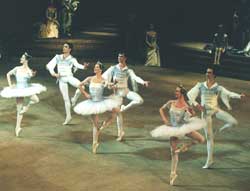
The Bolshoi Ballet's "Raymonda"
Meanwhile, Allan Ulrich had a different take and made the most of the internet to compellingly support it. Not willing to write "Raymonda" off as a mere vehicle for dancing, he writes:
"The fact is, Raymonda has genuine possibilities as a moral tale. This, like Swan Lake, is a ballet about making choices. Raymonda (a Hungarian or French princess) is confronted with two suitors - the safe, noble de Brienne and the dangerously erotic Abderakhman. But for the story to make sense, the choreographer must take the original narrative seriously. It is possible to deconstruct the Bolshoi’s Raymonda and attribute sundry episodes to various choreographers, but that is a pedant’s game.
Rather, what we should ask is whether what one saw on the stage Friday (Nov. 5) added up to cogent storytelling. Not by any stretch of the imagination with this Raymonda. The narrative arc is seriously skewed. I doubt if Petipa would have followed up a public pas de deux for his protagonists with an intimate duet 20 minutes later; his sense of structure was better than that. I suspect Petipa would not have Raymonda fall asleep under a pillar. And I am sure he would not have portrayed Abderakhman’s retinue with the ludicrously bowing and scraping corps that Grigorovich puts on the stage. Act 3, which contains the best pages of the Alexander Glazunov score (much cannibalized by George Balanchine and others), is sheer divertissement and the most satisfying portion of the Bolshoi version.
Given the absence of physical allure, this Raymonda was a strange choice for an American tour."
This is a difficult review to excerpt; I really do recommend reading the entire thing.
November 08, 2004 · 12:29 PM · Dance · Comments (2)
Mr. B in Cuba
In the U.S., ballet companies have to jump through strict hoops to dance Balanchine. In Cuba, as the New York Times reports from the Havanna International Festival of Ballet, the Nacional just copies the steps from pirated videos:
“Only one of the seven pieces performed this week is currently licensed by the George Balanchine Foundation. Two have expired licenses, and the rest were copied from videotapes.
The debate over the authenticity of these productions has emerged at a festival already hurt by the United States government's restrictions on travel to Cuba. Nine dancers from the New York City Ballet and one from the Dance Theater of Harlem were barred from attending, making this the first time in 30 years that an American has not performed at the festival.”
Several readers on Ballet Alert! have pointed out errors—which I haven’t double-checked myself—but I do know ballets are licensed by the Balanchine Trust, rather than the Foundation. Still, it’s an interesting story, and you have to wonder what Balanchine himself would have thought of the Nacional’s defense, as articulated by the company historian:
“ "Here it is considered that Balanchine's work belongs to humanity. These economic rules civilization has imposed against the spiritual enrichment of human beings, I am 100 percent against." ”
November 07, 2004 · 10:06 PM · Dance · Comments (0)
The Bolshoi's Bloodless "R&J"
I suspect the Chronicle may get some mail about my thoughts on the Bolshoi Ballet's "Romeo and Juliet":
"Let's be clear: The new "Romeo and Juliet" that Moscow's storied Bolshoi Ballet brought to Cal Performances on Wednesday night is not bad because it trades pointe shoes and tutus for tuxedos and negligees. It is not bloodless and unaffecting because it showcases a 228-year-old company of finely trained classicists -- scandal! -- doing the bump and grind.
And it was not the worst idea to tap noted British theater director Declan Donnellan to inject some contemporary daring into a troupe long isolated by the Iron Curtain and stagnated by a repertory too heavy on former leader Yuri Grigorovich's works."
This "R&J" isn't offensive, I go on to say--the choreography is simply too thin:
"Donnellan has been matched with a choreographer too inexperienced to do the job. Radu Poklitaru, a former Bolshoi dancer, aims for the fluency and frankness of European dance theater but comes up short. Think of the cartoonishness of Sweden's Mats Ek mixed with the limb-flailing aggression of France's Angelin Preljocaj -- but sans the structural sophistication."
But the audience, as I note in the review, offered a friendly ovation. I suspect last night's non-gala crowd might have responded differently.
Voice of Dance's Allan Ulrich had a strong reaction as well:
"Have Shakespeare’s doomed young lovers from Renaissance Verona ever found themselves trapped in a sillier framework than that imported by Moscow’s Bolshoi Ballet, which Wednesday evening (Nov. 3) brought a whiff of a new era to Berkeley’s Zellerbach Hall, the opening of a five-day Cal Performances run? After Thursday, this modern-dress Romeo and Juliet vanishes from the boards here, to be replaced by the more conventional Raymonda, so this foolish, unmusical and often incoherent project may be soon a matter of ancient history."
And reminds Bay Area ballet lovers of a sad bit of casting news regarding Maria Alexandrova:
"Alexandrova did what was required and showed us sparks from an incendiary stage personality; this, alas, was her only scheduled performance during the Berkeley run."
November 05, 2004 · 11:13 AM · Dance · Comments (0)
Recommended this week
There’s so much good dance in the Bay Area this week that I can’t even get to it all. Something for everyone:
The Bolshoi Ballet returns to Berkeley tonight. I’ll have a review of the new, naturalistic and highly controversial “Romeo and Juliet” in the Chronicle on Friday. The 19th century classical ballet “Raymonda,” which is probably far more in line with the general ballet-goer’s expectations, opens Friday too. For details on the Bolshoi engagement, click here.
Ballet of a more postmodern, global stripe can be found in the fall engagement of Alonzo King’s LINES Ballet. The two-weekend run at the Yerba Buena Center for the Arts opens Friday and includes the world premiere of “Before the Blues,” a collaboration with saxophonist Pharoah Sanders, and 1998’s “Who Dressed You Like a Foreigner,” with music by tabla master Zakir Hussain. For details, click here.
Leslie Seiters is a visual artist and emerging choreographer who creates exquisitely detailed sets and dance phrases of mystery and integrity. Her little known dance theater (that’s the company’s name, not my editorializing) continues a two-week run at 848 Community Space in “The Way to Disappear” tomorrow through Saturday. I’ll be checking out the show tomorrow. For details, click here and scroll down.
And finally (I said I had something for everyone), if you like classical Indian dance, the Chitresh Das Dance Company premieres Pandit Das’ “Sampurnam” tomorrow through Saturday at the Cowell Theater. This is a consistently impressive troupe of Kathak dancers, most of them American-born, handpicked and trained by Das. The live music alone is usually worth the price of admission. I’ll be seeing the show Saturday. For details, click here.
November 03, 2004 · 06:44 PM · Dance · Comments (0)
Dancing tall
The too-seldom seen Joan Acocella writes in the New Yorker about American Ballet Theatre's Herman Cornejo:
"Now, presumably inspired by Baryshnikov and Bocca, there is another short man at A.B.T. who dances tall: Herman Cornejo. He is five feet six and not unusually handsome. (He looks like a regular person, but with an overbite.) To my knowledge, he is the most technically accomplished male ballet dancer in the United States . . .
. . . But what is most remarkable about him is his clarity. Many young male dancers, particularly since Nureyev and Baryshnikov started the craze for male bravura, push the “show” steps as far as they possibly can; that is, until they are practically falling on the floor. Cornejo does not do this. He must certainly be pushing—he gets so far—but he never, ever sacrifices form. As a result, he gives you more steps, more ballet for the buck. This is true even when he is in the air, the hardest place to hold a shape, because gravity is working against you. You, but not him."
November 02, 2004 · 01:16 PM · Dance · Comments (0)
a master redeemed
I’m back, the polls are open, and the reviews are in for Mark Morris’s “Rock of Ages,” given its world premiere at UC Berkeley’s Cal Performances last Thursday.
Bucking consensus, first by admiring “Violet Cavern” and now by discounting the new work, the Chronicle’s Steve Winn writes:
“With "Rock of Ages," the evening's world premiere for four dancers, Morris is working in a smaller compass and a more muted, almost guarded way. It was not, on first viewing, an especially engaging effort.
Using Schubert's Piano Trio in E-Flat, D. 987, the single-movement "Notturno," as a score, Morris restricts most of the action to a focal point at center stage. There, paired off at first by twos and subsequently in different groupings, the dancers execute some slow, sweeping moves, then tuck their hands behind their backs and shoot quick glances up and away. They come and go separately, walking to and from the wings and darting more looks here and there. The music's stately lyricism and trilling undertow never gain much traction as the dancers leave off, peel away, reassemble and try again. In the end, enigmatically, the dancers pace across the stage, cross in the middle and depart, their gaits slowing as the lights fade.
Four women -- Amber Darragh, Rita Donahue, Julie Worden and Michelle Yard, costumed in deep blues, aquas and greens by Katherine McDowell -- performed on opening night. By programming two women and two men on Friday and four men tonight, Morris may be signaling the minimalist mutability of the piece. "Rock" will be whatever the dancers and audiences project on it. That seems a challengingly bare facade.”
Meanwhile, straight-talking Stephanie von Buchau (a Bay Area critic whose work really should be available online more frequently) found “Rock of Ages” redeeming:
“In this short work, excellently played from the left side of the stage by members of the Mark Morris Dance Group Ensemble (including pianist Benjamin Hochman coaxing "period" types noises out of an old Steinway), the four dancers are dressed in emerald and Prussian blue by designer Katherine McDowell. The movement is mostly soft and graceful, with the occasional cutting arm or stabbing foot. Some circular patterns are suggested -- I always wish I could witness Morris' dances simultaneously from above and the front -- but the most interesting aspect of a first viewing was watching the way the entrances and exits are achieved. We're always yapping about Morris' "musicality" (which is why the ear-shattering "Violet Cavern" came as such a disagreeable shock), and part of that musicality includes knowing when to stop and when to start. By trusting the composer, sensibly not slavishly, Morris makes a work like "Rock of Ages" seem as inevitable as Schubert's music. Just as a sequence seems to have worn itself out, another entrance refreshes the palate. The result is that -- even with the simplest of gestures -- the piece is over before you've begun to tire of it.”
And Allan Ulrich, making the most of the Internet’s lack of space limitations, gives a thorough explication of “Rock of Ages’s” craft:
“Before the curtain rose on the world premiere of Mark Morris’ Rock of Ages last Thursday (Oct. 28) at the University of California’s Zellerbach Hall, it was impossible to conceive of anyone making a legible dance from Schubert’s little-known Piano Trio in E-flat, D.897, a Notturno that is always overshadowed by this composer’s two formidable trios for the same instruments. At the end of the performance, it was impossible to imagine this score being choreographed by anyone else . . .
. . . The modest and entirely lovable Rock of Ages looks as if it had been conceived in a single burst of inspiration. The score’s structure, with the piano conveying the thematic substance for a heavenly Schubertian length before the violin and cello assume a more prominent role, exudes a kind of limpid drama. The modulation to E Major and the rising dynamic in the middle section, before the ensemble returns to its dreamy state, suggests an overflowing stream subsiding to its original proportions after a flash flood. Out of this, Morris has conceived a haunting little chamber piece for four dancers, who exemplify the yearning one finds constantly in this composer.”
I loved “Rock of Ages,” as I wrote earlier. It had a mood of gentle fortitude, almost a hominess about it—and my perception of it will always be colored by that all-women premiere cast. One element not mentioned in the reviews: about two-thirds through the work, during another of the reluctant exits to the four corners of the stage, the house lights slowly rose. Discomfort and confusion registered in abundant coughs and fidgeting. And then slowly as the dancers reentered, the house lights dimmed. It was almost certainly part of the choreography, and in its self-consciousness as an “effect,” it felt very un-Morris. If you have an interpretation of this house lights phenomenon, please do share it with me.
November 02, 2004 · 01:09 PM · Dance · Comments (0)
Another View
Gia Kourlas is back in Newsday, and surprised to find herself taken by the new offerings at ABT:
"American Ballet Theatre's new choreography usually amounts to little more than rambling forays into dance-theater and even sorrier attempts to give traditional ballet a face-lift. But for ABT's intimate City Center season, artistic director Kevin McKenzie has chosen a pair of young choreographers - Trey McIntyre and Christopher Wheeldon - with reputations for musicality and imagination."
October 28, 2004 · 01:40 PM · Dance · Comments (0)
The Bolshoi is coming to Berkeley next week. For anyone wishing to study up (or just marvel at some gorgeous photos--check out these photo galleries), I direct you to Marc Haegeman's incredibly encycopedic web site.
For info on the Bolshoi visit, click here.
October 28, 2004 · 01:01 PM · Dance · Comments (0)
Far-flung correspondents
Far, far from where I sit, American Ballet Theatre is back at City Center—and Tobi Tobias, whose blog “Seeing Things” covers New York ballet like nobody’s business, is providing her usual thoroughgoing analysis. Writing about two ABT premieres, she’s pulled to an eternally vexing question:
“Should the subject of dance come up outside the tiny circle of certified aficionados, “Have you seen?” or “What did you think of?” is not likely to be followed by “Theme and Variations,” “ Pillar of Fire,” or “Les Sylphides,” though the Balanchine, the Tudor, and the Fokine are being showcased during American Ballet Theatre’s three-week autumn season at City Center. No, the “news” consists of Christopher Wheeldon’s remake for the company of his VIII (about King Henry and the first two of his six wives, created for the Hamburg Ballet in 2001) and Pretty Good Year, commissioned from Trey McIntyre. Each in its own way is a decent effort, but surely unlikely to survive five years, let alone 57, 62, or 95. And what gets reviewed? First and foremost, the new. See below.”
She’s evenhanded about the McIntyre, an overrated choreographer in my book:
“Pretty Good Year, set to excerpts from a Dvorák trio for piano, violin, and cello, lives up to McIntyre’s reputation for a certain competence . . . The ballet’s opening section creates a good-humored atmosphere, one full of genuine sweetness, with the dancers going through their paces like children at play, all bounce and verve. Even this early on, though, the busyness of the choreography—a step for every note, it would seem; lifts that are too coyly devised; an almost complete absence of stillness—threatens to exhaust the spectator . . .
And rather less than impassioned about the Wheeldon:
“As a whole, VIII has the air not of a dance or dance-drama but of a pageant.”
What really stirs her is the promise of “Les Sylphides” and “La Spectre de la Rose,” and she pledges to cover both next Monday. A good read and a lot cheaper than a plane ticket . . .
October 28, 2004 · 12:55 PM · Dance · Comments (0)
Flamenco frenzy
My review of Yaelisa & Caminos Flamencos actually ran in the Chronicle yesterday, but I was just able to find it online this morning:
"A Caminos Flamencos performance brings several guarantees: virtuosic music, striking lighting and a closing tour-de-force solo by artistic director Yaelisa to draw shouts of "olé!"
The sassy, mono-monikered Yaelisa is one of her form's most prolific local proponents and the founder of the New World Flamenco Festival in Irvine. But she's also spent her last 14 years in the flamenco-crazy Bay Area training a new generation of dancers. And in the company's latest show, which played the Yerba Buena Center for the Arts Theater over the weekend and repeats at San Jose's Mexican Heritage Plaza on Thursday, she hands the spotlight to a protege of dazzlingly soulful maturity."
I'm no flamenco expert, but I'm seeing and loving the form more every year. And the one flamenco experience that remains most vividly in mind for me is Spain's Eva Yerbabuena. I reviewed her for Voice of Dance last year:
"Advance buzz from those who should know had it that Eva Yerbabuena was the hottest flamenco dancer now working in Spain, not to be missed. And from the moment La Yerbabuena took the Zellerbach Hall stage Saturday with her crisp articulation and a sense of intention so focused that every movement had the force of fate, it was clear the aficionados had it right. But there was a surprise as the evening unfolded, more striking as each number of the seamless 90-minute Eva, now touring North America, passed. This is impeccable choreography, a new model for transferring an intimate art form to the proscenium stage.
Yerbabuena, who has run her own company since 1998, is a minimalist: She deploys six dancers and seven excellent musicians, no sets to clutter Raul Perotti’s dramatic lighting, and simple but stunning costumes. But the understated radicalism of her approach runs deeper than this.
She uses her dancers not as personalities but as elemental presences. Her dances have a compelling formal logic, so that each unexpected entrance or departure feels simultaneously inevitable. Eva has drama in the same way that, say, Balanchine’s Concerto Barocco has drama. It is cool, sometimes distant, without even a glimmer of story (the men and women hardly look at one another), and yet you are on the edge of your seat to see what happens next. In essence, Yerbabuena has filtered a deeply expressionistic dance form through her own abstractionist sensibility."
Closer to home, the Bay Area is fortunate to have Theatre Flamenco, the elegant La Tania (who's performed memorably with, among other groups, LINES Ballet), and of course Yaelisa, whom I also reviewed last year:
Yaelisa
"At the end of Caminos Flamencos’ latest full evening show "Mujeres," a richly deserved bouquet appeared for the company’s artistic director and star dancer. Yaelisa extracted a rose and tossed it to the audience. She paused, narrowed her eyes mischievously, and revved up as though to throw the whole bunch. Almost everyone laughed but no one ducked. Yaelisa was just being playful again.
That playfulness is the hallmark of Yaelisa’s dancing, and it sparkled last weekend in two lengthy, tour-de-force soleas. Her performance alone would have earned the sold out crowd’s instantaneous standing ovation. As it happened there was so much more to applaud: sultry musicianship that turned a rainy San Francisco night into an evening in Seville, sumptuous costumes and lighting, and daringly simple stage design that lent Yerba Buena’s vast theater the intimacy of a Spanish café while shining the spotlight on gutsy dancing."
And of course there are so many other flamenco groups in and near San Francisco, and so many I haven't gotten around to seeing. If you'd like to check them out, the Flamenco Events Calendar is a good place to start.
October 27, 2004 · 12:02 PM · Dance · Comments (0)
Morris Mis-steps
The reviews are in for Mark Morris’s “Violet Cavern,” which had its West Coast premiere at UC Berkeley’s Cal Performances last Friday. The Chronicle’s Steven Winn liked it, with one tiny caveat:
“The second half of the evening was devoted to the West Coast premiere of "Violet Cavern," a knottily drawn yet expansive full-company work on an exciting commissioned score by the jazz trio the Bad Plus. Happy as Morris fans may be to revisit familiar choreography from his repertoire, something new always heightens the mood. Almost a quarter century after founding his troupe, Morris remains one of the great, seemingly inexhaustible artists of his day . . .
The weekend's Program A did not reveal Morris and his dancers in their most openly affecting or wittiest temperaments. But in their organic evolutions, both "Mosaic & United" and "Violet Cavern" turned Morris' inventive vocabulary into an eloquent and absorbing language. Even when the meaning gets muddied at times, Morris dances speak in a lovely, strange and memorably distinctive voice.”
And the Contra Costa Times’ Mary Ellen Hunt was also partial:
“A collaboration of music, art and dance met up with imagination and wit as the Mark Morris Dance Group kicked off its two-week run at Cal Performances with the thoroughly enjoyable "Violet Cavern" on Friday night.
Set to a commissioned score by the Bad Plus -- the reverberant jazz trio of Ethan Iverson, Reid Anderson and David King, who accompanied "Violet Cavern" live on Friday night -- this engaging and highly visual work for 15 dancers isn't going to compete for precedence with such Morris masterpieces as the brilliant "L'Allegro, il Penseroso ed il Moderato," which the company performed last season. Nevertheless, it amply demonstrates why Morris holds a place among the top flight of American modern choreographers.”
But Voice of Dance’s Allan Ulrich was none the less respectful but more decisive about deeming “Violet Cavern” one to file under “forgivable failures”:
“What’s different about Violet Cavern is that it is set to an original jazz-pop score, one of the few commissions the company has undertaken. If an earlier commission, Rhymes with Silver, elicited a wondrous piece of music from the late Lou Harrison (you can hear it on a New Albion compact disc) and a fanciful skein of movement from Morris, the results in this new work are more problematic. This is one choreographer who starts with the music and we should, too. Violet Cavern is the work of The Bad Plus, a trio comprised of pianist Ethan Iverson (MMDG’s former music director), bass Reid Anderson and percussion David King. It is pounded out in the Zellerbach pit and seems to consist of two motives - an assertive sequence of chords and more lyrical episodes. Listening to the music alone for 50 minutes might prove a trial, but, in the presence of Morris’ 15 bright dancers, the music, paradoxically, seems more, rather than less overextended.
What Morris has done here is to weld the open, improvisatory structure that defines jazz to a carefully plotted movement plan that leaves the viewer bewildered. Choreographers who don’t customarily take to Morris’ work (some feel he is hamstrung by his music) have found much to like here, because, as one said, the dance allows a degree of gestural expressiveness missing elsewhere in his dances. You can see where they are coming from at the beginning, when Michelle Yard sails downstage, where a group of dancers recline in darkness. You can see it, too, in a twisty encounter between Bradon McDonald and Julie Worden.
Still, the choreography is more tightly plotted than one might expect. Morris has found his own striking series of imagery here. The repeated episode of two supine dancers pushing themselves across the stage while propelling an erect dancer (or is the latter propelling them?) seems fabulously emblematic of the collaborative spirit. The choreographer mines the tension and sweep to be derived from waves of dancers rushing on and offstage. We get occasional ballet references. There are allusions, also, to pedestrian movements: are those push-ups a group launches at one point? What does not emerge is a satisfying structure. Violet Cavern, unusually for Morris, seems padded, accumulative, rather than organic.”
Mark Morris Dance Group in "Violet Cavern"
I’m with Allan on this one. Morris does his best with an overblown score constantly revving up to another drum-fill finale. But despite some beautiful motifs—dancers sliding through their partners’ arms into deep, shoulder shrugging plies; one dancer walking backwards with her eyes covered as another dancer slaps her extended hand—I hope the Mark Morris Dance Group will not repeat “Violet Cavern” often. Because it doesn’t suit Morris’s particular brand of musicality, it’s fuel for those who (mistakenly) reject his musicality as too simple. One example of how it showcases what Morris does well to very unflattering effect: Toward the end of “Violet Cavern,” the ensemble begins regrouping in rows and peeling off in complex canons—and it looks like a weirdly dour Esther Williams water ballet. Structural devices that Morris can make illuminating when set to, say, Handel, or deliciously camp when set to Richard Rodgers, look downright pretentious here.
That said, Michael Chybowski’s lighting of Stephen Hendee’s overhead panels was a marvel of isolated jewel tones. And the current company is so strong. Julie Worden, more the goddess every year, is one of my favorites, along with the lush Bradon McDonald. "Mosaic & United," while not one of my "desert island" Morris works, is well worth repeated viewings, and carried a pungent air of ritual and mystery Friday night.
Program B, which opens Thursday, includes a world premiere and the majestic “V.” For details, click here.
October 26, 2004 · 01:25 PM · Dance · Comments (0)
The Eternal Recurrence of Eliot Feld
That obstinate phoenix of the ballet world is back again with his Mandance Project, as Kisselgoff reports in the Times:
"Whatever Eliot Feld is eating for breakfast these days, it more than works. He is a choreographer renewed, refreshed and (why not?) reborn. Mandance Project, his new chamber dance group, which made its debut on Thursday night at the Joyce Theater with six striking premieres, is a showcase for Mr. Feld's best works in years. Ranging from urban cool to universal mystery, they resonate with originality.
Extraordinary is a word difficult to avoid for most of the dances and the performers. The New York City Ballet star Damian Woetzel and the bass clarinetist Evan Ziporyn engage in a witty dialogue that enhances the singular blend of majesty and lightness in Mr. Woetzel's dancing. Sean Suozzi, a younger guest from City Ballet, turns a gimmicky play with flashlights on his palms into a deep meditative solo."
October 24, 2004 · 05:21 PM · Dance · Comments (0)
Time Out New York's spunky and enviably hip dance editor Gia Kourlas is in Newsday with a review of American Ballet Theatre's opening gala:
"A gala without a gimmick is a rare event, but American Ballet Theatre managed to present something classier - save a tediously pained dying swan - than the usual fare at its opening-night showcase Wednesday.
A celebration of both the work of choreographer Michel Fokine and the anniversary of Alessandra Ferri's 20th year with the company, the program included works by Jerome Robbins and Jirí Kylián, as well as a couple of blockbuster pas de deux. Even the inevitable trills of untended mobile phones couldn't put a damper on the largely phenomenal dancing gracing the stage."
This is the first I've seen Gia in Newsday, though I've enjoyed her take-no-prisoners reviews on Danceview Times in recent years. I hope this is a regular gig as she is one of the franker and more fearless voices I've encountered--certainly a woman who knows her own mind.
October 22, 2004 · 02:20 PM · Dance · Comments (0)
Jenkins's public "Danger"
My review of Margaret Jenkins Dance Company's Danger Orange is up on Voice of Dance:
"The storm passed and the clouds cleared just in time for the premiere of Margaret Jenkins’s Danger Orange Wednesday, and what a sight. Two screaming orange stages connected by a path of orange boxes stood on the vast expanse of the Embarcadero’s Justin Herman Plaza. To the left loomed Armand Vallaincourt’s hulking water fountain, its square, worm-like pipes wrapped in orange cargo net. On strode the thirteen dancers of the Margaret Jenkins Dance Company in yellow tops and pants. Suddenly the lush palm trees and the Ferry Building, clock tower and all, became just an exotic backdrop for the eye-popping human drama playing out before it. Office workers on their lunch break gathered on the steps, the continual crush of rushing water obliterating all aural distractions.
Danger Orange, continuing through Saturday, possesses its public space in such a way that the contributions of its collaborators cannot be singled out for its success. Alexander V. Nichols did the bold but simple visual design; Jay Cloidt did the sound design, often filling the air with electronic reverberations that sounded eerily like gunfire. Jenkins, of course—one of the Bay Area’s seminal postmodernists—created the choreography. Clocking in at 40 minutes and excerpting in full her 2003 work Fractured Fictions, much of it is not new. But all of it proves that dance can explore politically timely emotions without pushing a political agenda."
October 21, 2004 · 06:02 PM · Dance · Comments (0)
Recommended this week
Dance: The San Francisco Bay Area is exploding with great dance this week. Take your pick:
Fortunately the rainy skies have mostly cleared, because the Margaret Jenkins Dance Company opens their latest show, “Danger Orange” at the Embarcadero’s Justin Herman Plaza today at noon. Alex Nichols has collaborated with Jenkins to create a “distinctive alteration of the landscape for the Plaza, including a surprise treatment of the Vaillancourt Fountain.” If the way he transformed the cold concrete Herbst Pavilion is any indication, the results could be spectacular. Jenkins, of course, is one of the seminal women of Bay Area modern dance (I like to picture her in sorority with Isadora Duncan, Anna Halprin, and Brenda Way—what a quartet!). The free lunchtime shows run through Saturday. For details, click here.
On Friday, the Mark Morris Dance Group returns to UC Berkeley’s Cal Performances with a West Coast premiere, “Violet Cavern,” set to a commissioned score performed live by jazz ensemble The Bad Plus, and “Mosaic and United.” The second program, opening next Thursday, is a can’t-miss: the world premiere of “Rock of Ages,” commissioned by Cal Performances; “I Don’t Want to Love;” “Marble Halls;” and the stirring “V.” For details, click here.
Meanwhile, the sassy and soulful Yaelisa is back with her Caminos Flamencos at the Yerba Buena Center for the Arts Saturday and Sunday in “Sol Viento Flamenco.” Always eliciting a shower of “Oles!,” Yaelisa is training an ensemble of distinctive young women who can each hold the spotlight in her own right. Virtuoso guitarist and adventurous music director Jason “El Rubio” McGuire promises to debut a “new electronic flamenco fusion sound of chambao, as it is known in Spain.” Whatever the surprises, Caminos Flamencos shows are consistently beautifully lit and staged. For details, click here.
October 20, 2004 · 01:56 PM · Dance · Comments (0)
Mothers who dance
Lovely article today in the revamped New York Times arts section on American Ballet Theater's Alessandra Ferri. This passage in particular reminded me of San Francisco Ballet's own Tina LeBlanc, who is also dancing better than ever after the birth of her second child:
"What she gained from pregnancy was a deeper understanding of her body, a sense of its utility and capacity for generosity, which she had only begun to understand from ballet.
"In dancing, the strongest feeling I get is onstage," she said. "You don't just use your body, but you go through your body to talk. You know who you are in that moment. Pregnancy is the same thing. You are giving yourself totally to somebody else, which is your baby, through your body. You know why you have a body when you're PREGNANT."
And surprisingly, those 57 pounds, gained and lost, seem to have lengthened her career.
"I thought I was almost done with dancing, and then I came back from my second baby, and my body feels better than it did before," Ms. Ferri said. "I came back so totally happy and relaxed. And I know how to treat my body, so my body is giving me back something. It's a second wind." "
The article also reminded me of Lucy Gray's gorgeous photos of three San Francisco Ballet dancer/mothers. They were recently on display at the SF Public Library, but I was delighted to discover you can also see 13 of these images on the web. I love the shot of principal Kristin Long in the bath with her little boy Kai.
October 17, 2004 · 08:51 PM · Dance · Comments (0)
The inimitable imagination of Mats Ek
I reviewed Cullberg Ballet for the Chronicle today:
"He gave the dance world a "Sleeping Beauty" hooked on heroin and a "Giselle" trapped in an insane asylum. But Mats Ek doesn't need a controversial twist on a classic to ignite his inimitable imagination.
That was the captivating lesson Thursday as San Francisco Performances brought Sweden's Cullberg Ballet back to the Yerba Buena Center for the Arts Theater. The bald, coed flock of the company's 2002 local debut in Ek's iconoclastic "Swan Lake" has flown the coop. And with revisionist gimmicks absent, the power and fluidity of these 20 multinational dancers -- and the emotional depth of the troupe's former artistic director -- shone all the more vividly."
My favorite offering was Ek's "Solo for Two," which was all the more touching on second viewing:
"But where "A Sort Of" is nightmarish and slightly unfocused, Ek's 1996 "Solo for Two" is delicate and distilled. Gunilla Hammar and Boaz Cohen are an all-too-human couple flitting through each other's sleep. Ek's gift for weirdly compelling emotional logic comes to the fore as he finds an unexpected layer of humor in Arvo Pärt's spare music. These lovers pee in the corner and blow their noses on their pajamas. But the endearing crudities only underscore the actuality of their solitude, and a sad ache colors every action."
The show continues at the Yerba Buena Center tonight and tomorrow.
October 16, 2004 · 01:47 PM · Dance · Comments (0)
New Dance Critic at the Times
Big news in the dance world: Anna Kisselgoff has announced her retirement as chief dance critic at the New York Times. Former rock and classical music critic and columnist John Rockwell, once a modern dancer with the Bay Area’s own Anna Halprin, will take her post in 2005. Kisselgoff has led the Times’ dance coverage since 1977, and obviously this is an important shift.
Will Rockwell make the "niche" subject of dance more mainstream? Will classical ballet receive its due? Naturally the sharp folks at Ballet Alert! are hot on the topic.
October 15, 2004 · 06:35 PM · Dance · Comments (0)
NYCB in LA
Allan Ulrich’s review of New York City Ballet in Los Angeles is now up on Voice of Dance, with a tidbit of information that will likely tantalize many West Coast ballet lovers:
“The West Coast - at least Costa Mesa and Berkeley - have seen NYC Ballet intermittently in the past 20 years, but Los Angeles, which does not boast a resident ballet troupe of any stature, seemed most in need of this visit. Before the performance Friday (Oct. 8), Ballet Master in Chief Peter Martins indicated that, now that the L.A. Philharmonic has moved to its new home at the Walt Disney Concert Hall, thus freeing up the schedule at the Dorothy Chandler Pavilion for a dance series, NYC Ballet might be back some year soon.
The time for reacquaintance was long overdue, even though this is not a great period in NYC Ballet’s history. In these three Los Angeles programs (the repertoire was somewhat different the previous week at the Orange County Performing Arts Center) it was, befitting the centennial, all gold-standard Balanchine - Serenade, the first American work; Concerto Barocco, Symphony in C, Agon, Stravinsky Violin Concerto, Tchaikovsky Pas de Deux and Who Cares?”
October 13, 2004 · 06:50 PM · Dance · Comments (0)
Dancing in their seats
I've got an article in the Chronicle today on the 25th anniversary of Rhythm & Motion dance center:
"A jazz dancer slinked in her silky dress. Robust women shook their shoulders to Cuban drumming. Twenty-year-olds in cargo pants spun on their hands to hip-hop beats. And in their seats, with wild claps or subtle head nods, the audience danced along Friday night as the Rhythm & Motion dance center celebrated its 25th anniversary.
The studio is one of San Francisco's most popular, as the turnout proved: Nearly 900 students and friends stood in a will-call line that spilled onto Van Ness Avenue. They packed the stately Herbst Theatre with exuberant shouts that threatened to strip the gold-gilt paint off those dignified walls.
Dance forms seemed as plentiful as dancers. Ramon Ramos Alayo and Patricia West married modern and Afro-Cuban genres in a clinging duet, their torsos pulsing like gills. Sydney Tufari tossed off jazzy fouette turns in choreographer Ann Barrett's solo set to Santana. Amara Tabor-Smith and Christal Brown danced a gut-wrenching "roots modern" piece of desperate hand- to-mouth gestures."
R&M's bread and butter is the dance workout program designed by founder Consuelo Faust, whose philosophy of dance is refreshingly inclusive:
"Who would guess, watching her bow with quiet pride, that it all began with aerobics? That was the rage in 1979, when Faust decided to support her career as a choreographer by calling "grapevine left!" and "four knee lifts!"
"I had to overlook some of the silliness of it," Faust remembered on a recent Tuesday night, sitting in her third-story office at the Rhythm & Motion headquarters on Mission Street between Seventh and Eighth. One floor below her, drummers pounded out the accompaniment for West African Guinean dancing; on the ground level, tappers hoofed it up in the smaller studio while a dozen women swung their hips with Afro-Cuban zeal next door. "But I saw that I could bring my dance technique to aerobics and teach the general public, people who would never come to an official dance class because they'd be too intimidated." "
It all made me want to dance again. Don't be surprised if you see me in a Fusion Rhythms class soon.
October 12, 2004 · 11:47 AM · Dance · Comments (0)
Balanchine in the 21st C.
It's incredibly difficult, I think, for anybody under 40--and especially a non-New Yorker--to write about New York City Ballet these days. There is the omnipresent shadow of the many persuasive detractors of Peter Martins's leadership, coupled with the handicap of not having witnessed the company while Balanchine was alive.
I tried to write this Voice of Dance review of the company's Orange County performances squarely from my limited perspective--which for better or worse is also the perspective of future ballet-goers:
"We have entered an age of the Balanchine smorgasbord. You can walk down the buffet line and pick your favorite Jewels as Miami City Ballet’s, your favorite Stravinsky Violin Concerto as San Francisco Ballet’s; your favorite Serenade as Suzanne Farrell Ballet’s. You can make a case for preferring these renditions based not on uniformity of technique, but on subtle yet crucial shadings of interpretation, intention, and mood. Whatever your argument, the conditions for it remain the same: NYCB no longer holds the monopoly of authority on how these ballets should be danced. Whether it relinquished this authority or whether that authority was bound to fade during the Balanchine diaspora remains, to me, an open question.
Perhaps to keepers of New York City Ballet history, this new laissez-faire Balanchine market is but another symptom of the sad slide they lament. But to those who came of age after Balanchine’s death, it is impossible to mourn a golden age you didn’t witness. Freed from memories of New York City Ballet under Balanchine, I was delighted to discover new dancers and to see new choreographic details in ballets, such as Rubies, that I had previously seen only other companies perform.
This West Coast tour is all about Balanchine: on Saturday and Sunday’s slates, the only non-Balanchine offering was artistic director Peter Martins’s swollen Thou Swell, a shrewd but choreographically vacuous package of sentimentality set to Richard Rodgers songs. The audience gave it a roaring standing ovation. Christopher Wheeldon’s Polyphonia was replaced by a repeat of Stravinsky Violin Concerto at the last moment due to injuries, and a second viewing proved NYCB’s rendition of it no less dull. Serenade, seen twice, fared better, as did Rubies and Symphony in C. That most sure-fire of Balanchine crowd-pleasers, Stars and Stripes, showed the company at its sharpest and strongest, while the bookends of Jewels, Emeralds and Diamonds, languished with undistinguished performances framed by Peter Harvey’s swampy new sets. All told, this was a chance for a Southern California audience far more accustomed to Swan Lakes than mixed bills to see a striking range of Balanchine’s genius—classicist, modernist, spiritualist, campy populist. Many, I’m sure, left as converts."
Do let me know what you think.
October 08, 2004 · 06:45 PM · Dance · Comments (0)
Good News
Given all the (justified) hand-wringing that dance is in down-cycle in terms of creativity and popular appeal, I thought I’d post two stories about efforts to fight the malaise. For starters, New York’s $10-per-ticket Fall for Dance Festival in New York proved an unqualified hit, selling out every performance at City Center:
“Dance presenters, choreographers and artistic directors are full of praise for what they call courageous programming, for the audacity of trying (successfully) to fill a 2,700-seat theater for six nights of dance and for bringing five companies together on stage each night for a $10 ticket.
"People were pretty much feeling maxed out on formulas for increasing dance attendance," said Elizabeth Streb, whose company, Streb, appeared on Sept. 28. "This is an idea that could change the course of events for the dance world and companies. It opens the door to wondering, 'Hmm, what could I put together to have a slam-dunk effect like that?' "
And despite the surprisingly nasty backlash this article captures, I have to agree with Bill T. Jones:
“ "This is ultimately going to be good for everybody," he said.”
Meanwhile, on the other side of the country, two Seattle dancers are doing something to fight the pervasive prejudice against dancing men:
“Despite the undeniably cool moves of Gene Kelly, Mikhail Baryshnikov, Savion Glover and countless MTV b-boys, our culture still harbors a weird taboo about men dancing. And that's precisely the reason Ray Houle and Gérard Théorêt started Against the Grain: Men in Dance.
Théorêt, who now teaches dance at Cornish College, recalls, "Ray and I were saying it was too bad that dance wasn't a popular or acceptable thing for boys when we were kids." Noting that as a consequence he and Houle came to dance relatively late in life, Théorêt posits, "We could've gone so much further." He calls this realization the "germ" for the Men in Dance festival, which began in 1994.
Taking place over two weekends (at the "Oddfellows Hall," of all places), the program features a wide variety of methods, music and men. This year's festival marks the fifth biannual event and features 12 choreographers, plus special guest dancer Yoko Moshi-Moshii from the all-male Ballets Grandiva. The slate of solo and ensemble numbers includes everything from ballet to breakdancing, performed by an all-ages, all-races, all-male cast of dancers.”
In the dance world, it’s easy to forget American culture-at-large isn’t as progressive as we’d like to presume. “Billy Elliot effect” notwithstanding, I encounter snickers about men who dance from educated people I’d think would know better (no need to name names, ahem). And it’s good to know this group of dance lovers isn’t just complaining, but doing something about it.
Links via Ballet Alert!.
October 07, 2004 · 05:39 PM · Dance · Comments (0)
Kudelka Rising
I'm en route to see the New York City Ballet in Orange County--four programs in two days. But I've just got time to post my Chronicle review of the National Ballet of Canada, which closes a Cal Performances run on Sunday:
"A mood of discovery percolated Thursday night through UC Berkeley's Zellerbach Hall, as the Bay Area greeted the National Ballet of Canada for the first time in 13 years.
The National is both a familiar name and something of a mystery in these parts. The troupe of 55-plus dancers rarely tours America despite its proximity in Toronto, but local audiences know the work of Artistic Director James Kudelka through his many commissions for San Francisco Ballet. This was the first chance to see how Kudelka has reshaped the storied National since taking the helm in 1996. The region's ballet dignitaries turned out in force and curiosity ran thick.
If the National evolved only as a showcase for Kudelka's prolific talents, that might, on the strength of the Cal Performances program repeating tonight and Sunday, be purpose enough. The evening was stacked with three Kudelka works, none a more fitting introduction to his distinctive voice than the world premiere solo, "Chacony." "
As Mary Ellen Hunt stresses in her review for the Contra Costa Times (which I'll post here later), Greta Hodgkinson was the big discovery, absolutely scintillating in the "Summer" section of "The Four Seasons."
Now time to hit the road.
October 02, 2004 · 01:17 PM · Dance · Comments (0)
Shen Wei
I’m in the Chronicle today with a review of Shen Wei Dance Arts. I entered the theater skeptical about Shen’s “The Rite of Spring” but exited a believer:
“Shen uses the two-piano reduction of Stravinsky's score, played with spine-tingling physicality by Fazil Say (at one point he plucks the piano's strings) and heard here recorded. The result is less bombastic than full orchestra but equally fearsome. The dancers shuffled with arms held rigidly by the sides in the focused manner of Chinese opera performers, charging the negative space like ionized atoms. At the first clashing chords, one dove into a somersault. The movements that followed were obsessed with the rotation of the joints, shoulders and hips torquing so that energy passed through like the crack of a whip. The dancers executed them with stark straight faces and incredible anatomical precision.
Shen's gift for visual tension is unflagging. A limb-by-limb collapse became more desperate. When the full company began walking tight circles, each in their individual orbit, you thought the stage might explode from centrifugal force.”
September 29, 2004 · 02:24 PM · Dance · Comments (0)
More delays and another take
My review of Shen Wei Dance Arts will actually run in the Chronicle tomorrow. And Thursday I’ll be checking out the National Ballet of Canada at Cal Performances, with a review appearing in the Chronicle on Saturday. In the meantime, Allan Ulrich has a very different (and as always, passionate) reaction to Shen Wei up on Voice of Dance:
“Sooner or later, shooting stars are destined to come to ground somewhere in the universe. The time may come sooner, rather than later for Shen Wei Dance Arts, which made its Northern California debut last weekend at the University of California, Berkeley’s Zellerbach Hall, a presentation of Cal Performances, and one that drew a smallish house at the final performance Sunday (Sept. 26). Talk about fame and its caprices. On the basis of a couple of programs, a smattering of festival dates and a handful of reviews (including what might be construed as an anointing from The New York Times), the company has been launched, inexplicably, on the national and international circuit.
Truth to tell, there was much less than met the eye and much less that pleased the ear in Shen’s vaunted The Rite of Spring (2003), and possibly more than one might have expected in the more opulent and less publicized Folding, the work on the second half of the program. Why all this interest in a dancer-choreographer who, three years ago, was scarcely a blip on any dance fan’s radar? Flavor of the decade, perhaps?”
September 28, 2004 · 04:59 PM · Dance · Comments (0)
Possokhov's "Study" in England
The Financial Times’ Clement Crisp has an interesting perspective on SFB principal Yuri Possokhov’s “Study in Motion”:
“The succeeding Study in Motion is very odd.
Skryabin piano music is realised by Yury Posokhov in dance that recalls the later choreographies of Kasyan Goleizovsky, a fascinating experimentalist in 1920s Moscow who fell victim to Stalinist artistic policy. When he returned to grace in the 1960s he produced concert numbers (using Skryabin) having the non-specific intensities we see in Posokhov's work.
Watching SFB's fine soloists surge through it (with disastrously unbecoming costumes for the women) is like time-travelling, and not a little disconcerting. Rampant anguish. Dance and emotions flung to the winds.
Posokhov catches Skryabin's weirdnesses and makes well-shaped movement but it is rather dated.”
The Guardian’s Judith Mackrell agrees:
“Yuri Possokhov's Study in Motion, the second of these, does, however, look like slightly exhausted family stock.
Dancing to Scriabin is always tricky - there's a diffuseness in the music that rarely focuses a choreographer's attention - and Possokhov's use of seven discrete piano pieces makes for more vagueness still. Ensembles, duets and solos flit by in unlinked progression, and while the steps are neatly assembled they don't transport either the performers or the music to a different place.”
The Telegraph’s Ismene Brown is rather more partial to it, and taken with Lorena Feijoo:
“Possokhov is an SFB dancer from Russia, and an intriguing emergent choreographer whose Russianness is writ thoroughly through his Study in Motion, premièred this year. White net curtains waft, silhouetted figures moon about, and Scriabin's thick, luscious, odd-flavoured piano music takes us on rather too long a journey into gracefully choreographed love business between four couples.
The leading female, Lorena Feijoo, makes it worth watching – you can split ballerinas into dancers and women who dance, and the latter are often the more rewarding artists. So it is with Feijoo, with her down-turned Jeanne Moreau mouth and inflammatory moodiness.”
So you win some, you lose some when you look overseas to shore up your critical evaluations. I found Possokhov’s latest dance stunning when it premiered last year—I saw it three times. But the Brits bring their own contexts—and fresh eyes—to the table. I respect their viewpoint but I retain my fondness for the work.
September 23, 2004 · 12:18 PM · Dance · Comments (0)
London calling
The reviews of San Francisco Ballet keep rolling in from London. Raves for the dancers and for Tomasson’s leadership, and pans for Bolshoi director Alexey Ratmansky’s “Carnival des Animaux.” I could not agree more. I was in the minority when this ballet premiered at SFB, sitting baffled as the crowd around me roared with glee. The work served its purpose, I suppose, as comic relief, but I don’t see it enduring as a repertory staple.
One of my favorite critics, the delightfully acerbic Clement Crisp, also singles out Katita Waldo, an elegant veteran ballerina often underappreciated here in San Francisco. Writing of Christopher Wheeldon’s “Continuum”:
“I must salute the Klee-like way that the elegant Katita Waldo takes a line for a walk, and hail the duet for Muriel Maffre and Yury Posokhov, who are grown-ups in a grown-up situation, and wonderful. And so to the suicide-attempt that closed the evening. For inscrutable reasons SFB asked Alexey Ratmansky (now director of the Bolshoi Ballet) to realise Saint-Saens' "Carnival of the Animals". Lumpen dance; the musical wit of an enraged rhino, loathsome costuming, and a feeling that this was intended to show how silly ballet could be, made for something repulsive that was greeted with peals of merry laughter (especially when Fokine's Swan was mauled).”
The Telegraph’s Ismene Brown admires the strength of SFB’s rep:
“San Francisco is collecting the hearts of great choreographers – first Mark Morris and recently the English expatriate Christopher Wheeldon have fallen in love with its ballet company. This American company has also captured British affection on its increasingly frequent tours, with its warm-hearted spirit, an eager but disciplined corps de ballet and some remarkable and varied leading artists.
In this turbo-charged week in London, SFB are performing 11 ballets on three programmes, their opening one showing, for better and for worse, how widely they range. Starting with a charming Balanchine, then a simply magnificent Wheeldon, and ending with the tritest of animal ballets by the Bolshoi's new director, Alexei Ratmansky, it runs the gamut of taste and admiration.”
And the Times’ Debra Craine offers similar laurels, though alas a paid subscription is required to read her review online:
"For this, its third visit to London in five years, San Francisco Ballet has brought 11 ballets, including four UK premieres and two London premieres. It’s a most impressive lineup which puts British companies to shame.
Under Helgi Tomasson’s long-standing direction, the California company — America’s third largest — is a hotbed of creativity. And, as it showed at Sadler’s Wells on Monday night, the San Francisco troupe is also a glittering showcase for fine dancing.”
Links via Criticaldance, which—true to form—has gone hog wild with coverage, and via Ballet Alert!.
September 22, 2004 · 01:25 PM · Dance · Comments (0)
Eureka?
Voice of Dance’s Allan Ulrich is unmoved by John Jasperse’s “CALIFORNIA”:
“There is a moment in John Jasperse’s CALIFORNIA when you suddenly sit up, giddy with delight. A man bends and nuzzles his female partner like a youthful gazelle expressing affection for another of its own kind. It’s not a revelatory gesture, but in the context of the gelid, but smoothly honed formalism of this 55-minute piece, the moment arrives like a minor earthquake. Here, for an instant, we happen upon a recognizable human emotion. We can, in the cheesy parlance of an earlier era, relate to the movement scheme before us.
Jasperse’s work, premiered in France last year at the Festival International de la Danse a Cannes, marked the New York-based postmodernist’s Bay Area debut, while the weekend’s two performances at San Francisco’s Yerba Buena Center for the Arts Theater also inaugurated the first extensive season of presentations by the center’s new executive director Ken Foster. It’s genuinely comforting to discover that Foster is making an effort to book out-of-town companies overlooked by the more conservative presenters. The substantial number of local dancers and choreographers in the audience last Friday (Sept. 17) testified to the community’s interest in Jasperse. But I wonder what they could possibly have taken away with them - except for a certain satisfaction in their own work, the knowledge that they weren’t missing anything.”
I found the work respectably intelligent, though it neither excited me nor lingered long in mind. Of my native state California it told me nothing, though with conceptual work of this nature you hardly expect illumination on such literal matters. I must have arrived with excess caffeine in my system, because I found my attention holding steady to marvel at how thoughtfully the movement mirrored the construction of architect Ammar Eloeuini’s overhead sculpture. It was made of sort of translucent plastic scalene triangles joined together to create an undulating plane (if such a thing is possible) of rectangles. I need an illustration. At any rate, the dancing folded in the same way the sculpture did. Much of it took place with the dancer bent at the waist, touching the floor, arms and legs walking side to side to create an endless series of triangles. Interesting too was the final appearance of the leaf blowers, when the dancers lay with them across their stomach, turning on the machines in little huffs. It was like breath made extra-noisy, a kind of electric-powered resuscitation.
September 21, 2004 · 12:42 PM · Dance · Comments (0)
The first (short) reviews of San Francisco Ballet’s London engagement are in. Judith Mackrell in the Guardian:
“As director of San Francisco Ballet, Helgi Tomasson has started to acquire an aura of infallibility, his expertise in laying down repertory, and in balancing great evenings of dance is held in envy by the rest of the profession.
Certainly his choices for the company's opening programme make for an unusually adroit mix, setting the frisky grace notes and velvet elegance of Balanchine's Square Dance against the potent secrets of Christopher Wheeldon's Continuum and the whimsical romp of Alexei Ratmanksy's Carnaval des Animaux.”
And Zoe Anderson in the Independent:
“San Francisco Ballet opened their Sadler's Wells season on buoyant form. This is an outgoing company, crisp and characterful. They dance a varied repertory with confident style.”
For anyone in London wanting to study up before attending, I recommend Paul Parish’s colorful preview on the website Ballet.co:
“Tomasson as director has turned a company that used to sacrifice classical equilibrium for effects which brought down the house, where principal male dancers did sloppy glissades, into a beautifully disciplined cadre of musician-dancers. His own ballets, while not great choreography, are finely crafted, often beautiful works that give the dancers wonderful chances to shine. His Concerto Grosso displays five men from the lower ranks who look like principal dancers in this ballet. And his new Bach piano-concerto ballet looks like the music sounds - it gleams in the dark (especially when leBlanc dances it).
The least of the current dancers are technically adroit, and they are quick studies - they have to be, they don't get enough rehearsal time. (No American company does, really.) These dancers can execute the most complex transfers of weight and the trickiest rhythms without loss of poise; they can show the transitions cleanly while phrasing the steps with a grand sweep. They share a similar talent and gusto for movement and hunger to perform, which makes for consistency of spirit. On the other hand, they don't have a consistent basic style. It shows least in new works, where the choreographer has coached them, and the details are freshest in their imaginations. But... Head positions are not the same throughout, nor are backs, arms, shoulders, hands, not even feet, and certainly not attack. The roster is packed with fantastic dancers - they come from all over the world (especially Russia, Spain, Cuba, and France). They come in all shapes and sizes and colors, and do not by any means have the same training. The weaknesses of the company show in ballets that require character, epoch, nationality in the background; we have Swan Lake, Sleeping Beauty, La Sylphide, Don Quixote, Giselle, but only a couple of corps dancers can make convincing peasants (except in a splendid new version of Sylvia by Mark Morris, who has put the qualities he wanted into the steps themselves).”
September 21, 2004 · 12:17 PM · Dance · Comments (0)
I reviewed the Virsky Ukrainian National Dance Company’s Cal Performances appearance yesterday for Voice of Dance:
“Watching the Virsky Ukrainian National Dance Company explode across the stage with color and good cheer, it’s easy to understand why former ballet master Pavlo Virsky felt drawn to his region’s folkloric traditions. Bounding 85-strong through Zellerbach Hall Sunday, faces brighter than the most solicitous of airline attendants, the Virsky company was big and bold but also remarkably refined. The matinee crowd roared approval for the tricks and the artistry.
The troupe has both elements in spades. Virsky left a career in classical dancing to establish his ensemble in 1937 and direct it from 1955 until his death in 1975. The ballet training continues under Myroslav Vantukh, who assumed leadership in 1980. Arms are light and elegant above vigorously stamping feet, and the heel clicks in the women’s Kozachok dance are as fleet and fluttery as brises. The polish detracts nothing from the men’s powerful leaps and the women’s earthy charm.”
Fun show, fun review to write. What more can you ask for?
September 20, 2004 · 07:07 PM · Dance · Comments (1)
DTH Disbands
Sad news from Dance Theatre of Harlem today:
“The Dance Theatre of Harlem, one of the most acclaimed dance troupes in the world, plans to disband its 44-member company and shut its doors for the rest of the 2004-05 season until its finances can be restructured, a dance union official said yesterday.
"They are taking a hiatus to restructure finances. It's no secret it has been quite challenging . . . so they made the decision with conversations with us that they want to go on hiatus for one year," said Deborah Allton, national dance executive director for The American Guild of Musical Artists, the dance union.”
Interestingly,
“The Dance Insider Online, a popular website magazine, first reported the story yesterday.”
The story reports that the dancers will still appear in City Center’s “Fall for Dance Festival.” Other than that,
“ “It's horrible," Allton said. "It's an incredible institution: Mr. Mitchell has great courage for his artistry and everything, but it takes a business side and artistic side to keep something going and I think it's probably a wise decision. Actually -- the only decision. He did everything he could. It's time to step back and regroup.’”
Link via Ballet Alert!.
September 18, 2004 · 01:05 PM · Dance · Comments (0)
Recommended this week
I’ll be checking out the Bay Area premiere of John Jasperse’s “CALIFORNIA” tomorrow night at the Yerba Buena Center for the Arts. Jasperse, whose heady approach to creating experimental dance environments has generated buzz on the east coast, is still little known out here. This new evening-length work uses a fractured set designed by architect Ammar Eloueini, and five dancers wielding leaf blowers.
If you’re intrigued, Voice of Dance has arranged a two-for-one ticket deal for their newsletter subscribers. Sign up for the email list and you’ll receive frequent alerts to such specials: Last spring I got 50 percent off my ticket to Ballett Frankfurt. Plus you’ll get the heads up when either I or my colleague Allan Ulrich have a new review on the site.
For details on the Jasperse show, click here.
September 16, 2004 · 03:03 PM · Dance · Comments (0)
critical apathy
I’ve got a review of Huckabay McAllister’s tenth anniversary show up on Voice of Dance:
“Honey, I’m Home!, the title of Huckabay McAllister Dance’s 10th anniversary program, perfectly captures this company’s goofy sense of theatricality. HMD’s nine dancers are wide-eyed and wily; they exchange heaps of knowing winks whether the joke has to do with wife-swapping or simply turning in place like a ballerina in a jewelry box. You can’t help giggling at the performers’ total commitment, and sometimes the choreography truly earns your laughter. But even comedy that keeps you chuckling brings varying degrees of satisfaction, as the evening of eight dances proved. There’s cleverness and then there’s cloying—and it’s hard to say which wins out at an HMD show.”
This was a tough one to write. Sometimes you go to shows that don’t quite work, but you’re so drawn to their strengths that it’s fascinating to tease out what went wrong. Hagen & Simone was such a case: I could have written about them for pages. I find HMD’s work competent but not terribly sophisticated—it doesn’t fail in interesting ways. And HMD has its own dedicated audience who like what they’re doing just fine. As a critic lacking a passionate reaction either positive or negative, you almost wonder whether there’s much need for your response in this somewhat closed circle.
One thing I wish I had noted in the review: the production values were solid. Sara Linnie Slocum did the lighting and Plastique contributed the costumes.
September 13, 2004 · 08:09 PM · Dance · Comments (0)
SFB in 2004
My review of San Francisco Ballet’s 2004 season is out in this month’s Dance Magazine. The article is not online, but here’s a taste:
“It took a full-length world premiere by Mark Morris to draw the international press to San Francisco Ballet in 2004, but that choreographic coup was only the high-point finish of a landmark season.
Artistic Director Helgi Tomasson pulled out all the programming stops during his nineteenth year in charge, offering two bills in tribute to George Balanchine’s centennial and one in recognition of Frederick Ashton’s, and topping it all with well-crafted premieres by in-house choreographers. In the process he showcased a diverse company that, from the youngest corps members on up, can make a blinding array of classicism’s facets sparkle.”
If you want to read more, you’ll have to buy the magazine. And if you haven’t picked up Dance Magazine since the redesign, I recommend getting reacquainted. The new look is clean and bold, with an emphasis on artful photographs that convey motion—no more endless gallery of tutu studio portraits with cotton candy pink backgrounds (though I have a soft spot for those, too). American Ballet Theatre’s Erica and Herman Cornejo zoom across this month’s cover, with a package of stories on Latin dancers inside. I also contributed a small report on Margaret Jenkins’s new CHIME (Choreographers in Mentorship Exchange) program, which fielded some interesting pairings for its first year, including Erika Shuch with Joe Goode, and Alma Esperanza Cunningham with Robert Moses. Check it all out and let me know what you think.
September 08, 2004 · 05:10 PM · Dance · Comments (0)
Women in Ballet
The Houston Ballet assembles a program of choreography by women: Lila York, Natalie Weir, and former San Francisco Ballet principal Julia Adam. Molly Glentzer seizes the occasion to talk with Lynn Garafola, whose new book due out in January includes a chapter on, as Glentzer calls it, “ballet’s glass ceiling”:
“When George Balanchine said so famously, "The ballet is a purely female thing; it is a woman," he was thinking of dancers, not choreographers. Offstage, women still haven't come a long way, baby.
But Houston Ballet and its artistic director, Stanton Welch, will celebrate women dancemakers in the season-opening program Women@Art on Thursday. It offers the world premieres of Julia Adam's The Accidental and Natalie Weir's The Host, plus the company premiere of Lila York's popular Celts.
And it's rare air. Among the five largest U.S. companies, the only other ballet by a woman being staged this season is Susan Stroman's Double Feature, commissioned last year by the New York City Ballet.”
September 07, 2004 · 12:54 PM · Dance · Comments (0)
Parental Advisory
Toni Bentley, the former New York City Ballet dancer whose wonderfully revealing first book, Winter Season, I’m finally reading, has a new nonfiction title slated for publication in October. If you thought Sisters of Salome, her book about stripping, exposed all, The Surrender goes, er, deeper still.
Naturally the highly literate dance lovers at Ballet Alert! keep their discussion within the bounds of good taste.
September 07, 2004 · 12:18 PM · Dance · Comments (0)
SFB's new soloist
San Francisco Ballet is on tour to London, and the company’s new soloist, 18-year-old Royal Ballet School grad Nutnaree Pipithsuksunt, talks to the Independent:
“Before being signed up by San Francisco Ballet, she was offered contracts with Birmingham Royal Ballet, American Ballet Theatre, Houston Ballet, Hamburg Ballet and La Scala Ballet. "I don't know if that is lucky or not... I worked very hard. I didn't audition as such for any of them. I went to New York to do some classes with the American Ballet Theatre, but when San Francisco Ballet - who had seen my end-of-term performance - wanted to see me again, I had to miss a week of school in London."
Can’t wait to see this young woman come Nutcracker season. Thanks to Ballet Alert! for the link.
September 02, 2004 · 01:00 PM · Dance · Comments (0)
Passion for fashion
My review of the Hagen & Simone/TONGUE double-header is now up on Voice of Dance:
“ODC Theater manager Rob Bailis has a flair for provocative programming. Last weekend he paired San Francisco’s Hagen & Simone with Los Angeles’s TONGUE. Hagen & Simone’s Future Perfect played up the duo’s shared obsession for fashion; TONGUE’s Tertium Quid began with a bass-pounding fashion show. One work showed moments of surprising emotional depth but needed more theatrical slickness; the other was all surface style. But the promise of each was compelling, and the shortcomings worth pondering.”
Hagen & Simone
On Hagen & Simone:
There was little of movement interest in Future Perfect—almost the only dancing consisted of Jenkinson performing ballet class moments, occasionally violated with modernist upper body (breaking the "rules" of classicism, natch). But the script, though in need of trimming, was often strong, and flashes of personal drama and thematic complexity hinted at the heart of the work waiting to be discovered through focused revision. In the most gripping section, Clarke told of throwing his grandfather’s vest away after a heckler called him "queer." And in that moment it was clear that Future Perfect was fundamentally about insecurity. Do the dictums of fashion make us insecure or do we turn to fashion to mask deeper insecurities? That question charged the show with pathos even as the ambiguously rebellious conclusion rang half-hearted.”
And on TONGUE:
“Southern California is not known as a hospitable locale to dance, and that alone makes TONGUE a success story. The eight dancers (Peter Volk also appeared as a guest) are toned, tanned, and tenacious, and choreographer Stephanie Gilliland’s aesthetic is quintessentially Los Angelean. The movement base is contact-improv inspired, but as tough as an action movie hero and as teasing as a Hollywood pole dancer. The men are brawny and bare-chested; the scantily clad women are of all shapes, some strikingly curvaceous. They roll over one another and slice the air like tomahawks and pause in muscular headstands. In one favorite and overused move, the dancers kick both legs into the air in a sideways stag, as though the rug had been pulled out from under them, then drop like bricks to the floor.”
August 31, 2004 · 12:57 PM · Dance · Comments (0)
The Season Ahead
Anita Amirrezvani, in what one hopes is not her final article on dance for the San Jose Mercury News, starts her roundup of fall’s dance events on a downbeat note:
“Fall brings with it the hustle and bustle of the Bay Area dance season, often said to be second only to New York's in size and scope. But despite the many local and touring shows on their way, the season also will reflect the sad results of ongoing cuts in government, corporate and private support for the arts.”
Meanwhile, arts and culture critic Steve Winn compiles the fall dance preview in the Chronicle, and Rita Felciano surveys the scene for the Bay Guardian.
August 29, 2004 · 11:25 PM · Dance · Comments (0)
It’s true: The San Jose Mercury News’ dance critic Anita Amirrezvani (click here for a taste of her thoughtful work) has been reassigned from the dance beat to the copy desk. She tells me there are no plans she knows of afoot to hire a replacement dance writer. Bay Area dance lovers will surely miss her voice in the critical conversation. Sadly, the news may not surprise readers who watched Anita’s reviews shrink to 150 word bites which the paper called “Rapid.” How you cover a company like Ballett Frankfurt in haiku form is beyond me, but Anita valiantly attempted it. Here’s hoping she finds a new outlet for her observations on dance. Dance scenes thrive on a diversity of critical opinion, and the Bay Area is poorer for the loss of her reviews.
August 28, 2004 · 12:17 PM · Dance · Comments (0)
Recommended this week
--ODC Theater has a promising double feature running tonight through Saturday. Hagen and Simone, AKA the ever theatrical and fashion-minded Kevin Clarke and Monique Jenkinson, present “Future Perfect,” pairing Strunk and White’s “Elements of Style” and the writings of legendary Vogue editor Diana Vreeland. And visiting from L.A., Stephanie Gilliland’s TONGUE performs “Tertium Quid.” They also danced an excerpt from this in the West Wave Festival; trusted sources swear that slice was not the best representation of what this company can do.
Click here for details, and see you there!
August 26, 2004 · 01:03 PM · Dance · Comments (0)
Birthday Bash
I’m in the Chronicle today, writing about a surprise celebration of Bay Area dance:
“You'd expect a socialite to fete her 50th birthday with dinner and dancing, but former cookie magnate and professional dancer Linda Rawlings has decided to do that formula one better.
"I thought, 'How can I give myself a birthday present?,' " Rawlings said last week from Toronto, where she was attending a wedding. "I was ruminating on turning 50 and missing the Bay Area and the dance scene there." So last month Rawlings called haute event designer and former San Francisco Arts Commission President Stanlee Gatti, who was already planning her Saturday birthday bash, and asked him to pencil in a second event.
At "A Celebration of Dance and Music," taking over the Cowell Theater at Fort Mason on Monday night, revelers will dance in the lobby and up the aisles, but most importantly on the stage, with representatives from 10 Bay Area groups each giving five-minute performances before letting loose to the sounds of Los Angeles' Durell Coleman Band and munching savories from McCall Catering. The program includes delegates from small companies like Run for Your Life and Tantrum, alongside major players like Smuin Ballet, ODC/SF and Diablo Ballet. Children from Cal Performances' Ailey Camp will take part, and, for a flashy finale, members of Ballet Counterpointe Rep will model togs by Hong Kong designer Barney Cheng.
The free extravaganza is not a fund-raiser -- "I'm asked for money all the time too," she said -- and it's not just another chance for the in-crowd to rub elbows. Rawlings has set aside a block of tickets to distribute among dancers and choreographers through local studios.”
Rawlings now sits on the boards of the Mark Morris Dance Group and UC Berkeley’s Cal Performances, and wins my admiration for earning three college degrees, leading a busy career, and raising four children. It’s still not at all clear to me how she’ll distribute the tickets set aside for members of the dance community. But if you’ve heard rumors that Mark Morris was going to perform and a big marching band was going to take over the Cowell, now you have the real scoop.
My favorite quote in the piece is from ODC/SF artistic director Brenda Way:
"How fantastic that someone would mark a milestone birthday with dancing, " Way said. "It's a wonderful statement that to celebrate major moments, we dance."
August 25, 2004 · 01:39 PM · Dance · Comments (0)
Allan Ulrich reports in the Chronicle today on a new film about the
Ballet Russe de Monte Carlo:
“The names and histories of those dancers -- Alicia Markova (now 93), Maria Tallchief, Irina Baronova and Tatiana Riabouchinska (two of the three celebrated "baby ballerinas"), Nathalie Krassovska, Yvonne Chouteau, Frederic Franklin, Mia Slavenska, Marc Platt and George Zoritch, to cite the most prominent -- add up to a chronicle of ballet in the 20th century. Within that span, the art of classical dance traveled from its home in czarist Russia to what many observers deemed its logical destination in the United States. These people made it happen.”
The catalyst for the documentary was the company’s 2000 reunion, which inspired filmmakers Dayna Goldfine and Dan Geller:
"To see people that old who relied on their bodies for their whole careers, finding their bodies betraying them and still carrying on with optimism and exuberance, still working every day, is remarkable," Geller says in the couple's home and office in San Francisco's Alamo Square. "These people are examples of lives well lived."
It sounds as though the film offers plenty of glimpses of the dancers in their prime, as captured by Ann Barzel:
“The public has never seen most of this footage. True, it comprises short excerpts, it is all silent (though some is in color), and the speed varies. Yet these tantalizing glimpses of the young Tamara Toumanova in George Balanchine's "Cotillon," or Franklin and Alexandra Danilova in a number of traditional and character assignments, are a unique window on the past.”
Geller and Goldfine are the same team that made an excellent documentary about Isadora Duncan featuring many restaged dances. Keep an eye out for this new project.
August 24, 2004 · 02:43 PM · Dance · Comments (0)
Speaking out
A big day for dialogue in the dance world yesterday.
In response to the New York Times article on patrons who sponsor individual dancers, Dance Magazine editor Wendy Perron writes to the paper:
“Because dance doesn't get the media support accorded movies, music and sports, dance companies cannot count on box office income and must be resourceful about fund-raising ["How Much Is That Dancer in the Program?" by Erika Kinetz, Aug. 15]. If daily newspapers like The New York Times gave more space to dance — the actual art of it — maybe more readers would attend performances and dance companies wouldn't have to resort to tactics like those described in the article.”
Robert Greskovic and Joseph Carman also pipe up to correct errors and omissions.
And former New York City Ballet dancer and memoirist Toni Bentley writes in apropos Deborah Jowitt’s engrossing new Jerome Robbins bio:
“Robbins was Salieri to Balanchine's Mozart, and we all knew it. On the Great White Way he was ''Mr. Robbins,'' the King of Broadway, but in the elevators and studios backstage at the New York State Theater he was ''Jerry,'' just ''Jerry.'' Balanchine was the Man. And he was the Man to Jerry too. Perhaps Jerry found it a relief. No one understood Balanchine's depth better than Jerome Robbins. But unlike Peter Martins, who appears to have drowned in the wake of Balanchine's enormous spirit, Robbins had the intelligence and humility to embrace it and risk living under its moral reckoning. That took considerable courage.”
August 23, 2004 · 02:24 PM · Dance · Comments (0)
In previous posts I've referred to Michael Smuin's company as Smuin Ballets/SF. Alert readers will notice the company has rechristened itself Smuin Ballet. The name is much improved. The company also has a snazzy new web site, and this October's program at the Palace of Fine Arts will include a premiere by Amy Seiwert, whom many Bay Area ballet fans have their eyes on. I may actually have to attend the show just to see that piece.
August 21, 2004 · 01:31 PM · Dance · Comments (0)
Recommended this week
August is low tide for the dance scene, but adventurous modern dance fans will likely find these shows worthwhile:
--“Three Drops of Blood” is a new multi-disciplinary series curated by the experimental music ensemble Nanos Operetta. This week’s installment includes performances by inkBoat, the stunning Balinese music group Gamelan Sekar Jaya, and the young but talented choreographer Leyya Tawil. Friday and Saturday, 8 p.m., at Dance Mission Theater (3316 24th Street at Mission). Tickets are $15 advance/$18 door; call (415) 273-4633.
--ODC Theater’s “House Special” presents works-in-progress, but theater manager Rob Bailis has an eye for choreographers on the verge, and last year’s installment was followed by some wonderfully open Q and A. This Saturday’s show features work by Lisa Townsend, Rachael Lincoln, and Leslie Seiters. Click here for details.
August 19, 2004 · 01:54 PM · Dance · Comments (0)
Ballet in the park
Paul Parish reviews San Francisco Ballet’s Stern Grove performance for the DanceView Times. Like so much that Paul writes, the whole review is so lively that I’m tempted to quote it in its entirety, but I’ll offer just this slice:
“Last year, or was it the year before, they actually cancelled one of the trickier ballets because it was so cold. The dancers agreed to go on anyway, even though it was several degrees below what it said in their contracts they didn't have to do, and they did everything else instead.
I love going to Stern Grove. You see what the dancers are made of out there.
This year's concert yielded several more occasions to see grace under pressure . The funniest, probably was watching Vanessa Zahorian checking out the situation in front of her as she executed her variation from Makarova's "Paquita Pas de Trois" while a horizontal lady in distress was being carried directly across the sight lines on the shoulders of paramedics like the dead Sylphide. Ms. Zahorian seemed to yield pride of place to the lady—who was not by any means unconscious, but was overseeing the proceedings and trying, it seemed, to direct traffic with very expressive use of her eyes and chin—without neglecting her duty to her dance, giving each step its little life. I found myself admiring Ms. Zahorian greatly, and remembering her performance in San Jose when the Kirov Academy's "Nutcracker" came through and the lights went out all over San Jose right at the beginning of her big solo. (We watched her by the ghostly radiance of emergency illumination till an oafish stagehand came out and told us we were just going to have to wait and see if the power came back on. She was gracious on that occasion also.)”
August 17, 2004 · 12:48 PM · Dance · Comments (0)
Seattle’s Pacific Northwest Ballet has announced semi-finalists to replace Francia Russell and Kent Stowell and artistic directors. And the shortlist is: Peter Boal, Thordal Christensen and Colleen Neary, Jeff Edwards, Benjamin Houk, and Victoria Morgan.
Link via Ballet Alert!.
August 16, 2004 · 01:08 PM · Dance · Comments (0)
The New York Times reports on ballet companies whose patrons sponsor dancers:
“In a surprisingly entrepreneurial move, American ballet companies have recently begun allowing donors to sponsor individual dancers, for amounts that range from $2,500 to $100,000 a year. Some ballet companies even compile and distribute rosters, which look eerily like shopping lists, specifying their dancers' ranks and prices . . .
‘The first time you look at your photo and you see where you're from and `so-and-so's artistry is supported by whoever,' " said Ethan Stiefel, a principal with Ballet Theater, "the first time it's a little different. But you get used to it.
"You have to have a practical sense of what the business of ballet is. It's kind of a fact of life of arts in America.’”
I’d seen this at ABT but had no idea the practice was this widespread . . .
August 16, 2004 · 12:36 PM · Dance · Comments (0)
I can never see Balanchine’s “Serenade” too many times—or read too many elucidating essays on it. This one is by Tom Phillips in the DanceView Times:
“Seventeen girls stand in blue light, with their feet parallel. One arm is raised, the hand flexed toward the vertical. Balanchine reportedly told them they were ‘blocking the moonlight.’ The position is un-balletic, the expression anti-romantic; but then it is transformed. Suddenly, the wrist curves and circles overhead, then downward through the center line of the body, followed by the gaze; the arms form a ballet fifth position at the hips. Then, without warning or preparation, seventeen pairs of feet suddenly turn out from parallel to first position. The floor squeaks in protest. This movement is striking in its abruptness, almost violence. The point is that it is not an impulse from within, but a discipline imposed from outside. Graham herself said the first time she saw it, tears sprang to her eyes. ‘It was simplicity itself,’ she said, ‘but the simplicity of a very great master.’”
Earlier this year I led an outing with members of my church (several of whom had never been to the ballet) to a San Francisco Ballet performance of “Serenade,” and gave a preparatory lecture on “Balanchine and Spirituality.” No surprise—they were enchanted by “Serenade,” and many were eager to see more of SFB’s season.
I think Phillips has it right when he says:
“This was Balanchine’s answer to the despair of modernism, to an age of blindness and death. For him, even death is communal, and redeemed by beauty.”
I must have seen “Serenade” a dozen times in the last year, and it moved me on every occasion.
August 13, 2004 · 04:58 PM · Dance · Comments (0)
Calling all dance review readers
The more I reflect upon the conclusion to my post “Thinking out of the Niche,” the more those final lines sound like a futile and frustrated directive to no one but myself. Last week I harped about the need to continue pitching dance criticism to the fabled general reader even as dance writing migrates to the fractionalized web. And then what should I do come Monday? Post a review written for already committed balletomanes. Why? Because a journalist naturally writes with the actual, not the idealized, audience in mind. So as that actual audience narrows, how do dance writers prove they can connect widely? I don’t have the answer.
But I know it involves rallying an audience whose members identify not as readers of dance reviews, but as general readers who happen to want to read about dance. And I think we have an excellent test case in the San Francisco Chronicle, which decided not to hire a dance critic after the departure of Octavio Roca a year ago. To be perfectly forthright as one of the stringers now providing coverage, the situation works to my advantage: I like freelancing. But the lack of outcry from the dance audience—and the reaction from the dance community itself—puzzles me.
A group of dancemakers calling themselves Choreographers in Action (or CIA) launched a write-in campaign to the Chronicle in the spring. Their tactic was for each dance company to send a press release for an upcoming performance along with a big glossy photo showing the Chronicle editors what their paper was missing out on and shaming the paper for neglecting to support the local arts. In other words, they wrote in as a special interest group demanding their right to coverage.
I admire their spunk and believe that at the very least, the CIA has tightened connections among Bay Area choreographers. But does their strategy work? Or does it inadvertently strengthen the impression that dance reviews are for a specialty audience? Because what did not come in to shore up the CIA’s position, at least according to Datebook editor David Wiegand on this Voice of Dance thread, were letters from the readers of dance reviews.
Dance review readers! Are you out there? When the Chronicle cut its book review, readers cried out and the section was restored. A campaign to get readers of dance reviews to write in—not just to the Chronicle, but to mainstream publications everywhere—now that I could really get behind.
August 12, 2004 · 03:41 PM · Dance · Comments (1)
Voice of Dance’s Allan Ulrich also reveled in San Francisco Ballet’s Stern Grove appearance:
“Having returned from its annual holiday a month ago, the S.F. Ballet is gearing up for next month’s tour to the Athens Festival and Sadler’s Wells Theatre in London.
Logically, everything on Sunday’s meaty program - George Balanchine’s Ballo della Regina and The Four Temperaments, Christopher Wheeldon’s Rush and Natalia Makarova’s setting of Marius Petipa’s Paquita, of which we were shown the Pas de Trois - will be included in that tour. As a preview, this was something special. Refreshed from its vacation and with several dancers back after extended injury layoffs (the list includes Sergio Torrado, David Arce and Kristin Long), the company should leave them wanting more abroad.”
And enjoyed inkBoat’s “Ame to Ame.”
August 12, 2004 · 12:53 PM · Dance · Comments (0)
Via Arts Journal, a rather touchingly earnest column on why dance criticism matters, from a Montreal critic:
"I read dance criticism—and write it—because dance still deserves more attention than it gets, despite the fact there is more dance and writing on it than ever. A case in point was an article in Time Magazine this past spring on New York City Ballet’s resident choreographer, Christopher Wheeldon. At first I was happy to see it, but how paltry it was! Wheeldon is an artist who not only creates significant art but can speak eloquently about it and his field (see “Balanchine’s Heir Apparent”). Compared to most of his fellow dance makers, he gets far more press, but anything substantial is usually found in trade publications. In mainstream journalism, forget it."
August 11, 2004 · 01:43 PM · Dance · Comments (0)
inkBoat's "Ame to Ame," which I review in the SF Chronicle today, did not disappoint:
"'Romance' isn't a word usually associated with the Japanese dance form butoh, but inkBoat's "Ame to Ame (Candy and Rain)," which opened Friday at the Yerba Buena Center for the Arts and repeats this weekend, manages to pull heartstrings while posing profoundly philosophical questions . . .
. . .the core of the work is the dance performances. The petite Kaseki, in her Carnaby Street Mod white minidress and knee socks, is like a wise child. Koga is an extraordinarily focused performer with a long face capable of resembling a gargoyle one moment and the visage in Edward Munch's "The Scream" the next. The unfailing intensity of their connection only underlines the tragedy of their psychic individuality."
The show repeats this weekend. For info, click here.
August 10, 2004 · 01:50 PM · Dance · Comments (0)
life's a picnic at the ballet
San Francisco Ballet
Stern Grove, San Francisco
August 8, 2004
One of the pre-show pastimes for San Francisco Ballet’s free annual appearance at Stern Grove is predicting the weather. The odds are stacked: if memory serves, four out of the last five years a thick shroud of fog has come cascading over the eucalyptus trees while the dancers tried to stay warm and the crowd clutched their winter coats. The weather this year was ideal by San Francisco standards: an even layer of gray in the sky, but no wind chill. No sunburns, no need for sunglasses or squinting, and no worries about whether the temperature was too low for the dancers to safely take the stage.
SFB made the most of these conditions with a program that was surprisingly meaty for an afternoon in the park: two servings of Balanchine, a slice of Petipa, and for an overwhelming dessert an ambitious work by Christopher Wheeldon. Most of the time, these ballets looked just as good or better than they have on the opera house stage during the last two seasons, and the casting was top-drawer.
The moments that stayed most vividly in mind came during “The Four Temperaments,” one of the strengths of SFB’s recent Balanchine Festival. The company danced to the Hindemith as though in the cauldrons of hell, not at a summer picnic. Gonzalo Garcia, in the Melancholic variation, looked ready to throw himself from the Golden Gate Bridge. Sarah van Patten, a young and highly individualistic dancer recruited from the Royal Danish Ballet, danced the Sanguinic variation with Vadim Solomakha. If once I doubted what Helgi Tomasson so prized in her, I see it now. She is uncannily musical—the crisp correspondence of her footwork to pianist Roy Bogas’s single notes in one passage makes you wonder if her body isn’t somehow producing the sound. And she breathes drama like a perfume. She stole your eye in last season’s “Serenade,” and she did it here again in the full company finale.
The most fascinating interpretation, though, was Yuri Possokhov’s. All the balletomane picnic tables were a-twitter about his Phelgmatic: “he dances it like Petrouchka!” Indeed, he plays the sad clown-puppet with an incredible economy of facial gesture. He looks like Todd Bolender in those old photographs, dressed in the original Kurt Seligmann costumes. No one would want those distracting rags restored, but Possokhov’s rendering does make you rethink the appropriateness of character in Balanchine’s supposedly “abstract” works.
Like Sarah van Patten, Sergio Torrado is another young dancer whose quick ascendancy I questioned. Is he dancing better with a new haircut, or could his old coiffure have clouded my judgment? His longer, romantic locks flying, he made a robust cavalier to Lorena Feijoo in “Ballo della Regina.” Perhaps programming such a notoriously challenging work for less than perfect stage conditions is asking for trouble: If so, Feijoo dispensed of it quickly with a small tumble to one knee before whipping through those piqué turns and punching up those bouncing échappés. The entire cast galloped nimbly to the Verdi.
Likewise Vanessa Zahorian kept her cheery composure during her hummingbird-like solo in the “Paquita” pas de trois (drawn from Natalia Makarova's setting) as an ailing audience member was carried away. Guennadi Nedviguine delivered his uncommonly clean beats with gentle nobility. Frances Chung’s epaulement lacked sophistication, but the stretch of her feet in glissade was a delight.
A second viewing of Christopher Wheeldon’s “Rush” only confirmed my dislike for it. I’m an admirer of Wheeldon’s trio of ballets to Ligeti, and appreciate the challenge he’s bitten off in setting Bohuslav Martinu’s almost manic Sinfonettia La Jolla. It’s a big, busy, inventive work for 10 corps dancers, two principal couples, and another pair who dance the adagio sections, and it’s full of quirky shoulder rolls, torso ripples, and floorwork. But “Rush” illuminates the score only in fragments, and it suffers a confusion of tone. In one key image, repeated throughout and used as the closing tableau, the men place their partners on the floor with the women’s hands pushing against the ground. Is this merely quirky or disturbing? You can’t get a clear sense of Wheeldon’s “take” on the music to guide you.
No matter, the dancers looked ravishing. Katita Waldo and Damian Smith danced the adagio couple with elegance. Spunky Kristin Long reclaimed the stage after a long injury, making a sparkling pair with Tina LeBlanc. The orchestra heroically battled the elements under Andrew Mogrelia’s baton.
August 09, 2004 · 04:33 PM · Dance · Comments (0)
Thinking out of the niche
Leigh Witchel furthers our discussion on the (sidelined) place of dance criticism in mainstream journalism:
“I've had a similar conversation with Alexandra T. over at Ballet Alert. If I recall the substance of it correctly, she maintained, interestingly and arguably, that we have to think of the media as more than an instrument of response to people's interests. It forms them as well. She felt there was a time that papers operated on that assumption with a sense of cultural duty. It's easy to posit the self-perpetuating cycle of lower profits and more specialized readers leading the media to think of itself purely in terms of commercial survival.
Pretty depressing I realize, but to ask the question optimistically, can we find new ways to form popular taste?”
I agree more editors taking the initiative to offer their readership a broader range of interests would help. But let me provide a grim example of how it’s not happening.
A month ago, National Public Radio’s ombudsman wrote a gently wrist-slapping analysis of NPR’s pop music reviews. They were, he said, “incomprehensible.” But just look at the examples he cited:
“The songs themselves are the draw. They're disciplined little gems of composition, poison-pen letters set in the first person and caustic, coffee-shop observations propelled by not particularly heroic desires. The best of them tell about being deluded in love or not being able to let go of an old flame. And even under Merritt's dour storm clouds, they gleam.”
And:
“Morrissey has always seemed to be a walking paradox, both playful and morose, ambiguously asexual, political but hopelessly self-involved, which is why You Are the Quarry is still a classic Morrissey album. Songs like "All the Lazy Dykes" and "The World Is Full of Crashing Bores" serve up such themes in spades. But his usual inclination towards detachment ends there. And the new Morrissey, the older Morrissey, the wiser Morrissey, the Morrissey of this moment is unafraid to show a more personal side, venting his soul with songs like "Irish Blood, English Heart" about his withering sense of nationalism and, of course, the starkly brave and confessional accusation of Christianity entitled "I Have Forgiven Jesus."
Both perfectly comprehensible to me (and to Terry Teachout). In fact I remember these reviews catching my ear and holding my attention when they first aired. But then, I’m not a member of NPR’s base demographic. The real problem, it seems, is that these reviews made NPR’s older listeners feel unhip. And because those listeners feel an ownership of NPR, they wrote in—crankily.
The ombudsman’s conclusion is a misguided one. He believes the network should pull smart pop reviews like these and run soft features on pop music instead. But the pop reviews—not the stories on, say, how Timbaland found inspiration in “The Lord of the Rings”—snagged me, and I venture they would snag other younger listeners too. And the listeners who were incensed because they were made to feel unhip are hardly going to abandon NPR because they have to sit through a three-minute pop review. They’re vociferous, but if you heed their every complaint, you’re going to lose a potential new audience and gain nothing.
What is the moral here for dance writing? After all, just as pop reviews are considered a niche on NPR, so is dance writing considered in most publications. I take away two points: We need to build a committed, vocal audience that speaks to newspaper and magazine editors not as uppity representatives of a special interest but as general readers who happen to like the dance reviews. And we need to do what we have the most power to do: write well, and write for a broader audience. In the above article on NPR’s pop reviews, the review excerpts themselves are the best evidence against the ombudsman’s argument. We need to stop hand-wringing over sociological factors we can’t control and start building our arsenal of evidence that dance writing can engage a wider readership.
August 04, 2004 · 01:08 PM · Dance · Comments (0)
Other takes on West Wave
For those who caught the West Wave Dance Festival and would like an alternative to my impressions, let me steer you to some excellent sources. Voice of Dance offers Allan Ulrich on programs three and four. Meanwhile the Dance View Times has Christopher Correa on program two and Ann Murphy on program three. Correa is a new name to me and, from what I can gather on the Internet, quite young—though you would never guess it from his writing. It’s nice to welcome a smart new voice to the scene.
August 03, 2004 · 02:50 PM · Dance · Comments (0)
Writing in the Dark, Dancing in the Margins
Sandra Kurtz and Leigh Witchel, both of whom I enjoy reading at Ballet Alert! (and Leigh at Dance View Times, post some thoughtful comments to “Damning with Fulsome Praise?”
Leigh writes:
“It is sad that the byproduct of the Internet is the specialization of the reader. But when Bill Keller, editor at the NY Times, calls people who read dance and opera reviews a niche market as he did in an interview with the LA Times, he's counted us out of the general readership. How do we reconvince mainstream publications that the fine arts are not a specialized interest, but a necessary part of cultural literacy?”
And Sandra writes:
“Several years ago, at a Dance Critics Association conference, we had a panel on changes in dance writing as it moves to the 'net, and one of the phenomenon discussed was something then called "point casting" -- the method through which the reader (or, more ominously, the publisher) could tailor news to the specific reader. As a reader you could request to see only certain parts of a publication -- as a publisher/distributor you could use that information to track other, specialized, material to that reader. I don't know that this potential is always utilized, but I do know that the weekly paper I write for tracks individual "hits" on section of the website quite thoroughly. And that every time I as a reader go to a specific part of any web publication they have the capacity to put a "check" in that particular "box." We have, as readers, in many ways participated in our own marginalization.”
Leigh’s final question is a tough one. Newspapers and magazines are simply responding to what they perceive their audience wants. That’s why I think reader engagement is key. If a newspaper’s subscribers wrote letters to the editor on dance with one-tenth the frequency with which they respond to movie reviews, we’d see a lot more space for dance coverage. I like to think it’s not just a personal pipe dream of mine that this could happen.
I’m not sure if the DCA conference to which Sandra refers is the same one I attended in 2003. The Nation’s Victor Navasky and the NY Times’ John Rockwell spoke to us with grim news about the increasingly sidelined place of dance—and indeed all the “high” arts—in even culturally literate publications. All kinds of sociological explanations—many of them accurate, I’m sure—were given. But what frustrated me was the scant time given to finding solutions. I hate to be simplistic, but I think as dance writers the number one thing we can do is focus on the writing—i.e., take pains to write for a general audience even as all signs point to that audience diminishing. This does not mean “dumbing down.” One of the things I admire in Joan Acocella’s work for the New Yorker is that it’s intelligent without presupposing historical or technical knowledge of dance on the part of the reader. Any culturally literate person could stumble across one of her reviews and engage with it.
Of course, there is always an important place for specialists and the specialist audience. But as more dance writers migrate to the Internet, as dance coverage withers in general interest publications, it’s incumbent upon those of us so inclined to try to write for people both inside and outside the dance world. If we accept that dance today belongs in the margins, we may write ourselves right off the page.
August 03, 2004 · 02:34 PM · Dance · Comments (1)
Still ailing
West Wave Dance Festival program #4
Cowell Theater, San Francisco
August 1, 2004
The shingles took me down a few more notches than expected. I had to skip Mary Armentrout’s show Friday--actually, I showed up at 7:45 only to learn the show started at 8:30 and lose heart. And I had to ask Janice Berman to take over my review of the West Wave Dance Festival’s program four for the Chronicle (many thanks for stepping in, Janice).
But yesterday, still nauseated but recovering, I could not resist taking a cab to the Cowell Theater for the final show. The big draws were premieres by Benjamin Levy and Amy Seiwert, two choreographers I’ve been watching out for over the last year and a half. They were worth it, and the program as a whole, with one baffling exception, was a delight. Since I was a bit drugged, what I offer here is snap commentary, not a review.
Levy is a young UC Berkeley grad with a remarkable gift for densely layered, kinesthetically detailed modern dance. His aesthetic tends to be futuristic and brutal yet beautiful: “Holding Pattern,” like several other Levy works I’ve seen, was set to mechanistic music (in this case by Matthew Johnson) and costumed (in slashed space suits) by Wendy Sparks. Cambria Garell and Lauren Slater stood defiantly in the background as Christopher Hojin Lee caught his own arm as though to prevent himself from committing violence. One girl returned to push his chest, which rippled through him like an electrical current. Their entwined duet was full of inventive partnering—at one moment, she slid into a shoulder stand and he dove to balance upon her split leg. When the second girl entered their trio was a waterfall of cascading bodies. Finally the two girls left, chained to one another. “Holding Pattern” was engrossing.
Seiwert is a fine technician with Smuin Ballets/SF who’s proven adept at twisty pas de deux and interesting ensemble spacing; she contorts the classical vocabulary with extreme flexibility, perhaps influenced by William Forsythe. For “End Quote,” her infelicitously titled company im-ij-re looked like a “Who’s Who” of former Oakland Ballet members. Set to Andrea Parker’s now lush, now stark music, the piece was anchored by male-female duets, with forays into all-female unison and a shadow-lit all-male section. The duets had lovely moments, especially some very pretty lifts, but some of the unison sections looked a bit like an avant-garde dance competition. Motifs were introduced—a woman hoisted by her partner walking upside-down, for instance—but they didn’t thread through with the force of logic. I don’t think it’s a breakthrough work for Seiwert, but it’s a fine addition to her continuing development and yet another demonstration of her considerable skills. And the dancers—especially Phaedra Jarrett, Lynlee Towne, Ethan White, Vanessa Thiessen, and Seiwert herself—looked chiseled and fabulous.
Among the other three works, Liss Fain’s “The Unknown Land” proved a pleasant surprise. She chose a very difficult piece of music in Ligeti’s piano concerto and tackled it straight on, with the full ensemble of eight rushing in. I don’t think I’m alone in seeing Alonzo King’s influence in the hinged-from-the-hip positions, but the heady use of stage space was all her own. I especially liked the way the dancers lurked in the shadows during the menacing slow sections, creeping by like forest goblins. This piece is worth a second look.
“Three Quartets,” created and performed by Annie Rosenthal Parr, Ashley Holladay, Patricia Jiron, and Julie Kane, was solidly built upon eye-arresting gestures (like applause that deteriorated into hand-wiping), but presented a flat line of monotone intensity. Jiron’s zany energy spiced it up. And Ken James’s “The Appetites of Gluttony” left me cold. Cynthia Adams, Ann Berman, and Julie Sheets (an intriguing enough trio) crossed the stage shouting “duck!” and placing little ceramic duckies. By work’s end, little dancing had transpired and one duck had bit the dust.
August 02, 2004 · 04:10 PM · Dance · Comments (0)
Damning with fulsome praise?
Allan Ulrich jumps into the discussion about Octavio Roca’s reclycling with his usual ferocity. Allan takes seriously the charge that Roca’s actions smear critics as a class:
“Nevertheless, any lapse in ethical standards on the part of one critic makes all critics suspect. Many readers and editors still don’t consider us quite legitimate, and every time a critic is fired for recycling or reviewing an event in absentia or committing a crime while in a paper’s employ or using a position for ulterior motives, editors simply find one more reason for not hiring a successor. Critics, editors feel, are deemed more trouble than they are worth. So, let’s not gloat too long, folks.”
He sounds weary of the debate over just what crimes Roca committed, but he raises some important and provocative points about the proper role of dance criticism:
“[I]f these frustrated scribes claimed that newspapers should have staff dance critics because dance is an infinitely fascinating subject worthy of discussion in a large circulation newspaper in 2004, I could buy it.
But no, the argument goes something like: "All those poor dance companies will wither if they’re not reviewed." The presumption here is that critics, as a matter of course, should use their bully pulpits in praise of what they find in their communities. They believe, in their self-aggrandizing way, that to find fault with a local favorite is to consign this choreographer to oblivion. Never mind that, back in the 1930s, John Martin’s doubts about Martha Graham scarcely impeded the progress of that seminal artist; and not all the Balanchine ballets we celebrate as masterpieces today were thus greeted at their premieres.
To enter into dance criticism because you feel you should boost local talent, rather than examining it as objectively as you can, seems like do-goodism misplaced, an ethical lapse almost on a par with Roca’s. I sometimes read Bay Area reviews that suggest the successor to Margot Fonteyn is slaving away in a studio in Walnut Creek, waiting to be discovered. Where does validation end and sheer dishonesty begin? No wonder prospective audiences don’t trust critics. Too many dance critics write with dancers, rather than audiences, in mind. Do you wonder why readers often feel left out of the critical process?”
It’s the last three sentences that rally me. The delivery is perhaps harsh, but the warning is, I believe, well taken. Although it’s not unwarranted praise I worry about so much as the increasingly technical and insider tone of reviews. As serious dance writing increasingly migrates to the web (and thank God we have an outlet for it), dance writers can take for granted that the readers who seek them out online are dancers, choreographers, and hardcore dance fans. We have very few dance critics today who write to engage with a general audience—the reader who, perhaps looking for a book review, stops and lingers over the critique of last week’s ballet. Dance criticism is drawing its circle of readership tighter and tighter, a trend the Internet, with its specialized groups of readers, is encouraging. It’s a question of whom you write for—whether the review is laudatory or damning.
August 02, 2004 · 02:25 PM · Dance · Comments (2)
Garrett + Dancer show serious craft
West Wave Dance Festival Program #3
Cowell Theater, San Francisco
July 29, 2004
One of the aural charms of the bayside Cowell Theater are the crying seagulls which can often be heard between, and sometimes during, performances. The plaintive sound effects were fitting Thursday night as the West Wave Festival shifted into an evening of somber, full-ensemble works.
The standout pieces were by Janice Garrett and one of her dancers, Heidi Schweiker. As befits a former Stanford math major, Garrett titled her new foursome “Quaternion” after a mathematical concept that, I must admit, flies over my head. More readily accessible was the dark, secretive mood of the dance, set to Peter Sculthorpe’s skin-crawling, digeridoo-enhanced quartet. Dressed in James Meyer’s purple velvet tunics, Heather Tietsort-Lasky led a lunging Nol Simonse across the stage with a wavering hand like a sorceress casting a spell. Schweiker and Julian De Leon rushed in to strike a despairing frieze. A partner’s limbs exerted a kind of force field, and relationships mutated in clearly dangerous ways, the men passing through with their legs raised in front attitude, their arms pulling back an invisible arrow in the bow, reluctant hunters.
A longtime globetrotter, Garrett launched her San Francisco-based Janice Garrett + Dancers in 2002 to high expectations, which last March’s latest outing frankly flummoxed. Most of the works during that home season seemed to be missing their dramatic center. No such lack with “Quaternion,” which needs only stronger lighting to become a signature work. Tietsort-Lasky, in full attack mode, was ravishing.
Schweiker, who also presented a work during last year’s festival, has clearly been influenced by Garrett in the best of ways. The sculpted arm and torso phrases, the widespread hands, the fiercely concentrated energy, the way the dancers wait for one another to finish their movement and then respond in kind as though in physical conversation: all these hallmarks were put to good use by Schweiker in a deftly structured quintet.
In “Of Checkered Breezes” Schweiker eventually curled up on the floor as her dancers carried on an almost tribal dialogue. Paul Scriver’s music moved between bleak piano melodies and electro-trance drumming. The work never lost its layer of interpersonal drama, though Schweiker—a compelling dancer with a seriousness that belies her child-like face—perhaps inevitably stole the focus. She also created the mossy green costumes, which looked lush in Sara Linnie Slocum’s golden light.
The remainder of the program was rather a wash. “Men’s Trio” was too small an excerpt by which to judge the Los Angeles choreographer Stephanie Gilliland, whose company TONGUE will dance the full-length work at ODC Theater next month. Three muscled men tramped across the stage like mystics in a desert, their ankles shackled inside jacket armholes; for the finale they donned the blazers on their torsos. Out of context and unsupported by interesting movement, it looked gimmicky and pretentious.
The kinetic images in Nancy Karp’s highly abstracted “La Traversa” were too plain to hold the eye for their own sake. Six performers wore black mourning clothes in a dance inspired by the funeral processions of Italy. As an elderly dancer, Diane McKallip meshed nicely with the younger ensemble, but choreographic tension there was naught.
Jodi Lomask’s Capacitor unveiled an excerpt from “Digging in the Dark.” Lomask is a young and ambitious dancer/aerialist/daredevil with a high-concept head for scientific conceits—“Digging” takes its inspiration from geography. Her troupe of dancer/juggler/capoeira-practitioners has found a following at Burning Man and among the rave scene. I admire her initiative at finding new dance audiences, but she needs a more sophisticated vocabulary and use of space to make this work for the concert stage. Five performers were seen projected in heat-sensitive videography as they danced, their bodies burrowing like moles. Zachary Bernstein appeared bearing light and juggling fiery sticks; the full ensemble shook their tiki torches in a primitive dance. Entertaining enough, but a bit silly.
The West Wave Festival’s program three continues tonight at the Cowell. Program four—featuring work by Liss Fain, Amy Seiwert, Benjamin Levy, and others—runs Saturday and Sunday.
July 30, 2004 · 02:22 PM · Dance · Comments (0)
The Bolshoi Theatre’s director general proclaims that British audiences actually loved the new “Romeo and Juliet.” The critics only panned it “because the Bolshoi Theatre had broken classical stereotypes and created an unusual ballet.” And the issue was one of national literary pride: “the critics were jealous about William Shakespeare [the way] that Russians were also jealous of foreign interpretations of Russian classics like Chekhov, Gogol, Ostrovsky, and others.”
Thanks to Ballet Alert! for another amusing link.
July 30, 2004 · 12:43 PM · Dance · Comments (0)
Here's some enticing programming: City Center's first annual Fall for Dance Festival will showcase 30 companies ranging from Rennie Harris Puremovement to American Ballet Theater--and cost just $10 per evening. Will this bring more 19 to 34-year-olds to dance? I wager yes.
July 28, 2004 · 12:16 PM · Dance · Comments (0)
Points I wish I'd made . . .
Allan Ulrich writes about the West Wave Dance Festival’s second program in more depth than I’ve offered here.
One statement that rings true as gospel for me: “What was notably encouraging throughout the sold-out program was a return to movement solutions, rather than a reliance on the props or the talking bodies of a few years ago.”
When I first came to the Bay Area five years ago, Summerfest/dance (the festival had not yet been re-christened West Wave) was full of Joe Goode imitators who shared his penchant for talking while standing on his head, but not his writing talent. There’s a place in my heart for good talking dance—but it’s nice to see the San Francisco scene has pulled out of a rut.
July 27, 2004 · 01:42 PM · Dance · Comments (0)
Every step tells a story
Joan Acocella brings her literary insight to what I consider exemplary coverage of Lincoln Center’s Ashton Celebration:
“A note of charity pervades many Ashton ballets, as does charity’s frequent partner melancholy. To that combination add wit—Ashton was the funniest choreographer who ever lived—and restraint, and you have a fine bouquet of English traits, above all, the traits of the English novel, from Jane Austen down through Penelope Fitzgerald. Like those writers, Ashton used this equipment to unearth feelings that we barely knew we had but which, once he showed them to us, we realized we’d been living on our whole lives.”
She doesn’t bother scoring the ballet companies and dancers against one another, but she does look at the steps, offering this thought-provoking thesis:
“With only one exception, that of his English colleague Antony Tudor, no other major ballet choreographer began studying the art at so late an age, and I believe this had a huge effect on Ashton. In his eyes, the academic ballet was in no way old hat, something that needed to be adapted. He had waited for it, longed for it, for years. And so, in his work, the classroom steps are treated like treasured possessions. He can’t stop bringing them out, showing them to us. Temps de flèche, double saut de basque, grand battement en cloche—They are so beautiful, we hear him thinking. Can’t he get just one more in? And he does. No old coot in “Enigma Variations” is so busy with his pipe that he can’t perform a perfect arabesque, atop a bicycle. This is not to say that Ashton didn’t modify the Russian lexicon. He did. He cut it up, elaborated on it. But always, beaming through his personal style, we see the academic steps—isolated, precise, displayed just as themselves, for themselves.”
Acocella has an uncanny way of seeing meaning in those steps, and she’s not afraid to take her imagery into ungracious territory:
“When, in “Cinderella,” the heroine goes to the ball and entrances the prince and his guests, she clinches her triumph by doing a grand manège, or circling of the stage. Around she goes, the full circuit of the space, in alternating sets of piqué and chaîné turns. Then she does the whole thing one more time, adding leaps. (When Alina Cojocaru uncorked this marvel in the first “Cinderella” of the Lincoln Center series, the people around me just about fell out of their seats.) What is the dramatic function of this double circle? How does it advance the story? Well, you could say that Cinderella is showing off, charmingly, or that she is coming into her own. But I think that the passage may have a blunter meaning. Animals in the wild urinate around the perimeter of their territory to tell other animals to keep out. Cinderella may be doing something like that, just more politely. A few minutes later, when she is alone with the prince, she performs the feat again—and again she does it twice—but this time the radius is smaller. She encircles only the prince. What was a necklace becomes a ring. She’s going to marry him. She has decided.”
Several of the well-informed folks at Ballet Alert! are as glad as I am to see two dance articles in the New Yorker in the space of a month. And it seems Acocella’s recent work is finding unlikely channels of circulation: Her Balanchine Festival review, highly critical of Peter Martins, is causing a new flap in the campaign to keep New York City Ballet performing in Saratoga.
July 27, 2004 · 01:07 PM · Dance · Comments (0)
Rage without revelations
West Wave Dance Festival Program 2
ODC Theater, San Francisco
July 24, 2004
I can’t think of a better way to jump back into the San Francisco dance scene than to rush right over to the West Wave Dance Festival, which is what I did Saturday night. With 22 choreographers and 15 premieres crammed into two weeks, it’s truly a crash course in Bay Area dance. One of the festival’s better innovations in recent years has been to divide the programs between the black box ODC Theater and the much larger proscenium Cowell Theater, scheduling the bigger names at the bigger venue. Saturday’s program at ODC had an in-your-face spirit that the proximity between performers and audience only enhanced. There were no revelations, but no stinkers either.
The most distinctive offering was Scott Wells’s “Duet in three parts: Fun. Struggle. May-be Beauty,” danced to silence by Gabriel Forestieri and Christine Cali. Wells tends to dress his powerful women like disheveled 1960’s prom queens, and for their first encounter Forestieri took the stage in slacks and button-down shirt, Cali in a bubblegum pink dress. The skirt draped Forestieri’s head as she sat on his shoulders and he spun in rapture. After a perky phone message interlude, the two reemerged wearing black and white, their relationship having entered a starker phase. A dial tone droned and the couple entered again naked, backbending over one another, ending in a signature Wells position—her crotch on his face.
Wells has an impeccable sense of dramatic timing and an individualistic movement vocabulary, something the less experienced choreographers on the program lacked. Brittany Brown Ceres’s “Wandrian,” set to tense Charles Amirkhanian, flowed cleanly through space but was cluttered with motifs, finally ending with the six dancers on their stomachs, echoing the position in which they’d slid toward the wings earlier. Linda Brown’s orange and blue patchwork bellbottom costumes were enormously distracting.
Erin Mei-Ling Stuart’s “Songs for You” was one of the most engaging works I’ve seen by her, a pissy-faced romp for six disaffected youths, set to defeatist tunes by the Mountain Goats. The six dancers shook their heads and hands in frustration and coupled like patrons in a smoky pool hall, angry at the world. Ostrich-like Ann Berman presided over the despair with her intense stare; Damara Ganley and Julie Sheetz were also excellent.
Lisa Townsend, a striking blond athlete of a dancer, premiered “that I am not you,” a quirky if overlong duet with Alisa Rasera performed to the spoken word non-sequiturs of Tom Patton. For “TRIO (in the space between), Deborah Slater took inspiration from a painting of three confrontational women by Alan Feltus. The tension held frozen in the artwork remained strangely static when brought to motion, despite striking costumes by Jeanne Henzel and unflinching performances by Deborah Miller, Kerry Mehling, and Rachel Whiting.
Company Mécanique Dance Theater closed the evening with a commission by Sara Shelton Mann. I wasn’t in San Francisco for Mann’s high season as the leader of Contraband, but her whiplash influence on the younger generation is obvious. In “Eddy/against the main current,” set to James Kass’s anti-Bush “Bad Revolution Poem” and grinding music by Daniel Berkman, it was good to go back to the source. The six dancers infused the movement’s ragged edges with a repressed rage just one degree shy of boiling over.
The West Wave Dance Festival’s next program, with works by Heidi Schweiker, Stephanie Gilliland, Janice Garrett, Nancy Karp, and Capacitor, runs Thursday and Friday at the Cowell Theater.
July 26, 2004 · 02:04 PM · Dance · Comments (0)

New York choreographer Doug Elkins may have lost his company, but he hasn’t lost his naughty edge. His latest work, created for Santa Barbara Dance Theater and unveiled at Summerdance Santa Barbara’s closing showcase, is titled “Love Comes in Spurts.” If you don’t get that double entendre (fortunately the kiddies among Friday’s crowd didn’t) I am not going to explain. My favorite section? Rufus Wainwright’s “Vibrate” (as in “My phone’s on vibrate for you . . .”) set as a matador’s dance, full of bullfighting flourishes and executed with Spanish flair by Christina McCarthy.
July 26, 2004 · 12:53 PM · Dance · Comments (0)
Sadly I missed the opening night of San Francisco’s West Wave Dance Festival (I’m returning from Santa Barbara tomorrow). I’ll post some commentary on the Saturday and Thursday shows here, and I’ll cover the July 31 performance for the San Francisco Chronicle. In the meantime, let me steer Bay Area dance folks to
Allan Ulrich’s Voice of Dance review. West Wave is the anchor of the Bay Area’s summer dance schedule and, as Allan writes, “a generally accurate bellwether of what’s happening in the local dance scene, a place where discoveries are occasionally made.” For another take on Wednesday’s show, check out Janice Berman’s write-up in the Chronicle.
July 23, 2004 · 12:04 PM · Dance · Comments (0)
In the pink
Brian Brooks Moving Company
Summerdance Santa Barbara
Center Stage Theater, Santa Barbara
July 21, 2004
Brian Brooks’s “Dance-o-Matic” is, to quote Balanchine, “a machine that thinks”--but a machine that thinks pink! Everything at the Center Stage Theater--the backdrop, the floor, even most of the gamely pink-clothed audience members--was rosy Wednesday night for the first of two Summerdance festival shows. The mood was as giddy as the characters in a Hello Kitty boutique, but with a brainy twist. This machine may have been inspired in part by a laundromat vending device, but its workings are as serious as they are sudsy.
Brooks is a Brooklyn-based minimalist with a mathematician’s exactitude and an interior decorator’s passion for color. “Dance-o-Matic,” created in 2002, has since been followed by last year’s all-green “Acre,” and during this Summerdance residency, Brooks is working on a new piece that will start in white and burst into full spectrum. But the standing ovation crowd was pleased as pink punch with the limited palette Wednesday, as the five members of Brian Brooks Moving Company jumped in and out of a pool of pink floor-covering, bordered by pink fluorescent tubes and lit by Jeremy Morris. Eli McAfee contributed the sex-toy costumes, ranging from unisex ruffled panties and feather boa tops to slick hot pants.
Brooks is as single-minded a choreographer as he is a visual conceptualist. Each of the sections of “Dance-o-Matic” starts with one clear movement idea and keeps evolving like an equation that grows longer and more mind-bending before magically reducing to a simple solution. One section of slides to the floor permutes to plank position rolls, and when the dancers break off into their own directions, it’s like origami unfolding. In the opening segment, set to naughty electronica music by Peaches, the company stands in line, arms pinned behind backs, and prances in ever more precise echoes of the vocal rhythms.
They pause with one leg raised like flamingoes in repose, a connection that is soon made explicit in Sarah Browder Venkatesh’s animated video clips. Following a trio of Peaches tunes, the lounge-lizard vibe is picked up in John Stone’s winking score. But not all is Florida-style cheesiness. When Stone’s music turns to soothing wind chimes, the dancers fall into file and swing their arms, first synchronized, then dissolving into seeming disorder like the blades of those energy-generating windmills I’ve seen on the 580 freeway. Their surprising realignments invite you to see order in chaos, design in nature.
Brooks is a former dancer with Elizabeth Streb, and “Dance-o-Matic” is full of stunning athleticism. At the celebratory height of the show, the dancers toss pink balloons to the audience, filling the space like a bubble bath. When the fun is over, Brooks, Alexander Gish, and Nicholas Duran take the stage in silence. One jumps in the air and another pushes him mid-flight, like a balloon being batted in a new direction.
The effect takes amazing muscle power and timing, which Brooks’s dancers have in spades. Jo-anne Lee is the smaller, wonder-eyed ingénue, often being carried across the stage like an effigy. Weena Pauly is more like Xena the Princess Warrior, able to catch a flying man above her head in a show of strength that doesn’t so much suspend the laws of physics as make you see them with a wondrous clarity.
All the sections have a formalist purity, but as with any formalism, there are very human themes to read in if you so wish. In the midst of all the liberation and sexy fun, Brooks walks on with a blue square which he places on the stage. The dance he performs in its confines is tense, fractured, and constrained, as he falls to his knees like a pigeon with clipped wings. Framed by the frothy freedom of the rest of “Dance-o-Matic,” the solo is a sobering reminder of the restrictions of a “straight,” “normal” world.
The finale of “Dance-o-Matic” is also somber, a series of crystalline solos and a lulling, harmonious full company finish. The audience’s attention held steady, prepared by the preceding light-heartedness to appreciate form as well as fun.
For excellent writing on “Dance-o-Matic” by Chris Dohse and Deborah Jowitt, click here and follow the links.
July 22, 2004 · 04:11 PM · Dance · Comments (0)
This "humor" column on the New York City Ballet's Saratoga season has to be read to be believed.
July 21, 2004 · 01:56 PM · Dance · Comments (1)
San Francisco Ballet has announced dancer promotions and hires for the 2005 season. No surprise to subscribers, Liz Miner (she appears to have officially shortened her first name à la Liz Taylor) is now a soloist. I first noticed Miner four years ago as a touchingly tender “Breadcrumb” fairy in “The Sleeping Beauty.” She possesses a gorgeous line, a solid technique, and a Grace Kelly-glamour, and regular attendees have long been puzzled to see her remain in the corps. Then in May she became everyone’s favorite “Sylvia” in Mark Morris’s new three-act ballet, galloping through with spunk and sass. That seemed to set the seal on her ascendancy through the ranks.
In other notable moves, Nicolas Blanc becomes principal, the lyrical Rachel Viselli rises to soloist, and Nutnaree Pipthsuksunt, a native of Thailand and a Royal Ballet School grad, joins as soloist. Pipthsuksunt has already caught the sharp eyes at Ballet Alert!. If you can’t wait until Nutcracker to see the company again, they’re performing at Stern Grove August 8.
July 20, 2004 · 02:54 PM · Dance · Comments (0)
survival of the fittest
Keigwin + Company
Summerdance Santa Barbara
Center Stage Theater, Santa Barbara
July 16, 2004
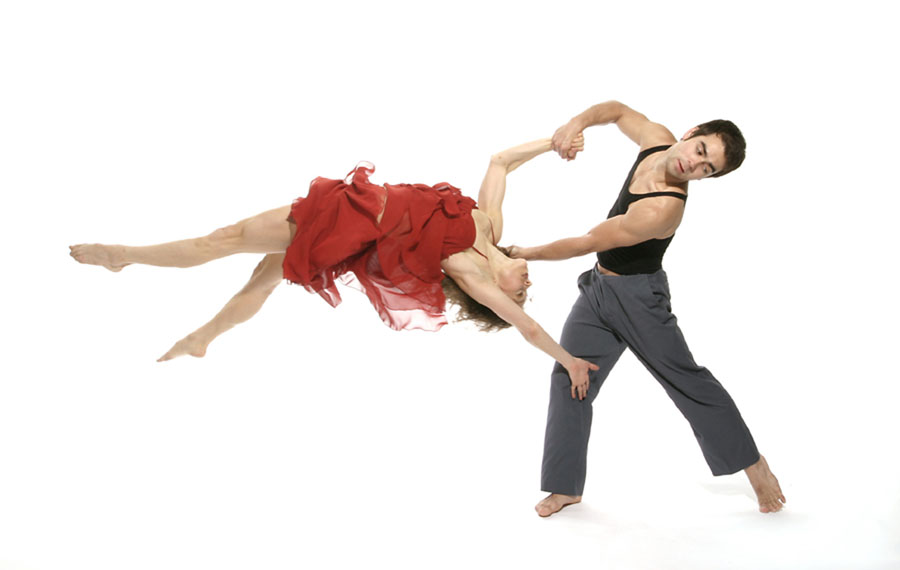
Keigwin + Company's Julian Barnett and Nicole Wolcott
Summerdance Santa Barbara tends to prize wit in its choreographers, and Larry Keigwin is no exception. His company’s west coast debut, held Friday in the first of two shows at the Center Stage Theater, was packed with punchy, unabashedly campy, and precisely drawn character sketches. Yet it was his starker side that revealed the full breadth of his talents in “Natural Selection,” premiered last month at the American Dance Festival and raw in only the best of ways.
Faun-like and gorgeously proportioned, with precise and powerful legs, Keigwin first visited SDSB in 2000 as associate artistic director of Dendy Dance & Theater. The festival brought him to lead master classes in 2001, and gave him rehearsal time in 2002. Keigwin + Company, his New York-based band of five, is only one year old, though you wouldn’t guess it from the onstage synergy.
Keigwin Kabarets have attracted notice in New York for their sharply structured humor, and most of the works on Friday’s program (several shown in different versions in New York) showed off why. In “Mattress Suite,” created in part during an SDSB residency, Keigwin and Nicole Wolcott stripped their wedding-day duds and romped on a Sealy Posturepedic to Cecilia Bartoli’s fluttering rendition of Scarlatti, without ever doing the deed. Keigwin escaped to a gay threesome danced to “La Traviata” in tighty-whities while Wolcott became a self-actualized woman, grinding her hips against the upended bedding as Etta James purred.
Like “Female Portraits,” the action felt diverting but slight. Ying-Ying Shiau thrashed her Rapunzel-like locks to Cyndi Lauper, Wolcott strutted to Pat Benatar, and Hilary Clark chased the spotlight and lip-synched Bette Midler’s “The Rose.” Every member of Keigwin’s company can make the subtlest emotional shifts read as clear as subtitles across their faces. They moved through Keigwin’s surprising stacatto phrasings, quick and muscular legwork, and sudden falls to the floor with a chiseled surety. And yet, with the pounding pop music to fall back on, it all looked too easy. It was like watching a Ferrari pause for traffic lights—you wanted Keigwin to hit the open road with his skills and show us what he could really do.
Coming last, “Natural Selection” revved his gifts to top speed, and the exhilaration in the audience was as palpable as the hollering at a NASCAR rally. Think of it as “Rite of Spring” in chiffon eveningwear: six dancers driven to mania by the urgent string chords of Michael Gordon’s stunning, somewhat minimalist score. They slugged and crawled across the floor in ever more dizzying arrangements. Sometimes they resembled primitive cave dwellers fighting the elements; in other, even more terrifying, moments, they called to mind rats scratching at the side of a cage.
It’s a long piece, and just when you thought the tension would explode, Gordon’s music ratcheted it further, and Keigwin matched him and then some. Two dancers slammed against the wall as if to copulate, but as two more piled on the situation became more desperate than violent. Just when everyone had huddled, Keigwin ran Shiau up their backs and along the wall, racing her parallel to the floor as the rhythms surged. It was surreal, guttural, and shocking.
Brawny Alexander Gish and fluid Julian Barnett were the two excellent men. The absence of stage wings only added a layer of terror to the piece Friday, as you watched the dancers gasp for breath and rush back into battle. If “Natural Selection” pitched humanity against an indifferent universe, the open wings pitched Keigwin’s dancers against the work itself. In their chilling defeat, these dancers won.
July 17, 2004 · 06:41 PM · Dance · Comments (0)
Ashtonmania
I have to admit that I don’t read dance reviews from New York in a timely fashion; it’s too painful for me not to be able to weigh my own observations against the reviewer’s. But Lincoln Center’s Ashton Celebration and the Royal Ballet's visit (which opened in NY with an all-Ashton program) are too important to ignore for long, and I’m finally catching up on them. Fortunately the dance world has two keen dance writers to fill us in: Mindy Aloff and Tobi Tobias. That both have lost their print-media pulpits in recent years (Aloff once wrote regularly for The New Republic; Tobias held a long and influential tenure at New York Magazine) is a shame on the publishing industry and a boon to the legitimacy of online arts writing. You can now find Aloff at the DanceViewTimes, while Tobias has her own blog at Arts Journal. Together their reports overcame my regret of missing the festival by creating the illusion in my mind that I had in fact seen it.
Tobias, in her latest review, gets to the larger point of why we should care about Ashton:
“The Lincoln Center Festival’s Ashton Celebration has reintroduced the British choreographer to the American audience for dance, an audience for whom Balanchine has long reigned supreme. This renewed interest in Ashton may spark a fruitful exploration of what the 20th century’s two foremost geniuses of classical dance choreography have in common—and what makes each distinctive. One hopes, too, that it will inspire more first-class Ashton productions from our native companies (ABT, this means you!) and more visits from the likes of the two Royals. For the last twenty-five years, the dance audience has been complaining about the dearth of new classical choreographers. All the more reason, during these relatively barren times, to cultivate the old ones.”
And don’t miss her reassessment of the Joffrey. On the company’s production of “A Wedding Bouquet,” she writes:
“I recall being enchanted, years back, by the Joffrey’s production. Now, with neither the dancing nor the characters fine-tuned, the piece is apt to appear incomprehensible or pointless to neophyte viewers and sadly coarsened to veteran fans.”
Aloff too is aware of the public-at-large’s reaction, though she never doubts her own opinions in the face of it, which is a large part of why I admire her:
“ ‘Enigma Variations,’ a demi-caractère epic of Edwardian sensibility, with classical underpinnings, about the interior life of an artist in his garden on an autumn afternoon, is among the greatest ballets in history. “Monotones I,” for a trio of terrestrials whose reference point is a sun that, although invisible to the audience, clearly dwarfs them, is the product of a master craftsman who understands how what can be seen testifies to what can’t: frequently beautiful, often surprising, an enticement to the eye on multiple viewings. “Rhapsody”, a chamber ballet for 14, in which a handsome interloper invades a court, overtakes it by dint of sheer bravura, and gets the queen, too, was made as a star vehicle for Mikhail Baryshnikov. While not top-drawer Ashton, it roused the audience on Tuesday more than his masterpieces. “Enigma Variations” was politely applauded; the reception for “Rhapsody” was tumultuous. It’s not the way I would want things to be, but one can’t legislate people’s responses in the theater, even when one’s heart is breaking over the crowd’s choice.”
Elsewhere she paints a vivid picture of Darcey Bussell’s arabesque allongée.
If you can stand the jealousy of not witnessing it with your own eyes, I recommend a read.
July 15, 2004 · 12:50 PM · Dance · Comments (1)
A five-star Aurora
I’m going to say something sacrilegious. I think assigning ratings to dance reviews is not a bad idea.
You know ratings: five stars, a scale of one to ten, or at the paper I currently freelance for, a cartoon man in various states of interest, from sleeping to falling off his chair with enthusiasm. That balding bowler-hatted guy holds his own copyright and big sway at the box office. (If you doubt this, talk to any theater producer in the Bay Area.)
The “little man” also draws readers to the movie, CD, and theater reviews he graces. He—and any rating—is a snap visual handle, an instant way to engage with the critique. A rating makes you want to test whether the writer can persuade you that “Shrek 2” is more than a marketing bonanza, or that, as the Chron’s pop critic Aidin Vaziri has provocatively argued, Prince’s latest album is actually mediocre.
The Chronicle, like most papers, currently draws the line at the high arts: Classical music, visual art, and dance are ostensibly too lofty to place on a scale of relative merit. Until recently, I bought in to the usual arguments for the distinction: ideas in “serious” art should be grappled with, not assigned value; reviews of dance should not be presented or construed as “consumer advice.”
But why shouldn’t we recommend dance performances to one another with various degrees of enthusiasm? Why shouldn’t we codify that degree of excitement in a symbol that will bring more readers to dance reviews? Instead, right now, the absence of a rating signals to the Everyman Joe reader, “Don’t bother reading about this show, it’s very serious and too arty for you and therefore can’t possibly be entertaining.”
Ratings would help box office. Small, local modern dance performances that rely on word of mouth would hardly face a rush of returned tickets should the little man be caught sleeping. And let’s say a dozen Joe Everymen (and women) saw the clapping guy and showed up at Paul Taylor expecting something more on the order of “Riverdance.” Among the disillusioned, serious dance would undoubtedly win a few pleasantly surprised converts before the house lights went up.
Dance companies—ballet companies in particular, I would guess—would protest the new ratings, say it cheapens their art. But I think ballet would have the most to gain. Ballet companies are perpetually striving to convince that golden demographic, 19- to 34-year-olds, that going to the ballet is fun and hip. Many companies have tried to do that by setting “ballets” to everything from Prince to Bruce Springsteen. With exceptions for Twyla Tharp, the result tends to be a neither-fish-nor-foul compromise of the art form and a mixed message. Ballet wants to appropriate popular art but remain untouchable in its high art sphere.
But imagine this: a review of “The Sleeping Beauty” in the paper with a little man falling off his chair, next to a review of “Lost in Translation” carrying the same rating. The message? Different art forms, both worthy of your interest. You might even get a few 19- to 34-year-olds in the opera house door to see that evening’s Aurora. And some of them, having encountered a new art form on its own terms, might even come back.
July 14, 2004 · 01:25 PM · Dance · Comments (0)
In the Chronicle today, I am charmed by Oakland's Artship Dance/Theater. One caveat: I'm not a stickler for rigid categories, but the show is much more theater than dance.
July 13, 2004 · 01:01 PM · Dance · Comments (0)
Dancing in Paradise
Brian Brooks Moving Company performs in front of the Santa Barbara Mission as part of Monday's 13-location "Dance about Town."
I’m in Santa Barbara for the next week and a half on a kind of writing/dance-watching mini-retreat. I’m doing a last batch of revisions to the memoir by day and taking in Summerdance Santa Barbara, the best festival no one but the blessed citizens of this town has ever heard of, by night.
SDSB might be the most fun you can have watching contemporary dance within the Pacific time zone, as I was reminded during tonight’s open rehearsal at the black box Center Stage Theater. Brian Brooks Moving Company shared some of their latest vocabulary explorations, including a kind of fully supine sit-up that morphed into back arches and climaxed in a spectacular full-body flopping fish action across the floor. Keigwin + Company (led by former Mark Dendy dancer Larry Keigwin) presented a medley of their latest choreographic sketches, skating by in knee-high stockings, breathlessly reaching for one another to the likes of Stevie Wonder and Sinatra.
And Doug Elkins, whose New York company has sadly disbanded, proved that he has wasted no time during this last week creating a commission for the UCSB-based Santa Barbara Dance Theater. He said he’s been going through a divorce and that this work is the result. “It’s better than stalking her,” he offered. The actual dance phrases were anything but self-pitying, particularly two duets: one rapturous and set to Bjork; one passive-aggressive, danced to the Beach Boys’ “Don’t Worry Baby,” and performed on two chairs, in four different variations. “Every choreographer should make one chair piece so that he knows how to work with furniture—and so he can get sponsored by IKEA,” he said.
I wrote about his festival during its first seasons, when I was just starting out at the Santa Barbara Independent. (I also, for old times’ sake, wrote a preview of the festival for the Indy again last week.) Back in 1997 executive director Dianne Vapnek brought Doug Varone, and the opportunity to watch him work was invaluable. I haven’t attended in five years, and as time passed I came to wonder whether nostalgia hadn’t colored my esteem for Vapnek’s efforts. It’s nice to discover that memory has served. As for why the festival’s reputation doesn’t cross the Santa Barbara County line, I have my theories. Los Angeles, two hours away, is not a major dance hub. Santa Barbara is seen as a resort destination, too pretty and laid-back for serious art. And don’t all the important dance festivals take place on the East Coast?
But Vapnek is giving all three New York-based choreographers ample time and space to create work this year, and so the impact of this festival will trickle back to the centers of the dance world. In the meantime Southern Californian dance lovers should know that a day trip is well advised.
Coming soon: Brian Brooks Moving Company and Keigwin + Company will each have a repertory show at the Center Stage, which I’ll review on this site.
July 13, 2004 · 03:53 AM · Dance · Comments (0)